Archivi tag: Maskhadov

Olivier Dupuis and Chechnya: the European voice that refused to bow to Moscow

On May 4, Olivier Dupuis, former Radical Member of the European Parliament, passed away. An atypical and often isolated figure in the European political landscape, his death has largely gone unnoticed in public debate. Yet for those who have followed the history of Chechnya, it marks the loss of one of the very few European voices who, in the most difficult years, maintained a coherent, lucid, and countercurrent position.

Dupuis was not merely a parliamentarian. He was, in the fullest sense of the word, an activist for the rights of peoples.


A Radical consistency

A member of the Partito Radicale, close to figures such as Marco Pannella and Emma Bonino, Dupuis belonged to a very specific political tradition: that of nonviolent struggles, self-determination of peoples, and the defense of human rights even when it meant political isolation.

Chechnya, in this path, was not an exception. It was a consequence.

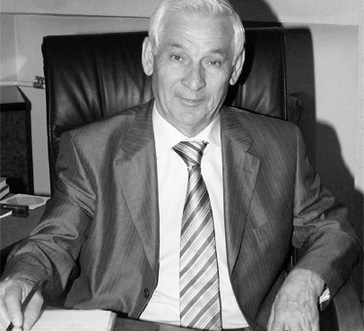
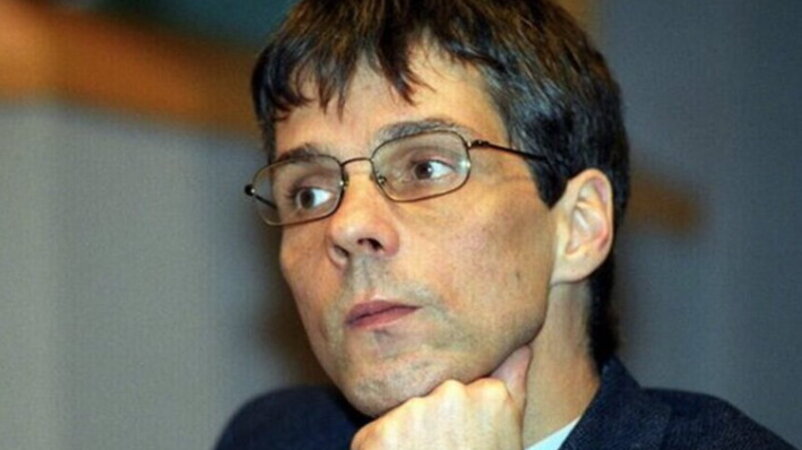
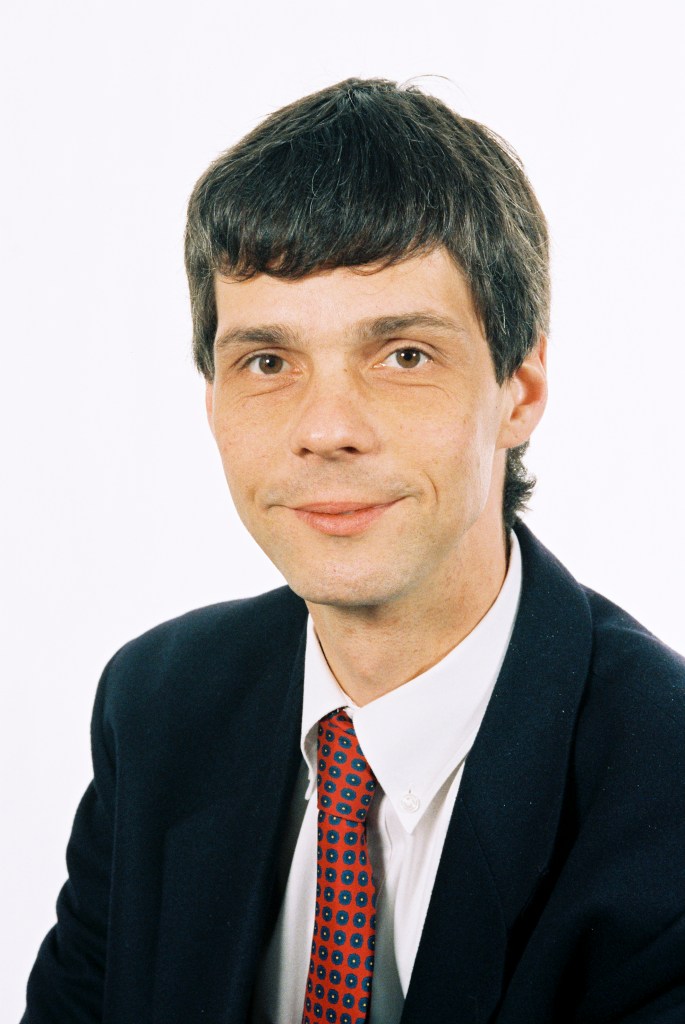
Portrait of Olivier DUPUIS MEP

Chechnya in its darkest hour

During the Second Chechen War, while much of Europe chose diplomatic caution or silence, Dupuis took a clear stance.

He openly denounced Russian military operations, the systematic human rights violations and the destruction of Grozny, and entire civilian communities

At a time when the dominant narrative tended to reduce the conflict to an internal Russian matter or a mere fight against terrorism, Dupuis insisted on a fundamental point: Chechnya was прежде всего an international political issue.


Support for the leadership of Ichkeria

One of the most significant aspects of his engagement was his relationship with the leadership of the Chechen Republic of Ichkeria, particularly Aslan Maskhadov.

Dupuis supported: the recognition of Maskhadov as a legitimate interlocutor, the opening of political negotiations and a clear distinction between the independence leadership and extremist drifts within the conflict

This position, already uncomfortable in the late 1990s, became openly countercurrent after the shift in the international context.


After 9/11: against simplification

After the September 11 attacks, the war in Chechnya was progressively absorbed into the global “war on terror” narrative.

Russia used this shift to legitimize its military actions. Most European capitals aligned with this perspective.

Dupuis did not.

He continued to distinguish between jihadist terrorism, real but limited, and the Chechen independence struggle, which he considered politically legitimate

This distinction, which today may seem self-evident to many analysts, was far from obvious at the time—and came at a political cost.


An isolated voice

Perhaps the most defining trait of his action was precisely his isolation.

Dupuis did not represent a majority line. On the contrary, the European Union avoided confrontation with Moscow, governments prioritized stability and economic relations, while the Chechen issue was gradually marginalized

In this context, his position was never opportunistic. It was a position of principle.

And for this very reason, it carries particular historical value today.


A bridge between Europe and Chechnya

For the Chechen cause, Dupuis was more than just a supporter.

He was:

  • a point of contact with European institutions
  • a voice capable of translating the Chechen issue into the language of international rights
  • one of the few European politicians who refused to reduce the conflict to terrorism

At a time when Ichkeria was being erased from public discourse, Dupuis helped preserve its political dimension.


Legacy

Today, many of his insights appear clearer:

  • the instrumentalization of terrorism by states
  • Europe’s difficulty in confronting Russia
  • the marginalization of self-determination struggles when they become inconvenient

Dupuis saw all this in advance.

And he consciously chose not to conform.


The tightrope walker

To remember him today are also the words of his wife—simple and powerful—perhaps capturing better than any political analysis the essence of who he was:

Chers si chers amis
Chères
Si Chères amies

Notre Olivier
S’en est allé
Très apaisé

Notre Olivier
S’est envolé
Le cœur léger

Le Funambule
Cheveux au vent
Danse
Sur
Son
Fil…

The tightrope walker.

It is a striking image, because it precisely captures what Dupuis was: a man in balance, suspended between principles and realpolitik, between political solitude and fidelity to his ideals.

In a Europe that, then as now, often chooses the comfort of silence, Olivier Dupuis chose to remain on the wire.

And never to step down.

My fate is the fate of my people – Interview with Magomed Mamatiev


(Golos Chechenskoy Respubliki newspaper, No. 3 (20995), January 24–31, 1997)

Today we present to our readers a conversation with the hero of many articles published in our newspaper in the 1960s and 1970s, civil engineer Magomed Mamatiev, a candidate for deputy to the Parliament of the Chechen Republic in Electoral District No. 3 “Olympic” of the Leninsky District of Grozny.


Correspondent: Magomed, tell us briefly about yourself.

Magomed Mamatiev: I am 55 years old, I come from the village of Valerik, I have a higher education—a degree in construction from the Oil Institute—and I worked my way up from bricklayer to head of the construction department. I am currently vice president of the Federation of Trade Unions of the Chechen Republic. I have been awarded the Order of the Red Banner of Labor and two medals.


Correspondent: You belong to the generation that lived through the tragedy of 1944; did you perhaps think that all our problems were behind us?


Magomed Mamatiev: Our family ended up in the coldest region of Kazakhstan, the Kustanai region. My father was arrested in 1949 along with a learned alim for singing nazmy, and later my mother as well for cutting down three trees when the barn roof collapsed. The five of us children—the oldest was 14 and the youngest a newborn—were left on our own. We were saved from hunger and cold by the kindness of people, both Chechens and Russians.
In September 1959, I enrolled at the Grozny Oil Institute. Studying was easy. For today’s youth, most of whom pretend to study, I want to say that we didn’t know what it meant to pay money for a test or an exam. And we didn’t even have any money. Sometimes we went without food for days. We unloaded carts full of potatoes, onions, and coal at night. We constantly felt the teachers’ distrust of our knowledge. They graded our knowledge one point lower than students of other nationalities. We had to prove our worth through our diligence and hard work.
Like all my peers, my childhood was stolen from me, and we were left with a hungry and difficult youth.
After graduating from high school, I had to spend three months knocking on the doors of construction companies that, according to the ads, were looking for skilled workers. They asked me to fill out application forms and then politely turned me down. After three months, I met the kindest person, my new mentor Baskhanov Umar (Dala gechdoyla tsunna), who
hired me as a foreman and started my new working life.

Correspondent: In almost every country, trade unions are called upon to protect the interests of workers. Naturally, friction arises between them and the authorities on many issues. You and your colleagues led the union leadership in 1992. How did your relations with those in power develop?

Magomed Mamatiev: Numerous measures were adopted and efforts were made to foster cooperation between enterprises and all branches of the Republic’s government. However, none of the issues raised during meetings and by union activists were resolved. Wage arrears increased; pensions, salaries, and other benefits were not paid.

Correspondent: In the spring of 1993, a demonstration organized by the unions began in Grozny. Many are inclined to believe that this demonstration—that is, you and your comrades—is responsible for the subsequent negative events of 1993. What can you say to your opponents?

Magomed Mamatiev: Before the demonstration, the unions called a three-day strike demanding the cancellation of arrears on wages, pensions, and other social benefits, and warned the government that if these issues were not resolved, they would organize a demonstration. No response. We tried to meet with the President, but it didn’t work out. After receiving authorization for the demonstration from the mayor’s office, we organized a one-day protest and concluded the union demonstration at the scheduled time. Subsequently, the demonstration was led by local and municipal officials.
As you say, some politicians blamed union leaders for the subsequent clashes with their former associates. And our president and colleague Ampukaev Ramzan, declared an enemy by these “some,” organized massive rallies and protest marches against the entry of Russian troops into the Polish cities of Warsaw and Krakow.
And no one speaks of the military action in late December 1993, when the Presidential Palace was surrounded by tanks, armored vehicles, and troops.

Correspondent: Who do you believe is responsible for the national tragedies?

Magomed Mamatiev: There are many. Briefly, here are a few. Foremost among those responsible for our tragedy are the gray-bearded “Hajji pilgrims,” whom our President called sailors. These people did everything possible and impossible to divide our society into teips, virds, and nationalities. Having imagined themselves to be leaders of the people, they eventually began to interfere in state affairs. Some of the current candidates for the presidency have supported these pilgrims.
Usman Imaev did everything to exacerbate the confrontation between the President and Parliament; the main fault of this “man” is the complete destruction of the foundations of the Chechen state: its finances. After Russia abolished the 1991–1992 banknotes effective August 25, 1993, Imaev decided to keep this currency in circulation in the Republic until November 1, and for this worthless paper, the sale of everything that had not yet been sold began. This worthless paper was purchased in neighboring regions and republics at 102% of face value and delivered to Imaev’s bank for 30% of the cost. The remaining 70% of the cost was covered by Imaev and others like him.
According to some sources, loans totaling over 800 billion rubles were disbursed in the Republic starting in November 1993. And this is precisely where Imaev’s scheme was developed. Using forged documents from guarantor companies—whose executives received 5–10% of the loan amount—the lender paid Imaev 20% in dollars, and the National Bank transferred the loan amount to one of the commercial banks. These banks, in turn, transferred this sum to any address in the former Soviet Union for 15–20% of the loan amount.
And it is no coincidence that the National Bank and other banks were the first to be destroyed during the war. According to eyewitnesses, all the streets and squares of destroyed Grozny were littered with Imaev’s scrap paper.
In the same camp are Taymaz Abubakarov, Yeraghi Mamodayev with his team, the Albakovs, and, of course, Zavgaev’s team.
Here lies a vast field of activity for the Sharia court.

Correspondent: 16 presidential candidates. Isn’t that too many for our small republic? And in general, who do you prefer? I can’t insist on an answer to the last question…

Magomed Mamatiev: Whether many or not so many. After all, there are only five main contenders. I would vote for any of them if they were the only candidate.
But I see Aslan Maskhadov as the President of the Republic. I don’t know him personally, but I know Vakha Arsanov. Due to my professional responsibilities, I had to attend parliamentary sessions and learn the positions of all the deputies on issues related to building an independent state. I got the impression that Vakha was an honest and decent person who cares deeply about our future.
I am certain that Arsanov would never have agreed to run in the elections alongside Maskhadov if he had doubted his integrity and his intentions to build an independent Chechen state.

Correspondent: What motivated you to run in the parliamentary elections?

Magomed Mamatiev: The only thing that motivated me to run in the parliamentary elections was the hope that we would build a free and socially oriented state.
If I briefly discuss the program and the concrete legislative initiatives I intend to implement in the interest of the workers of the Chechen Republic, then, obviously, they will focus on the implementation of the principles of a social state.

Correspondent: And one last question. What is your vision for state-building and the role of trade unions?

Magomed Mamatiev: I intend to work on these priority issues if the voters of District No. 3 “Olympic” show their trust in me and elect me as their deputy to the Parliament of the Chechen Republic.
I appeal to voters to come out and vote for our future—not for me, but for our President Aslan Maskhadov. Together we will win!

Alkhazur Abuev – The weak men of the Maskhadov’s Army

Background and education

A career officer in the Soviet Navy, Alkhazur Abuev (also transliterated as Olkhazur Abuev) was born in the Chechen-Ingush Socialist Republic in the first half of the 1950s.

In 1972, he graduated from the M. V. Frunze Higher Naval Academy in Leningrad, a prestigious Soviet Navy academy, obtaining the rank of Captain First Rank (капитан первого ранга). He served in the Black Sea Fleet and later in the Caspian Flotilla, where he held technical and staff positions.

He left his military career in the early 1990s, during the collapse of the USSR, and returned to Chechnya, apparently in March 1992, where he was immediately appointed by President Dzhokhar Dudaev to the organizational chart of the nascent Chechen national army, obtaining the position of deputy head of the Operational Directorate of the Armed Forces General Staff and, from June 1993, head of the same directorate. At the outbreak of the First Russian-Chechen War, however, Abuev did not take up arms but left the country.

Maskhadov’s Army

Upon his return to his homeland, he was called back by President Aslan Maskhadov to help reorganize the regular army, which, according to the plans of the new head of state, was to be called the National Guard and consist of eight specialized regiments. Maskhadov appointed Abuev Chief of Staff immediately after his election as President. According to Timur Muzaev’s reconstruction, on March 13, 1997, Maskhadov established the National Guard, and on May 15, 1997, Abuev signed the general reorganization of the army, abolishing the previous front commands and centralizing the chain of command.

The measures taken by the new Chief of Staff had their own abstract logic and were in line with the President’s desire to professionalize the army, but they did not take into account the important changes that had affected the armed forces during the war. Dudaev’s death had accentuated the tendency of units to rally around their field commanders, and Abuev appeared to be ‘disconnected’ from the natural hierarchies that were forming. The new General Staff’s claim to establish a professional system in an army that resembled more an advanced popular militia than a classic armed force clashed with the convictions (and interests) of many field commanders, who preferred to consider their units in ‘permanent mobilization’, both because they were convinced that war with Russia would soon resume and because they wanted to maintain the privileges and impunity that some of them had acquired.

The friction between Abuev, who was pushing for the demobilization of the armed units, and the main brigade generals, who wanted to avoid it, led to an institutional crisis that, in October 1998, resulted in Abuev’s resignation. He was replaced by Maskhadov with the “veteran” Abubakar Bantaev.

Retirement and final years

At the outbreak of the Second Chechen War (1999), Abuev retired to Baku, Azerbaijan, where he lived for almost ten years. On April 23, 2008, according to Kommersant and RBC News, he voluntarily surrendered to the Russian federal authorities, claiming that he had not participated in armed activities since 1999. The authorities confirmed that, despite having served as Chief of Staff in 1997-1998, he was not involved in war crimes. Akhmed Zakayev commented on his surrender as follows: “I don’t understand why he had to surrender. He could have returned home without announcing it, and there would have been no charges against him.” This position was confirmed by one of Abuev’s relatives, who commented: “In Chechnya, only the laziest or the illiterate are unaware that Olkhazar never fought against the federal forces […] Olkhazar was a naval officer and only arrived in Chechnya after the end of the first war, leaving before the start of the second military campaign. Why turn him into a militant commander?”

After a brief interrogation, he was released and not prosecuted.

Press sources indicated that he still lives in Chechnya under discreet surveillance, maintaining a low profile and staying out of public life.

Profile and assessment

Alkhazur Abuev was one of the most atypical figures in the Ichkerian military elite: a Soviet-trained technician, uninterested in religious or revolutionary rhetoric, focused on rebuilding a modern state military structure. He was the main architect of the attempt to transition from a guerrilla army to a regular force, which was thwarted by the fragmentation of the armed forces in 1998 and then by the second Russian invasion of Chechnya. His story—from his career in the USSR Navy to his command of the Ichkerian forces, to his retirement in Baku and surrender in 2008—reflects the trajectory of a generation of Chechen officers who sought to reconcile military professionalism and national identity, only to be crushed between the two logics.

Biographies: Supyan Abdullaev – from the Nation to the Emirate

Son of Exile

Born on November 8, 1956, in Kazakhstan to a family of deportees belonging to the Teip Thadakhara tribe originally from the village of Khatuni, Supyan Minkailovich Abdullaev was just a child when, after Khrushchev’s “Pardon,” he moved to Chechnya with his parents. His family was one of many that, during the Ardakhar, had been deported by Stalin to Kazakhstan, officially as “punishment” for not fighting the Nazi invasion of the USSR with sufficient rigor, but in reality to consolidate the colonization of the Caucasus by ethnic Russians.

Exile first, then social ghettoization after their return, had produced a strong sense of disorientation in the younger Chechen generation: for a people accustomed to living in the same land for millennia, organized into clans deeply rooted in specific territories, deportation to Central Asia and the chaotic return to their homeland thirteen years later, unable to rebuild the ancient social mosaic based on the “family-territory” relationship meant the loss of every “cardinal point of identity.” In this context, the only cultural pillar remaining to the Chechens was Islam, which until the deportation had taken root in a very ‘light’ form, often syncretic with ancient cultural values, but which now represented the only foothold for Chechens to recognize themselves in a USSR that was predominantly Orthodox and Russian-speaking.

Supyan grew up cultivating traditional Chechen customs, soon became very skilled in fighting, and studied the Koran. After graduating in 1972, he earned a degree from the Chechen-Ingush State University and found work as a physical education teacher in schools in the Vedeno district, the “ancestral land” of the Chechen nation.

From madrasas to the Islamic Battalion

With the advent of Glasnost and the easing of censorship, Abdullaev was able to devote himself openly to religious propaganda, teaching in local madrasas, acquiring contacts throughout the Eastern Caucasus, and eventually participating in the creation of the Islamic Revival Party, the first explicitly confessional political movement in the Soviet Union. His social activism took the form of participation in the activities of the Ar-Risalya Islamic center in Grozny, where he began teaching Islamic doctrine and law, achieving the honorary title of Ustaz (Teacher). He eventually became director of the center and, in this capacity, supported the Chechen Revolution, the proclamation of independence, and the rise of Dzhokhar Dudaev to the presidency of the republic. He differed from most other teachers, who struggled to express themselves in Russian, in his almost complete lack of accent and a style of speech that would have been the envy of a university professor. He had a long red beard that reached down to his waist (hence the nickname “Supjan the Red”).

Supyan ran the Islamic center until 1994, when the Russian army entered Chechnya with the aim of reconquering the small republic. On November 26, 1994, a contingent of anti-Dudaev militiamen, mercenaries, and undercover Russian soldiers attempted to overthrow Dudaev by attacking Grozny. Abdulaev enlisted in a village militia and took part in the fighting that saw the attackers destroyed and put to flight. The group of volunteers to which Supyan belonged engaged the attackers at the Press House. According to some, it was in that battle that people first began to talk about the “Islamic Battalion.” Supyan’s bravery during the battle earned him the position of deputy commander of the battalion, a unit that would fight with honor throughout the First Chechen War (for more information, read “Freedom or Death! History of the Chechen Republic of Ichkeria,” available HERE).

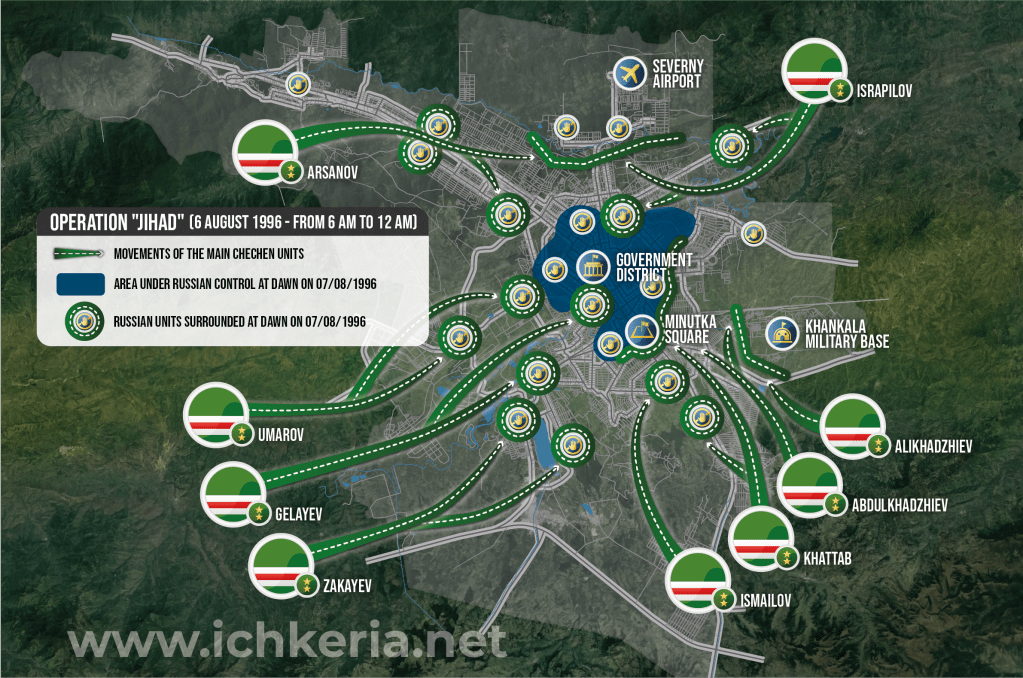
Supyan took part in Operation Jihad, the action with which the independence fighters recaptured the capital, putting the Russian army in check and forcing Moscow to withdraw from Chechnya. During the battle, he commanded several assault groups against the FSB headquarters, the “Government Palace,” the Dinamo Stadium, and other sensitive targets. For his role, he was apparently appointed ‘Brigadier General’ (a mainly honorary title, which would become rather inflated in the following years).

Islam and War

Maskhadov’s rise to power, democratically elected by the overwhelming majority of Chechens in 1997, saw Supyan align himself with the so-called “Radicals,” whose main exponent was Shamil Basayev. In the distribution of posts, seeking to please the radicals, Maskhadov appointed him Deputy Minister of Sharia for State Security, with the task of working on the ideological and religious training of officials. With the proclamation of full Sharia law (1999), Supyan’s role (recognized as one of the leading exponents of radical Islam in Chechnya alongside Movladi Ugudov) in the training of state officials grew significantly, as the Chechen legal system had no background in religious law. Thus, the few scholars available became ‘experts’ in Islamic law, even though they often lacked even a basic knowledge of the subject.

In any case, the formation of the ‘Islamised’ Chechen ruling class was soon brought to an end when Russia invaded Chechnya again at the end of 1999. Abdullaev quickly became a key figure, not only because he reconstituted his unit (renamed the ‘Jundullah’ Brigade) at the outbreak of the war, but also because, as a radical figure not only in politics but also in religion, he had access to the richest sources of foreign funding, coming from Wahhabi Islamic associations, which were happy to finance the jihad while ignoring any interest on the part of the moderate political and religious current of the Chechen government, of which Maskhadov was the expression.

During the Second Russian-Chechen War, Abdullaev first commanded the Jundullah Brigade as second-in-command, then as commander, earning himself a place in the political-military council of the Chechen resistance[1], the Majilis-Al-Shura (successor to the Committee for the Defense of the State at the head of the Republic). After taking command of the Eastern Front of the war theater (2003) centered in the territories of Vedeno and Shali (where he was wounded several times in combat[2]), on July 5, 2004, he was appointed Minister of Finance of the war government, with the aim of raising the necessary funds to continue operations and distribute them to units in the field. His work was appreciated, if it is true that Maskhadov’s successor, Sadulayev, confirmed him in his position. Among the fighters, Supyan gained the goodwill of his comrades, earning the respect of all. Despite his advanced age compared to the other commanders, he actively participated in operations and war councils, and was known for his austere religious discipline, moral authority, and charisma among the fighters.

The Emirate

On March 3, 2007, he was appointed Vice President of the Chechen Republic of Ichkeria by Dokka Umarov, a position he held until the founding of the Emirate of the Caucasus on October 7, 2007. He joined the new formation, formally abandoning the state structures of the ChRI, and took on the role of “Naib” (political successor) to the former President, now “Emir,” Umarov. When, in June 2009, unconfirmed information emerged about the alleged death of Doku Umarov, Akhmed Zakayev expressed the opinion that his closest associate, Supyan Abdullayev, would most likely become his successor. Within the Caucasus Emirate, Supyan Abdullaev maintained a leading role as Dokka Umarov’s deputy, being the de facto number two in the movement. For this reason, the Russian authorities tried in every way to capture or kill him, even arresting his son, Masud, then 22, who was deported from Egypt to Russia. Nevertheless, Supyan did not give in to blackmail and did not surrender.

He was considered the most influential of the Salafi ideologues and acted as a liaison between the various Wilayat (provinces) of the new Emirate. As an educator, he oversaw the religious and ideological training of new militants in mountain training camps. He carried out this task until March 28, 2011, when, during a raid by Russian special forces in the village of Verkhny Alkun, in the Sunzha district, the Russians hunted him down and killed him. The operation was aimed at preventing a meeting between Umarov and his staff. According to some, Umarov managed to escape, while Abdullaev was killed in a heavy air strike, following which he and several others

[1] His radio call signs were “Red Supyan” and “Chitok.”

[2] In January 2006, information appeared about Abdullaev’s elimination following a special operation in the district of Shali in Chechnya. This information was later denied, as it was his youngest nephew, field commander Adam Abdullaev, who was killed. Two other field commanders were killed along with him.

First Russian – Chechen War: a Preview from “Freedom or Death” Volume II

The following is a preview of the second volume of “Freedom or Death!” just released in English. The passage deals with Russian and Chechen preparations in the days immediately preceding the outbreak of war.

Zero Hour

In 1994, Russian-backed forces in Chechnya opposing Dzhokhar Dudayev led the failed November Assault, and it was a moment of realization for everyone.[1] President Yeltsin now clearly understood he needed to do more than covertly support groups inside Chechnya. He had to officially intervene to prevent the small, historically rebellious mountain republic from seceding. The Chechen opposition’s Provisional Council itself desperately appealed to him to send troops against the Dudayevites.[2] Meanwhile, General Dudayev was hopeful for peace negotiations but took seriously the threat of Russia fully invading.

For Yeltsin and Defense Minister Pavel Grachev, victory was not an achievable objective but a ripening fact. A “small victorious war” promised to raise the administration’s ratings against the increasing popularity of nationalist parties.[3] They ignored, or pretended to ignore, the deplorable state of their military and underestimated their enemy’s determination. Meanwhile the Chechens were preparing to resist the invasion.[4] Dudayev entrusted command of the regular forces to Colonel Aslan Maskhadov,[5] who inherited ragtag units rather than an army from his former colleague Viskhan Shakhabov.[6] Throughout 1994, he attempted to structure it partly according to army reforms enacted in 1992 and based on pre-existing forces, which were comprised of veterans from wars in Afghanistan and Abkhazia. Some units were combat-ready by the beginning of December. Among such forces was the Presidential Guard commanded by Abu Arsanukaev, and its Spetnatz unit under Apti Takhaev. Next was Shamil Basayev’s Reconnaissance and Sabotage Battalion, which was composed mostly of veterans of Abkhazia. Then came Ruslan Gelayev’s Special Borz (“Wolf”) Regiment, which included a battalion led by Umalt Dashayev. Adding also the Shali Armored Regiment and other minor units, there was a nucleus of 1,500 troops joined by 1,000 men from the Ministry of the Interior and the National Security Service (police officials, riot police and state intelligence services). Maskhadov added some volunteer territorial militia battalions, such as the so-called “Islamic Regiment” under Islam Halimov and the Naursk Battalion[7] with Major Apti Batalov.[8]  Thanks to their contribution and the many other bands of volunteers who rushed to Grozny’s defense, Chechen Headquarters relied on 5,000 men at the start of Russia’s invasion. Several more formations followed Dudayev’s general mobilization proclamation on 4 December.[9] The Chechens understood however, that regardless of how they prepared they could only temporarily hold the enemy at the gates. Chechnya lacked the numbers, arms, and organization to take on enemy armored brigades directly.[10] Russia had even preemptively destroyed the modest air force on 1 December.

Russia’s initial approach to the invasion reflected its narrow aim to eliminate the leadership rather than destroy Chechnya. The average Russian solider, struggling to pin it on a map, cared even less about Chechnya. The government narrowed its invasion partly to avoid a humanitarian crisis since the wary West was watching with a hand on the money tap keeping Russia afloat. 

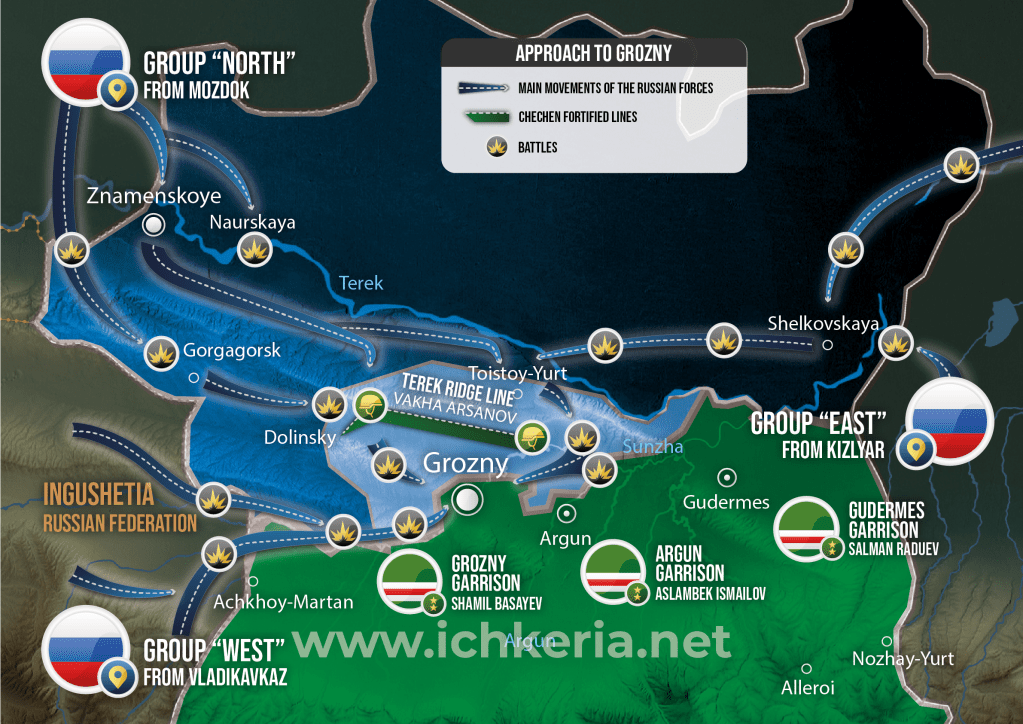
Whatever way the Russians intended to attack, the Chechens were preparing to fight and die all the same. Their plan was “to last.” They wanted to resist as long as possible and hopefully expose the Kremlin to domestic public opinion, which was still struggling with trauma from the Soviet-Afghan War. Equally important was the opinion of the West, whose conditional loans kept Russia’s economy from sinking.[11] The Chechens organized their defense in three phases. They planned to first trap the Russians inside Grozny, a “concrete forest,” and ensnarl their overwhelming armor. To entice the Russians, the Chechens yielded the defensive line to the north to create the illusion they had abandoned the capital. This line along a strip of hills running north of Grozny on the so-called Terek Ridge hinged to the west by the villages Dolinskyand Pervomaisk. It ended in the east at the height of the village Petropavlovskaya on the left bank of the Sunzha. After crossing the line and penetrating the capital, the Russians would encounter Chechnya’s best forces eagerly waiting to recreate the success they had against the anti-Dudayevites back in 26 November. This was ideally going to force Yeltsin to negotiate with Dudayev, but with far more realistic expectations, the Chechens planned to retreat south to the main centers of Achkhoy-Martan, Shatoy, Vedeno, and Nozhay Yurt.

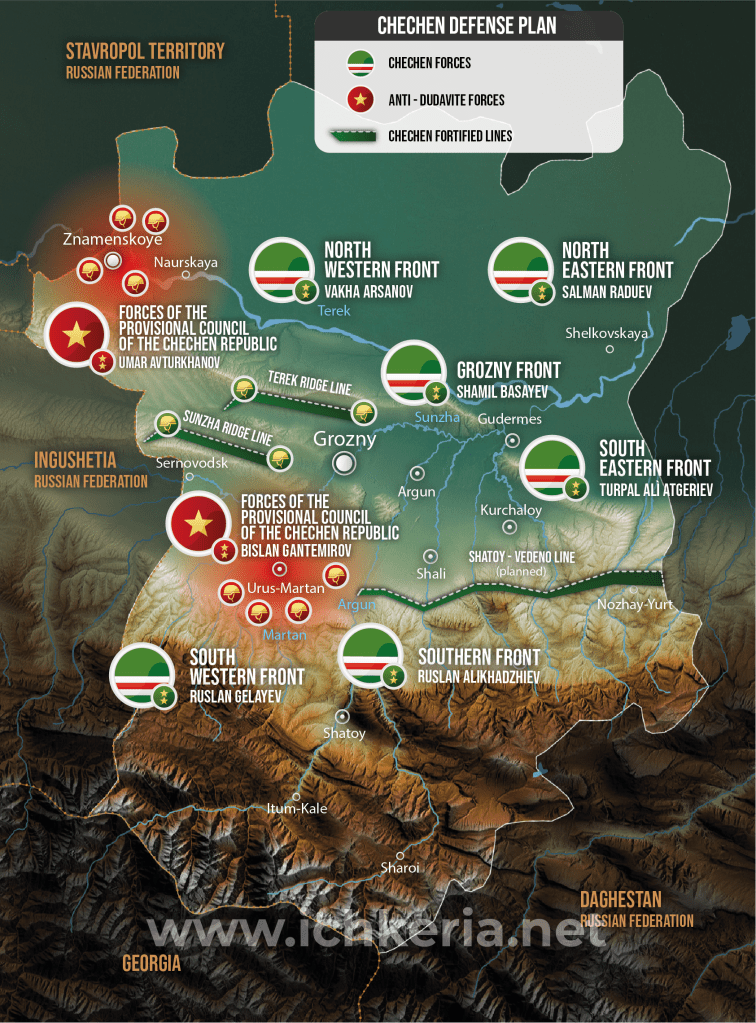
  Maskhadov divided the territory into six military districts called “Fronts” and entrusted them to his best men.[12] The loyal former police captain Vakha Arsanov held the Terek Ridge Line. Ruslan Gelayev was charged with the South-Western Front, a quadrilateral defined by the villages Assinovskaya, Novy-Sharoy, Achkhoy-Martan, and Bamut. Dudayev’s twenty-eight-year-old son-in-law Salman Raduyevcommanded the North-Eastern Front centering on the city Gudermes. CommanderRuslan Alikhadziyev[13] of the newly appointed Shali Armored Regimentled the southern front, with its main centers being Shatoyand Shali. Turpal Atgeriyev, a twenty-six-year-old veteran of the Abkhaz War and one of Raduyev’s most trusted men led the South-Eastern Front, centering on Nozhay Yurt. Finally, Shamil Basayev held Grozny. Unfortunately, the government lacked a comprehensive plan to protect the population,[14] and the situation was especially dire in Grozny. Unlike their Chechen neighbors there, the many ethnic Russian residents did not have relatives and friends in the countryside to flee to.

 The Russian Headquarters was busily gathering nineteen thousand fresh conscripts from the most diverse branches. Collectively baptized the “Joint Group of the United Forces,”[15] it also included five thousand soldiers from the Interior Ministry to comb the rear for enemies. The army was divided into the West, East, and North groups.[16] West Group started off from Vladikavkaz, North Ossetia to penetrate in three columns, taking up a position at the height of Novy-Sharoy behind the Chechen Terek RidgeLine. From Klizyar, Dagestan, East Group was to reach Tolstoy-Yurt along the Terek River. Finally, North Group in Mozdok, North Ossetia would cross the pro-Russian occupied plains of northern Chechnya to link up with East Group north of Grozny. With one hundred kilometers to the objectives, the operation had a schedule of a couple days. The high command of the Russian military prepared to issue an ultimatum to the leadership and offer amnesty to Chechen troops who surrendered.[17] Afterwards, artillery would clear the way for tanks to finally crush the rest of Dudayev’s “little rebellion”.

 However, the commander of the Russian operation Colonel General Eduard Vorobyov refused to lead the plan,[18] dismissing it as “madness”and a dishonor to send the military against citizens Russian considered its own.[19] Grachev promptly dismissed and investigated him, and instead tapped the unquestioning General Anatoly Kvashnin. Vorobyov’s forced resignation quickly led to the replacement of the Military Command of the Caucasus, further disrupting the chain of command which, on the eve of the invasion, was completely “purged.”

There were also important fringes of Parliament, including in the majority, opposed to military intervention. Yegor Gaidar, one of Yeltsin’s closest allies and chairman of the pro-government Democratic Choice of Russia Party,[20] spoke out and brought others from his faction with him.[21] Galina Starovoytova from the Democratic Russia Party was also opposed. Many moderates remained ambivalent though: the newly established center-left Yabloko Party saw heated internal debate between skeptics and those that supported the invasion “in principle” if not in execution.[22] On the right, nationalist movements beat the war drums, particularly Vadim Zhirinovsky’s Liberal Democratic Party. Opponents argued that using the military was unconstitutional without the government declaring a state of emergency and imposing martial law. According to Article 102 of the Constitution, the president had to consult Parliament to issue the provision, which would likely have been rejected. Supporters of military action, on the other hand, pointed to Articles 80 and 86 as support for Yeltsin’s right to lead the military and his duty to “safeguard the sovereignty” and “integrity of the state.”[23] A public debate could perhaps have steered tanks away from the Caucasus, especially as concerned newspapers all over the world began to cover the matter.[24] But the die was cast, and Yelstin was moving his pieces towards Chechnya.


[1] For more on the November Assault and the events preceding the outbreak of the First Russo-Chechen War, see Volume I of this work.

[2] In a conversation with the author, Ilyas Akhmadov recalled a telegram from the Provisional Council explicitly requesting Yeltsin to intervene. It was signed by Umar Avturkhanov and arrived in Moscow in the first days of December 1994.

[3] One analysis of the beginning of Yeltsin’s political shift: “With the controversial decision to use force to stop the secession of a small ‘province’ of his empire, Yeltsin himself also crossed a political ‘Rubicon,’ from which it will be difficult to go back: that of the alliance with the democratic forces that had supported him from the dissolution of the USSR in 1991 to the bloody battle against the rebel parliament in ’93. . . . After the victory of nationalists and communists in the legislative elections of December ’93, Yeltsin assumed new positions in foreign policy and in the management of economic reforms, thus trying to pander to the opposition, regain popular consent, and maintain power at the next electoral appointments, the legislative ones in a year, the presidential elections in a year and a half.” (Enrico Franceschini, “A Peace Party in Moscow,” La Repubblica, December 19, 1994).

[4] Chechen Foreign Minister Shamsouddin Youssef responded to news of Russia’s likely invasion by demanding Russia to recognize Chechnya’s independence. Otherwise, the Chechens would “fight, and bring war in the Russian Federation.” On the same day, Aslan Maskhadov added that Moscow risked fighting a “new Afghanistan.” First Name Last Name, “Title,” La Repubblica, May 12, 1994. 

[5]Aslan Alievich Maskhadov, introduced in Volume I of this work, was born in Shakai, Kazakh Soviet Socialist Republic, and returned to Chechnya with his family in 1957. He enrolled at the Artillery School of Tbilisi in 1972, then perfected himself at the High School of Kalinin Artillery in Leningrad. After his service in Hungary, he transferred to Vilnius and witnessed the Lithuanian independence uprisings. After resigning in 1992, he returned to Chechnya again and entered Dudayev’s service. In November 1993, he replaced Viskhan Sakhabov as chief of the general staff, first on an interim basis, then permanently beginning in March 1994. For a comprehensive biography written by his son Anzor, see Frihetskjemperen: Min far, Tsjetsjenias president.

[6] As Musa Temishev shared in a conversation with the author, Viskhan Shakhabov (extensively discussed in Volume I of this work) could not organize the nascent Chechen armed forces as a result of frictions with President Dudayev that arose between 1992 and 1993. Their disagreements on the methods of acquisition and use of Soviet arsenals paralyzed the Ministry of Defense, which was never officially established, leading to Shakhabov’s resignation.

[7] To be precise, Aslan Maskhadov christened the unit “Naursk Battalion” only in January 1995, during a live television broadcast on the presidential channel. The nom de guerre was a eulogy to Batalov’s units who had fought during the siege of Grozny. According to the commander, the regiment was still a “people’s militia”until the Battle for Grozny: “There were no cadres, there were no officers, there were only groups of people from different villages, commanded by people elected by them, totally on a voluntary basis. People came and went, and no one could order anything from them.”To read more about Apti Batalov and the Naursk Battalion, see the series of articles The General of Naur: Memoirs of Apti Batalov at www.ichkeria.net.

[8] Apti Batalov Aldamovich, born in Kyrgyzstan on October 19, 1956, returned to Chechnya and graduated from the Petroleum Institute of Grozny as a civil engineer. After entering the police force, he served as part of the Ishcherskaya Militia in the Naursk district, becoming its commander on June 20 1994. According to our conversations, until early August he served under District Military Commander Duta Muzaev, Dudayev’s son-in-law. After Muzaev’s return to Gronzy, Batalov became of head of the military administration of the Naursk and Nadterechny districts on September 16, 1994. He was tasked with organizing their defense against raids by the pro-Russia armed opposition.

[9] On 4 December, President Dudayev proclaimed a total mobilization of reservists. All male citizens between the ages of 15 and 60 were summoned, too many to realistically arm and train for the regular forces. Most were sent back to their villages of origin with the task of setting up self-defense militias using light weapons or resorting to hunting weapons.

Regarding the composition and nature of these militias, Ilyas Akhmadov recalled in a conversation with the author in 2022: “During the war there were many local volunteer groups consisting of five or six people, sometimes related to each other. It was very important to find a band that you knew. If you were with someone from your village, street, block, or family, you had a 90% guarantee that they wouldn’t leave your body if killed or injured. If they didn’t know you, they didn’t want you. This was mutually understandable to all: If something happened they would not be able to find the relatives, and for us it was very important to be returned to our families.”

[10] To learn more about the ChRI Air Force and its eventual destruction by Russia, see the in-depth study Green Wolf Stars: the ChRI Air Force on the website www.ichkria.net and consult Volume I of this work.

[11] United States Congress opened debates on 11 December 1994, on financially leveraging Russia to discourage war. Senators John McCain and Joseph Lieberan asked for aid to be reevaluated. Their colleague Alfonse D’Amato, argued on 3 January, that this could “send the wrong signal,”although he felt it necessary to express US displeasure at the civilian losses caused by the invasion.

[12] To view the Chechen defense plan, see thematic map A.

[13] Ruslan Alikhadzhiev was born in 1961 in Shali. After completing his military service with the rank of Sergeant, he returned to Chechnya in 1992. He took command of the Shali Armored Regiment in the autumn of 1994, replacing Isa Dalkhaev. At the outbreak of hostilities he organized the recruitment of militia in the Shali district (the “Shali Regiment”).

[14] Anatol Lieven’s first-hand account: “A government plan to feed the population and evacuate the children if the Russians started a siege? I don’t know of any such thing, but if President Dudayev said so, of course it is true,” an official told me in early December 1994, sitting in his deserted office in the municipal offices of the central district of Grozny, . . . “Anyway, it doesn’t matter. We Chechens are such strong people, we will be able to feed ourselves no matter what happens. Is it my responsibility? What do you mean by this? I’m here in my office, right? Don’t you think I will fight to the death to defend my country?” With that he let out a gasp, blowing a breath of vodka in our direction, and with wet fingers lifted a piece of greyish meat from a glass jar on his knees, and fed it to his cat.” Anatol Lieven, Chechnya: Tombstone of Russian Power (New Haven: Yale University Press, 1998), 34.

[15] The unpreparedness of the federal forces was well known to the military commands, and to the Minister of Defense himself. A few days before the start of the military campaign, Grachev read a top secret directive (No. D-0010) which described “unpreparedness for action of fighting.” Stazys Knezys and Romana Sedlickas, The War in Chechnya, (College Station: Texas A&M University Press, 1999).

The assessment report drawn up by the office of the North Caucasus Military Region was similar: “Most of the officers are not only unfamiliar with the required combat readiness requirements set out in the control documents, but also do not know how to recognize their personal duties, or what they should do in times of peace or war. Watch officers and units, in most formations inspected, are poorly trained to take practical actions in response to combat commands. The instructions and other control documents are prepared in gross violation of the requirements of the General Staff.” Knezys and Sedlickas,  War in Chechnya.

[16] To view the Russian invasion plan, see thematic map B.

[17] The Duma approved a resolution to this effect 13 December 1994.

[18] Grachev’s plan was entirely based on the assumption that a massive deployment of forces would disperse the separatists: “Grachev’s plan and timetable reflect expectations of limited resistance. Little intelligence used and bad planning were to blame… The planning also ignored the experience of loyalist Chechen forces [i.e. thread . Russians] who had attempted to storm Grozny in August , October and November 1994. If that experience had been studied, the Russian command would have been aware of the dangers that faced tank columns in Grozny.”Olga Oliker, Russia’s Chechen wars 1994-2000: Lessons from Urban Combat (Santa Monica: RAND, 2001) 11-12.  

[19] As Eduard Vorobjev said in an interview with journalist Vitaly Moiseev: “I was shocked by the situation, the units that arrived were completely unprepared, the commanders did not know their subordinates, many of the fighters did not have the necessary professional skills. I turned to the Chief of the General Staff: ‘If you think that a change of command will change the situation for the better, then you are wrong. It’s not about the commander, it’s about the adventurous approach. . . . Approaching me, the Minister of Defense said ‘I am disappointed in you, Colonel General, and I think you should submit your letter of resignation.’ I replied ‘I have it.’… It was not easy for me, a person who served in the armed forces for 38 years, who constantly answered ‘Yes!’ I was faced with a choice: to make a deal with my conscience and deal with completely unprepared people, to conduct an operation not planned by me, or to leave the armed forces, which meant the end of my military career.… It seems to me that Grachev underestimated the moral and psychological state of the Chechens, which had reached fanaticism. The operation was designed to intimidate: they thought that Dudayev would get scared when he saw hundreds of units and thousands of soldiers, and surrender to the victor’s mercy. Indeed, the Chechen side clearly knew where our troops were, what they were doing—information was spreading in all directions.”

[20] To the press Gaidar declared: “I appeal to Yeltsin not to allow a military escalation in Chechnya. The intervention was a tragic mistake. Taking Grozny will cost huge human losses. It will worsen the internal political situation in Russia, it will be a blow to the integrity of the nation, to our democratic achievements, to everything we have achieved in recent years.” Franceschini, “A Peace Party in Moscow.” 

[21] Deputy of Democratic Choice Dimitrij Golkogonov’s response to “Why are you against the invasion?”: “Because my party, Choice of Russia, led by the ex-Prime Minister Gajdar, is against violence, against the use of force to solve political problems. In Chechnya there is a leader, Dudayev, who does not want to lose power, thanks to whom he has enriched himself and his friends with the trade of oil. Independence has nothing to do with it. But to attack Dudayev is to make a criminal a popular hero. . . . A negotiation had to be opened. If Yeltsin had invited the Chechens to Moscow, they would have come running.” Enrico Franceschini, “‘Yeltsin Made Wrong Move in Invading But Remains Leader of Russia,’” La Repubblica, December 15, 1994.

[22] Vladimir Lukin, former ambassador to the United States and prominent member of Yabloko, in his January 24, 1995 speech in the Nezavisimaya Gazeta wrote: “The executive branch has shown itself and society that it can act independently, regardless of and in spite of political pressures . . . In an ideal world, the preposterous and dangerous idea that the military should not be used for internal conflicts should be driven out of the heads of our armed forces. . . . Using the army inside the country in extreme situations, when threats to the state appear, is the norm in democratic states. Nezavisimaya Gazeta.

[23] For careful study of this topic see Stuart Goldman and Jim Nichol, Russian Conflict in Chechnya and Implications for the United States (DC: Congressional Research Service, 1995).See also Victoria A. Malko, The Chechen Wars: Responses in Russia and the United States(Lambert Academic Publishing, 2015).  

[24]  An example from an Italian newspaper: “In the end, like a mountain annoyed by a daredevil mouse, Yeltsin ordered the direct intervention of his troops. Moscow claims that Chechnya is part of Russia, therefore it is its right to occupy it to restore order. For the moment, Western public opinion seems aligned with this position, considering yesterday’s events as an “internal matter” for Russia: for which there are no international complaints, unlike what happened with the invasion of Afghanistan. But if we look at the substance of the Russian military expedition in Chechnya, some resemblance to the Soviet invasion fifteen years ago emerges. . . . The fact remains that Yeltsin does not hesitate to use tanks when he sees that other means (negotiation, economic pressure, support for the local opposition) do not produce results. The propensity to resolve political crises militarily, as a year ago in the tug of war with the rebel Parliament, is a hallmark of his presidency. The future will tell whether Russia needed a “strongman” to become a civilized and democratic nation”. Enrico Franceschini,“Moscow Fears the Kabul Syndrome,” La Repubblica, December 12, 1994.

The English maps of the second volume are online

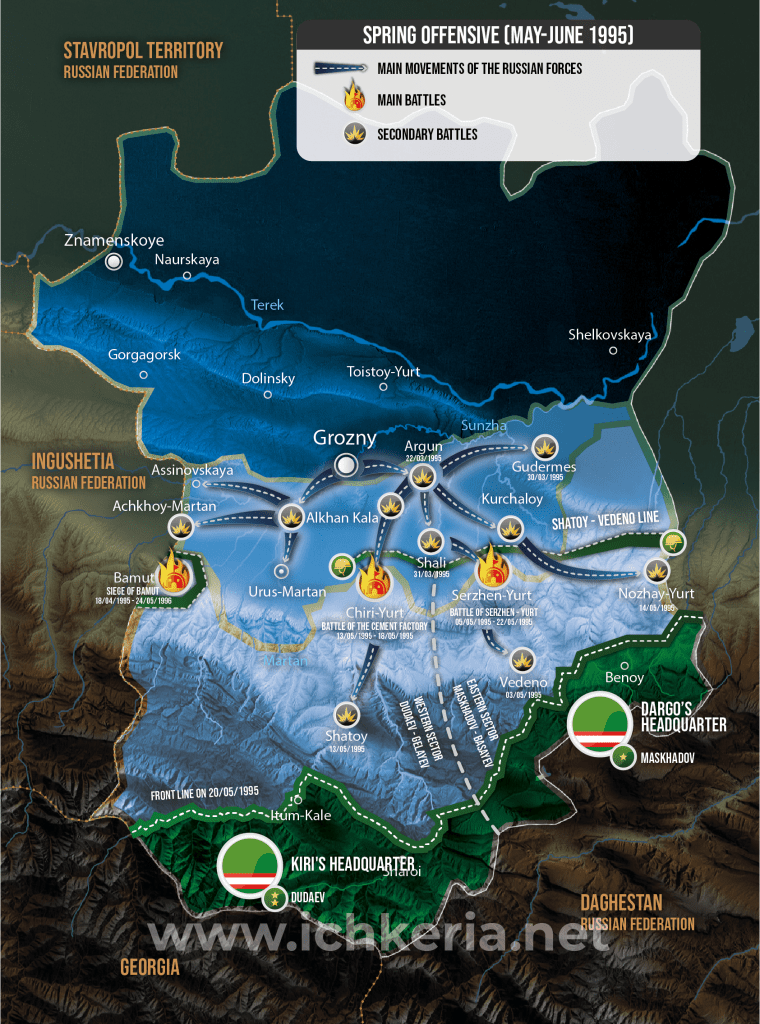
In view of the upcoming publication of the second volume of “Freedom or Death! History of the Chechen Republic of Ichkeria” we are publishing the maps in English, which will be available to readers via the QR code printed in the book.

BIOGRAPHIES – Umalt Yakhubovich Dashaev  

The work on this biography is carried out in collaboration with the Instagram page “Qoman Sij”, based on information received from the former deputy of the Minister of Foreign Affairs of the Chechen Republic of Ichkeria, Ilyas Musaev, verified with the sources at our disposal.

Born in Prigorodnoye (?/?/1956)

Died in Khankala (12/28/1994)

Native of the Varanda teip, he participated in the actions of the International Brigades during the Georgian – Abkhaz war, distinguishing himself for valor on numerous occasions, in particular during the Battle of Gagra (September 1992) and Sukhumi (September 1993). Wounded several times, after the war he returned to Chechnya, where he placed himself at the disposal of the nascent National Guard, operating in the Separate Battalion for Special Purposes “Borz”.

In November 1994 he participated in the operations to defend Grozny from the attack launched by Bislan Gantemirov’s forces. At the outbreak of the First Chechen War he mobilized his unit to defend Grozny, being wounded several times, until he lost an eye.

Umalt Dashaev with Khamzat Khankarov in Abkhazia

At the end of December 1994 he was sent by the Chief of Staff, Maskhadov, to defend the Khanakala airport from the federal troops who were about to occupy it. He led the Chechen contingent in the Battle of Khankala, during which, after being wounded several times, he died. According to the chronicles, he fought to his last breath against the attacking forces, earning the state award of Qoman Turpal (“Warrior of the Nation”).Riguardo la sua morte:

Eyewitnesses say that the seriously wounded Umalt Dashaev continued to lead his soldiers, urging them to conduct grenade launcher fire at Russian tanks. Umalt Dashaev was a born warrior, who did not know what fear is and was selflessly devoted to the ideas of freedom and independence of the Chechen people. From the first days of the beginning of the national liberation movement of the Chechen people, he took part in the hottest spots of the confrontation between Chechen soldiers and Russian mercenaries, destroying the enemies of the Chechen state. (Qoman Sij)

Umalt Dashaev with Shamil Basayev in Abkhazia, 1992

“Independence is not a whim or an ambition. It is the necessary condition of our survival as an ethnic group” Thomas de Waal interviews Aslan Maskhadov (April 2002)

In an interview with IWPR, Maskhadov said that armed resistance by the rebels would continue as a means of “self-preservation” against the Russian army, but that he was seeking a political solution. Questions were sent by IWPR’s Caucasus Editor Thomas de Waal via an intermediary in March 2022, via a Chechen intermediary. The interview was recorded in late April in Chechnya, before the death was announced of the Arab warlord Khattab. Maskhadov’s answers, recorded on cassette, were returned to IWPR in London only last week.

Thomas de Waal

What is the general situation in Chechnya at the moment? What can you say about the ‘clean-up’ operations by Russian troops, about the level of resistance of Chechen fighters, about losses on both sides?

The general situation in Chechnya is dictated by the logic of a protracted war that is senseless for the men who began it. Almost three years after the beginning of the second war, the Russian side has not achieved any of its aims. At least they have not managed to break the resistance of our warriors and they will not be able to. As a result of this all the rage and cruelty of the occupiers is falling on the civilian population. And recent months have been especially hard for the inhabitants of the foothills and mountains of Chechnya. Every day Russian troops are carrying out endless ‘clean-up’ operations in these places, with robberies, murders and disappearances. General Moltenskoi devised his new tactic (ceaseless brutal clean-ups) with the idea of bringing people to the point where they would catch our warriors themselves and give them up to Russian forces. But it seems that the general is ill acquainted with the history and mentality of our people. And he also forgets that the men whom he is asking to be given up are the brothers, sons, husbands and fathers of the people his soldiers are subjecting to daily tortures and humiliations.

Russian special forces policeman patrols a street in Chechen town of Gudermes, 29 March 2001, as Chechen family looks at him, standing in front of the gates of their house, with bullet marks on them. The situation in Chechnya is set to improve significantly in the near future, the head of the pro-Moscow administration in Chechnya Akhmad Kadyrov said today, adding that Russian President Vladimir Putin as maintaining “an uncompromising line” with Chechen separatists and that there was “no question of talks” with rebel President Aslan Maskhadov. (Photo by ALEXANDER NEMENOV / AFP) (Photo by ALEXANDER NEMENOV/AFP via Getty Images)

Recently [at the end of March] the general, wishing to come across as a champion of human rights, issued an order requiring the search operations be carried out in the presence of a member of the prosecutor’s office and the local administration, that the armoured vehicles which took part in the operation have numbers on their hulls and the soldiers identify themselves in the houses of people they were making checks. This order was advertised by [Sergei] Yastrzhembsky [the main Russian spokesman on Chechnya] in the media pretty much as though it was the UN Declaration of Human Rights. However in reality it turned out to be just a propaganda trick. In the latest operations in Tsatsan-Yurt, Kurchaloi, Gekhi and other places the same scenes were repeated – there were armoured personnel carriers without numbers, OMON troops in masks, beatings, robberies and dozens of people disappeared without trace.

Even if General Moltenskoi wanted to, he is incapable of reining in the fighters who are out of control and long ago forgot what army regulations and order are. From the beginning they are recruited to carry out punitive operations against civilians and have turned into real bandit formations under cover of being state structures.

As I said before, the Russian side has completely turned on the civilian population. They keep away from the places where our units are deployed. Even though attacks on Russian army columns and checkpoints have not stopped for a single day. Diversionary raids are carried out on the points where enemy units are deployed. The daily losses of Russian forces vary between ten and 50 in men killed alone. There are losses on our side. That is a fact of war. But they are significantly fewer than the enemy’s because we are using partisan tactics and act in small groups and do not allow large numbers of men to be concentrated in one place.

What is your status now, as your presidential term has expired, but new elections have not yet been held? How do you see the resolution of this problem?

There cannot be some special solution for this problem in our republic. We strictly follow the dictates of international law and our constitution. Until fighting ends and there are conditions, which allow the free expression of will by the people, there can be no elections and elections are not held in these circumstances anywhere in the world. As soon as the fighting stops and the right conditions are created I will be the first with the initiative to hold elections in the republic. I assure you, it would be much more pleasant for me to be an ordinary voter in peaceful Chechnya than the president of a republic at war. So, whether the Russian authorities like me or not, to end the war they will have to hold negotiations with the legally elected authorities of Chechnya, headed by President Maskhadov. If they want to keep on repeating that the puppet regime of [Russian-appointed leader Akhmad] Kadyrov is the lawful authority in the republic, let them summon him to Moscow and sign any agreement with him on ending the fighting. We’ll see how that works out.

Do you have any contact with any Russian officials and, if so, what are you discussing?

I do not have any direct contacts with the Russian leadership. I have appointed Chechnya’s deputy prime minister Akhmed Zakayev to make these contacts. He met the president of Russia’s representative for the Southern Federal District, Vladimir Kazantsev and keeps up contact with him. But it has not got beyond general conversation. The Russian side is too afraid of its generals to have serious concrete discussions with him.

In the opinion of many people in Chechnya and outside Shamil Basayev and Khattab bear a large degree of responsibility for the second war in Chechnya. Do you believe they still enjoy support in Chechnya and it is possible to seek a way out of the situation by removing them from the game?

It would be naïve to suppose that the fifty or so volunteers who set off with Basayev to Dagestan, which was at that time totally gripped by an internal conflict (in the Tsumada and Botlikh regions and the villages of Karamakhi and Chebanmakhi), were the reason for such a wide-scale war, which has lasted for almost three years. In case the Russian public was not convinced that this was reason enough to begin a massive war (Dagestan is far away and few people understand what goes on there), they also engineered the explosions against buildings in Moscow and other Russian cities and blamed them on the Chechens. So the war against Chechnya was planned before and was not the result of a chain of accidental events.

But that does not mean that the leadership of Chechnya welcomed or encouraged Basayev’s actions in Dagestan. Quite the opposite. I called for an early meeting with the leaders of Dagestan and the other North Caucasian republics to combine our efforts and work out ways of not letting such conflicts occur. The first man to reject the idea of this meeting was the leader of Dagestan, as strong pressure was put on him from Moscow; for them the whole planned invasion of Chechnya would have been put under threat if the meeting had taken place. All these things are now well known to the public thanks to the revelations of one of the players of this game, Boris Berezovsky. The current Russian leadership is trying to present it as though only he was responsible for all this. But he is only one of the players in the game and not the main one.

As for Basayev and Khattab, they are active participants in the resistance movement and their removal from the game, as you put it, can only weaken overall resistance and not bring the end of the war any closer.

From left to right: Abu Al – Walid, Shamil Basayev, Ibn Al – Khattab and Ramzan Akhmadov

Everyone understands that this time Russian forces will not simply leave Chechnya and that in both Russia and Chechnya many people are suffering a great deal because of this. What concessions are you ready to make in order for the bloodshed to stop? Are you ready, for example, to agree to a freezing of your independence declaration in return for genuine negotiations?

As we understand it, independence means above all independence from the whim of bureaucrats, who sit in Moscow offices somewhere and decree the fates of our people without facing any punishment. Genocide has continued for several centuries now and no one has borne any responsibility for it (true, the recently formed UN Human Rights Criminal Tribunal does inspire some hope).

Armed resistance is a means of self-preservation when no other methods of defence are available. International institutions, charged with defending us and created specially for that purpose are unable to do so. Nor can the world community, which can raise its voice in defence of the Bosnians, the Timorese, the Hutus and Tutsis, the Kosovars, the Croatians and so on. In their case prominent states have the courage to send peacekeeping forces to the conflict region, impose sanctions on aggressor countries, establish international tribunals and so on. In our case, all our efforts lead only to statements by the Parliamentary Assembly of the Council of Europe and human-rights organizations and a handful of politicians, whose conscience and civil courage does not permit them to remain silent about the horrific crimes which are being committed in Chechnya.

So ending resistance will not guarantee for us ending the genocide. Rather the opposite. Being undefended would make us even more vulnerable in the face of the arbitrary behaviour of the Russian military machine. I want to be understood correctly. Independence is not a whim or an ambition. It is the necessary condition of our survival as an ethnic group. If Russia is prepared to undertake internationally, through the mediation of other states or international organizations, that from henceforth it will not allow itself any more armed aggression against Chechnya, if Putin is replaced by Ivanov or Ivanov by Sidorov, or in the case of any political change-over, then we are ready to discuss any questions with the Russian side, including questions of independence. Of course we well understand that we are not situated on some island, somewhere in the ocean, but next door to Russia and in some places our border runs down a country road or through a ploughed field. We are in the same economic, energy and ecological space as Russia. We share the same water resources, transport communications and many other links. So, if good will can be found, no obstacles are insuperable.

Ruslan Gelayev

What can you say about Ruslan Gelayev, his presence in the Pankisi Gorge and his raid into Abkhazia last year? In whose name was and is he acting?

In any war and especially in one so bloody and protracted as the current one in Chechnya transformations occur which are hard to understand for a person who is far away from events. Ruslan Gelayev has long been absent from Chechnya and I cannot say whether he is in the Pankisi Gorge or somewhere else. I have not given him any order to leave the territory of Chechnya and I await his explanations.

PUBLISHED ON:

https://iwpr.net/global-voices/maskhadov-seeks-negotiations

WAR MEMORIES: FRANCESCO BENEDETTI INTERVIEWS AKHMED ZAKAYEV (PART 2)

The following is the transcript of the first part of the interview between Francesco Benedetti and Akhmed Zakayev conducted by Inna Kurochkina for INEWS (we attach the link to the original video, which will soon be accompanied by English and Italian subtitles)

On 6 March 1996 the armed forces of the ChRI launched their first major offensive action of the conflict: the so-called “Operation Retribution”. According to what I was told by Huseyn Iskhanov, then Representative of the General Staff, the plan was conceived in Goiskoye and saw your participation, as well as that of the Chief of Staff, Maskhadov, and the Deputy Chief of Staff, Saydaev. Do you remember how you planned this operation?

Yes, of course I remember that. This, in principle, came out of the operation that we carried out to blockade the city of Urus-Martan in order to prevent elections. After this operation, my Chief of Staff Dolkhan Khadzhaev and I met with Dzhokhar Dudayev. And we suggested the option that something like this should be done. We understood that any of our actions in order to make any attempts to change this situation, the Russians needed at least three days, theoretically.

It took them three days to recover and start doing something. And then we started talking about the possibility of blocking several districts at the same time. And then Dzhokhar Dudayev said: “You see how good it is when a team works. I, he says, was with these thoughts and thought about how best and what kind of operation we should carry out.

It was then that the idea arose to carry out this operation in the city of Grozny, in the city of Dzhokhar – in the future.

And on the same day, it was decided to invite Aslan Maskhadov, Chief of the General Staff, to call him to our side, and from that time, almost two or three days after we discussed this with Dzhokhar Dudayev, we began preparations over this operation. Practically – we had our own intelligence in Grozny, we knew where each Russian unit was concentrated, and we did additional work and identified all these points where Russian units are located. Where are checkpoints, commandant’s offices, military units.

Yes, Umadi Saidaev, the late Umadi Saidaev, he was the Chief of the Operational Headquarters, and then, later, Aslan Maskhadov arrived there, and together with the Commanders of the Directions who were supposed to take part, we developed this operation.

Returning again to Operation Retribution, this was a success that the ChRI leadership chose to use more symbolically than strategically. In your memoir you recall that at the time the decision to withdraw from Grozny, despite having taken it under your control, did not please you, and that even now you maintain that what was achieved in the following August, with Operation Jihad , could have been achieved with Operation Retribution. Finally, you say: In March of 1996 we probably had the opportunity to finish the war victoriously, and then much of our recent history could have gone differently. What do you mean by this sentence? Are you alluding to the fact that Dudayev was still alive, or to the fact that the Russian presidential election had not yet been held? Or again, to something else?

I thought about the elections in Russia last, because there have never been any elections there. Yes, the very fact that Dzhokhar was alive at that time could have been of great importance, and the course of history could have been completely different if the war had ended with Dzhokhar Dudayev alive. And it is unlikely that the Russians would go for it, I also admit this, on the one hand, I admit that they would not go. They made every effort to eliminate Dzhokhar Dudayev, and subsequently to seek peace. As for this operation, I’m just sure of it. Yes, then we planned the operation for three or four days, but there was no concrete decision, such that we would leave in three days. Because Dzhokhar Dudayev arrived in Grozny, he was at my Headquarters in the city of Grozny, in my defense sector, in that part of the operation that the units under my command took part, he arrived there, and we were together last night at our headquarters. And I remember the reaction of Dzhokhar Dudayev when he learned that there was an order to leave the city, that some units had already begun to leave Grozny. He did not agree with this, because you can really assess the situation when you see the situation in the process, how it changes, and based on this you must draw conclusions and make decisions. Dzhokhar Dudayev was in Grozny for the first time after the Russian occupation, we traveled with him at night, in Grozny at night, we went to the bus station, he watched all this destruction, and when we returned to the Headquarters, some of our units had already begun to leave. He said: “Well, if there is an order, it is necessary to carry it out.”

And we retreated. And I later thought about it, because nothing more than what we did for the month of March, we did nothing in August. This operation was repeated one by one in the same way, and with the same forces and means. Even in August, we initially had and at the beginning of this operation, the funds involved were two times less than in the March operation. And therefore, I am sure that if we had stayed in Grozny … (well … history does not tolerate the subjunctive mood). What had to happen happened. But I remain of my opinion that it could have been different. But this is already from the area of \u200b\u200b”could”.

But that did not happen.

In March 1996 you faced, as commander, what was perhaps the biggest defensive battle fought by the Chechen army in 1996. I am referring to the Battle of Goiskoye. I’ve read conflicting opinions regarding the choice to face the Russians in that position. Some argue that the defense of the village was senseless, resulting in numerous unwarranted casualties for the Chechen forces. Others argue that if Goiskoye had fallen too soon into federal hands, the entire Chechen defense system could have shattered. After all these years, what do you think?

To prevent the enemy from reaching the foothills, to block him in the village of Goyskoe, this was, from a strategic point of view, militarily an absolutely correct decision. This decision was made by the Supreme Command of the Armed Forces of the Chechen Republic of Ichkeria. Yes, I also know that there is such a statement, but based on real losses, we did not suffer any serious losses during the defense of Goisky. Yes, there were dead, several people who died were injured, but there were no such losses. There is no war without loss. Well, in a strategic sense, the protection and defense of Goisky kept the front line, which moved from Bamut to Alkhazurov. Alkhazurov fell under Russian control, but Komsomolskoye also fell under Russian control. But in Goyskoe we didn’t let them go any further. We prevented the passage of the Russians up to the foothills. And thus they retained the Front and the front line. And this was of very important strategic importance, all the more so against the background of the fact that the Russians began to talk about negotiations, about a truce. If we talk about a truce and start a conversation with them about a political dialogue, naturally, the preservation of a certain territory that we controlled, this was of great political importance, and in connection with this, Dzhokhar Dudayev made the decision to protect Goiskoye. Yes, we lasted a month and a half. And later, after the death of Dzhokhar Dudayev, when Bamut had already fallen, it was decided to leave Goiskoye. But as long as Achkhoy and Bamut were on the defensive, we held the line of defense in Goyskoye as well.

But when the front had already been interrupted there, it was pointless to continue to hold the front line and lose our fighters. And so it was decided to withdraw our units already to the mountains. Subsequently, we already redeployed closer to the city and began to prepare for the August operation.

After Dudayev’s death, power was transferred to Vice-President Yandarbiev, who took office as Interim President. Was the decision to transfer power to him unanimous? Or were there discussions about it?

In principle, there were no discussions, one vote was against, the rest all spoke in favor of recognizing Zelimkhan Yandarbiyev as Vice President. It was in line with our constitution, presidency provision, and it was accepted. And Zelimkhan Yandarbiev began to act as President.

After Yandarbiev assumed presidential powers, he appointed you as Presidential Assistant at Security. What were your duties in this position?

Yes. He appointed me Assistant to the President for National Security. And at the same time, that unit, that is, the Third Sector, which I commanded, I was simultaneously appointed Commander of the Separate Special Purpose Brigade. That is, the unit that I commanded, being the Commander of the Third Sector, he was also transferred to the Brigade, to the status of the Brigade under the President of the Chechen Republic of Ichkeria. Basically, this was done because Zelimkhan Yandarbiyev, after we retreated and put up the Presidential Palace at the beginning of the war, he was inside the Presidential Palace until the last moment, until we left the city. Since that time, in principle, Zelimkhan Yandarbiev has not been involved in military operations, and over the past year and a half, over the past year, new units have already been created and new people have appeared in these military structures. And naturally, Zelimkhan needed a person who knew this whole system militarily, and, of course, we worked with him and in the near future Zelimkhan was introduced to the course in all Directions, Fronts and our units, and already as the Supreme Commander, he Subsequently, he began to manage these processes himself. And my task included power components. And later it was transferred, after graduation this position was transferred, retrained to the position of “Secretary of the Security Council”.

And before the elections, in principle, I performed these functions.

MASSACRES, SPIES AND NUCLEAR WEAPONS: THE ASSASSINATION OF FRED CUNY

Frederick Carl Cuny (November 14, 1944, April 14, 1995) was an American citizen who throughout his life committed himself, officially for humanitarian reasons, to supporting the populations of countries in war, humanitarian and environmental crises. Active since 1969 in the consultancy and coordination of humanitarian services, he had worked in Biafra, Pakistan, Nicaragua, Guatemala, El Salvador, and dozens of other contexts, often very difficult, in which he had to deal not only with the difficult situation on the field, but also with the inefficiencies of humanitarian associations and the corruption of local governments. At the end of 1994 Cuny was contacted by George Soros’ Open Society Institute and sent to Chechnya with the aim of organizing a humanitarian plan for the safety of the inhabitants of Grozny. Returning the following March from his mission, during which he had witnessed the terrible siege of Grozny and made friends with Aslan Maskhadov, he had tried to involve the United States government in order to force Russia to stop military operations, negotiating a humanitarian truce. He held numerous conferences, public and private meetings with high-level politicians, and his article Killing Chechnya [1], in which he accused Russia of unleashing a war of aggression with genocidal purposes,went around the world. Despite his efforts and the support of some politicians in Congress, Cuny had failed to convince any of the high offices of state to intercede for him [2]. So he returned to Chechnya, to restart his mission on behalf of the Open Society. On April 1 , 1996, while on his way to Maskhadov’s headquarters in Orekhovo [3], he was captured in Starye Achkoy together with two Russian doctors and an interpreter [4], with whom he was crossing the country in an ambulance, after which he was lost traces completely. His search lasted for many months, after which his son and brother communicated that they had received reliable information according to which he would have been killed almost immediately after his arrest, presumably carried out by men of the Department of State Security, at that time directed by Abusupyan Mosvaev . His body and that of his colleagues would never be found. Charges regarding his killing fell on Colonel Rizvan Elbiev , State Defense Department officer in Achkhoy –Martan district. The latter, according to Cuny ‘s driver (the only one of the group left alive) after the ambulance had been stopped near Starye Achkhoy by a detachment of the State Department of Defense, requested that the members of the team of Cuny presented themselves to him to provide the personal details, and then accompany them to the Headquarters of Maskhadov. The volunteers sent the driver back with a note intended for Open Society in which they said they were fine, to postpone the scheduled appointments by 3 days and to alert the authorities if they did not return within the established time [5].

Days passed, then weeks, and no trace of Cuny was found. Family members involved the FBI, the US government, and even the Soros Foundation, which had financed the mission, began his research, spending up to eighty thousand dollars a month to obtain information [6]. Calls for the release of the American came from the American president Clinton, from the Russian Yeltsin and even from the Chechen one, Dudayev.

The following August, after months of unsuccessful attempts to locate Cuny and his friends, his family publicly announced that they had learned of the death of their relative, and all members of his group. Cuny ‘s son and brother publicly accused the Chechen government of responsibility for the murder, and likewise accused the Russian authorities of presenting Cuny as a spy. In the confidential report sent to the US government, the family specifically named Elbiev , whose name was given by the State Security Department soldier who had taken custody of the group. According to what they reported , Elbiev had all four shot on April 14th . This information was confirmed to the driver of the Cuny family , an ex combatant, in August 1995, on the basis of an indication given to him by a certain “A”, Bamut defense field officer [7].

In August 1996, a bloody bundle was found in the ruins of a house in Starye Achkhoy , and inside it were found the documents of all four members of Cuny ‘s team . Besides these there was a note, addressed to Maskhadov, in which was written: Esteemed Aslan, We have tried to come to you, with the medicines and the two doctors we had promised. With me is Fred Cuny , the American you already know, who came to hold the meeting that didn’t take place last time. to confirm that you are aware of us and our mission. Respectfully, Galina Oleinik . Soros Foundation. Being certain that it was Elbiev who seized the documents, it is quite probable that he was responsible for the deaths of Cuny and the others [8].

It is possible that Eldiev was only the material executor of the murder. According to what an anonymous Chechen source reported to Scott Anderson, journalist of the New York Times, and confirmed by Memorial in one of its reports, [9]the order to shoot Cuny and his friends would have come directly from the Director of the State Defense Department, Abusupyan Mosvaev who would have been deceived by a list of spies circulated by the FSB around Bamut, to push Chechen fighters into a false step [10]. The choice of Mosvaev , however, could also have been determined by another factor, a suspicion that opens up to a rather imaginative theory, based exclusively on a rumor: that in those parts, and precisely in the surroundings of Bamut, a short distance from Starye Achkhoy , the Chechen government was hiding radioactive material , or even a nuclear weapon. Let’s start again: these are theses that have no basis for proof, and we report them solely for the record.

Grozny in 1995

Bamut was one of the strongholds of the Chechen defense. The village, and the missile base located nearby, withstood a long and exhausting siege, which lasted from April 18 , 1995 to May 24, 1996. The Chechens defended that position with great fury, apparently out of the way of the heart of the Chechen defense system. It so happens that the village’s main point of interest was a base for launching ballistic missiles capable of carrying nuclear warheads. The Russians had already abandoned the base in 1992, solemnly declaring that they had stolen all unconventional weapons, and that they had brought all the radioactive material back to Russia . In mid- November , following a communication sent from Chechnya, the Russian authorities found a container containing an explosive sprinkled with radioactive material in a park in Moscow . There was talk of non-military material, therefore not coming from an atomic warhead, but the case produced a search for psychosis among the federal security forces. The other element that raises doubts is the route taken by Cuny to reach Yandi . Instead of taking a main road, perhaps passing through Rostov – Baku, for you to turn towards Katar – Yurt and from there you can easily reach Maskhadov’s headquarters, Cuny decided to cross Bamut and climb up a path that is very difficult to do by car, facing voluntarily an already difficult journey in itself, complicated by the fact that the village garrison, notoriously reluctant to collaborate with journalists and foreign volunteers, was about to end up under siege [11].

The cover of the Frontline program dedicated to Fred Cuny

Neither of these two leads, in any case, appears completely convincing. It seems strange, in fact, that a man with such extensive connections and knowledge as Fred Cuny would end up shot just because he was mentioned in a fabricated FSB document. And likewise the story of the investigation into the “Dudaev atomic bomb” is totally devoid of evidence (after all, no atomic warhead, nor box containing atomic material has ever been found). What happened then? A third theory is provided by Kommersant, in his April 21, 1999 edition:

This time [on his second trip, ed .] Cuny presented a specific plan for a truce between Moscow and Grozny. And therefore, he certainly had to meet with General Dudayev . That is why the inspection by the Chechen State Security Department did not worry him at all. However, on April 7 – this is the date Galina Oleinik feared – [in the note found in 1996, ed .] the Russian army began the famous “cleansing” of Samashki, the ancestral village of the Chechen president. The shootings continued there for two days. And they couldn’t help but ruin Cuny and his mission. By then Kewney was getting in the way of everyone: Russian hawks, Chechen warlords, and even his own country’s politicians. Kewney has not overestimated the extent of his influence and authority in the American establishment. Suffice it to say that US military doctrine changed largely under his influence […] not surprisingly, the “missionary” activities of Fred Cuny and that of the US military began to go hand in hand after the Gulf War. However, if at first Cuny and American politicians successfully cooperated, trying not to interfere in each other’s sphere of competence, very soon they began to compete. […] The death of a competitor has allowed politicians to become monopolists. And they reversed his plan: Cuny , starting from the elimination of the consequences of military operations, tried to build an international mechanism to prevent humanitarian catastrophes. Politicians have transformed his doctrine into “humanitarian wars” in which a humanitarian catastrophe is caused.

Whatever the reason that led to Cuny’s death, this will presumably be buried together with his body and that of his travel companions. Precisely with regard to his remains, in November 1998 unknown criminals tried to contact Fred’s family to return the body, which they claimed to have. As evidence, they sent a photo of a metal pin that had been inserted into Cuny ‘s leg many years earlier after he had been hit by a taxi. The family replied that they would never pay a ransom for the body, following the will of the father, who stated: you don’t pay for the body, with reference to the practice of ransom of corpses. Cuny was convinced that the practice of paying ransoms for kidnapped people or getting their remains back was one of the main drivers of kidnappings for ransom, and that if the ransoms were not paid, this heinous criminal activity would soon disappear from Chechnya [12].

SOURCES

Frontline article at www.pbs.org

https://www.pbs.org/wgbh/pages/frontline/shows/cuny/kill/

February 25, 1996 – What happened to Fred Cuny ?

Kommersant of 21 April 1999

https://www.kommersant.ru/doc/217216?query=%D0%A7%D0%B5%D1%87%D0%BD%D1%8F

New York Times of July 26 , 1999


[1]https://www.nybooks.com/articles/1995/04/06/killing-chechnya/

[2]In particular, according to an article by Kommersant dated April 24 , 1999, the US ambassador in Moscow, Thomas Pickering, responded to Cuny ‘s requests that the United States had no strategic interest in this region and that if the Soros Foundation wanted to act in Chechnya he would have done so at his own peril.

[3]Today’s Yandi .

[4]The interpreter was Galina Oleinik , the two doctors were Sergei Makarov and Andrei Sereda .

[5]The contents of the ticket, like all the other circumstances described so far can be found in the Frontline article, Who killed Fred Cuny ? available at www.pbs.org

[6]February 25, 1996 – What happened to Fred Cuny ?

[7] Mr. “A” could be Captain Shirvani Albakov , Bamut’s Chief of Defense Staff, shot in the neck on 16 June 1995. In this sense, it could be a settlement of accounts due precisely to the cover-up of the affair in question.

[8] Frontline, Who Killed Fred Cuny ? available on the site www.pbs.org

[9]The account is quoted by Kommersant in an April 21 , 1999 article

[10]The news of the “list” presumably circulated by the FSB around Bamut to induce the Chechens to doubt foreign humanitarian agents would have been provided not only by the family of the deceased Cuny, but also by a witness interviewed by the New York Times , whose memoirs were published in the February 25, 1996 article What happened to Fred Cuny ? The circumstance is doubtful, because Cuny had arrived in Chechnya only a few days earlier, and the FSB would hardly have been able to organize such an operation in such a short time. On the other hand, it is strange that the Chechen government, always very helpful towards Western supporters at that stage of the conflict, had on its own initiative betrayed a consolidated relationship of trust with one of the most famous humanitarian workers in all of the West.

[11]New York Times of February 25 , 1996.

[12]New York Times of July 26 , 1999.

VERSIONE ITALIANA

STRAGI, SPIE ED ARMI NUCLEARI: L’ASSASSINIO DI FRED CUNY

Frederick Carl Cuny (14 Novembre 1944, 15 Aprile 1995) era un cittadino americano che per tutta la vita si impegnò, ufficialmente per motivi umanitari, nel sostegno alle popolazioni di paesi in crisi bellica, umanitaria ed ambientale. Attivo fin dal 1969 nell’attività di consulenza e coordinamento dei servizi umanitari, aveva lavorato in Biafra, Pakistan, Nicaragua, Guatemala, El Salvador, e dozzine di altri contesti, spesso molto difficili, nei quali doveva confrontarsi non soltanto con la difficile situazione sul campo, ma anche con le inefficienze delle associazioni umanitarie e la corruzione dei governi locali. Alla fine del 1994 Cuny era stato contattato dall’Open Society Institute di George Soros ed inviato in Cecenia con lo scopo di organizzare un piano umanitario per la sicurezza degli abitanti di Grozny. Rientrato nel Marzo successivo dalla sua missione, durante la quale aveva assistito al terribile assedio di Grozny ed aveva stretto amicizia con Aslan Maskhadov, aveva cercato di coinvolgere il governo degli Stati Uniti ad entrare in campo per costringere la Russia ad interrompere le operazioni militari, negoziando una tregua umanitaria. Tenne numerose conferenze, incontri pubblici e privati con politici di alto livello, ed il suo articolo Killing Chechnya[1], nel quale accusava la Russia di aver scatenato una guerra di aggressione con scopi genocidi,fece il giro del mondo. Nonostante il suo impegno e l’appoggio di alcuni politici al Congresso, Cuny non era riuscito a convincere nessuna delle alte cariche dello stato ad intercedere per lui[2]. Così era tornato in Cecenia, per ricominciare la sua missione per conto della Open Society. Il 1 Aprile 1996, mentre si dirigeva al Quartier Generale di Maskhadov, ad Orekhovo[3], venne catturato a Starye Achkoy insieme a due medici russi ed un interprete[4], con i quali stava attraversando il paese a bordo di un’ambulanza, dopodiché di lui si persero completamente le tracce. Le sue ricerche si protrassero per molti mesi, dopodichè il figlio ed il fratello comunicarono di aver ricevuto informazioni affidabili secondo le quali egli sarebbe stato ucciso quasi subito dopo il suo arresto, operato presumibilmente da uomini del Dipartimento per la Sicurezza dello Stato, a quel tempo diretto da Abusupyan Mosvaev. Il suo corpo e quello dei suoi colleghi non sarebbero mai strati ritrovati. Le accuse riguardo la sua uccisione ricaddero sul Colonnello Rizvan Elbiev, ufficiale del Dipartimento per la Difesa dello Stato nel distretto di Achkhoy – Martan.  Questi, secondo quanto riferito dall’autista di Cuny (l’unico del gruppo rimasto in vita) dopo che l’ambulanza era stata fermata nei pressi di Starye Achkhoy da un distaccamento del Dipartimento per la Difesa dello Stato, richiese che i componenti della squadra di Cuny si presentassero da lui per fornire le generalità, per poi accompagnarli al Quartier Generale di Maskhadov. I volontari rimandarono l’autista indietro con un biglietto destinato ad Open Society nel quale dicevano di stare bene, di spostare gli appuntamenti in programma di 3 giorni e di allertare le autorità qualora non fossero rientrati entro il tempo stabilito[5].

Passarono i giorni, poi le settimane, e di Cuny non si trovò traccia. I familiari coinvolsero l’FBI, il governo americano, ed anche la Fondazione Soros, che aveva finanziato la missione, iniziò le sue ricerche, spendendo fino ad ottantamila dollari al mese per ottenere informazioni[6]. Appelli alla liberazione dell’americano giunsero dal presidente americano Clinton, da quello russo Eltsin e perfino da quello ceceno, Dudaev.

Nell’Agosto successivo, dopo mesi di inutili tentativi di rintracciare Cuny ed i suoi amici, la sua famiglia annunciò pubblicamente di essere venuta a conoscenza della morte del loro congiunto, e di tutti i membri del suo gruppo. Il figlio ed il fratello di Cuny accusarono pubblicamente il governo ceceno della responsabilità dell’omicidio, e parimenti accusarono le autorità russe di aver presentato Cuny come una spia. Nel rapporto confidenziale inviato al governo degli Stati Uniti, la famiglia fece precisamente il nome di Elbiev, il cui nome era stato fatto dal militare del Dipartimento per la Sicurezza dello Stato che aveva preso in custodia il gruppo. Secondo quanto riferito da questi, Elbiev avrebbe fatto fucilare tutti e quattro il 14 Aprile. Tale informazione fu confermata all’autista della famiglia Cuny, un ex combattente, nell’Agosto del 1995, sulla base di un’indicazione a questi fornita da un certo “A”, ufficiale di campo della difesa di Bamut[7].

Nell’Agosto del 1996, tra le rovine di una casa di Starye Achkhoy fu rinvenuto un fagotto insanguinato, e all’interno di questo furono trovati i documenti di tutti e quattro i membri della squadra di Cuny. Oltre a questi c’era un biglietto, indirizzato a Maskhadov, nel quale c’era scritto: Stimato Aslan, Abbiamo cercato di passare da te, con le medicine e i due dottori che avevamo promesso. Con me c’è Fred Cuny, l’americano che già conosci, che è venuto per tenere l’incontro che l’altra volta non c’è stato. per confermare che sei a conoscenza di noi e della nostra missione. Con rispetto, Galina Oleinik. Fondazione Soros. Essendo certo che fu Elbiev a sequestrare i documenti, è piuttosto probabile che fosse lui il responsabile della morte di Cuny e degli altri[8].

E’ possibile che Eldiev fosse soltanto l’esecutore materiale dell’omicidio. Secondo quanto riferito da una fonte anonima cecena a Scott Anderson, giornalista de New York Times, e confermato da Memorial in uno dei suoi resoconti[9] l’ordine di fucilare Cuny ed i suoi amici sarebbe venuto direttamente dal Direttore del Dipartimento per la Difesa dello Stato, Abusupyan Mosvaev il quale sarebbe stato tratto in inganno da una lista di spie fatta circolare dall’FSB nei dintorni di Bamut, per spingere i combattenti ceceni ad un passo falso[10]. La scelta di Mosvaev, tuttavia, avrebbe potuto essere determinata anche da un altro fattore, un sospetto che apre ad una teoria piuttosto fantasiosa, basata esclusivamente su una diceria: che da quelle parti, e precisamente nei dintorni di Bamut, a poca distanza da Starye Achkhoy, il governo ceceno nascondesse materiale radiattivo, o addirittura un’arma nucleare. Premettiamo nuovamente: si tratta di tesi che non hanno alcun fondamento di prova, e le riportiamo unicamente per dovere di cronaca.

Bamut era uno dei capisaldi della difesa cecena. Il villaggio, e la base missilistica situata nei suoi pressi, resistettero ad un lungo ed estenuante assedio, protrattosi dal 18 Aprile 1995 al 24 Maggio 1996. I ceceni difesero con grande accanimento quella posizione, apparentemente defilata rispetto al cuore del sistema difensivo ceceno. Il caso vuole che il punto di interesse principale del villaggio fosse una base per il lancio di missili balistici capaci di trasportare testate nucleari. I russi avevano abbandonato la base già nel 1992, dichiarando solennemente di aver sottratto qualsiasi arma non convenzionale, e di aver riportato in Russia tutto il materiale radiattivo. A metà Novembre, a seguito di una comunicazione inviata dalla Cecenia, le autorità russe rinvennero in un parco di Mosca un contenitore contenente un esplosivo cosparso di materiale radiattivo. Si parlava di materiale non militare, quindi non proveniente da una testata atomica, ma il caso produsse una cerca psicosi tra le forze di sicurezza federali. L’altro elemento che solleva dei dubbi è il percorso fatto da Cuny per raggiungere Yandi. Anziché prendere una strada principale, magari passando dalla Rostov – Baku, per voi svoltare verso Katar – Yurt e da lì raggiungere agilmente il Quartier Generale di Maskhadov, Cuny decise di attraversare Bamut e di inerpicarsi su un sentiero molto difficile da fare in automobile, affrontando volontariamente un viaggio già difficile di per sé, complicato dal fatto che la guarnigione del villaggio, notoriamente poco incline a collaborare con giornalisti e volontari stranieri, stava per finire sotto assedio[11].

Nessuna tra queste due piste, in ogni caso, appare completamente convincente. Appare strano, infatti, che un uomo con agganci e conoscenze così vaste come Fred Cuny finisse fucilato soltanto perché citato in un documento artefatto dall’FSB. E parimenti la storia dell’indagine sulla “atomica di Dudaev” è totalmente priva di elementi di prova (del resto nessuna testata atomica, né scatola contenente materiale atomico è mai stata ritrovata). Che cosa successe, quindi? Una terza teoria è fornita da Kommersant, nella sua edizione del 21 Aprile 1999:

Questa volta [durante il suo secondo viaggio, ndr.] Cuny ha presentato un piano specifico per una tregua tra Mosca e Grozny. E quindi, doveva certamente incontrare il generale Dudayev. Ecco perché l’ispezione da parte del Dipartimento per la sicurezza dello Stato ceceno non lo impensieriva affatto. Tuttavia, il 7 aprile – questa è la data che temeva Galina Oleinik – [nel biglietto ritrovato nel 1996, ndr.] l’esercito russo ha iniziato la famosa “pulizia” di Samashki, il villaggio ancestrale del presidente ceceno. Le sparatorie sono continuate lì per due giorni. E non potevano fare a meno di rovinare Cuny e la sua missione. A quel punto Kewney stava intralciando tutti: falchi russi, signori della guerra ceceni e persino i politici del suo stesso paese. Kewney non ha sopravvalutato la portata della sua influenza e autorità nell’establishment americano. Basti dire che la dottrina militare degli Stati Uniti è cambiata in gran parte sotto la sua influenza […] non sorprende che l’attività “missionarie” di Fred Cuny e quella dell’esercito americano, dopo la Guerra del Golfo, abbiano cominciato ad andare di pari passo. Tuttavia, se all’inizio Cuny e i politici americani hanno collaborato con successo, cercando di non interferire nella sfera di competenza l’uno dell’altro, molto presto hanno iniziato a competere. […] La morte di un concorrente ha permesso ai politici di diventare monopolisti. E hanno ribaltato il suo piano: Cuny, partendo dall’eliminazione delle conseguenze delle operazioni militari, ha provato a costruire un meccanismo internazionale per prevenire le catastrofi umanitarie. I politici hanno trasformato la sua dottrina in “guerre umanitarie” in cui si provoca una catastrofe umanitaria.

Quale che fosse il motivo che portò Cuny alla morte, questo rimarrà presumibilmente sepolto insieme al suo cadavere ed a quello dei suoi compagni di viaggio. Proprio riguardo ai suoi resti, nel Novembre del 1998 ignoti criminali cercarono di contattare la famiglia di Fred per restituire il cadavere, che dichiaravano di detenere. Come prova inviarono una foto che ritraeva un perno di metallo che era stato inserito in una gamba di Cuny molti anni prima, dopo che era stato investito da un taxi. La famiglia rispose che non avrebbe mai pagato un riscatto per il corpo, seguendo la volontà del padre, il quale affermava: non si paga per il corpo, con riferimento alla pratica del riscatto dei cadaveri. Cuny era convinto che la prassi di pagare i riscatti per persone rapite o per riavere i loro resti era uno dei motori principali dei sequestri a scopo estorsivo, e che se i riscatti non fossero stati pagati ben presto tale odiosa attività criminale sarebbe sparita dalla Cecenia[12].

FONTI

Articolo di Frontline su www.pbs.org

https://www.pbs.org/wgbh/pages/frontline/shows/cuny/kill/

New York Times Magazines del 25 Febbraio 1996 – What happened to Fred Cuny?

Kommersant del 21 Aprile 1999

https://www.kommersant.ru/doc/217216?query=%D0%A7%D0%B5%D1%87%D0%BD%D1%8F

New York Times del 26 Luglio 1999


[1] https://www.nybooks.com/articles/1995/04/06/killing-chechnya/

[2] In particolare, secondo quanto riportato da un articolo di Kommersant del 24 Aprile 1999, l’ambasciatore statunitense a Mosca, Thomas Pickering, rispose alle sollecitazioni di Cuny che gli Stati Uniti non avevano interessi strategici in questa regione e che se la Soros Foundation avesse voluto agire in Cecenia lo avrebbe fatto a proprio rischio e pericolo.

[3] Odierna Yandi.

[4] L’interprete era Galina Oleinik, i due medici si chiamavano Sergei Makarov e Andrei Sereda.

[5] Il contenuto del biglietto, al pari di tutte le altre circostanze finora descritte sono reperibili sull’articolo di Frontline, Who killed Fred Cuny? disponibile sul sito www.pbs.org

[6] New York Times Magazines del 25 Febbraio 1996 – What happened to Fred Cuny?

[7] Il Signor “A” potrebbe essere il Capitano Shirvani Albakov, Capo di Stato Maggiore della Difesa di Bamut, ucciso con un colpo alla nuca il 16 Giugno 1995. In questo senso potrebbe trattarsi di un regolamento di conti dovuto proprio all’insabbiamento della vicenda in questione.

[8] Frontline, Who killed Fred Cuny? disponibile sul sito www.pbs.org

[9] Il resoconto è citato da Kommersant in un articolo del 21 Aprile 1999

[10] La notizia della “lista” fatta circolare presumibilmente dall’FSB nei dintorni di Bamut per indurre i ceceni a dubitare degli agenti umanitari stranieri sarebbe stata fornita, oltre che dalla famiglia del defunto Cuny, anche da un testimone intervistato dal New York Times, le cui memorie sono state pubblicate sull’articolo del 25 Febbraio 1996 What happened to Fred Cuny? La circostanza è dubbia, perché Cuny era arrivato soltanto pochi giorni prima in Cecenia, e difficilmente l’FSB sarebbe stato in grado di predisporre una simile operazione in così poco tempo. D’altra parte è strano che il governo ceceno, sempre molto disponibile verso i sostenitori occidentali in quella fase del conflitto, avesse di propria iniziativa tradito un rapporto consolidato di fiducia con uno degli operatori umanitari più celebri di tutto l’Occidente.

[11] New York Times del 25 Febbraio 1996.

[12] New York Times del 26 Luglio 1999.