The opinion piece published by the Kyiv Post under the title “Kadyrov and Chechnya – Putin’s Black Swans” offers a critical reading of the growing vulnerability of Vladimir Putin’s regime in light of the “Kadyrov factor” and Russia’s internal political condition.
The author, Inal Sherip — a cultural studies scholar and political figure within the Chechen diaspora — argues that Ramzan Kadyrov should no longer be seen merely as a loyal ally of the Kremlin, but increasingly as a source of fragility for Putin’s system itself. The article opens by examining the recent “surprises” (so-called black swans) confronting Putin — diplomatic failures, international pressure, and military deadlock — and explains how, in this context, Kadyrov’s role has become increasingly problematic.
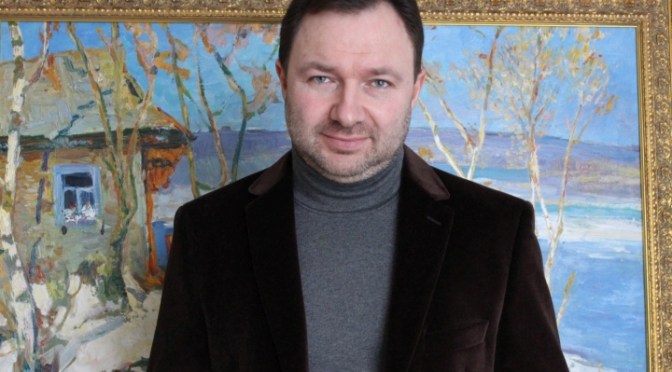
Inal Sharip, Foreign Minister of the Chechen Republic of Ichkeria
Sherip traces the evolution of the political project that, over the years, led to the construction of a personal power apparatus around Kadyrov — initially designed as a tool for Moscow’s control over the Caucasus — and shows how this same apparatus now risks turning into a “toxic asset.” The reasons are multiple: the growing cultural and religious autonomy of Chechnya’s leadership from Russia’s official narrative, its ties with Gulf states, and the ostentatious concentration of power and wealth.
At the core of the analysis lies the hypothesis that the potential disappearance or weakening of Kadyrov — whether due to health issues or internal conflict — could trigger a chain reaction capable of undermining Russia’s internal power balances themselves: from the redistribution of federal security forces, to an intense succession struggle within Kadyrov’s inner circle, to the opening of new spaces for intervention by Russia’s central security services, such as the FSB.
Ultimately, Sherip advances a non-conventional but compelling interpretation: Putin’s dependence on figures like Kadyrov is no longer merely a coercive advantage, but a potential breaking point for the stability of his own system of power — an internal “black swan” that could accelerate far broader dynamics of instability.
A career officer in the Soviet Navy, Alkhazur Abuev (also transliterated as Olkhazur Abuev) was born in the Chechen-Ingush Socialist Republic in the first half of the 1950s.
In 1972, he graduated from the M. V. Frunze Higher Naval Academy in Leningrad, a prestigious Soviet Navy academy, obtaining the rank of Captain First Rank (капитан первого ранга). He served in the Black Sea Fleet and later in the Caspian Flotilla, where he held technical and staff positions.
He left his military career in the early 1990s, during the collapse of the USSR, and returned to Chechnya, apparently in March 1992, where he was immediately appointed by President Dzhokhar Dudaev to the organizational chart of the nascent Chechen national army, obtaining the position of deputy head of the Operational Directorate of the Armed Forces General Staff and, from June 1993, head of the same directorate. At the outbreak of the First Russian-Chechen War, however, Abuev did not take up arms but left the country.
Maskhadov’s Army
Upon his return to his homeland, he was called back by President Aslan Maskhadov to help reorganize the regular army, which, according to the plans of the new head of state, was to be called the National Guard and consist of eight specialized regiments. Maskhadov appointed Abuev Chief of Staff immediately after his election as President. According to Timur Muzaev’s reconstruction, on March 13, 1997, Maskhadov established the National Guard, and on May 15, 1997, Abuev signed the general reorganization of the army, abolishing the previous front commands and centralizing the chain of command.
The Chechen National Guard in 1997
The measures taken by the new Chief of Staff had their own abstract logic and were in line with the President’s desire to professionalize the army, but they did not take into account the important changes that had affected the armed forces during the war. Dudaev’s death had accentuated the tendency of units to rally around their field commanders, and Abuev appeared to be ‘disconnected’ from the natural hierarchies that were forming. The new General Staff’s claim to establish a professional system in an army that resembled more an advanced popular militia than a classic armed force clashed with the convictions (and interests) of many field commanders, who preferred to consider their units in ‘permanent mobilization’, both because they were convinced that war with Russia would soon resume and because they wanted to maintain the privileges and impunity that some of them had acquired.
The friction between Abuev, who was pushing for the demobilization of the armed units, and the main brigade generals, who wanted to avoid it, led to an institutional crisis that, in October 1998, resulted in Abuev’s resignation. He was replaced by Maskhadov with the “veteran” Abubakar Bantaev.
Retirement and final years
At the outbreak of the Second Chechen War (1999), Abuev retired to Baku, Azerbaijan, where he lived for almost ten years. On April 23, 2008, according to Kommersant and RBC News, he voluntarily surrendered to the Russian federal authorities, claiming that he had not participated in armed activities since 1999. The authorities confirmed that, despite having served as Chief of Staff in 1997-1998, he was not involved in war crimes. Akhmed Zakayev commented on his surrender as follows: “I don’t understand why he had to surrender. He could have returned home without announcing it, and there would have been no charges against him.” This position was confirmed by one of Abuev’s relatives, who commented: “In Chechnya, only the laziest or the illiterate are unaware that Olkhazar never fought against the federal forces […] Olkhazar was a naval officer and only arrived in Chechnya after the end of the first war, leaving before the start of the second military campaign. Why turn him into a militant commander?”
After a brief interrogation, he was released and not prosecuted.
Press sources indicated that he still lives in Chechnya under discreet surveillance, maintaining a low profile and staying out of public life.
The Chechen National Guard in 1999
Profile and assessment
Alkhazur Abuev was one of the most atypical figures in the Ichkerian military elite: a Soviet-trained technician, uninterested in religious or revolutionary rhetoric, focused on rebuilding a modern state military structure. He was the main architect of the attempt to transition from a guerrilla army to a regular force, which was thwarted by the fragmentation of the armed forces in 1998 and then by the second Russian invasion of Chechnya. His story—from his career in the USSR Navy to his command of the Ichkerian forces, to his retirement in Baku and surrender in 2008—reflects the trajectory of a generation of Chechen officers who sought to reconcile military professionalism and national identity, only to be crushed between the two logics.
Russian ambition is vulnerable in what has always been the Empire’s soft underbelly: the North Caucasus. A conference in Kyiv sets a framework for opposition to Moscow’s imperialist legacy.
The following article was written by the Minister of Foreign Affairs of the Chechen Republic of Ichkeria, Inal Sharip, and published in the Kyiv Post at the following link:
The Kyiv conference “The North Caucasus as Europe’s Security Frontier” was timed to the third anniversary of Verkhovna Rada Resolution No. 2672-IX on the temporary occupation of the territory of the Chechen Republic of Ichkeria (ChRI). Its core conclusion is that Europe’s stability is inseparable from the fate of the peoples of the North Caucasus; therefore, the “Caucasus track” must move from declarations to a managed policy with institutional tools and clearly defined addressees.
The lineup underscored the political weight and attention to the topic. Participants included Verkhovna Rada Speaker Ruslan Stefanchuk and First Deputy Speaker Oleksandr Korniyenko; Ukraine’s third President Viktor Yushchenko; Mykhailo Podolyak, advisor to the Head of the Office of the President of Ukraine; Prime Minister of the ChRI Akhmed Zakayev; MEP Rasa Jukneviciene (former Lithuanian Minister of Defense, Vice-Chair of the EPP Group in the European Parliament); former Polish Foreign Minister Anna Fotyga; as well as members of the Ukrainian parliament and international experts. Such a roster widens the frame from a national to a pan-European and transatlantic level, signaling that the North Caucasus is entering the security mainstream.
Prime Minister of ChRI Akhmed Zakayev with the third President of the Republic of Ukraine, Viktor Andrijovych Yushchenko
The normative direction of the discussion was set by the adopted Kyiv Declaration.
First, it fixes a strategic lens: the North Caucasus is a critical link in pan-European security; the threats are transnational (hybrid aggression, repression, deportations, disinformation) and require coordinated international responses. This turn implies abandoning the “all-Russia prism” in favor of viewing the North Caucasus as a distinct macro-region with its own elites and trajectory.
Second, the declaration sets an operational framework – a four-track roadmap, which makes the conversation reproducible within EU/NATO policy and at national levels:
Legal (universal jurisdiction, documentation of crimes, support for applications to international courts);
Sanctions (expansion of personal and sectoral measures for repression, mobilization, deportations, and cultural erasure);
Humanitarian (protection of refugees and political prisoners, access to medical and psychological care, preservation of language and culture);
Communications (countering disinformation, supporting independent media and expert analysis).
Third, much attention was dedicated to the Ukrainian pillar. Participants called on the Verkhovna Rada to take steps enabling “Ichkerian entities” to function within Ukraine’s legal field: recognize ChRI citizenship; provide for representation of ChRI citizens in third countries pending international recognition; grant the State Committee for the De-Occupation of the ChRI official status as an organ of national-liberation struggle; and launch a regular parliamentary dialogue. They also propose energizing cross-party caucuses and supporting draft law No. 11402 on engagement with national movements of the Russian Federation’s colonized peoples. Taken together, this moves moral-political declarations toward legally operable mechanisms.
ChRI Prime Minister Akhmed Zakayev with the Speaker of the Ukrainian Parliament, Ruslan Stefanchuk
External addressees are divided into two groups. The first – the European Parliament, PACE/NATO PA, and national parliaments – are urged to strengthen the parliamentary dimension of de-occupation policy, initiate public hearings and evidence-gathering missions, establish systematic dialogue with national-liberation movements, and expand sanctions lists, including accountability for the use of North Caucasus natives in Russia’s war against Ukraine. The second – governments and institutions of the EU/UK/Canada/US – are encouraged to integrate North Caucasus issues into strategic reviews and deterrence plans, and to support human rights, cultural heritage, and the languages of the Caucasus peoples.
A key infrastructural outcome was the decision to build an expert network and a public monitoring panel, Caucasus Watch – a tool that links human-rights reporting, sanctions tracking, and analysis, thereby reducing information asymmetries for policymakers and regulators. A dedicated grant track is envisioned for researchers working on law, security, and culture in the North Caucasus.
The tone of the discussion was well captured by remarks from Laura Lindermann of the United States (Senior Fellow at the Atlantic Council’s Eurasia Center and Director of Programs at the Central Asia – Caucasus Institute at the American Foreign Policy Council). She noted Russia’s “strategic retrenchment” from the South Caucasus, the shift in the mediation architecture, and the vulnerability of three pillars of control in the North – hyper-securitization, budget transfers, and personal patronage networks (including the “Kadyrov model”). The weakening of these pillars increases the risks of local conflicts and terrorism, as well as the play of external actors; hence integrating the “Caucasus track” into the core of Euro-Atlantic strategies is a matter of prevention, not reaction.
From here flows the practical logic of the Kyiv Declaration: institutionalizing subjecthood, standardizing sanctions-legal work, producing verifiable data, and advancing parliamentary diplomacy. The expected outputs fall into three baskets:
Legal (building out universal-jurisdiction cases and treaty-based procedures);
Political (consolidating inter-parliamentary formats, including channels to movements and diasporas);
Informational (reducing reliance on fragmentary testimony through a single data window (Caucasus Watch)).
The risks are evident: sanctions fatigue and bureaucratization; limited access to sources and witness security; competing external agendas. However, the very shift to an operational framework with clear addressees and instruments is already significant. The political will of parliaments and the cohesion of expert networks will be the key variables – both for implementing the Ukrainian pillar (including decisions on ChRI citizenship and the State Committee’s status) and for embedding the “Caucasus track” in EU/NATO strategies.
Kyiv has offered new arguments as well as a policy infrastructure, from legislation to enforcement. The trajectory ahead will be measured not by the volume of statements but by the speed of institutional steps and the quality of interagency coordination.
The views expressed in this opinion article are the author’s and not necessarily those of Kyiv Post.
The text of the Declaration signed in Kyiv is available in English, Russian and Ukrainian at this link
Taymaz Taysumovich Abubakarov was born on April 16, 1948 in Kazakhstan, where his family had been deported alongside the entire Chechen nation under Stalin’s 1944 mass deportations. After the rehabilitation of the Chechen people, his family returned to Chechnya, where he grew up in Grozny.
He initially worked as a mechanic at Grozny’s TETs-2 thermal power plant before pursuing higher education in economics at Moscow State University (MGU). He completed his studies with distinction and later earned the academic degree of Candidate of Economic Sciences. Upon returning to Grozny, Abubakarov embarked on an academic career at the Chechen-Ingush State University, rising to the post of First Vice-Rector. His research specialized in the economic and demographic dynamics of the North Caucasus, earning him respect as a regional development expert.
Entry into Politics and Early Career
During the period of perestroika, Abubakarov became involved in the Chechen national movement. As early as 1985, he was an active member of the organizations “Dosh” and “Nokhchicho”, which advocated Chechen sovereignty. He briefly served in the economic administration under Doku Zavgaev during the final phase of the Soviet administration in the Chechen-Ingush Autonomous Republic.
After General Dzhokhar Dudaev led the Chechen Republic to declare independence in 1991, Abubakarov was appointed Minister of Economy and Finance on October 27, 1991. His appointment was part of Dudaev’s strategy to balance revolutionary legitimacy with the need for capable technocratic leadership.
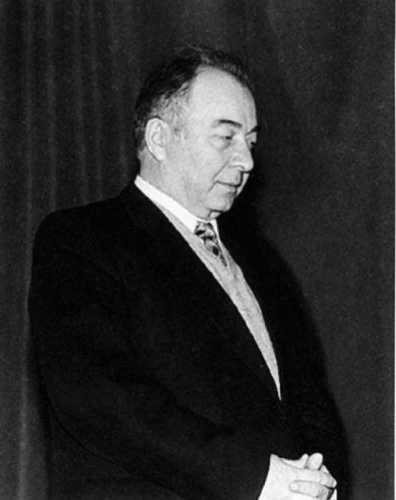
Doku Zavgaev
Economic Policies and Challenges
As minister, Abubakarov faced the enormous challenge of establishing an independent economic system in a collapsing post-Soviet environment. He proposed a mixed economy model: allowing private ownership while maintaining state control over key strategic sectors. This approach aimed to stabilize Ichkeria’s fragile economy and shield it from Russia’s impending blockade.
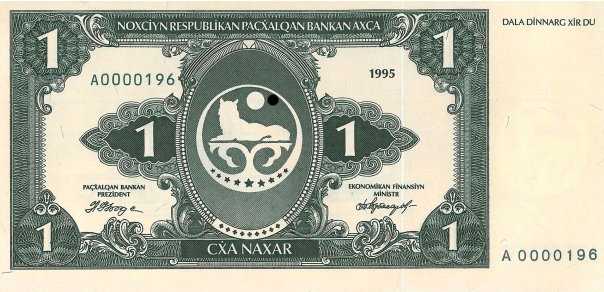
However, tensions soon emerged between Abubakarov and Dudaev, particularly over economic control. Dudaev maintained tight personal oversight over sectors such as oil exports. Abubakarov also opposed Dudaev’s attempts to launch a national currency (The “Nahar”), which were instead handled by Central Bank Governor Usman Imaev. In his memoirs (The Dudaev Regime: Truth and Lies, available HERE), Abubakarov describes the severe economic crisis gripping the republic in 1992-1993, including hyperinflation, speculative black-market pricing, and the collapse of state revenues. Attempts by Dudaev to subsidize basic food items proved unsustainable, aggravating the fiscal strain.
The Chechen national currency project, the Nahar
Involvement in Pre-War Diplomacy (1994)
In December 1994, with tensions escalating towards open war, Dudaev appointed Abubakarov to lead Ichkeria’s delegation in negotiations with Russian representatives in Vladikavkaz. Despite his position as Finance Minister rather than Foreign Minister, Abubakarov was chosen based on Dudaev’s personal trust and pragmatism. The Chechen delegation offered major concessions, including dismantling irregular armed formations, provided Russia agreed to withdraw its military forces first. Meanwhile, Moscow supported both negotiations and an escalating military buildup, leading Abubakarov to accuse Russia of duplicity.
The talks were further complicated by the presence of a second, pro-Moscow Chechen delegation representing the so-called “Provisional Council.” Figures like Bektimar Baskhanov and Bislan Gantamirov appeared at the negotiations, highlighting Moscow’s attempt to foster an alternative Chechen leadership.
On December 14, 1994, as head of the Chechen Working Commission, Abubakarov signed an official statement reaffirming Chechnya’s position: disarmament would proceed only after full Russian troop withdrawal. Nevertheless, the negotiations collapsed, and Russia launched its full-scale invasion on December 11, 1994. Shortly thereafter, Abubakarov was replaced in the negotiation team by Prosecutor General Usman Imaev.
The Council of Ministers of the Chechen Republic of Ichkeria (formerly “Sovmin”)
Corruption Allegations and Dismissal
As the war unfolded, accusations of corruption began to surround Abubakarov:
Prominent Chechen politician Musa Temishev accused him of massive misappropriation of state resources, calling him “one of Ichkeria’s most notorious looters.”
Russian journalist Yuri Shchekochikhin reported on a 1993 contract in which Abubakarov authorized the purchase of five metric tons of pure gold from Yakutia for 2.78 billion rubles, raising serious suspicions regarding the transaction’s legitimacy.
Abubakarov increasingly centralized control over export licenses, oil contracts, credit allocation, and financial institutions.
In 1995, President Dudaev dismissed Abubakarov on charges of financial misconduct. Following his removal, Abubakarov relocated to Moscow, where he lived in quiet exile, completely withdrawing from public life.
Memoirs and Historical Testimony
In 1998, Abubakarov published his memoirs, The Dudaev Regime: Truth and Lies, offering valuable firsthand insights into Ichkeria’s early governance, internal conflicts, and economic policies. The book serves both as a crucial historical source and as his personal defense against corruption allegations.
Later Life and Current Status
Following his exile, Abubakarov disappeared from the public scene. According to public real estate records, since 1998 he has owned an apartment in Moscow. As of 2024, no official records of his death exist. He is presumed alive at age 77. He has not participated in political, media, or social activities since the late 1990s.
Extensive searches in Russian archives, media, and historical forums confirm that no verified photographs of Abubakarov are publicly available. His image remains absent from media databases, official archives, and the Ichkeria.net Name Index.
Final Remarks
Taymaz Abubakarov’s personal journey exemplifies the turbulent fate of many Ichkerian leaders. From academia to state-building under extreme conditions, from internal power struggles to exile, his career reflects the complex realities of Ichkeria’s struggle for independence. Decades later, his role remains significant for historians analyzing the republic’s internal political dynamics and its economic challenges in the face of overwhelming adversity.
Born on November 8, 1956, in Kazakhstan to a family of deportees belonging to the Teip Thadakhara tribe originally from the village of Khatuni, Supyan Minkailovich Abdullaev was just a child when, after Khrushchev’s “Pardon,” he moved to Chechnya with his parents. His family was one of many that, during the Ardakhar, had been deported by Stalin to Kazakhstan, officially as “punishment” for not fighting the Nazi invasion of the USSR with sufficient rigor, but in reality to consolidate the colonization of the Caucasus by ethnic Russians.
Exile first, then social ghettoization after their return, had produced a strong sense of disorientation in the younger Chechen generation: for a people accustomed to living in the same land for millennia, organized into clans deeply rooted in specific territories, deportation to Central Asia and the chaotic return to their homeland thirteen years later, unable to rebuild the ancient social mosaic based on the “family-territory” relationship meant the loss of every “cardinal point of identity.” In this context, the only cultural pillar remaining to the Chechens was Islam, which until the deportation had taken root in a very ‘light’ form, often syncretic with ancient cultural values, but which now represented the only foothold for Chechens to recognize themselves in a USSR that was predominantly Orthodox and Russian-speaking.
Supyan grew up cultivating traditional Chechen customs, soon became very skilled in fighting, and studied the Koran. After graduating in 1972, he earned a degree from the Chechen-Ingush State University and found work as a physical education teacher in schools in the Vedeno district, the “ancestral land” of the Chechen nation.
From madrasas to the Islamic Battalion
With the advent of Glasnost and the easing of censorship, Abdullaev was able to devote himself openly to religious propaganda, teaching in local madrasas, acquiring contacts throughout the Eastern Caucasus, and eventually participating in the creation of the Islamic Revival Party, the first explicitly confessional political movement in the Soviet Union. His social activism took the form of participation in the activities of the Ar-Risalya Islamic center in Grozny, where he began teaching Islamic doctrine and law, achieving the honorary title of Ustaz (Teacher). He eventually became director of the center and, in this capacity, supported the Chechen Revolution, the proclamation of independence, and the rise of Dzhokhar Dudaev to the presidency of the republic. He differed from most other teachers, who struggled to express themselves in Russian, in his almost complete lack of accent and a style of speech that would have been the envy of a university professor. He had a long red beard that reached down to his waist (hence the nickname “Supjan the Red”).
Supyan ran the Islamic center until 1994, when the Russian army entered Chechnya with the aim of reconquering the small republic. On November 26, 1994, a contingent of anti-Dudaev militiamen, mercenaries, and undercover Russian soldiers attempted to overthrow Dudaev by attacking Grozny. Abdulaev enlisted in a village militia and took part in the fighting that saw the attackers destroyed and put to flight. The group of volunteers to which Supyan belonged engaged the attackers at the Press House. According to some, it was in that battle that people first began to talk about the “Islamic Battalion.” Supyan’s bravery during the battle earned him the position of deputy commander of the battalion, a unit that would fight with honor throughout the First Chechen War (for more information, read “Freedom or Death! History of the Chechen Republic of Ichkeria,” available HERE).
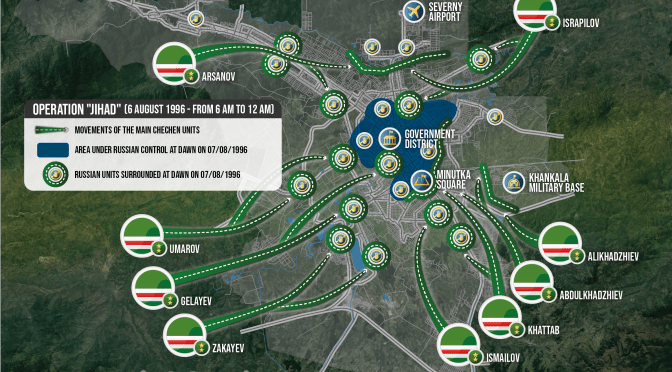
Supyan took part in Operation Jihad, the action with which the independence fighters recaptured the capital, putting the Russian army in check and forcing Moscow to withdraw from Chechnya. During the battle, he commanded several assault groups against the FSB headquarters, the “Government Palace,” the Dinamo Stadium, and other sensitive targets. For his role, he was apparently appointed ‘Brigadier General’ (a mainly honorary title, which would become rather inflated in the following years).
Islam and War
Maskhadov’s rise to power, democratically elected by the overwhelming majority of Chechens in 1997, saw Supyan align himself with the so-called “Radicals,” whose main exponent was Shamil Basayev. In the distribution of posts, seeking to please the radicals, Maskhadov appointed him Deputy Minister of Sharia for State Security, with the task of working on the ideological and religious training of officials. With the proclamation of full Sharia law (1999), Supyan’s role (recognized as one of the leading exponents of radical Islam in Chechnya alongside Movladi Ugudov) in the training of state officials grew significantly, as the Chechen legal system had no background in religious law. Thus, the few scholars available became ‘experts’ in Islamic law, even though they often lacked even a basic knowledge of the subject.
In any case, the formation of the ‘Islamised’ Chechen ruling class was soon brought to an end when Russia invaded Chechnya again at the end of 1999. Abdullaev quickly became a key figure, not only because he reconstituted his unit (renamed the ‘Jundullah’ Brigade) at the outbreak of the war, but also because, as a radical figure not only in politics but also in religion, he had access to the richest sources of foreign funding, coming from Wahhabi Islamic associations, which were happy to finance the jihad while ignoring any interest on the part of the moderate political and religious current of the Chechen government, of which Maskhadov was the expression.
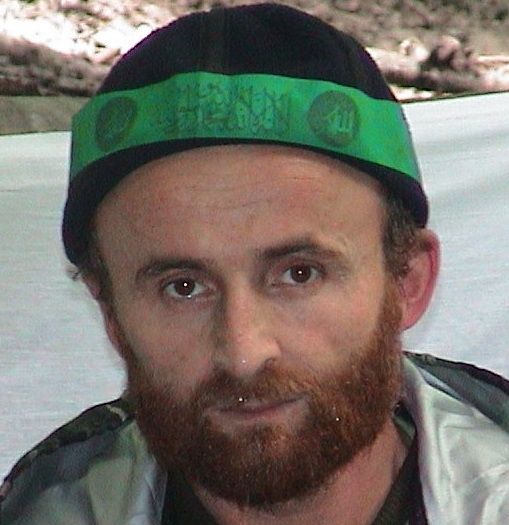
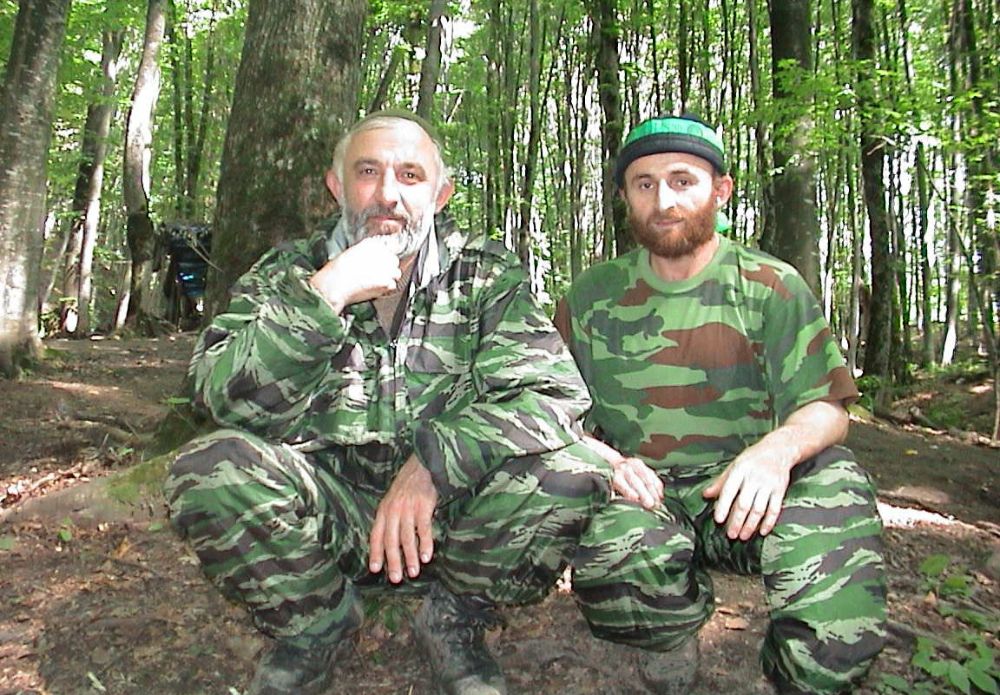
During the Second Russian-Chechen War, Abdullaev first commanded the Jundullah Brigade as second-in-command, then as commander, earning himself a place in the political-military council of the Chechen resistance[1], the Majilis-Al-Shura (successor to the Committee for the Defense of the State at the head of the Republic). After taking command of the Eastern Front of the war theater (2003) centered in the territories of Vedeno and Shali (where he was wounded several times in combat[2]), on July 5, 2004, he was appointed Minister of Finance of the war government, with the aim of raising the necessary funds to continue operations and distribute them to units in the field. His work was appreciated, if it is true that Maskhadov’s successor, Sadulayev, confirmed him in his position. Among the fighters, Supyan gained the goodwill of his comrades, earning the respect of all. Despite his advanced age compared to the other commanders, he actively participated in operations and war councils, and was known for his austere religious discipline, moral authority, and charisma among the fighters.
The Emirate
On March 3, 2007, he was appointed Vice President of the Chechen Republic of Ichkeria by Dokka Umarov, a position he held until the founding of the Emirate of the Caucasus on October 7, 2007. He joined the new formation, formally abandoning the state structures of the ChRI, and took on the role of “Naib” (political successor) to the former President, now “Emir,” Umarov. When, in June 2009, unconfirmed information emerged about the alleged death of Doku Umarov, Akhmed Zakayev expressed the opinion that his closest associate, Supyan Abdullayev, would most likely become his successor. Within the Caucasus Emirate, Supyan Abdullaev maintained a leading role as Dokka Umarov’s deputy, being the de facto number two in the movement. For this reason, the Russian authorities tried in every way to capture or kill him, even arresting his son, Masud, then 22, who was deported from Egypt to Russia. Nevertheless, Supyan did not give in to blackmail and did not surrender.
He was considered the most influential of the Salafi ideologues and acted as a liaison between the various Wilayat (provinces) of the new Emirate. As an educator, he oversaw the religious and ideological training of new militants in mountain training camps. He carried out this task until March 28, 2011, when, during a raid by Russian special forces in the village of Verkhny Alkun, in the Sunzha district, the Russians hunted him down and killed him. The operation was aimed at preventing a meeting between Umarov and his staff. According to some, Umarov managed to escape, while Abdullaev was killed in a heavy air strike, following which he and several others
[1] His radio call signs were “Red Supyan” and “Chitok.”
[2] In January 2006, information appeared about Abdullaev’s elimination following a special operation in the district of Shali in Chechnya. This information was later denied, as it was his youngest nephew, field commander Adam Abdullaev, who was killed. Two other field commanders were killed along with him.
There are very little information about him in the press, and we were unable to find a personal photo of him. All we know about him is that he was born in 1954, that he graduated from Voronezh State University with a degree in law, and that, according to our sources, he is still alive.
Before Chechnya’s independence, Abdulkharimov worked as a law enforcement officer in the Chechen-Ingush Autonomous Soviet Socialist Republic. During the period between 1991 and 1994, he had the opportunity to establish himself in the oil business, acquiring skills and contacts that earned him the government’s interest.
It is not known what his political position was with respect to the issue of Chechen independence, and whether or not he participated (and if so in what form) in the defense of the country during the First Russo-Chechen War. It is known, however, that after the withdrawal of Russian troops from the country, he moved closer to government positions, beginning a notable political rise.
Institutional roles
Presidential Advisor for Oil Production (since 1996): After the end of the First Chechen War and the election of Aslan Maskhadov, Abdulkharimov was appointed Presidential Advisor for Oil Production, taking on a key role in managing the country’s energy resources.
Minister of Oil Production and Energy (03/07/1998 – 10/10/1998): During this short period, he headed the ministry responsible for energy policies, in a context of reconstruction and political instability.
First Deputy Chairman of the Cabinet of Ministers with responsibility for oil production (since 10/10/1998): Subsequently, he was promoted to First Deputy Chairman of the Cabinet of Ministers, maintaining responsibility for oil production.
Director of the State Enterprise “ChechenTEK” (since September 1998): He took over the management of ChechenTEK, the state enterprise responsible for the management of the oil sector, at a time when Chechnya was trying to consolidate its economy.
Member of the collaborationist government
After the conquest of Chechnya by the Russian army and the installation of the collaborationist government of Ramzan Kadyrov, Abdulkharimov was appointed Minister of Industry and Energy, by nomination of Kadyrov himself, replacing Amadi Temishev.
Temishev had repeatedly criticized the policy of “plunder” carried out by the Russian state oil company, Rosneft, complaining about the systematic violation of the contractual agreements signed in 2002 between the company and the collaborationist government, at the time led by Akhmat Kadyrov, Ramzan’s father, the disinterest of the Russian administration in the economic and environmental fate of the Republic, and the lack of investment in the restoration of Chechen industrial infrastructure. His last public interview, dated October 11, 2006, was an explicit indictment of Moscow. It is not surprising, therefore, that in April 2007 Ramzan Kadyrov (newly elected President of the Chechen Republic by decree of Vladimir Putin) decided to remove him from government, replacing him with a figure supposedly less cumbersome and more “available” towards the Russian imperial center.
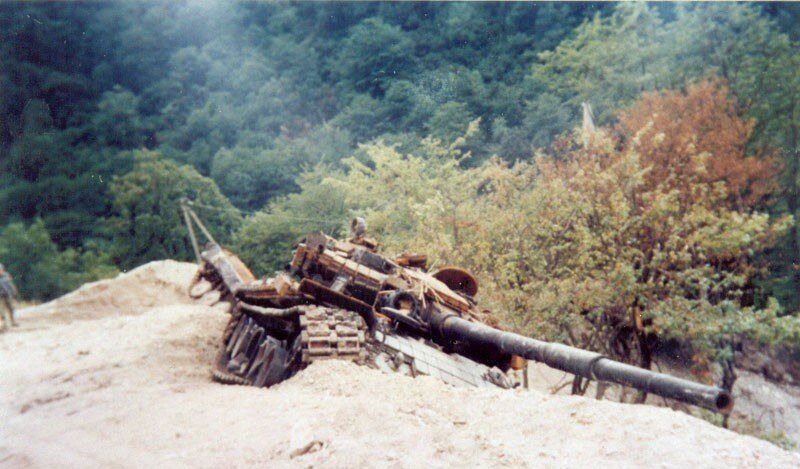
On 16 April, a few hundred meters from the village Yarish-Mardy in the Argun Gorge, the Russians suffered one of their worst setbacks. At 2:20 p.m., after a several hours’ march from Khankala Military Base, an armored column of thirty fighting vehicles,[1] four oil trucks, and numerous supply trucks, hit a bottleneck between the villages Chishki and Zony. The area was the only along the route without a permanently-manned Russian checkpoint and, due to the differences in height between the road and hills, without radio coverage too. Waiting there instead were Chechen units led by an obscure young commander of Arab origin. He had arrived in Chechnya in mid-1995 leading a small group of foreign fighters. Now with 80-160 men, his name was Samir Saleh Abdullah but went by Ibn Al Khattab.[2]
The ambushers jammed the radios of the passing unsuspecting Russians before detonating a powerful anti-tank mine, stranding the forward vehicle. The hills began spewing down on the column, now stretched for almost a kilometer and a half, destroying the leading and trailing vehicles, and a few minutes later killing the commander and deputy commander, Major Terzovets and Captain Vyatkin. Most of the infantry and vehicles were destroyed eventually too. A nearby platoon of Russian soldiers set off to investigate the explosions. Hearing the nearby explosions, a platoon of Russian soldiers set off to investigate but came under heavy fire too and took up defensive positions. The command hurriedly organized a task force with battle tanks and heavy machine guns to relieve their trapped comrades. Simultaneously, a second relief column supported by combat helicopters was racing to the south. The two rescue teams made contact with the Chechens around five o’clock and fled to the woods an hour later. They had arrived at the ambush site to the smell of a hundred of their dead comrades burning. Of the initial 30 vehicles 21 were destroyed, and of the 200 men only 13 were unharmed. The Chechens lost twenty at most.[3] This was a defeat which blew up the tottering diplomatic bridge unilaterally constructed by Yeltsin. The day after the ambush, the Russian president backtracked, vowing not to “deal with the gangsters.” Meanwhile, Yarish-Mardy projected a hitherto unknown name, Al Khattab, onto the fresco of freedom fighters. With the advent of the internet, he had prudently brought a troupe of cameramen to record for a propaganda film, resulting in global clicks and new sympathizers for the Chechens. For the first time, footage out of Chechnya showed not helpless victims of Russian bombardment or desperate fighters, but a formidable fighting force winning true battles against Russia. The video of the Yarish-Mardy ambush evidently reached Parliament in Moscow: deputies requested an immediate report from Grachev and ordered the creation of a parliamentary commission of inquiry. As a result, formal accusations were brought against commanders of the devastated unit, but also the unified command of forces in Chechnya, for authorizing the column’s mission without properly assessing risks, even Grachev could not escape an accusation. Tough lessons went unheeded though, with another ambush on a Russian column destroying 15 combat vehicles and an unknown number of men on 5 May.
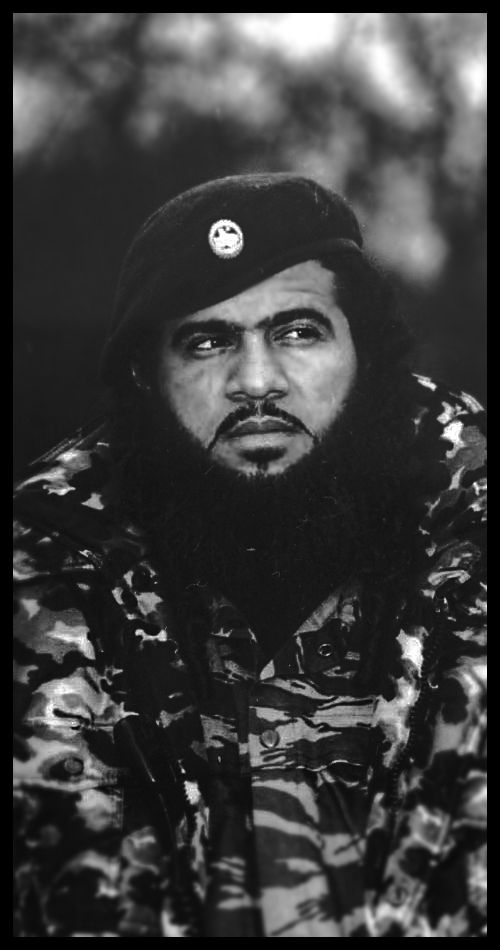
Khattab, whose fame would continue to grow with such attacks, needs to be put into context. He was a follower of Salafism, a radical current of Islam of which some fringes, called Wahhabism, openly preached global Jihad while supporting terrorist organizations such as Al Qaeda. Born in Arar, Saudi Arabia in 1969, he grew up passionate about Islam’s great figures, developing a radical vision of religious commitment that had led him to join, at seventeen years old, the Afghan Mujahedeen’s war against the Soviet Union. Earning the nom de guerre inspired by Caliph Omar Ibn Al- Khattab, he bore a permanent mark of that war after carelessly handling explosives and almost losing his entire right hand. According to his memoirs, between 1993 and 1995 he served in Tajikistan alongside the Islamic opposition and then moved to Bosnia.[4] More than just a strong fighter, he was an astute strategist and diplomat, skillfully commanding media to build a network of financiers. Cameramen captured the successes of his Jihad to show to the fringes of the Islamic world. Khattab was the first and certainly the main non-native commander to attract news in Chechnya.[5] After entering under the guise of a Jordanian journalist with his crew, he connected with Faith Al-Sistani, the commander of an Islamic battalion who led him to Dudaev.[6] With the president’s approval he settled down with some of his followers in an old Soviet Young Pioneer camp near Serzhen-Yurt.[7] Here Khattab set up a training course using his experience on previous battlefields: guerrilla warfare, explosives, and ambushes, focusing on how to transform a band of militiamen into a deadly combat force.[8] Though, what set his and other Chechen units apart was a strict adherence to the dictates of Islam. The war planted the seeds of Islamic formations by increasingly radicalizing the rural population.[9] According to Khattab, his “Jamaat’s (literally “community”, as was customary to call Islamist guerrilla military cells) first action was an ambush near Kharachoy, feeding a Russian column through the meat grinder. The initial success attracted new blood for the Yarish-Mardy ambush already described. Inflicting this second debacle on the Russians, Khattab won respect as a field commander and a seat on the Defense Council, the executive body through which Dudaev directed his armed forces. His invitation to the Defense Council marked the beginning of the so-called “Islamization of the resistance.” Until then, nationalism had been the common denominator across Chechen military groups.
Khattab
Two overwhelming factors encouraged the gradual Islamization of the Chechen resistance: the population’s suffering and the successes of field commanders associated with Islamic radicalism. In 1996, the sectarian view of the war for independence was in its infancy but growing fast. It is unsurprising that, with most of the population displaced, ravaged by poverty, and grieving over lost loved ones, people turned to extremism. Yandarbiev’s and Ugudov’s rhetoric fed the public with a holy war of independence against “Russian infidels.” The rule of law having died, Islam was a a simple and easily understandable replacement for a nation unaccustomed to the law of war. Next, political isolation incentivized supporting Jihad as desperate tool for gaining financial support from numerous religious networks across the Arab world. In exchange, these backers demanded the Chechens fight not for simply national aspirations but divine above all.
[1]According to The War in Chechnya, the column carried 199 men, mostly contract soldiers.
[2]According to what Khattab himself later reported, his contingent did not exceed 50 people. The Polish journalist Miroslav Kuleba, who entered the independence guerrilla, declared in his book The Empire on its knees the figure of 43 men, including Khattab.
[3]As reported by Ibn Al Khattab in his book of memoirs, the Shahid (“martyrs”) were 9, and 21 were wounded. On the Russian side, Chechen losses were never ascertained with certainty. The only certain data were the bodies of 7 militants from the Shatoy District, identified on the battle site in the following days.
[4]Most of Khattab’s autobiographical notes are contained in a book of memoirs, Memories of Amir Khattab , some extracts of which can be found on www.ichkeria.net in the Insights- Memoirs section.
[5]About his choice to participate in the war in Chechnya, Khattab says: “While we were preparing for the next year, the events in Chechnya began. I watched TV: the fight against the Russians was led by the communist general Dzhokhar Dudayev, or so we imagined. We thought it was a conflict between communists, we didn’t see Islamic prospects in Chechnya. One day I went back to the rear to nurse my wounded right arm. There a Chechen Mujahideen came to me and offered to take me to Chechnya for a week or two. We looked at the map of Chechnya. It was a small republic of 16,000 square kilometers. It was even hard to find on the map. I thought its population was a thousand […].”
[6]Regarding this meeting, Khattab recalls: I met Dudayev during a visit to Sheikh Fathi. […] Dzhokhar began to ask questions. […] He asked: “Why don’t they come to help us in your area?” I replied, “The truth is that the reasons for the war are not clear, and people don’t know what we are fighting for.” He told me: “Brother […] this is an Islamic land. Isn’t that enough for you?” […] I sat down next to them (Dudayev and Al – Sistani, ed.) and asked Dudayev the first question: “What is the purpose of your battle? Do you fight for Islam?” He replied: “Every son of Chechnya and the Caucasus, oppressed for decades, dreams that one day Islam will return not only to his homeland, but to the whole Caucasus. And I am one of these children.[…].”
[7]We have already mentioned this field in the paragraph concerning the Battle of Serzhen- Yurt.
[8]Regarding the establishment of the Serzhen Yurt camp, Khattab recalls: […] I remember that at the first meeting there were more than 80 mujahideen who have now become Emirs. I remember what I told them (and Fathi translated): “If any of you want to be Emir, then he must offer his fighting program and we will obey him.” Nobody said anything. In those days the battle was approaching the mountains. So I told them, “I’m not telling you that I have knowledge. I only have combat experience in Afghanistan and Tajikistan. Maybe it’s time to get to work. I have a program staggered into three phases: preparation, arming and operations. If we are not ahead of you in battle you can shoot us. We will be in front of you after the course. After arming, we will start implementing the combat program. We will always go ahead of you, I and the brothers who are with me.”
[9]Again we quote Khattab’s recollections, contained in his memoir: The fighting soon approached our area. The young people argued whether it was a Jihad, the Sufi mullahs declared that it was not, that it was a showdown between Dzhokhar Dudayev and the Communists, and the hypocrites added fuel to the fire […]. The puppets of the Russians (the anti-Dudayevite opposition, ed.) said that this was a problem between them and Dudayev, and that we shouldn’t have intervened. […] I didn’t really know the situation because I hadn’t studied it. I had a video camera and started filming people, asking them what they were fighting for. That’s how I met Shamil Basayev. Some people thought I was a reporter. I have seen sincere people and, I swear by Allah, I cried when I asked an old woman, “How long will you bear these hardships?” and she replied: “We want to get rid of the Russians.” I asked her “What are you fighting for?” and she replied: “We want to live as Muslims and we don’t want to live with Russians.” So I asked her. “What can you give to the Mujahideen?” And she: “I have only this jacket on.” I cried: if this old woman can help by having only this, why do we allow ourselves to be afraid and doubtful? From that day I decided with my brothers to start preparing people for battle, as a first step.
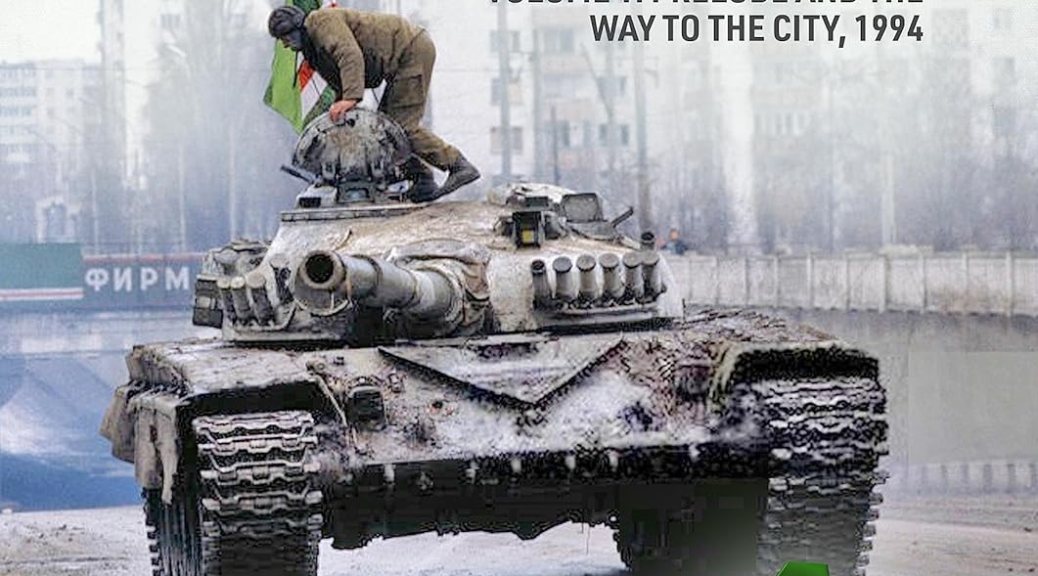
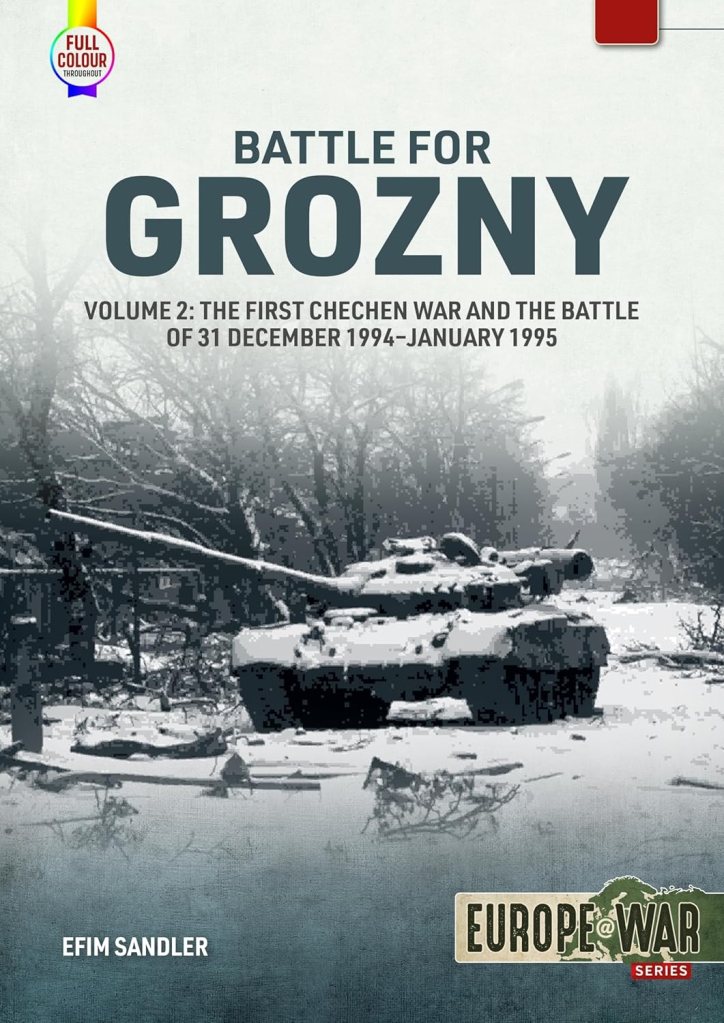
Born in the Union of Soviet Socialist Republics, Efim Sandler is a veteran of the Israeli Defence Force Armoured Corps and is currently living in the USA. An enthusiastic historian since his youth, he developed a deep interest in the armoured warfare of the Arab–Israeli Wars and conflicts in the former USSR, and has been collecting related information for decades. He is the co-author of the Lebanese Civil War series, and after posting several articles about the Chechen Wars he wrote Battle for Grozny: Prelude and the Way to the City, 1994. Next January the second volume of his work, Battle for Grozny: The First Chechen War and the Battle of 31 December 1994-january 1995 will be avaiable.
Your work on the First Russian-Chechen War, released in 2023, is the first in a series of essays whose next volume will be released in January next year
Yes, originally there was a plan for 2-3 volumes but it looks there will be at least 4 or even 5. The publishing house is not able to release the next one till spring 2025. Thus it is not really connected to when my books ready but to the availability of publisher resources.
Efim Sandler
Why did you decide to take such an in-depth interest in the First Russian – Chechen War?
It is kind of personal. I left Soviet Union in 1989 when I was 15 and by 1994 I was already in IDF. I cannot say we were following the war but the New Year assault on Grozny was pretty much discussed. We were shown the pictures of destroyed Russian tanks and killed Russian soldiers. Of cause there was not much details but the feeling was pretty bad. I felt bad for the whole situation in general, political stupidity and carelessness, poor condition of Russian army and the destruction that was coming upon Chechens. I had absolutely no doubt that Russia would grinder Chechnya despite the losses. At the top nobody ever cared about the losses. I visited Moscow in early 1995 and there were talks about the war was all about money and power. Some people blamed Yeltsin, others blamed Dudaev. There was no real censoring and you could see all the chaos of Grozny on various TV channels. I remember watching the footage of burning Russian armor and was thinking – how lucky I am for not being there! Many years later, when I started to develop my interest in military history one of my major directions were modern wars of USSR/Russia and the two big ones fell right into it: Afghanistan and Chechnya.
Did you find difficulties in the preliminary research work?
Obviously. There were several problems. At first there were not many sources and those available basically were telling the same story. It looked “fishy” as it was basically supporting the formal version that I did not believe. It took me a while to arrange a decent collection of sources including books, periodicals, videos and internet resources. Secondly there was barely any mention of particular units besides the ill-famed 131st and 81st. Majority of the sources gave very high level picture of the events. I had to approach this issue like assembling a puzzle. The phenomena of so-called ‘joint units’ added complexity as, for example, on veteran forums sometimes people were using their original units and not the ones they were assigned to.Chechen side was mostly covered by Russian version that was copied from one source to another. Especially pre-war period. I found a lot of stuff in Chechen History group on FB and later in your book. I also had to go over video footage from western news channels like AP and Reuters.I used veteran memories as well though many of them were kind of misleading. This is pretty obvious as people do not memorize everything in order but fetch some most vivid pieces. Some of the accounts I was able to cross-check, some I treated as ‘probable’. I also used a lot of my personal experience and logic to decide if the account is valid for the research.
What were your main sources?
This is a hard question as I do not have any major source for the whole period. For example to work on the Russian advance from 11 till 31 December I used the blog of Konstantin Yuk (botter) for the general structure then added information from several other sources like the books I am Kaliber 10, Win or Disappear, Life and Death of a General, Moloch of Grozny, Tanks in Grozny, Fangs of the Lone Wolf, First Chechen War, Soldier of Fortune and Bratishka magazines, and others. The videos also did some good job especially the news feeds as I was able to identify military units by the markings on the vehicles.
As a former – soldier and an expert in military history, what aspect, in your opinion, is particularly interesting in this war?
First of all I do not consider myself ‘an expert’ but an enthusiast of military history. I know a thing or two and I’ve developed my own method to make a research and tell the story in a way that is not as boring as pure academic history papers. Besides personal factors that I mentioned above, I think that the Battle for Grozny was the first and only massive urban clash of such a scale since WWII. It was asymmetric engagement where the advantage of firepower was minimized by mobility, experience and training. It is also interesting to see how Russian forces got themselves adapted to the very unfamiliar type of war and managed to take over the city. At last this war is barely explored and this makes it even more interesting – probably this is the major reason for me personally.
What experience, from the military side, do you think the First Russian-Chechen War brought?
Talking about military side we need to accept the fact that not all Russian units were devastated as common narrative tells us. There were many that fought well and got themselves adapted very quickly. I am talking not only about Lev Rokhlin and his troops. The major issue was at the top. As I tried to show it in my first book the whole management of preparations was a failure. This was the reason that I spent so much on describing the issues in details. I called it ‘a show of absurd’. Personally I was so horrified by learning the actual picture that I could not simply pass by. Thus my most important message – each operation should be carefully prepared from the top to the bottom.
Having studied this topic in depth, do you think that the Russian army has effectively learned from that experience, considering the operational fields in which it has competed in the following years, especially in Ukraine?
I don’t really know the operational details of the battles in Ukraine but we can look at the Second Chechen war (1999-2000) for example. I do believe that Russians learned something and tried to apply to certain extent. In general the Russian military remained on the low level of training and equipment while the higher command remained disconnected from the situation on the ground with some exceptions. Speaking about later conflicts like 5-Day (2008) it looked like there was some improvement in level of training but there still were issues with coordination.
One of the certainly most interesting aspects of this war is the fact that its asymmetrical nature has overwhelmingly benefited the militarily less strong faction, going so far as to force the Russian invasion army to retreat, recognizing a factual victory for the armed forces of the Chechen Republic of Ichkeria. How do you, as an expert, interpret this unexpected Chechen victory against the Russians?
Well, I believe there are two answers – simple and not very obvious. As I mentioned above Russians had upper hand in firepower but it was minimized by mobility, experience and training of Chechen units. What is not obvious is the fact that Russians were totally unprepared for fighting while the whole operation was taken as ‘show of force’ by the higher command with the exception of Group North-East commander, Lev Rokhlin. In large Chechens managed to repel Russian assault on the night of 31 Dec – 1 Jan due to neglectance and carelessness of top Russian commanders. There is no sense to compare types of firearms or other equipment. The tank is a tank and it can fire and kill. The problem is when the tank crew is unprepared and unit commander has no idea where he is and who is from the right and who is from the left – this is a problem. Squeezing dozens of armored vehicles into the small railway station area – this is a problem. Having not enough troops to perform proper sweeping and organize defensive perimeter – this is a problem. This will sound strange but I will say like this: Chechens did not win the New Year night, Russians lost it by giving them the lead. I hope I will be able to prove it in my coming book.
Regarding your next volume, what could you tell us to make the reader curious to read it? What could he find “unpublished”, compared to the superficial narrative that often fills the internet about this topic?
First of all let’s agree that there are only a few comprehensive publications available to western audience. All of them give a relatively decent overview of the events that led to the war (mostly from Chechen side) but poorly describe military activities. Sometimes the authors fill the gap with their own fantasies making the story look spicy. My job is to present the events in a most realistic way. Describing military actions I will go as deep as I can down to single unit level – battalion, company, platoon or even a team. I am combining various types of sources like publications, books, forum discussions, documentaries, personal memories, blogs, raw footage, news channels. Of cause majority of such sources are Russian and less of Chechen. Your books give good insight on the Chechen side.
Did you have the opportunity to interview war veterans, or eyewitnesses of these events? If yes, what impression did you get from their words?
As I mentioned above, I mostly used published accounts. I tried to interview a couple of times but it did not go well. Too many emotions. Can not blame them.
Have you had any difficulties talking to veterans? Do you remember a conversation that particularly impressed you?
Most of the veterans that I tried to contact declined after learning that I am living in USA. Several conversations I had were not very impressive and gave almost no additional details while switching to emotions. After Russia launched its intervention into Ukraine I lost all my contacts in Russia.
Two years later, do you feel that the public still retains a strong interest in this topic?
You means since the release of first book? I think the War in Ukraine invoked additional interest in everything connected to modern Russia. I cannot estimate to what extent though. Just to mention that general interest in Chechen wars was very low and this is the reason there so few serious publications about it. Need to mention that in early mid 1990s there were several major events that completely overshadowed what was going in Chechnya. Gulf War, collapse of Soviet Union, rearrangement of Eastern Europe just to name few. There were also numerous local conflicts like Balkans, Somalia, Lebanon, Tajikistan, Transnistria, Abkhazia, NKAO, etc. Thus for western observer 1st Chechen War was just one of them. Talking about Russians – they are trying to forget it due to their reasons.
Trying to bring the First Russian-Chechen War into the present day: do you think there are any similarities, or points of contact, between the invasion of Chechnya in 1994 and that Of Ukraine in 2022?
To my personal knowledge of the events in Ukraine (and I definitely can’t consider myself an expert there), the situation is pretty much different. Starting from the point that Ukraine is an independent country, and not a part of Russia trying to separate itself. Russians prepared the invasion and it looked they started to work on it well in advance. Russian military at least at first showed pretty much organization, equipment and training. Similar to Chechnya Ukrainian local population showed their dedication to resist invading troops and in my opinion that was the major factor that caused Russian advance to stall. In Chechnya Russians managed to suppress such resistance with numbers and firepower have almost no issues with supplies. In Ukraine this did not work. Western weapons also played some role in Ukraine while Chechens relied mostly on what they inherited from Russian units located in Chechnya prior to 1992. Of cause this is only a couple of examples but I tend not to compare these two wars. On the other hand the conflict in Donbass (2014-15) can be compared to Chechen War.
What role did Aushev play in the restoration of the Ingush state? And how is he seen today?
Aushev is a military man and obeys orders. The first thing he did when he became president was to ban all political organizations and establish a barracks regime in the republic. He created the conditions for corruption. He divided the Ingush people into three parts: the “Ingush” Ingush, who lived on the uncontested part of the land, the “Chechen” Ingush, who were forced to leave Grozny, and the “Ossetian” Ingush, who were expelled from North Ossetia after the ethnocide by the Russian army.
He violated Article 11 of the Constitution of the Republic of Ingushetia: he gave up the ancestral territories of Ingushetia and the city of Vladikavkaz by signing the so-called “Kislovodsk Treaties”. He did this under pressure from Yeltsin, who threatened to remove him from the presidency for the next term. There is video evidence of this. I don’t remember exactly when I wrote this comment on Facebook, but it concerns Aushev.
“All those who criticize Aushev for the Kislovodsk/Nalchik agreement, for the pocket parliament, for the barracks regime, for dancing at Ossetian government meetings, for abandoning the right bank of Vladikavkaz, for corruption, for jumping off personnel, for populism …. First of all, everyone has the right to criticize, because he is not a private person, but a public person, and every public person is subject to criticism; secondly, or rather, above all, all critics are right, because they tell the TRUTH. He led the republic built by us, the ancients, not as a general, but as a sergeant. Aushev was a talented but uneducated man, and that is why he drove all serious and worthy, educated and professional Ingush out of politics and business, placing himself alongside sycophants and other amateurs.”
Ruslan Aushev
So Aushev “sold” legitimate Ingush claims in order to avoid a conflict with Moscow. Considering what you told me about Dudayev’s decision not to pander to Yeltsin, don’t you think Aushev’s decision was wiser than Dudayev’s? A compromise to avoid ethnocide? Or do you think it could have been done differently?
Aushev took office after the ethnocide. It is very difficult to negotiate with the imperial Kremlin. It is necessary to be politically flexible. A good example of this was the President of Tatarstan Shaimiev Mintimer Sharipovich. Aushev violated Article 11 of the Constitution of the Republic of Ingushetia in order to retain his office as president, or more precisely, to extend it for a second term. Dudayev opted for open confrontation in the hope of gaining international support. Both generals knew how to wage war.
Aushev was in Afghanistan as an infantryman and put himself in real danger. Dudayev was the commander of a squadron of strategic bombers from the “carpet bombing” era, but neither of them understood anything about politics. As Krylov’s fable says: “It’s a disaster when a cobbler starts baking cakes and a baker starts grinding boots.”
Do you therefore think that the leadership in both the case of Ingushetia and Chechnya was not the right one to achieve “separation” from Moscow? Do you think that there were better people at the time who could have handled the situation better?
Yes, certainly. For example, Salambek Naibovich Khadzhiev in Chechnya and Bembulat Bersovich Bogatyrev in Ingushetia. I knew Khadzhiyev personally. An academic, an intellectual. An experienced person who didn’t need to improve his image because he was a seasoned personality. It is the hotheads who slander him. Unlike many others, Khadzhiyev was “capable of judgment” (according to Kant), and he never followed the euphoric, apparent freedom of the Chechens and did not declare independence, but used his authority to improve the lives of his people step by step, taking more and more powers away from Moscow… until the empire weakened. Khadzhiyev would not have sacrificed the Chechen people to the Russian barbarians.
The empire has never allowed people who were not loyal to it to lead the colonies. I said at the beginning of our conversation that I consider the declaration of independence to be a tragic mistake that was a catastrophe not only for the Chechen people, but also for the entire national and liberation movement in the Caucasus.
The military should not interfere in politics: it usually ends badly. But you can’t change it, history doesn’t tolerate the subjunctive. With the right tactics towards Moscow, the people I mentioned would have achieved results slowly, without losses, gradually gaining more and more independence, distancing themselves from the Kremlin and gaining strength, coordinating their actions with other peoples in the Caucasus and taking the path of DECOLONIZATION.
Do you believe that Salambek Khadzhiyev really wanted Chechnya to be independent? And as for the need to avoid a break with Moscow: Don’t you think that, given the way things developed in the following years, Chechnya’s independence would have been impossible to achieve if Russia had overcome its period of weakness?
You and I are talking about what could have been. In principle, this is only necessary in order to understand the processes that have taken place. The past must be known for the future. That is clear. Besides, it makes no sense to compare Dudayev and Khadzhiyev. We are talking about facts here. It is a fact that the Chechens declared independence under the leadership of Dudayev! Did they achieve it? NO. This is an indisputable fact.
As it turned out later in his interview, he knew very well what would happen in the future and even predicted it. He knew that a military confrontation with Russia was unwinnable. He knew that, and yet he took the risk. Dudayev did not achieve his goal! The Chechen people suffered heavy losses and fell under the yoke of Kadyrov, who was loyal to the Kremlin. The Russian empire was not weak in the years 1991-1998. Its economy was weak but its imperial face remained unchanged, although Yeltsin managed to fool the world into believing that Russia could be a democratic state. This will never happen.
The Russian empire will only get weaker now that it has gone to war against Ukraine. Now is the time when the colonized peoples, if they work together in harmony, can embark on the path of decolonization with the support of the Western democratic world. This includes the creation of a sovereign state. Thirty years ago, this was still impossible.
Salambek Khadzhiyev
More about Khadzhiyev. After Dudayev came to power, Khadzhiyev represented the opposition and led the “collaboration government” with Moscow for a while during the war. Do you think this was the right choice for him? Wouldn’t it have been better not to lead this government?
Khadzhiyev, who knew the history of the Russian Empire well and understood that a tragic mistake had been made that would inflict great losses on the Chechen people and thwart the dream of freedom for many years, could not remain indifferent to the tragedy that was rapidly approaching his people and tried everything to prevent this catastrophe. But a man in a stately general’s uniform, who spoke in a confident and authoritarian voice about the freedom of the Chechen spirit and called for death in the fight for it, was more attractive than a thoughtful intellectual who called for a cautious confrontation with the monster that had oppressed many peoples for many years.
The calm voice and the calls of the thinking people for sensible action were easily drowned out by the general’s slogan “Freedom or death”. Intoxicated by the apparent proximity of long-awaited freedom, the crowd chose death. Khadzhiyev was not a collaborator. Like me and many other thinking Chechens, he was sure that this monster could not be defeated alone and tried to save his people from disaster.
On October 23, 1995, Khadzhiyev resigned from the government he had formed and was replaced by Zavgaev. In light of this event, do you not believe that Khadzhiyev (without judging the nobility of his soul) was more a pawn of Moscow than an asset to the Chechen people? Under his rule, the federal forces committed numerous atrocities, which Khadzhiyev apparently had to endure, and after him, power passed to the old head of the Chechen Republic, who, as far as I know, was now hated by everyone.
Khadzhiyev did not allow himself to be manipulated by anyone. He was a true Chechen for whom the terms “honor” and “human dignity” were not empty words. In September 1991, S. Khadzhiyev led the movement for democratic reforms in Chechnya-Ingushetia and on the eve of the first presidential elections of the Chechen Republic in November 1991 was considered Dudayev’s main rival, but refused to take part in the elections and subsequently work in the government formed by the Chechen National Congress (OKCHN). In 1992, he again turned down the OKCHN’s offer to become Prime Minister of the Chechen government. This was because he was against Dudayev and Yandarbiyev, who were driving the people to tragedy. Khadzhiyev tried to prevent the impending catastrophe. A few days before the Russian aggression began, he tried to end the unrest and chaos in Chechnya and lead the government. But the federal troops, as you rightly pointed out, committed atrocities. Precisely because he refused to be manipulated by Moscow, he was replaced by Zavgaev.
Zavgaev was there before Khadzhiev. The Moscow puppet was ready to carry out any order from the Kremlin. In 1991, I headed the Ingush State Theater, which I had founded, and Zavgaev wanted me to join his team, invited me to run as a deputy for the Supreme Council of the Chechen-Ingush Republic, but in 1989, at the Second Ingush People’s Congress, I withdrew and distanced myself from political activity because I did not agree with the path I had chosen. But that’s another topic.
Doku Zavgaev
Doku Zavgaev: What do you think of him? Is he a man who tried to save Chechnya from war, or a weak politician who just wanted to exploit the situation for his own personal gain?
Zavgaev was an obedient lackey of Moscow. He was only interested in himself. He tried to get anyone who was popular with the people on his side. In short, he bought those who could be bought.
Back to the war. How did the Ingush deal with the Russian invasion of Chechnya? Didn’t the Ingush also declare independence after the end of the invasion in 1996 with the withdrawal of the Moscow army?
Ingushetia served as logistical support for the Chechen resistance fighters. The families of the Chechen resistance fighters were safe in Ingushetia. Wounded resistance fighters were treated in Ingushetia. Although the Republic of Ingushetia officially belonged to Russia, the Ingush strongly supported the Chechen resistance and their Chechen brothers. Individual Ingush also took part in the war against the Russian occupiers on the side of the Chechens.
What were the relations between Ingushetia and Chechnya between the end of the first and the beginning of the second war? Did the scourge of abductions also affect Ingushetia? Were there crises during this period because the borders between Ingushetia and Ichkeria could not be defined?
Despite constant provocations and attempts by the colonial authorities to divide and divide these two related peoples, all their efforts were in vain. The Chechen and Ingush people learned not to transfer the actions of politicians and the government, the lackeys of the Kremlin, to the relations between Chechens and Ingush. These attempts have continued throughout the ages, starting with the Russo-Caucasian War.
The merits of Presidents Dudayev and Aushev can be seen in the fact that they did not raise the issue of the border and postponed the resolution of these questions until better times. Chechen resistance fighters who had entered the territory of Ingushetia were arrested by the Ingushetian army and police and transferred to Chechnya with the request not to transfer the fight with the Russians to the territory of Ingushetia.
For two years, Russia has succeeded in changing the mood of the Western community from sympathy to antipathy towards the Chechens through “special operations” with hostage-taking, especially of foreign aid organizations. Who would sympathize with bandits who cut off the heads of people who wanted to help them? In the period between the first and second wars, I was often in Chechnya with German doctors. We brought wounded children to Germany to be treated free of charge. When we visited the Chechen Republic, Maskhadov, whom I knew personally, always gave us an armed escort. In a country devastated by war, there were always people who took hostages for money. Moscow provided considerable resources for this. There were no mass hostage-takings for ransom in Ingushetia.
Although the Dudayev government did not help the Ingush with either people or weapons during the ethnocide of the Ingush people in 1992, although it sent and received a delegation to North Ossetia twice and assured the Ossetian leadership of non-interference … basically betrayed the fraternal people and got them into trouble … there were no complaints or reproaches from the Ingush other than resentment. On the contrary, everyone understood that the Chechens had been provoked.
Dzhokhar Dudaev
You have described the hostage crisis in Chechnya as an instrument controlled by Russia to distance Chechnya from the West. In your opinion, were the apartment explosions of 1999, which justified the second invasion of Chechnya, also organized by the Russian government?
Yes, it was an initiative of the Russian secret services to discredit the Chechens. Irena Brezna, a Swiss writer of Slovakian origin, published a memo from the Analytical Center of the Russian Federation, in which the necessity and methods of discrediting the Chechen people and their struggle for freedom were pointed out. There were direct instructions on how to proceed and that no expense should be spared. One of the well-known facts confirming these methods is the murder of a humanitarian affairs expert from the American Soros Foundation, US citizen Fred Cuney, his translator Galina Oleynik and two employees of the Russian Committee of the Red Cross who were accompanying them. The Chechen State Security Service was held responsible for the murder.
In the interwar period, I witnessed such propaganda activities at the Russian embassy in Germany, where a video was shown of Chechens cutting off the heads of Russian mercenaries. This video certainly had a shocking effect on the German public.
Yes, of course houses in Russia were blown up by the FSB itself. There is a book by KGB officer Alexander Litvinenko, who was murdered by Putin in London with polonium, and by historian Yuri Felshtinsky entitled “The FSB blows up Russia”.
Akhmat Kadyrov. What kind of person was he? Did the Ingush know him? What was their opinion of him and how did it change over time?
As a rule, the spiritual leaders in Russia were KGB officers. I don’t know whether Akhmat Kadyrov was one. After he became the spiritual leader of the people, he first called for the killing of Russians. He promised paradise to anyone who killed as many Russian attackers as possible. And then he sided with the Russians and became the first president of the already conquered Chechnya? Strange metamorphosis!
As far as I know, the Ingush had no time for Mufti Kadyrov. In any case, Kadyrov senior betrayed the Chechen people or, in the opinion of others, saved the Chechen people from annihilation. I don’t know. The Ingush, like all other peoples of the world, have the same attitude towards traitors.
Kadyrov senior asked for money to rebuild the destroyed city of Grozny under his control (I heard him talk about it personally on a TV program). Moscow wanted to manage the money itself… Akhmat Kadyrov became an uncomfortable figure; he was too independent. The empire doesn’t need such people, so they liquidated him and installed Kadyrov Jr. who hadn’t even finished school. Kadyrov Jr. became Putin’s loyal ‘foot soldier’, killing his enemies (Politkovskaya, Nemtsov) and terrorizing the Chechen people!
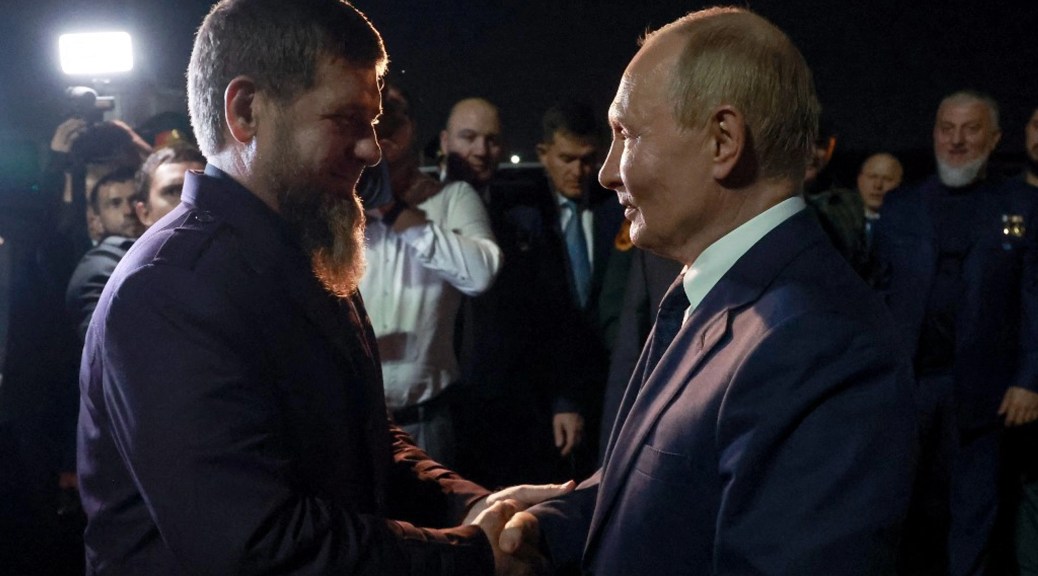
Akhmat Kadyrov with Vladimir Putin
After the death of Akhmat Kadyrov, power in Chechnya passed to his son Ramzan after a brief interregnum. How did relations between Ingush and Chechens develop during his dictatorship?
The Kremlin and Kadyrov, as well as Ingush appointees such as FSB General Zyazikov and GRU General Yevkurov, have done the bidding of their masters in the Kremlin. They have tried to sow enmity between our peoples. In Chechnya, for example, information has been spread at government level that the Ingush are profiting from Chechen refugees by renting unsuitable premises for accommodation for hundreds of dollars, etc.
In 2018, on the Kremlin’s instructions, they carried out a provocation to cede Ingush territories to the Chechen Republic. It’s not just a question of land. It is about the history of the people, the graves of their ancestors and everything that is important for the self-confidence of the Ingush. Yevkurov and Kadyrov reached an agreement and drew the border between Ingush and Chechens, so that an original part of Ingushetia went to Chechnya. The protests of the Ingush were widely felt. The Kremlin had long wanted to shed blood to separate these two peoples. But the Ingush police did not allow any retaliatory measures to be taken against the demonstrators. This happened in 2018, and the leaders of this protest were sentenced to draconian punishments and are in prison. And there is no one in world public opinion who cares about this injustice.
Of course, this provocation has not left both peoples unscathed, and relations between Chechens and Ingush have become more difficult.
But the Chechens, Ingush and other colonized peoples of the Caucasus must unite and establish their own state.
The empire does not tolerate any criticism, let alone any demands from colonized peoples.
The Empire is afraid of the unification of the colonized peoples and their national freedom movement and will therefore do everything to ensure that the peoples of the Caucasus have reason not to trust each other. Even better if they come into conflict with each other.
It is time for all the colonized peoples of the Caucasus to realize that they are not full and equal citizens of Russia. When we realize this, we will want to free ourselves from this oppression. The genetic inability to be a slave forces us to resist the position of a slave. The national liberation struggle will begin. The Chechens have tried to go it alone, have shown courage and will, have suffered heavy losses and have not reached the goal. All the peoples of the Caucasus must unite and take the path of decolonization together, because this is the path to the creation of a common independent pan-Caucasian state.
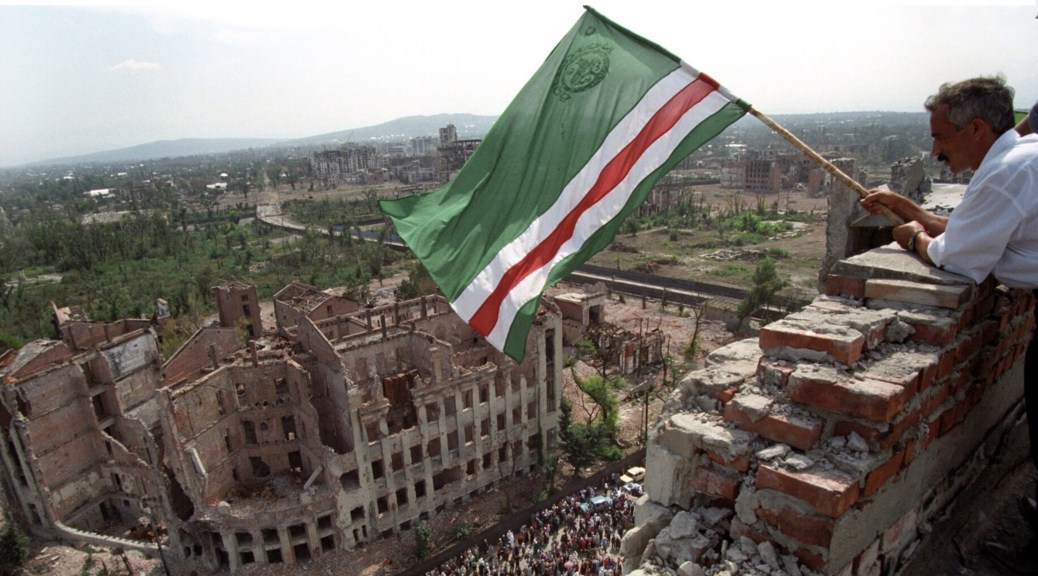
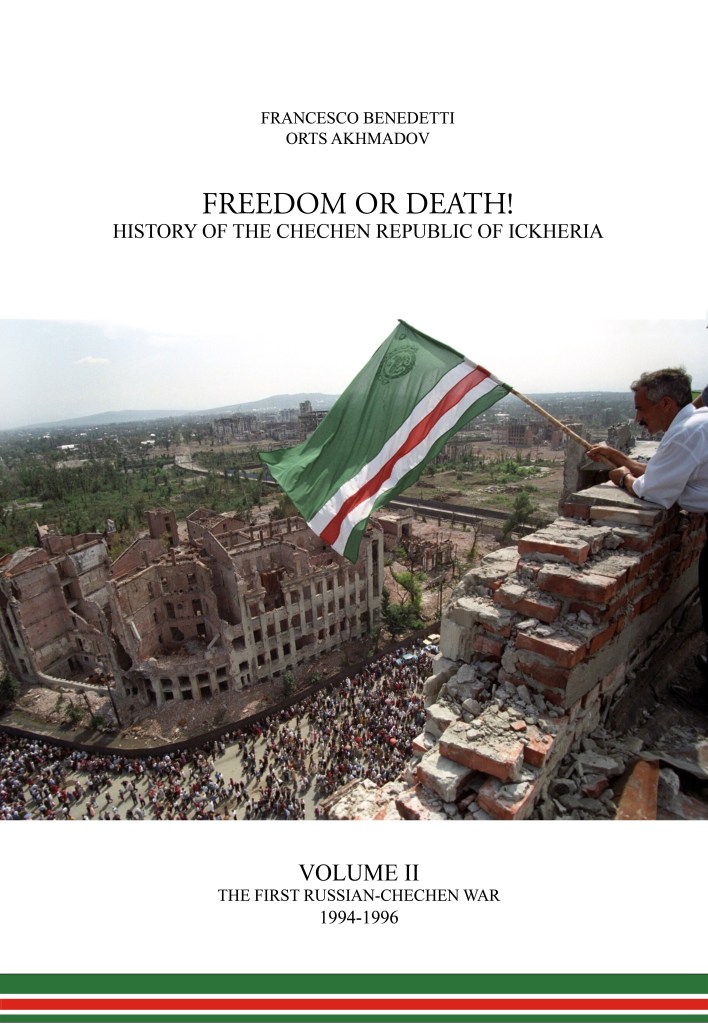
After a long work of translation, verification of sources and restyling of the text, we are pleased to announce the release of the English version of Volume II of “Freedom or Death! History of the Chechen Republic of Ichkeria”.
With this volume, Orts Akhamdov officially joins the team. Read his presentation on www.freedomordeath.net !
With the introduction to the book, we wish you a good read.
The war in Ukraine began in Chechnya.
It may seem like a provocation. Yet, it is the reality that the pages of this second volume, entirely dedicated to the First Russo-Chechen War, reveal. The genesis, development and unfolding of this bloody conflict seem like the draft of the script that the world is witnessing in these months between Donbass and Crimea. Even then, as today, Russia invaded a free state, masking the war it was unleashing behind the definition of a ‘special operation’. Even then, as today, the enemy of the Russian state had been labelled and demonised: if Zelensky and his government are called ‘Nazis’ today, Dudaev and his ministers were called ‘bandits’ back then. Even then, as today, convinced of their superiority, the military commands marched on the capital, claiming to bend a people to their will, as they had done several times in the Soviet era. But even then, as today, they were forced to retreat, only to unleash a bloody total war, the most devastating European war since 1945.
The First Russo-Chechen War was the first tragic product of Russian revanchism: the ‘zero point’ of a parabola that leads from Grozny to Kiev, passing through Georgia, Crimea, Belarus and Donbass. With one substantial difference: that the Russians lost that first war against Chechnya. Their ambitions, based on the worn foundations of a crumbling empire, ended up frustrated by the stubbornness of a nation immensely inferior, in numbers and means, to the Ukrainian one, which today defends its land from the war unleashed by Putin.
This story can teach those who have the patience to read it two important lessons: what happens when you indulge the ambitions of an empire, and how to defeat it. If it is already too late to put the first into practice, for the second we are still in time














 Ichkeria Digital Archive