Official figures from Chechnya’s family reconciliation programme have renewed questions about whether divorced spouses can freely decline to reunite.
Authorities in Chechnya say that government-backed reconciliation commissions have reunited 3,168 divorced couples since 2017, renewing debate over whether former spouses can freely refuse reconciliation.
The commissions were established on 4 July 2017, at the initiative of Chechen leader Ramzan Kadyrov. Their stated purpose is to strengthen families, protect children’s interests and encourage reconciliation between separated spouses.
Their activities involve government officials, religious representatives and community figures.
On 26 October, independent news outlet Caucasian Knot reported critical reactions from Chechen social-media users who questioned whether all reunifications had taken place voluntarily.
Some commenters expressed concern that women might face pressure to return to unwanted marriages, potentially exposing themselves and their children to renewed family conflicts.
Others defended the commissions, arguing that reconciliation can help couples overcome misunderstandings and that not every divorce results from irreconcilable differences.
The controversy is not new.
In September 2017, Human Rights Watch warned that local reconciliation councils were allegedly pressuring divorced women to return to former husbands, including women who had escaped abusive relationships.
An investigation published by OC Media in 2017 also examined the potential consequences of official intervention in family decisions, documenting concerns about the autonomy of former spouses.
The authorities’ latest statistics have not been independently audited. Likewise, the social-media reactions do not establish that all reported reconciliations were involuntary.
Why it matters
The controversy raises important questions about personal autonomy, women’s rights and the limits of state intervention in family life.
For women who have left abusive relationships, pressure to return to a former husband may present serious risks, particularly when access to children is involved.
The central question is not whether reconciliation can benefit families, but whether both former spouses have the genuine freedom to accept or refuse it without facing pressure or consequences.
Two published volumes. Multiple languages. Years of historical research into the Chechen Republic of Ichkeria.
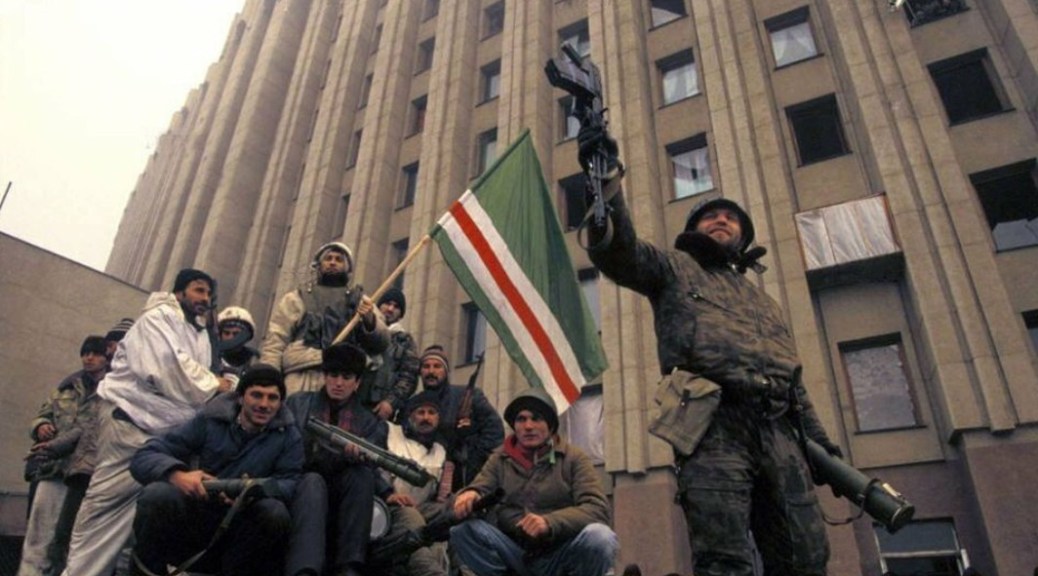
Freedom or Death! — History of the Chechen Republic of Ichkeria is a historical book series by Francesco Benedetti, drawing on archival documents, interviews and eyewitness accounts to reconstruct the story of a republic whose struggle for independence remains little understood beyond the Caucasus.
Volume I — From Revolution to War (1991–1994)
The first volume traces the independence movement, the events of the 1991 revolution, the creation of Ichkeria’s institutions and the political tensions that preceded Russia’s military intervention.
Available in English, Italian, Russian and Chechen.
Volume II — The First Russo-Chechen War (1994–1996)
The second volume follows the invasion, the battle for Grozny, the principal stages of the war and the negotiations that led to the Khasavyurt agreements of 1996. Historical records are complemented by testimony from people who experienced the conflict.
Available in English and Italian.
An ongoing historical project
The published volumes form part of a wider research effort into the history of the Chechen Republic of Ichkeria. A third volume, dedicated to the years after the first war, is currently in preparation.
The books complement the interviews, official documents and historical materials collected by Ichkeria Digital Archive.
Read history. Preserve memory.
Discover the existing editions, choose your language and explore the sources, stories and people behind the series.
Statements published on 23 October have renewed debate over the risks facing Chechen political exiles and their families.
Chechen leader Ramzan Kadyrov has condemned Chechens living in Europe who publicly criticise his administration, describing them as “traitors” and “pseudo-patriots” and declaring that there is “no way back” for them.
Kadyrov accused expatriate critics of spreading false information and undermining the peace and stability that, he claimed, his administration had established in Chechnya. He asserted that those who had betrayed their people had no place in their homeland.
No specific individuals or organisations were named, and no formal measure preventing their return has been announced.
The statements echo previous warnings against Chechen dissidents abroad. In 2016, Kadyrov publicly claimed that the authorities knew the identities and online activities of expatriate critics.
His latest remarks come amid renewed concerns about European deportations of Chechen asylum seekers. On 21 October, Chechen activists demonstrated outside the German Embassy in Vienna, demanding stronger protection for refugees facing removal.
An investigation published by Radio Liberty on 5 October also documented allegations of continued pressure against Chechen exiles and their relatives remaining in the republic.
Why it matters
Kadyrov’s statements raise further questions about the safety of political opponents who could be returned to Russia.
They are particularly relevant to European asylum proceedings, where authorities must evaluate the individual risks that applicants might face upon return.
The remarks also illustrate the continuing confrontation between Chechnya’s Moscow-backed leadership and its political critics abroad.
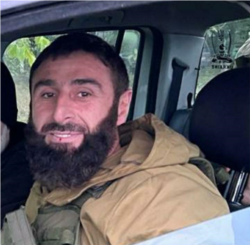
Khavazhi Amaev, known by the nom de guerre Zumso, died in Ukraine in September 2026 at the age of 46. A former commander in the Chechen insurgency, an exile pursued through international police channels, and later deputy commander of the Separate Special Purpose Battalion (OBON), he lived through several distinct chapters of the Chechen armed struggle. His death was confirmed by Akhmed Zakayev, the head of the Chechen Republic of Ichkeria’s government in exile, but the exact circumstances remain unresolved in publicly verifiable reporting.
This retrospective draws on a lengthy interview Amaev gave in October 2022, contemporary reporting from Greece in 2014, official Ichkerian documents and accounts published following his death. It distinguishes his recollections from independently documented events and does not treat allegations or disputed accounts as established facts.
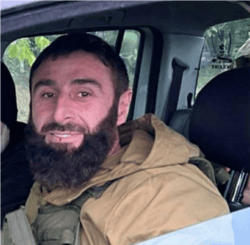
Khavazhi (Zumso) Amaev. Photograph: Kavkaz.Realii / RFE/RL, October 2022. Reproduced with permission. Original publication.
Growing up during the Russo-Chechen wars
Amaev came from the mountainous Itum-Kali district of Chechnya and was widely described as a native of the village of Zumsoy, the origin of his nom de guerre. Published biographical accounts give his birth year as 1980. When the first Russo-Chechen war began in 1994, he was still a teenager. In an interview with journalist Lidia Mikhalchenko for Kavkaz.Realii in October 2022, he recalled an adolescence disrupted by war and the impossibility of completing his schooling.
In that interview he traced his commitment to Chechen independence to his family. He described years spent moving through the mountains and living in hiding, but specified that he had formally joined Ichkerian forces in 2003. This distinction matters: experiencing the first war as a teenager does not establish that he served as an armed combatant during that conflict.
A commander in the mountain insurgency
Amaev said he had joined forces operating under the command of Dokka Umarov and subsequently rose to command a sector of the guerrilla. He portrayed a campaign in which units that had once assembled dozens of fighters became increasingly fragmented, as Russian military pressure, the loss of personnel and reprisals against suspected civilian supporters made prolonged operations difficult. These are his first-person recollections; independent military records covering his complete service have not been located.
He also described serious persecution of his family, including destruction of family homes, the detention of relatives and abuse attributed to forces loyal to the Russian-backed authorities in Chechnya. Such claims are part of his testimony and deserve to be recorded, while the individual incidents would require additional evidence to be presented as independently established.
The politics of the insurgency changed during those years. Umarov proclaimed the Caucasus Emirate in 2007, an ideological and organizational break from the institutional claim of the Chechen Republic of Ichkeria. Contemporary reports concerning Amaev’s pursuit by Russian authorities also associated him with the network of commander Tarkhan Gaziyev. His precise affiliations across these divisions remain a subject for further documentary research; his later service in an Ichkerian formation should not obscure this earlier complexity.
Syria and the disputed record of his movements
According to Amaev’s own account, he left Chechnya in 2012, passing through Georgia and Turkey before travelling to Syria. He said that he fought alongside rebels opposing the government of Bashar al-Assad, which was supported by Russia. In 2022 he explicitly denied ever having belonged to the Islamic State organization.
There is a significant contradiction in the contemporary record. In an eKathimerini interview published in October 2014, his wife Zarema denied that he had travelled to Syria or Iraq and contested intelligence allegations that connected him to the Islamic State. The Greek newspaper reported that the Greek Public Order Ministry had also rejected claims of such involvement. Amaev’s later admission that he had fought in Syria does not itself validate those separate allegations. Nor does the available evidence establish membership in Islamic State. This discrepancy should remain visible rather than be resolved by conjecture.
Arrest in Greece and the struggle against extradition
Amaev was detained after arriving by boat in Greek waters on 5 September 2014. Reporting by journalist Yiannis Souliotis described his request for asylum under another name, his identification through fingerprints and a Russian request circulated through Interpol. The report quoted both his wife and his Greek lawyer, Yiannis Lavrentiadis, who challenged the adequacy of the documentation supporting the case and opposed his return to Russia.
The case attracted demonstrations by Chechen communities abroad concerned about the risk of ill-treatment if he were extradited. In his 2022 interview, Amaev stated that he had spent about two years in detention in Greece before being transferred to Poland in 2016, where he received refugee protection. He subsequently worked in private security. Kavkaz.Realii reported in September 2022 that lawyers associated with the Chechen human-rights organization Vayfond had secured the removal of his data from an Interpol wanted-person database. A representative of that organization attributed the decision to his protection status in Poland; the underlying decision has not been independently inspected by Ichkeria.net.
Ukraine and the OBON battalion
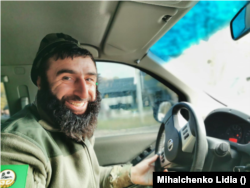
Amaev said he travelled to Ukraine in March 2022, following Russia’s full-scale invasion. He first joined the Sheikh Mansur Battalion, then moved into the newly created Separate Special Purpose Battalion (OBON), associated with the Ichkerian government in exile. By October 2022, Kavkaz.Realii identified him as OBON’s deputy commander and a lieutenant colonel in the Ichkerian armed forces.
His service connected a generation of veterans of the wars in Chechnya with new volunteers fighting on the Ukrainian side. In his published statements he regarded Ukraine’s resistance and the future of Chechen independence as related causes, while stressing the difficulties of adapting to a different country and battlefield.
Khavazhi Amaev during the war in Ukraine. Photograph: Kavkaz.Realii / RFE/RL, May 2023. Reproduced with permission. Original publication.
On 5 August 2023, the Council of Ministers of the Chechen Republic of Ichkeria in exile awarded Amaev the K’oman Turpal (‘Hero of the Nation’) distinction under Decree No. 38. The decree is a particularly valuable primary document for establishing his recognition by the exiled authorities. A separate decree in the same series, No. 37, honoured Hadji-Murad Zumso, the OBON commander: despite the shared ‘Zumso’ name, these are two different individuals.
Death in September 2026: what is known and what remains disputed
Chechenpress published a commemorative notice on 13 September 2026. On 15 September, Kavkaz.Realii reported that Akhmed Zakayev had confirmed Amaev’s death in Ukraine. Zakayev declined to endorse the competing accounts while investigative work was ongoing. The Sheikh Mansur Battalion also acknowledged the death, and reports referred to funeral arrangements in Kyiv.
The reported circumstances differ substantially. One account, circulated by Russian media, placed the discovery of Amaev’s body in an apartment in Lviv and mentioned stab wounds. Another located the killing in the Zaporizhzhia region and attributed it to a Ukrainian deserter. Russian state-linked reporting additionally raised suggestions concerning a dispute between Ukrainian security agencies. None of these explanations has been established by public investigative evidence available for this article. In an analysis published on 7 October, Kavkaz.Realii continued to describe the circumstances as unclear and cautioned against prematurely attributing the death to Russian intelligence services.
The information available as of 24 October 2026 supports the fact of Amaev’s death, but not a definitive location, perpetrator or motive. For a historical archive, preserving that distinction is essential.
A life across three conflicts
Amaev’s biography is not a simple narrative of uninterrupted organizational allegiance. His experiences belonged to successive and sometimes competing political and military worlds: the post-war Chechen insurgency, armed opposition to Assad in Syria, asylum and legal protection in Europe, and the volunteer formations fighting with Ukraine. His own testimony conveys the continuity he perceived between these experiences; surviving documents also reveal divisions, disputes and unanswered questions.
The significance of his life for the history of Ichkeria lies partly in that complexity. Reconstructing it requires taking seriously both the experiences he described and the contradictions left by the documentary record. The final chapter of his life remains open to clarification by Ukrainian investigative findings.
Chechen activists gathered outside the German Embassy in Vienna on 21 October to protest the threatened deportation of Chechen asylum seekers from Germany and other European countries, according to Caucasian Knot.
The demonstration was organised by activists associated with Roza Dunaeva, representative of the Chechen Republic of Ichkeria in Austria. According to the organisers, Chechen, Ukrainian and Austrian activists took part in the protest.
Participants warned that returning certain Chechen asylum seekers to Russia could expose them to political persecution, torture or forced recruitment into Russia’s war against Ukraine.
According to Dunaeva, an appeal concerning several individuals and families facing possible deportation was handed to the German Embassy. Independent confirmation of its formal receipt has not been obtained.
The demonstrators urged European authorities to assess asylum applications individually, considering each person’s circumstances and the current human-rights situation in Chechnya.
Why it matters
The Vienna demonstration is part of a wider campaign by Chechen diaspora activists concerned about European deportation policies.
Earlier reporting by OC Media, based on German parliamentary documentation, showed that the asylum recognition rate for ethnic Chechen applicants in Germany fell from 21.1% in 2023 to 3.9% in the available 2025 data (through November).
The latest protest also illustrates the continuing involvement of representatives of Ichkeria’s institutions in exile in European refugee-protection campaigns.
The Donetsk Regional Military Administration has recognised the contribution of Chechen volunteers who have fought alongside Ukraine since 2014.
Ukrainian regional authorities have honoured fighters of the Sheikh Mansur Battalion for their contribution to the defence of Donetsk against Russian aggression.
In an official announcement published on 17 October 2026, the Donetsk Regional State Administration reported that its head, Vadym Filashkin, had met representatives of the Chechen volunteer formation and presented them with two regional distinctions: the Defender of Donetsk Region badge and the Badge of Honour. The exact date of the meeting was not specified.
Filashkin praised the battalion’s longstanding participation in Ukraine’s defence, recalling the role played by its volunteers in resisting Russian forces over many years. During the meeting, he also received a distinction from the battalion in recognition of his assistance and support.
The Sheikh Mansur Battalion was established in 2014, during the first phase of Russia’s intervention in eastern Ukraine. Its members include Chechen veterans who view the Ukrainian struggle for sovereignty as connected to the history of resistance in their own homeland.
Why it matters
The ceremony is a public acknowledgement by a Ukrainian regional authority of the Chechen volunteers’ contribution. It underscores the enduring relationship between Ukrainian institutions and Chechen formations opposed to Moscow. The awards do not, by themselves, indicate any change in the battalion’s formal military status or chain of command.
A message from Ichkeria’s representatives in France recalls Ukraine’s 2022 parliamentary condemnation of Russia’s occupation of Chechnya.
The representation of the Chechen Republic of Ichkeria in France has published a letter addressed to Ukraine’s ambassador in Paris, marking the fourth anniversary of a landmark Ukrainian parliamentary resolution concerning Chechnya.
The letter, dated 18 October 2026 and signed by Khoussein Akhmadov, deputy representative of Ichkeria in France and member of the State Committee for De-occupation, expresses gratitude to Ukraine for its position on Russia’s occupation of Ichkeria.
On 18 October 2022, Ukraine’s Verkhovna Rada adopted Resolution No. 2672-IX with 287 votes in favour. The parliamentary statement condemned Russia’s armed aggression and occupation of the Chechen Republic of Ichkeria, denounced crimes committed during the Russo-Chechen wars, including what it described as the genocide of the Chechen people, and called for international investigations and accountability.
In his message, Akhmadov reaffirmed the Ichkerian representation’s support for Ukraine’s sovereignty and territorial integrity. Chechenpress published the letter in Russian and French. Its publication is confirmed, although its formal delivery to the Ukrainian embassy has not been independently established.
Four years later, the resolution remains an important point of reference for Ichkerian institutions in exile. A key legal distinction remains: Ukraine’s parliamentary condemnation of Russian occupation did not constitute a separate act of formal diplomatic recognition of Ichkeria as an independent state.
Decades after the Chechen wars, unexploded ordnance continues to pose a threat to the population and the use of agricultural land.
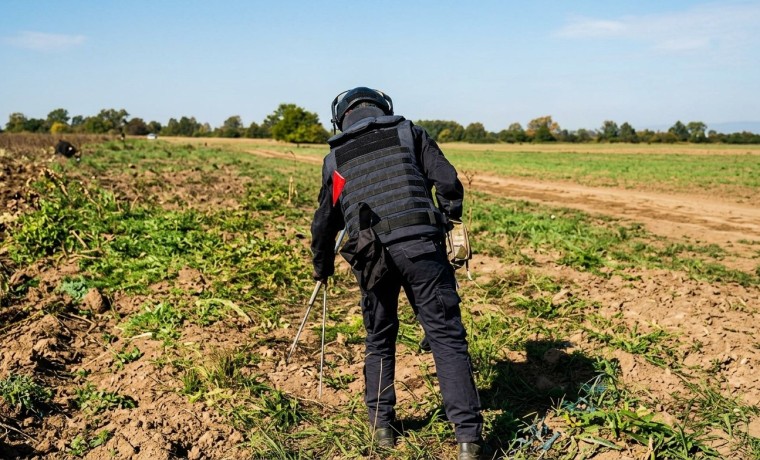
Bomb-disposal personnel surveying agricultural land in Chechnya. Photo: Grozny TV.
Russian emergency services have reported clearing more than 57 hectares of agricultural land and neutralising over 80 explosive devices in Chechnya between 1 September and 17 October 2026.
According to regional authorities, the operation was conducted in the Achkhoy-Martan district, where a specialised unit of Russia’s Ministry of Emergency Situations has been working to make farmland safe for cultivation.
On 17 October, Russian Emergencies Minister Aleksandr Kurenkov visited the area, inspected the clearance operations and presented awards to members of the bomb-disposal team. Ramzan Kadyrov subsequently thanked the ministry for its work.
The operation also highlights a lasting consequence of the two Chechen wars.
More than three decades after the beginning of the first conflict, explosive remnants of war continue to represent a concern in parts of the republic. Previous reporting by Caucasian Knot has also documented how unexploded munitions have complicated the use of Chechnya’s forests.
The authorities have not established publicly when each device recovered in the latest operation was deposited.
For Chechnya, the removal of unexploded ordnance is therefore more than a technical undertaking: it is part of the long process of recovering land and restoring safe conditions for civilian life.
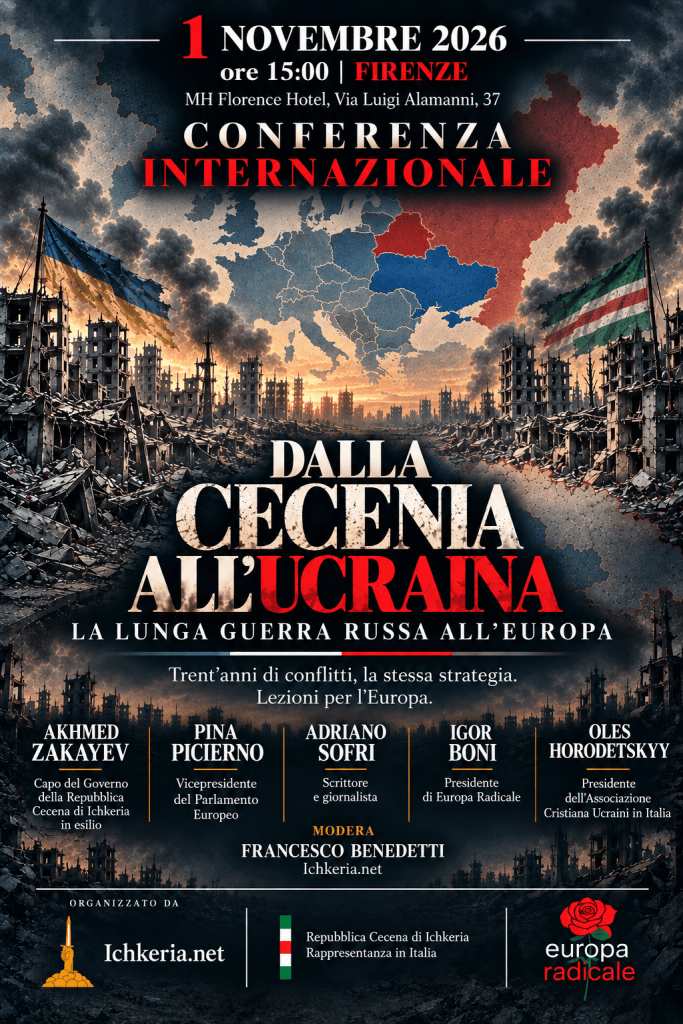
Trent’anni di conflitti, la stessa strategia. Lezioni per l’Europa.
📅 1° novembre 2026 – Ore 15:00 📍 MH Florence Hotel – Via Luigi Alamanni 37, Firenze
Dalla distruzione di Grozny all’invasione dell’Ucraina, trent’anni di guerre russe hanno segnato la storia dell’Europa contemporanea.
Ma quanto di ciò che accade oggi in Ucraina era già accaduto in Cecenia? E soprattutto, che cosa avrebbe potuto fare l’Europa per impedirlo?
Il 1° novembre, a Firenze, una conferenza internazionale riunirà protagonisti della resistenza cecena, rappresentanti delle istituzioni europee, giornalisti ed esponenti della comunità ucraina per ripercorrere trent’anni di conflitti, riflettere sulle responsabilità dell’Europa e discutere le sfide del futuro.
INTERVERRANNO
Akhmed Zakayev – Capo del Governo della Repubblica Cecena di Ichkeria in esilio
Pina Picierno – Vicepresidente del Parlamento Europeo
Adriano Sofri – Scrittore e giornalista
Igor Boni – Presidente di Europa Radicale
Oles Horodetskyy – Presidente dell’Associazione Cristiana Ucraini in Italia
Modera: Francesco Benedetti – Ichkeria.net
📩 PRENOTA IL TUO POSTO
La partecipazione è gratuita.
Chi desidera partecipare può prenotare il proprio posto attraverso la sezione “Contacts” del sito Ichkeria.net oppure inviando un messaggio WhatsApp al numero 393 9596375.
Organizzano: Ichkeria.net, Rappresentanza in Italia della Repubblica Cecena di Ichkeria ed Europa Radicale.
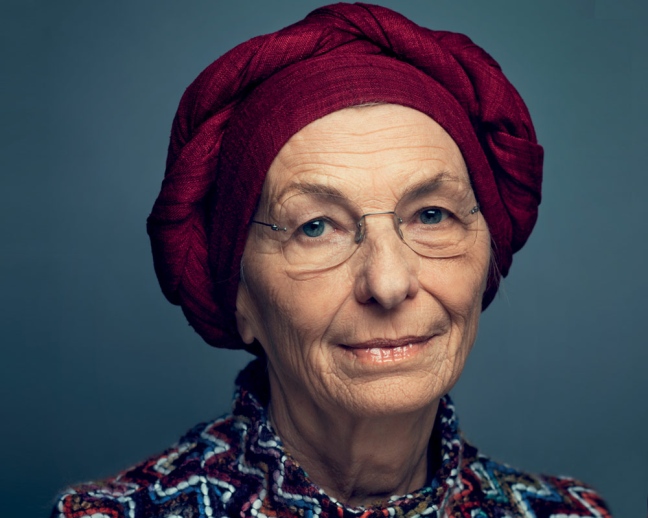
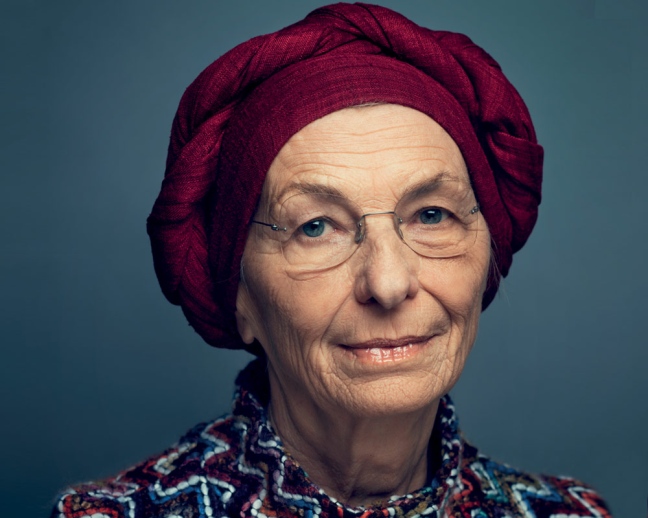
Emma Bonino, the prominent Italian politician, former European Commissioner and Foreign Minister, died on 11 September 2026 at the age of 78.
Alongside her better-known campaigns for civil and human rights, Bonino had a long and significant record of involvement with the Chechen question, particularly during the First and Second Russo-Chechen Wars.
As European Commissioner responsible for Humanitarian Aid from 1995 to 1999, Bonino dealt with the humanitarian consequences of the First Russo-Chechen War and consistently defended the principle of independent humanitarian access to populations affected by armed conflicts.
Her commitment became particularly visible during the Second Russo-Chechen War. In 2000, Bonino and the Transnational Radical Party actively worked to bring the Chechen issue before international institutions. The Radical Party provided representatives of the legitimate Chechen institutions with opportunities to address international forums, provoking strong opposition from the Russian Federation. Moscow even attempted to have the Transnational Radical Party’s consultative status at the United Nations suspended.
When the Russian request was rejected by ECOSOC in October 2000, Bonino dedicated the victory to Antonio Russo, the Radio Radicale journalist who had reported extensively from Chechnya and had been murdered in Georgia only days earlier.
On 23 November 2000, Bonino participated in and helped lead the major conference “Chechnya: A Hidden War – Free Access for the Media and International Humanitarian Intervention”, organised in Rome by the Radical Party, Reporters Without Borders and members of the European Parliament. Chechen and Russian human-rights activists, journalists and humanitarian organisations took part.
Perhaps the clearest political expression of Bonino’s position came in April 2002, when she co-sponsored a European Parliament motion on Chechnya. The text explicitly recalled the legitimacy of the election of President Aslan Maskhadov, his government and the Chechen Parliament, noting that the 1997 elections had been recognised by the OSCE and by the Russian Federation itself. It called for a political solution based on negotiations between the Russian authorities and the legitimate Chechen authorities and urged direct negotiations between Vladimir Putin and Aslan Maskhadov.
Bonino continued to defend this position publicly. Speaking before the European Parliament on 10 March 2004, she denounced the persecution and abduction of relatives of Chechen Health Minister Umar Khambiev, whom she described as an envoy of “elected President Aslan Maskhadov”. She referred to the Moscow-backed administration in Chechnya as a “puppet government” and urged European institutions not to remain silent about what was happening in Chechnya.
While Bonino does not appear to have formally advocated diplomatic recognition of Chechen independence, she consistently defended the democratic legitimacy of Maskhadov and the elected Chechen institutions, rejected Moscow’s attempt to reduce the Chechen question solely to terrorism, denounced serious human-rights violations committed during the war, and supported an international political settlement involving the legitimate Chechen leadership.
Her death therefore also marks the passing of one of the prominent European political figures who, during some of the darkest years of the Russo-Chechen conflict, repeatedly insisted that Chechnya should not be forgotten.