Archivi tag: Interwar period in Chechnya

My fate is the fate of my people – Interview with Magomed Mamatiev


(Golos Chechenskoy Respubliki newspaper, No. 3 (20995), January 24–31, 1997)

Today we present to our readers a conversation with the hero of many articles published in our newspaper in the 1960s and 1970s, civil engineer Magomed Mamatiev, a candidate for deputy to the Parliament of the Chechen Republic in Electoral District No. 3 “Olympic” of the Leninsky District of Grozny.


Correspondent: Magomed, tell us briefly about yourself.

Magomed Mamatiev: I am 55 years old, I come from the village of Valerik, I have a higher education—a degree in construction from the Oil Institute—and I worked my way up from bricklayer to head of the construction department. I am currently vice president of the Federation of Trade Unions of the Chechen Republic. I have been awarded the Order of the Red Banner of Labor and two medals.


Correspondent: You belong to the generation that lived through the tragedy of 1944; did you perhaps think that all our problems were behind us?


Magomed Mamatiev: Our family ended up in the coldest region of Kazakhstan, the Kustanai region. My father was arrested in 1949 along with a learned alim for singing nazmy, and later my mother as well for cutting down three trees when the barn roof collapsed. The five of us children—the oldest was 14 and the youngest a newborn—were left on our own. We were saved from hunger and cold by the kindness of people, both Chechens and Russians.
In September 1959, I enrolled at the Grozny Oil Institute. Studying was easy. For today’s youth, most of whom pretend to study, I want to say that we didn’t know what it meant to pay money for a test or an exam. And we didn’t even have any money. Sometimes we went without food for days. We unloaded carts full of potatoes, onions, and coal at night. We constantly felt the teachers’ distrust of our knowledge. They graded our knowledge one point lower than students of other nationalities. We had to prove our worth through our diligence and hard work.
Like all my peers, my childhood was stolen from me, and we were left with a hungry and difficult youth.
After graduating from high school, I had to spend three months knocking on the doors of construction companies that, according to the ads, were looking for skilled workers. They asked me to fill out application forms and then politely turned me down. After three months, I met the kindest person, my new mentor Baskhanov Umar (Dala gechdoyla tsunna), who
hired me as a foreman and started my new working life.

Correspondent: In almost every country, trade unions are called upon to protect the interests of workers. Naturally, friction arises between them and the authorities on many issues. You and your colleagues led the union leadership in 1992. How did your relations with those in power develop?

Magomed Mamatiev: Numerous measures were adopted and efforts were made to foster cooperation between enterprises and all branches of the Republic’s government. However, none of the issues raised during meetings and by union activists were resolved. Wage arrears increased; pensions, salaries, and other benefits were not paid.

Correspondent: In the spring of 1993, a demonstration organized by the unions began in Grozny. Many are inclined to believe that this demonstration—that is, you and your comrades—is responsible for the subsequent negative events of 1993. What can you say to your opponents?

Magomed Mamatiev: Before the demonstration, the unions called a three-day strike demanding the cancellation of arrears on wages, pensions, and other social benefits, and warned the government that if these issues were not resolved, they would organize a demonstration. No response. We tried to meet with the President, but it didn’t work out. After receiving authorization for the demonstration from the mayor’s office, we organized a one-day protest and concluded the union demonstration at the scheduled time. Subsequently, the demonstration was led by local and municipal officials.
As you say, some politicians blamed union leaders for the subsequent clashes with their former associates. And our president and colleague Ampukaev Ramzan, declared an enemy by these “some,” organized massive rallies and protest marches against the entry of Russian troops into the Polish cities of Warsaw and Krakow.
And no one speaks of the military action in late December 1993, when the Presidential Palace was surrounded by tanks, armored vehicles, and troops.

Correspondent: Who do you believe is responsible for the national tragedies?

Magomed Mamatiev: There are many. Briefly, here are a few. Foremost among those responsible for our tragedy are the gray-bearded “Hajji pilgrims,” whom our President called sailors. These people did everything possible and impossible to divide our society into teips, virds, and nationalities. Having imagined themselves to be leaders of the people, they eventually began to interfere in state affairs. Some of the current candidates for the presidency have supported these pilgrims.
Usman Imaev did everything to exacerbate the confrontation between the President and Parliament; the main fault of this “man” is the complete destruction of the foundations of the Chechen state: its finances. After Russia abolished the 1991–1992 banknotes effective August 25, 1993, Imaev decided to keep this currency in circulation in the Republic until November 1, and for this worthless paper, the sale of everything that had not yet been sold began. This worthless paper was purchased in neighboring regions and republics at 102% of face value and delivered to Imaev’s bank for 30% of the cost. The remaining 70% of the cost was covered by Imaev and others like him.
According to some sources, loans totaling over 800 billion rubles were disbursed in the Republic starting in November 1993. And this is precisely where Imaev’s scheme was developed. Using forged documents from guarantor companies—whose executives received 5–10% of the loan amount—the lender paid Imaev 20% in dollars, and the National Bank transferred the loan amount to one of the commercial banks. These banks, in turn, transferred this sum to any address in the former Soviet Union for 15–20% of the loan amount.
And it is no coincidence that the National Bank and other banks were the first to be destroyed during the war. According to eyewitnesses, all the streets and squares of destroyed Grozny were littered with Imaev’s scrap paper.
In the same camp are Taymaz Abubakarov, Yeraghi Mamodayev with his team, the Albakovs, and, of course, Zavgaev’s team.
Here lies a vast field of activity for the Sharia court.

Correspondent: 16 presidential candidates. Isn’t that too many for our small republic? And in general, who do you prefer? I can’t insist on an answer to the last question…

Magomed Mamatiev: Whether many or not so many. After all, there are only five main contenders. I would vote for any of them if they were the only candidate.
But I see Aslan Maskhadov as the President of the Republic. I don’t know him personally, but I know Vakha Arsanov. Due to my professional responsibilities, I had to attend parliamentary sessions and learn the positions of all the deputies on issues related to building an independent state. I got the impression that Vakha was an honest and decent person who cares deeply about our future.
I am certain that Arsanov would never have agreed to run in the elections alongside Maskhadov if he had doubted his integrity and his intentions to build an independent Chechen state.

Correspondent: What motivated you to run in the parliamentary elections?

Magomed Mamatiev: The only thing that motivated me to run in the parliamentary elections was the hope that we would build a free and socially oriented state.
If I briefly discuss the program and the concrete legislative initiatives I intend to implement in the interest of the workers of the Chechen Republic, then, obviously, they will focus on the implementation of the principles of a social state.

Correspondent: And one last question. What is your vision for state-building and the role of trade unions?

Magomed Mamatiev: I intend to work on these priority issues if the voters of District No. 3 “Olympic” show their trust in me and elect me as their deputy to the Parliament of the Chechen Republic.
I appeal to voters to come out and vote for our future—not for me, but for our President Aslan Maskhadov. Together we will win!

MASKHADOV “IL PRESIDENTE”: INTERVISTA DEL 28/01/1997

Il 27 Gennaio 1997 si tennero in Cecenia le elezioni per il rinnovo del Parlamento e per la carica di Presidente della Repubblica. Fu una sfida elettorale molto agguerrita, la quale vide contrapposto il fronte moderato, guidato dall’ex Capo di Stato Maggiore dell’esercito Aslan Maskhadov, ed il fronte radicale, fedele alla linea della “guerra continua” propugnata dal suo più formidabile combattente, Shamil Basayev. Le elezioni videro la vittoria a larga maggioranza di Maskhadov, ma provocarono anche un pericoloso “scisma” tra le due anime del separatismo ceceno, che avrebbe condizionato la politica del paese nei quasi tre anni di periodo interbellico, trascinando la Repubblica Cecena di Ichkeria in una guerra civile strisciante e provocandone, infine, la caduta. Il 28/01/1997, quando ancora la commissione elettorale non aveva diffuso i risultati definitivi, era già chiaro che Maskhadov avrebbe stravinto. Una inviata del Giornale “L’Unità” intervistò il favorito. Quella che segue è una delle poche interviste rilasciate da Maskhadov ad un giornalista italiano.

Aslan Maskhadov tiene una conferenza stampa al termine dello spoglio elettorale. Alla sua sinistra siede il candidato alla vicepresidenza Vakha Arsanov, sostenuto dal Partito dell’Indipendenza Nazionale

GROZNY – Aslan Maskhadov, forse da stamattina secondo presidente della repubblica cecena “Ichkeria” ha un tic, una piccola tosse, che soprattutto in pubblico non lo abbandona mai. Dicono che l’abbia presa durante la guerra, per lo stress. Questo generale ceceno di 46 anni, apprezzato e stimato perfino dai russi, non ha barba, ha smesso la divisa il giorno dopo gli accordi di pace e non ama portare le armi. Quando è venuto a Mosca per incontrare Cernomyrdin era addirittura in giacca e cravatta. Forse è per tutte queste cose messe insieme che non a tutti i ceceni piace: dicono che sono cattive abitudini prese durante il servizio nell’esercito russo quando ancora c’era l’URSS. Aslan Maskhadov dopo aver vinto la guerra vuole vincere la pace. Prima di incontrare noi, nella casa della sorella, nel villaggio di Staniza, ha a lungo discusso con gli anziani, il fondamento della società caucasica, per convincerli che è li l’uomo del futuro.

Signor Maskhadov, lei pensa di vincere al primo turno?

Lo vorrei sul serio. Perché il secondo turno è indesiderabile non soltanto per me, ma in generale per tutto il popolo, perché il popolo è stanco e vuole solo la pace. E poi anche perché le forze della provocazione avrebbero più probabilità di agire nel secondo turno.

La repubblica è un mucchio di macerie: a chi chiederete aiuti, alla Russia o ad altri paesi?

Non pregheremo la Russia di prestarci soldi. Le chiederemo, invece, di risarcire il danno arrecato dalla guerra. La Russia porta la responsabilità diretta per la distruzione dell’economia nazionale, delle città, dei centri abitati, è giusto che paghi. Quanto all’assistenza degli altri paesi, non la rifiuteremo da chi avrà il desiderio di darci una mano. Ma a condizioni di reciproco vantaggio, non vogliamo chiedere l’elemosina a nessuno.

Molti elettori non vogliono aspettare l’indipendenza per cinque anni, la vogliono subito. Che cosa risponde loro?

Anche noi non vogliamo che questo obiettivo si ponga solo tra cinque anni, oppure tra dieci. Penso che, fatte le elezioni, oneste democratiche e libere, tutto il mondo, compresa la Russia, sarà costretto a riconoscere che il Presidente eletto da tutto il popolo è legittimo. Ci metteremo così subito con Mosca al tavolo delle trattative per continuare quello che è cominciato a Khasavyurt. Non supplichiamo nessuno né per uno status né per l’altro ma vogliamo che ci riconoscano come Stato sovrano. Preciserei ancora che dovremo definire con la Russia solo i principi dei rapporti reciproci perché lo status è stato già stabilito nel 1991. Noi vogliamo il riconoscimento internazionale della nostra indipendenza, e cercheremo di averlo.

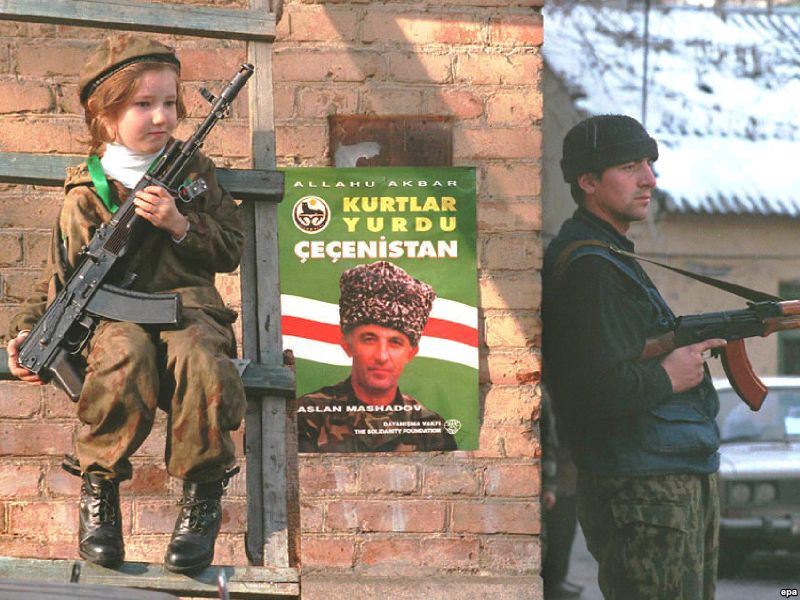
Un miliziano separatista ed un bambino in divisa mimetica posano davanti ad un manifesto elettorale di Aslan Maskhadov.

Molti parlano oggi dell’Ordine Islamico. Qual è il suo programma sul punto della religione? Quale ordine cerca lei, moderato all’egiziana o più rigoroso all’iraniana?

Si dice “ordine islamico”, “repubblica islamica”. Ma c’è il Corano. E’ la Costituzione, la legge di Allah, là c’è scritto tutto, non bisogna inventare nulla. Solo che in Arabia Saudita lo interpretano in un modo, in un altro paese diversamente. Ma il Corano è uguale per tutti. Bisogna prenderlo, conoscere il suo contenuto e fare come questo prescrive. E basta.

Nel corso della campagna elettorale Basaev ed altri candidati hanno mosso critiche nei suoi confronti. Ciò non potrebbe provocare una scissione nelle file dei sostenitori dell’indipendenza della Cecenia?

Penso che sia il problema ed il guaio di Basaev. Quando gli ho parlato, a quattrocchi, una decina di giorni fa, gli ho fatto la stessa domanda: “Shamil, perché ti abbassi a tanto, perché diffondi voci e dici bugie in tv?” Egli mi ha risposto: “E cosa devo fare? Voi state bene al potere, vi conoscono, a me che resta da fare? Sono i metodi della mia battaglia politica. Ciascuno combatte come può.”

Basaev entrerà nel governo che lei formerà da Presidente?

Si.

In caso di sua vittoria si aspetta difficoltà provenienti da Basaev e dai suoi sostenitori?

Mi aspettavo sì difficoltà, ma le legavo ai servizi segreti russi, cioè difficoltà prima delle elezioni, provocazioni e cose del genere. Abbiamo affrontato quella ipotesi molto realisticamente ed abbiamo prevenuto molto. Io personalmente sono andato a parlare con i cosacchi nel distretto di Naursk, aizzati dai russi. Però tutto è andato bene e nel “salvadanaio” dei nostri avversari non è rimasto più niente, a quanto pare. Dopo le elezioni penso che non avremo nessun problema, ne sono certo. Ho riunito apposta tutti i comandanti, in pratica dall’80 al 90 percento di tutti i capi delle formazioni. Con loro si è stabilito: ci sarà il presidente eletto dal popolo e tutti dovranno eseguire rigorosamente tutti i suoi ordini, i decreti e le disposizioni. Non ci può essere nessun dubbio su questo. La variante afghana o tagica che qualcuno si aspetta da noi non ci sarà. Anche se Shamil sarà consigliato male i suoi uomini non mi dichiareranno mai guerra, ne sono sicurissimo.

Shamil Basayev tiene un comizio elettorale nei giorni immediatamente precedenti alle elezioni. Lo “Scisma” tra Basayev e Maskhadov sarà all’origine dell’instabilità politica della repubblica.

Ma parlando con “L’Unità” Basaev ha detto che in caso di un non riconoscimento dell’Ichkeria lui potrebbe andare all’estero a far esplodere una bomba nucleare. Si possono prendere sul serio certe dichiarazioni?

Credo che sia la passione preelettorale, delirio ed immaginazione malsana. Nessuno andrà a far scoppiare centrali atomiche, lui compreso. Se noi vinceremo queste elezioni, raccoglieremo tutti i nostri sostenitori, tutti i compagni d’armi per riflettere insieme, e ci sarà anche Shamil Basaev, su come costruire il nostro Stato, su come farlo in un’unica squadra aiutandoci a vicenda. Nessuno sarà escluso da questo consiglio, e meno che mai Basaev.

Perché crede di essere migliore di altri candidati?

Non sono mai stato presuntuoso, affronto tutto con realismo. Non mi stupire se ci fossero falsificazioni a queste elezioni, quindi ci sono preparato. Ma in una battaglia onesta io ho più chances degli altri. Non dico di essere migliore, però è un dato di fatto che la base da cui si parte è a guerra ed è toccato a me essere tra i primi a condurla ed a guidare il processo postbellico. Tutti i documenti per finire la guerra sono stati firmati da me o in mia presenza. Perciò il popolo stanco di questa guerra spera che io porterò la pace nella terra cecena. Queste promesse sono legate al mio nome e inoltre il mondo si è accordo che sono uno promesso a compromessi accettabili, un uomo di parola.

Quanto può il business petrolifero influire sul benessere della repubblica?

Si, il petrolio è la ricchezza principale della Cecenia, la sua materia prima strategica e per la rinascita dell’economia faremo leva su questo, ma siamo anche ricchi della nostra agricoltura e del sottosuolo. Voglio dire che il petrolio non è l’unica fonte della nostra sopravvivenza.

Maskhadov presta giuramento come Presidente della Repubblica. Alla sua destra presenzia Akhmat Kadyrov, a quel tempo Muftì della ChRI.

Quale nome è stato scelto per la capitale: Grozny o Dzhokhar – Gala?

Lo ha deciso il Presidente Yandarbiev: Dzhokhar – Gala, cioè, “Città di Dzhokhar” in onore di Dudaev. Io penso che se lo sia meritato e tutto quello che facciamo si richiama a Dudaev. Perciò forse si chiamerà davvero così.

Come risolverà il problema delle troppe armi in giro per la repubblica?

I Ceceni hanno sempre portato le armi, in tutti i tempi, non è mai stato un problema, Ma oggi faremo tutto il possibile perché le porti solo chi ha il diritto di farlo e a chi spetta. Tutte le armi saranno registrate, tutte le formazioni armate troveranno il loro posto nell’esercito regolare, nelle forze dell’ordine, le armi portate illegalmente saranno sequestrate, ma sarà anche possibile l’acquisto di queste armi da parte dello Stato. Ci sono tante ipotesi, le abbiamo esaminate tutte. Quando lo spoglio delle Schede sarà finite ci metteremo al lavoro.

Servizio dell’emittente russa NTV sull’elezione di Aslan Maskhadov alla Presidenza della Repubblica