Archivi tag: RUssia

I NEWS interviews Francesco Benedetti

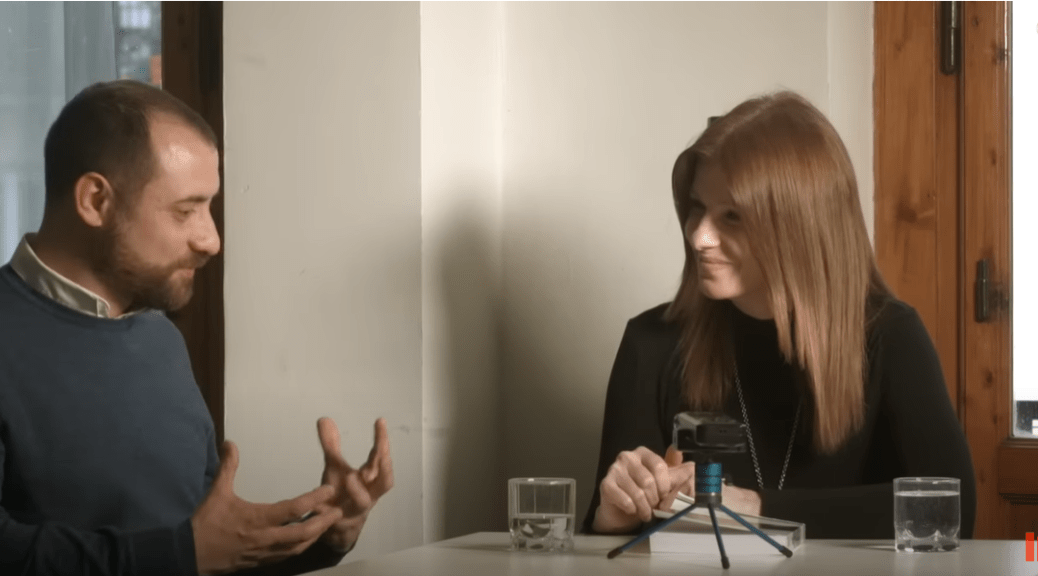
A few days ago Francesco Benedetti met Inna Kurochkina in Florence. The interview that emerged takes up the speeches addressed in another chat, which took place more or less a year ago, shortly before Russia invaded Ukraine. In the course of this year many things have changed, Francis’ work has moved forward and with it his awareness of how important the history of Chechnya is for the West.

We reproduce the video of the interview, attaching the transcript in English.

ENGLISH TRANSCRIPTION

First of all I would like to congratulate you from all visitors, subscribers who have already read your first volume. From today it is possible to have this second volume. How is it possible to have it?

First of all thanks to you, and thanks to all those who appreciated the first volume, and who gave me this consideration. The book is currently available in Italian, on Amazon, but will soon be available in English, thanks to the collaboration of Orts Akhmadov, son of Ilyas Akhmadov, who is working with me on the English version, and will soon also be available in Russian and Chechen, as for the first volume.

The other time we met and talked about your book was December 2021 and perhaps we were expecting war, this tragedy. Then we met in Brussels on the first day of the war, when both we and you met Akhmed Zakayev for the first time. With your help we attended some Radicali Italiani events, these very good people who organized Akhmed Zakayev’s visit to Italy, so somehow you are involved in our activities and in Ichkeria’s. How has your life changed during this year?

I have certainly had more real experiences with respect to this theme. I was a simple student of the history of the Chechen Republic of Ichkeria, but my experience was purely theoretical, abstract, not concrete, material. Since that day I have had the opportunity to speak with many people, and this second book is also written thanks to the memoirs of about a hundred people with whom I have spoken. Thus, my knowledge of that historical experience and of the human experience of the Chechens has grown enormously. From February to today I have given faces, names and lives to an experience that for me until then had only been theoretical.

You and I are working on the history of the Chechen Republic of Ichkeria, because I am also doing a cycle of chronicles. Do you understand the expression “in your skin”? How did you feel firsthand how the war was coming to Chechnya?

One of the questions I ask myself while studying the history of Chechnya, and in particular when studying this period, was “how would I have felt if I had found myself in that situation?” And I ask myself this question almost every day, because my study is based on the memories of the people I interview, and my interviews focus precisely on this aspect of every historical event: naturally I ask for information, names, dates, etc., but the first question I asked in almost every interview was “how did you feel at that moment?” “How did you spend the period between 26 November and 11 December (the time between the storming of Grozny by the pro-Russian opposition and the invasion). Personally, I try every day to imagine what the feelings of the people waiting for the war were, what they were thinking: their children, their families, how to save their families, how to save their things, their money, their cars, their homes. An event like this can completely destroy life, change people’s lives forever. I think I’m quite an empathic person, and I assure you that writing this book I suffered a lot. Like any author, I often re-read the book I’ve read, and every time I have the same feeling of tragedy on the one hand, and admiration on the other for those people who survived the war, in this case managing to win it, against their invaders .

I would like to understand how you frame the nature of the Chechen people. I was born in Georgia, I’m Ukrainian. I would like to work for the Georgian people, or for the Chechen people, but my whole heart now belongs to the Chechen people, I don’t know why. How could you describe your feeling towards the Chechen people? Because if you fell in love with this people, you did it because you have a passion in you.

I understand what you think because, when I think about it, what happened to me is really strange. I live in Tuscany, and I have no family, economic or any other connection with Chechnya. Yet ever since I was a child, something happened the first time I heard the name “Chechnya”. I don’t know exactly what, an elective affinity that has grown inside me, and I don’t know exactly why.

What I love about the Chechen people about this story is their ability to show happiness in tragedy. In them I have seen people who don’t want to be considered victims, but people who manage to find the beauty of life in everything. They have shown the world how to laugh in the face of death, and how to preserve humanity even in a situation which, if I imagine myself in their place, would strip humanity away from me as well. If a war destroyed my life maybe I’d go crazy. I have spoken to many people who have fought a war and have not gone mad, but rather have kept their kindness, their being good people. I don’t know if I would be able to keep these qualities in myself, fighting a war. I think this character trait of the Chechens is beautiful: the fact that they have managed to keep their happiness and will to live despite going through such bitter experiences.

Knowing this special character trait of this people, let’s think about how much Russia has gone to destroy them. It’s a biblical story for me. What do you think about it?

When a bully tries to hit a victim, and the victim smiles at him, the bully will become even more angry, but will ultimately be defeated by his victim’s resilience. In this sense I loved the struggle of the Chechens who showed the Russians that their spirit would never break.

In this last year we realized that the Ukrainians didn’t understand what the war in Chechnya was, just like the Russians they didn’t care about it. Now they have understood, and the Ukrainian parliament has recognized the independence, the state of occupation and the genocide of the Chechen people. What needs to happen for even Russian liberals to understand this tragedy? In their view of life there is no Chechen war and no Chechen tragedy, and of course there is no Ichkeria. What do you think?

I think Russian liberals are also part of the Russian empire. Maybe they want a “liberal empire”? Maybe it’s nonsense. I don’t think that in this sense there is much difference between the radical parties and the moderate or liberal ones. Everyone wants the same thing: to strengthen the empire, in one form or another. Maybe Russian liberals don’t want to fight the war in Ukraine, but they also don’t want to lose the integrity of their empire. I don’t see anything strange in this. I’m more used to studying and reading the news of another empire, the American one, and the liberals of the American empire are no less angry and aggressive than the nationalists. Citizens of an empire grow up thinking the only way to preserve the country is to stick together and squash any dissonant voices.

I was very surprised by your “hobby”. I’m going to show snippets from one of your band’s videos, which is called “Inner Code”. Tell me about this song about empire. I’m so surprised because you’re from Florence, we can’t relate the concept of “empire” with the city of Rome, which is so beautiful.

Rome in this song is the archetype of the empire. When we think of the Roman Empire we think of the empire by definition. The Russian Empire itself is inspired by the Roman Empire. The word “Tsar” is the translation of the Latin “Caesar”, the Kaiser of the German Empire is the Germanic translation of “Caesar”, and so on. “He will burn Rome” speaks of the fall of Rome, but by extension it speaks of the fall of all empires. No matter how big and strong, every empire will fall sooner or later. When I listen to this song I find a connection with the story we are talking about, being a story that can work with any empire, even the Russian one. However, I recommend listening to the song at a low volume!

[…]

Basically, everything we are talking about revolves around the word “Freedom”. You are a free person in all respects, as I see. Do you see the freedom of Ichkeria under attack? Do you think the imperial forces, the FSB , want to cancel this goal of freedom? We perceive these attacks, for example those that are being carried out against Akhmed Zakayev, a person who is a symbol of freedom of Ichkeria. Do you perceive these attacks from Italy?

I guess this behavior is consistent with the situation. I have an indirect perception of this, because unfortunately Italian newspapers don’t report much on what is happening in Chechnya or in the Chechen diaspora. However, having some contact with members of the Chechen diaspora due to my studies, I imagine that these people are talking about present and future plans to achieve independence and freedom for Chechnya and sometimes they do it in heated discussions, or getting angry. I speak as an Italian, I don’t think I have the right to tell the Chechens what they have to do. Only, seeing what is happening in the Chechen diaspora from the outside, I notice that there are “unresolved issues” and it is possible that the FSB , or anyone who does not want an independent Chechnya, could emphasize these divisions on the pro-independence front to weaken it. I hope people don’t fall into this trap. I don’t know if Chechnya’s independence is far or near, but it is important that at every step we find ourselves in the best condition to gather all our strength together to win freedom.

In recent months, also thanks to you and to the Italian Radicals (I am thinking of the meeting in Rome between Zakayev and Benedetto della Vedova, the speech to the Italian parliament, the recognition of Ichkeria by the Ukrainian parliament, the just finished speech by Zakayev at the European Parliament etc.) we have seen an evolution in the proposal of the government of Ichkeria. In Brussels, Zakayev presented a project for the reconstitution of the Republic of the Mountain, established in 1918 and dissolved by the Bolsheviks, and which Zviad Gamsakhurdia and Dzhokhar Dudaev at the time wanted to reconstitute in the 1990s. Now Zakayev is carrying out this idea, this project, and the Minister of Foreign Affairs, Inal Sharip has gone to Washington DC and is presenting it there. As a historian, do you think this project of the Mountain Republic is safer, more feasible than independent Chechnya? Do you think Chechnya alone could survive its monstrous neighbors?

I think creating a confederation is very difficult, but if it is led by a strong center, it can multiply the strength of every single member. If the confederation is a simple sum of subjects I don’t think it will last long. An example can be that of the European Union: a sum of countries, but its strength is not equivalent to the sum of the forces that compose it. Because each country defends its interests, and this is a problem because a state built like this cannot resist the forces of countries like the United States, Russia, China. The problem with our confederation is that we don’t have a center, a nation that holds all the others together. And every time one of the European nations takes supremacy, the others fight against it. So our European confederation is politically weak. If the Chechens want to lead a confederation they don’t have to do it like the Europeans did. If they are credible enough to attract other nations into a confederation of which they are the centre, not as an imperial centre, but as the place of those who believe most of all in this project, and who are ready to sacrifice themselves for it more than the others to keep everyone together, then I think this is a political project that can last. Like, for example, the United States, which is a confederacy that, after some major problems, has become the most powerful nation on earth. A confederation, therefore, can last, but you need a center that has the credibility and strength to hold all the others together, not by force but by setting an example. I think the Chechens have shown the world great examples more than once.

In 1997 Russia and Chechnya signed a peace treaty which was later betrayed. What do you think about the desire of the world community to persuade Ukraine to sign a similar treaty with Russia?

Looking at history, it is perfectly understood that the real value of documents depends on whether or not they reflect the real situation. In 1997 Russia signed a peace treaty, but while it was signing it was preparing its second invasion. In my opinion, if he now accepts a compromise with Russia, this compromise will in no case fix any situation, because I don’t think the Russians would be satisfied, and neither would the Ukrainians. I believe that a compromise now would only be a way of moving the war forward by three or four years. I believe that this is a moment in which it is necessary to solve a problem that was born in Chechnya. In a wonderful review by Adriano Sofri, an Italian who knows Chechnya well, and who wrote a wonderful article on this book, he says that what happened in Ukraine is a remake of what happened in Chechnya and Georgia, and that Ukraine is the end of a line that starts in Chechnya. It is time to break this line once and for all, otherwise we will have to add another point to this line in four or five years. As a European I reflect on the fact that this line does not go away from Europe, but from Chechnya towards Europe. The next point will be even closer to our home, not further away. I think Europe should think about this. If they don’t stop this process now, they will face it again even closer to home.
I NEWS intervista Francesco Benedetti

Alcuni giorni fa Francesco Benedetti ha incontrato a Firenze Inna Kurochkina di I NEWS. L’intervista che ne è uscita fuori riprende i discorsi affrontati in un’altra chiacchierata, svoltasi più o meno un anno fa, poco prima che la Russia invadesse l’Ucraina. Nel corso di questo anno molte cose sono cambiate, il lavoro di Francesco è andato avanti e con esso la sua consapevolezza di quanto sia importante per l’Occidente la storia della Cecenia.

Riproponiamo il video dell’intervista, allegandone la trascrizione in lingua italiana.

TRASCRIZIONE IN ITALIANO DELL’INTERVISTA

Prima di tutto vorrei congratularmi con te da parte di tutti i visitatori, gli abbonati che hanno già letto il tuo primo volume. Da oggi è possibile avere questo secondo volume. Com’è possibile averlo?

Prima di tutto grazie a te, e grazie a tutti coloro che hanno apprezzato il primo volume, e che mi hanno dato questa considerazione. Il libro in questo momento è disponibile in italiano, su Amazon, ma sarà presto disponibile in inglese, grazie alla collaborazione di Orts Akhmadov, figlio di Ilyas Akhmadov, che sta lavorando con me alla versione inglese, e presto sarà disponibile anche in lingua russa e cecena, come per il primo volume.

L’altra volta che ci siamo visti ed abbiamo parlato del tuo libro era il Dicembre del 2021 e forse ci aspettavamo la guerra, questa tragedia. Poi ci siamo incontrati a Bruxelles nel primo giorno della guerra, quando sia noi che tu incontrammo per la prima volta Akhmed Zakayev. Con il tuo aiuto partecipammo ad alcuni eventi di Radicali Italiani, queste ottime persone che organizzarono la visita di Akhmed Zakayev in Italia, quindi in qualche modo sei coinvolto nelle nostre attività ed in quelle di Ichkeria. Com’è cambiata la tua vita durante questo anno?

Sicuramente ho avuto esperienze più reali rispetto a questo tema. Ero un semplice studente della storia della Repubblica Cecena di Ichkeria, ma la mia esperienza era puramente teorica, astratta, non concreta, materiale. Da quel giorno ho avuto modo di parlare con molte persone, e questo secondo libro è scritto anche grazie alle memorie di circa un centinaio di persone con le quali ho parlato. Così, la mia conoscenza di quella esperienza storica e dell’esperienza umana dei ceceni è cresciuta enormemente. Da Febbraio ad oggi ho dato volti, nomi ed vite ad un’esperienza che per me fino ad allora era stata soltanto teoretica.

Io e te stiamo lavorando alla storia della Repubblica Cecena di Ichkeria, perché anch’io sto facendo un ciclo di cronache. Capisci l’espressione “nella tua pelle”? Come hai sentito sulla tua pelle come la guerra stesse arrivando in Cecenia?

Una delle domande che mi faccio studiando la storia della Cecenia, e in particolare studiando questo periodo è stata proprio “come mi sarei sentito se mi fossi trovato in quella situazione?” E mi faccio questa domanda quasi tutti i giorni, perché il mio studio si basa sulle memorie delle persone che intervisto, e le mie interviste si focalizzano proprio si questo aspetto di ogni evento storico: naturalmente chiedo informazioni, nomi, date eccetera, ma la prima domanda che ho fatto in quasi tutte le interviste è stata “come ti sentivi in quel momento?” “Come passasti il periodo tra il 26 Novembre e l’11 Dicembre (il lasso di tempo tra l’assalto a Grozny da parte dell’opposizione filorussa e l’invasione). Personalmente provo ogni giorno ad immaginarmi quali fossero i sentimenti delle persone che aspettavano la guerra, cosa pensavano: i loro figli, le loro famiglie, come mettere in salvo le loro famiglie, come mettere in salvo le loro cose, i loro soldi, le loro auto, le loro case. Un evento come questo può distruggere completamente la vita, cambia per sempre la vita della gente. Credo di essere una persona abbastanza empatica, e ti assicuro che scrivendo questo libro ho sofferto molto. Come ogni autore rileggo molto spesso il libro che ho letto, ed ogni volta ho la stessa sensazione da una parte di tragedia, dall’altra di ammirazione per quelle persone che sono sopravvissute alla guerra, in questo caso riuscendo a vincerla, contro i loro invasori.

Vorrei comprendere come inquadri la natura del popolo ceceno. Io sono nata in Georgia, sono ucraina. Vorrei lavorare per il popolo georgiano, o per quello ceceno, ma tutto il mio cuore ora appartiene al popolo ceceno, non so perché. Come potresti descrivere il tuo sentimento verso il popolo ceceno? Perché se ti sei innamorato per questo popolo, lo hai fatto perché hai in te una passione.

Capisco quello che pensi perché, se ci penso, è veramente strano ciò che mi è capitato. Vivo in Toscana, e non ho alcun collegamento familiare, economico o di qualsiasi altro genere con la Cecenia. Eppure fin da quando ero bambino, la prima volta in cui ho ascoltato il nome “Cecenia” è successo qualcosa. Non so cosa precisamente, un’affinità elettiva che è cresciuta dentro di me, e non so precisamente perché.

Ciò che amo del popolo ceceno, riguardo a questa storia, è la sua capacità di mostrare la felicità nella tragedia. In loro ho visto persone che non vogliono essere considerate vittime, ma persone che riescono a trovare la bellezza della vita in ogni cosa. Loro hanno mostrato al mondo come si ride di fronte alla morte, e come si conserva l’umanità anche in una situazione che, se mi immagino di essere al loro posto, strapperebbe via l’umanità anche da me. Se una guerra distruggesse la mia vita forse diventerei pazzo. Ho parlato con molte persone che hanno combattuto una guerra e non sono impazzite, ma anzi hanno conservato la loro gentilezza, il loro essere persone buone. Non so se sarei in grado di conservare in me queste qualità, combattendo una guerra. Penso che questo tratto caratteriale dei ceceni sia bellissimo: il fatto che siano riusciti a conservare felicità e voglia di vivere nonostante abbiano dovuto affrontare esperienze così amare.

Conoscendo questo tratto caratteriale speciale di questo popolo, pensiamo a quanto la Russia si sia impegnata a distruggerli. E’ una storia biblica per me. Tu che ne pensi?

Quando un bullo prova a picchiare una vittima, e questa gli sorride, il bullo diventerà ancora più rabbioso, ma alla fine sarà sconfitto dalla resilienza della sua vittima. In questo senso ho amato la lotta dei ceceni, i quali hanno mostrato ai russi che il loro spirito non si sarebbe mai spezzato.

In quest’ultimo anno ci siamo resi conto che gli ucraini non avevano capito cosa fosse stata la guerra in Cecenia, perché esattamente come i russi non se ne erano preoccupati. Adesso hanno capito, ed il parlamento ucraino ha riconosciuto l’indipendenza, lo stato di occupazione ed il genocidio del popolo ceceno. Cosa deve succedere perché anche i liberali russi capiscano questa tragedia? Nella loro visione della vita non c’è nessuna guerra cecena e nessuna tragedia cecena, e ovviamente non c’è nessuna Ichkeria. Cosa ne pensi?

Penso che i liberali russi siano anche loro parte dell’impero russo. Forse vogliono un “impero liberale”? Forse è un non – senso. Non credo che in questo senso ci sia tanta differenza tra i partiti radicali e quelli moderati, o liberali. Tutti vogliono la stessa cosa: rafforzare l’impero, in una forma o nell’altra. Forse i liberali russi, non vogliono combattere la guerra in Ucraina, ma non vogliono neanche perdere l’integrità del loro impero. Non vedo niente di strano in questo. Sono più abituato a studiare ed a leggere le notizie di un altro impero, quello americano, ed i liberali dell’impero americano non sono meno arrabbiati ed aggressivi rispetto ai nazionalisti. I cittadini di un impero crescono pensando che l’unico modo per preservare il paese sia tenero unito e schiacciare ogni voce dissonante.

Sono stata molto sorpresa dal tuo “hobby”. Mostrerò dei pezzi di uno dei video della tua band, che si chiama “Inner Code”. Parlami di questa canzone che parla dell’impero. Sono così sorpresa perché sei di Firenze, noi non riusciamo a mettere in relazione il concetto di “impero” con la città di Roma,  che è così bella.

Roma in questa canzone è l’archetipo dell’impero. Quando pensiamo all’impero romano pensiamo all’impero per definizione. Lo stesso impero russo si ispira all’impero romano. La parola “Zar” è la traduzione del latino “Caesar”, il Kaiser dell’impero tedesco è la traduzione germanica di “Caesar”, e così via. “Brucerà Roma” parla della caduta di Roma, ma per estensione parla della caduta di tutti gli imperi. Per quanto grande e forte, ogni impero prima o poi cadrà. Quando ascolto questa canzone trovo un collegamento con la storia di cui stiamo parlando, essendo una storia che può funzionare con qualsiasi impero, anche per quello russo. Consiglio comunque di ascoltare la canzone a volume basso!

[…]

Fondamentalmente, tutto ciò di cui stiamo parlando gira intorno alla parola “Libertà”. Tu sei una persona libera sotto tutti i punti di vista, come vedo. Vedi la libertà di Ichkeria sotto attacco? Pensi che le forze imperiali, l’Fsb, vogliano cancellare questo obiettivo di libertà? Noi percepiamo questi attacchi, per esempio quelli che stanno venendo portati contro Akhmed Zakayev, una persona che è un simbolo della libertà di Ichkeria. Percepisci questi attacchi dall’Italia?

Immagino che questo comportamento sia coerente con la situazione. Ho una percezione indiretta di questo, perché sfortunatamente i giornali italiani non raccontano molto ciò che succede in Cecenia o nella diaspora cecena. Tuttavia avendo alcuni contatti con i membri della diaspora cecena per via dei miei studi, immagino che queste persone stiano parlando di progetti  presenti e futuri per raggiungere l’indipendenza e la libertà della Cecenia e che talvolta lo facciano discutendo animatamente, o arrabbiandosi. Parlo da italiano, non penso di avere il diritto di dire ai ceceni ciò che devono fare. Solo, vedendo da fuori ciò che succede nella diaspora cecena, noto che ci sono delle “questioni irrisolte” ed è possibile che l’Fsb, o chiunque non voglia una Cecenia indipendente possa enfatizzare queste divisioni del fronte indipendentista per indebolirlo. Spero che le persone non cadano in questa trappola. Non so se l’indipendenza della Cecenia è lontana o vicina, ma è importante che ad ogni passo ci si trovi nella migliore condizione per raccogliere insieme tutte le forze per conquistare la libertà.

Negli ultimi mesi, anche grazie a te ed ai Radicali Italiani (penso all’incontro a Roma tra Zakayev e Benedetto della Vedova, al discorso al parlamento italiano, al riconoscimento di Ichkeria da parte del parlamento ucraino, all’appena terminato intervento di Zakayev al parlamento europeo ecc..) abbiamo visto un’evoluzione nella proposta del governo di Ichkeria. A Bruxelles Zakayev ha presentato un progetto di ricostituzione della Repubblica della Montagna, costituita nel 1918 e dissolta dai Bolscevichi, e che a suo tempo Zviad Gamsakhurdia e Dzhokhar Dudaev volevano ricostituire negli anni ’90.  Adesso Zakayev sta portando avanti quest’idea, questo progetto, ed il Ministro degli Affari Esteri, Inal Sharip è andato a Washington DC e lo sta presentando là. Da storico, pensi che questo progetto della Repubblica della Montagna sia più sicuro, più realizzabile rispetto alla Cecenia indipendente? Pensi che da sola la Cecenia riuscirebbe a sopravvivere ai suoi vicini così “mostruosi”?

Penso che creare una confederazione sia molto difficile, ma se questa è guidata da un centro forte, può moltiplicare la forza di ogni suo singolo membro. Se la confederazione è una semplice somma di soggetti non credo che durerà a lungo. Un esempio può essere quello dell’Unione Europea: una somma di paesi, ma la sua forza non è equivalente alla somma delle forze che la compongono. Perché ogni paese difende i suoi interessi, e questo è un problema perché uno stato costruito in questo modo non può resistere a forze di paesi come Stati Uniti, Russia, Cina. Il problema della nostra confederazione  è che non abbiamo un centro, una nazione che tiene unite tutte le altre. E ogni volta che una delle nazioni europee prende la supremazia le altre la combattono. Così la nostra confederazione europea è politicamente debole. Se i ceceni vogliono guidare una confederazione non devono farlo come lo hanno fatto gli europei. Se saranno abbastanza credibili da attrarre le altre nazioni in una confederazione della quale loro siano il centro, non come un centro imperiale, ma come il luogo di coloro che credono più di tutti gli altri a questo progetto,  e che per questo sono pronti a sacrificarsi più degli altri per tenere tutti insieme, allora credo che questo sia un progetto politico che può durare. Come, per esempio, gli Stati Uniti, i quali sono una confederazione che, dopo alcuni grossi problemi, è diventata la più potente nazione della terra. Una confederazione, quindi, può durare, ma ti serve un centro che abbia la credibilità e la forza per tenere insieme tutti gli altri, non con la forza ma dando l’esempio. Penso che i ceceni abbiano mostrato più di una volta al mondo grandi esempi.

Nel 1997 Russia e Cecenia firmarono un trattato di pace che poi fu tradito. Cosa pensi del desiderio da parte della comunità mondiale di convincere l’Ucraina a firmare un trattato simile con la Russia?

Guardando alla storia si capisce perfettamente che il reale valore dei documenti dipende dal fatto che questi riflettano o meno la situazione reale. Nel 1997 la Russia firmò un trattato di pace, ma mentre lo firmava stava preparando la seconda invasione. Secondo me se adesso accettasse un compromesso con la Russia, questo compromesso in nessun caso potrebbe sistemare alcuna situazione, perché non credo che i russi sarebbero soddisfatti, e neanche gli ucraini lo sarebbero. Credo che adesso un compromesso sarebbe soltanto un modo per spostare in avanti la guerra di tre o quattro anni. Credo che questo sia un momento nel quale è necessario risolvere un problema che è nato proprio in Cecenia. In una bellissima recensione di Adriano Sofri, un italiano che conosce bene la Cecenia, e che ha scritto un bellissimo articolo su questo libro, lui dice che quello che è successo in Ucraina è un remake di quello che è successo in Cecenia e in Georgia, e che l’Ucraina è la fine di una linea che inizia in Cecenia. E’ il momento di interrompere questa linea una volta per tutte, altrimenti dovremo aggiungere un altro punto a questa linea, tra quattro o cinque anni. Come europeo rifletto sul fatto che questa linea non si dirige lontano dall’Europa, ma dalla Cecenia verso l’Europa. Il punto successivo sarà ancora più vicino a casa nostra, non più lontano. Credo che l’Europa dovrebbe pensare a questo. Se non interrompono questo processo adesso, lo affronteranno di nuovo ancora più vicino a casa.

Memories of Budennovsk: Francesco Benedetti interviews Ikhvan Gerikhanov

Mr. Gerikhanov , your intervention in the Budennovsk hostage crisis begins on the evening of June 15, 1995, when you reach the city hospital, occupied by Basayev’s men, with the intention of starting negotiations. The task had been assigned to her by the Minister for Nationalities of the Russian Federation, Mikhailov. Do you remember how you responded to his request? Were you able to communicate with ChRI authorities from the time you were called to the hospital until you entered the hospital?

That’s essentially how it went. As chairman of the Constitutional Court , I had no contact with the leadership of the Chechen Republic, and was busy reporting on the war crimes that were taking place on the territory of our republic. I have personally held dozens of international conferences and roundtables, in which I have called for the intervention of the world community to stop the destruction of the Chechen people as an ethnic group!

At the time I was in Moscow, as an expert in the session of the International Tribunal for war crimes and crimes against humanity in the Chechen Republic, headed by State Duma Deputy Galina Starovoitova, later killed due to her civil engagement on the events in Chechnya. While I was at work, I was approached by one of my compatriots who held a responsible position in the presidential administration of the Russian Federation. He was looking for me at the request of the Minister for Nationalities, Mikhailov, who asked for my assistance in freeing the hostages held in Budennovsk. Naturally, I accepted the assignment, aware of the moral responsibility I had for these facts, as a senior official of the republic.

First of all, I interpreted my mission as that of allowing the hostages to understand the reason for this armed incursion, and to explain to them that they were not “militants”, as reported by all the world’s media, but defenders of their homeland.

Two or three days after I received the request, I was on a plane bound for Grozny, on which was also a delegation from the Russian Liberal Democratic Party, headed by Zhirinovsky. We had no contact with them, but the departure of the plane from Moscow was delayed for several hours.

Ikhvan Gerikhanov waits in front of an entrance to the Budennovsk hospital manned by one of Basayev’s men

Together with her were other Chechen officials. Who were they? And why did you choose them?

With me . were Paskushev and D. Khangoshvili . The second is a Georgian Chechen. Neither was an official of the state structure of the republic. I didn’t choose them, we just happened to be together. In fact I was not the head of the delegation. The other two simply knew my position among the authorities of the republic, and they recognized me as a sort of “primacy” in relation to the responsibility of my work. Unfortunately Khangoshvili passed away a week ago. Paskushev remained at headquarters in the Ministry of Internal Affairs building to ensure our safety.

I take this opportunity to express my special gratitude to my comrades for their courage and perseverance in these events. We were exposed to mortal danger of being shot in the rear by the Russian army, or by a sniper, or of being shot by our own if the military’s provocations ended with the assault on the hospital.

Did you personally know Basayev before Budennovsk? What opinion did you have of him? And how has it changed after the seizure of the hospital?

Before these events I had never had personal contact with him, as a Member of Parliament on first call and President of the Constitutional Court I was busy with my duties.

My opinion on this raid is still ambiguous today, I am against violence against civilians, although dozens of times we Chechens have seen how Russian troops put groups of civilians in front of them and went on the attack. But war is war , there are no rules of engagement and no one chooses the methods. This was mutually evident when civilians were killed by carpet bombing on the territory of the republic and filter camps were set up, where ordinary civilians, both women and men, were tortured, raped and killed.

The indifference of the absolute majority of Russian citizens and the world community gave the following result: our soldiers were forced to attract everyone’s attention in this way, to stop the destruction of the Chechens on a national basis. By the way, to this day the participants of Basayev’s raid are “found guilty” and sentenced to the maximum sentence, while not a single officer or soldier of the Russian army, except for the freak and rapist Budanov, has been held responsible for the criminal acts made on the territory of our republic.

This raid, with its pitiable innocent victims, produced results: the war was stopped and the Khasavyurt Accords on the cessation of hostilities and the beginning of peace negotiations were signed.

After landing in Budennovsk and reaching the hospital, you made contact with the Chechen units barricaded in the facility. Your first request to talk to Basayev, however, was turned down. Aslambek Ismailov, clarified that there would be no negotiations. Why do you think Basayev reacted so harshly? Didn’t he recognize you as a senior ChRI official? And speaking of Ismailov, did you know him before the Budennovsk events?

Before our arrival in Budennovsk, Basayev made it clear to everyone that there would be no negotiations before the withdrawal of the Russian army from the territory of our republic and that negotiations with Dudayev for the recognition of independence should begin. To all delegations, including one composed of Basayev’s relatives, he made it clear that he would not speak to anyone, and that any attempt to force the situation would lead to the death of the hostages.

After arriving at the Headquarters, headed by Russian Deputy Prime Minister Egorov, I informed everyone about the purpose of my visit and after long discussions I called the hospital directly to explain that my intention was to visit the building where the hostages were being held. Since it was night, I resolved to enter the building the next morning. Ismailov, Basayev’s deputy, answered me. I had never met him before. He knew me, he knew I was a high official of the republic. He promised to tell Basayev what I was proposing, and to give me an answer within a few hours.

To get an affirmative answer, I had to declare that I was willing to remain inside the hospital together with the hostages and Basayev’s men if my efforts to resolve the crisis were unsuccessful.

June 18 , you finally managed to enter the hospital, leading two different groups inside the facility and starting negotiations to open an exit corridor for Basayev’s men, in exchange for the release of a certain number of hostages. How did these negotiations take place? Why do you think Basayev changed his attitude towards you?

My first contact was on June 16 , when Khangoshvili and Ismailov met at the hospital entrance. Before our arrival a sniper had shot one of Basayev’s men, and his corpse was still lying in plain sight, covered in blood, at a distance of 1.5 – 2 meters. To avoid risking the same end, we met on the entrance stairway, sheltered from snipers. After a short conversation with Ismailov, we parted. On the same day he contacted the General Headquarters informing those present that Basayev was available to meet the President of the Constitutional Court of the Chechen Republic.

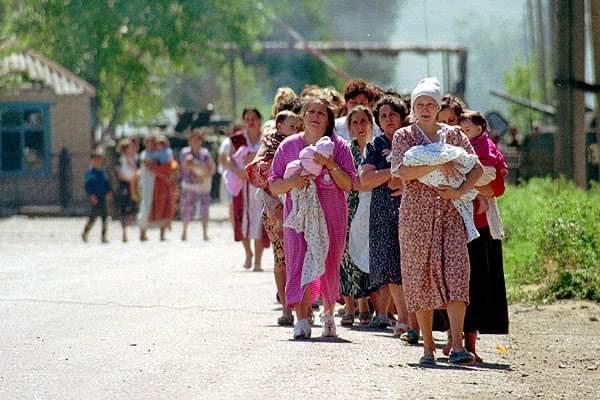
Women and children hostages are freed during the negotiations.

What situation did you find in the hospital? Do you remember the conditions of the hostages and militants during your stay in the facility?

The situation was very tense, there were many women and children, some wounded, mothers who had just given birth. With respect to this, the Russian media presented a distorted version of reality: with the exception of military pilots and police officers, the hostages were shown respect and care, relative to the conditions in which they found themselves. The hostages themselves had spread white scarves and sheets outside the windows to prevent an assault by the Russian army. I saw a woman, a doctor from the hospital, slap a police lieutenant general who was saying that Basayev’s team was putting women and children against the windows!

Khangoshvili and I have been to the hospital 5-6 times until June 18th , and each time we came back with several children, who we returned to their mothers. They persuaded me to take the children with me, referring to the fact that Basayev would not object and that the children would be saved. On our next visit, we heard the voices of the women talking to each other saying that there was a “mustachioed prosecutor” and that another group of children needed to be rounded up.

According to press reports, it was you who developed the text of the agreement that led to the resolution of the crisis. Do you remember the genesis of this document? Were there discussions about what should be written on it? Do you keep a copy of this document?

Yes, I wrote that text. At the first meeting with Basayev he recognized my rank as an official, but said that he was accountable to his command, and that without the approval of his bosses he would not take any decision. Basayev insisted that the withdrawal of Russian troops from Chechnya and the republic’s independence could not be negotiated. His detachment would not have left if these two conditions were not met. If necessary they would all have sacrificed their lives for this. I had to talk to all the members of Basayev’s team to explain to them that at this stage of the conflict, fulfilling both conditions would be impossible, even with the sacrifice of all Chechens on earth.

In the end, thanks to the help of the witnesses I brought, and the arguments of my reasoning, I managed to persuade Basayev that the withdrawal of troops and the opening of negotiations would be real steps towards ending the war and recognizing Chechen sovereignty . After another visit to the hospital on June 17 , Basayev finally declared that he was ready to open a dialogue on this basis, and asked me to draft a document. To the above conditions he added the request for a guarantee of safety for his men, so that they could return to Chechnya without incident. Finally, he reminded me that, as a Chechen, I would answer to the people and to Allah if the Russian military and political leadership did not abide by the agreements.

The text was signed by responsible persons. I was asked to sign as head of the Chechen delegation, but I refused because I was a state official. However, having to identify a guarantor among the Chechens, I asked Kanghoshvili to sign, since the Russian government would not accept my signature as an official of the Chechen Republic.

The main concern for me and for Basayev was: who would guarantee the free passage of the buses on which the Chechen fighters and their escorts would leave? Knowing the insidious behavior of the Russian military and leadership, when I returned to the HQ I asked on my own initiative that this guarantee be given by the Russian Prime Minister Chernomyrdin: without his direct intervention, Basayev’s men would not have left the building, and they would have agreed to fight to the death. All those present reacted with anger: Deputy Prime Minister Yegorov , FSB director Stephasin and other military commanders invited me to leave. To which, brusquely, I told them that if they stormed the hospital, the whole world would immediately know about it from me, and the death of the hostages would remain on their conscience!

While returning to Moscow with the Chechen delegation, the human rights activist, S. Kovalev, approached us, and told us that Chernomyrdin was willing to talk with us about the guarantees to be given to Basayev’s men. I replied that this shouldn’t have been behind the scenes, but that it should have been an official statement. I then demanded that the Prime Minister speak to Basayev directly on the phone, and threatened to abandon the negotiations, and to return to my job if the conversation did not take place.

When you left the hospital, you took about a hundred hostages with you. Do you remember any of them? Were you able to exchange a few words between you? What did the hostages think about what was happening?

As I said, after I learned that Chernomyrdin would call Basayev, I returned to the hospital on June 18th . Arriving from Basayev I asked him: if the Prime Minister provides a guarantee of safe passage to Chechnya, will this be a sufficient basis for the release of the hostages? Basayev and his men laughed: they didn’t believe such a guarantee would be possible. However Kovalev and the accompanying State Duma deputies confirmed my words, so we added this clause to the agreement, and signed it. I asked Basayev to give a sign of good will by handing over, together with the request for agreement, at least 100 hostages, including women and children, to be released. Basayev agreed to the request the next day.

Upon your departure, Basayev reportedly warned you: “Remember that you are a Chechen. If even a single hair falls from my fighters’ heads along the way, your whole family will answer for it!” Does this mean you got involved in a family feud to save the Budennovsk hostages?

Naturally this was a provocation on Basayev’s part. After all, I could not vouch for their free passage through Russian territory. Knowing about Yeltsin’s intention to show himself to the world community as a fighter against “terrorists”, I nipped in the bud another provocation thought up by the head of the operation to free the hostages, General Yerin . As soon as I arrived in Moscow, I gave several interviews to Russian and foreign journalists in which I feared a possible military provocation against Basayev’s detachment on the way back.

After signing the agreement, on your way home, you were abruptly called back at Aslambek ‘s explicit request Abdulkhadzhiev . The feds had asked all those who had joined Basayev on the return journey to sign a document that effectively exempted the Russian authorities from any responsibility in the event of accidents on the way back. It was a tacit admission of a willingness to raid Basayev’s convoy as soon as it entered Chechnya. Abdulkhadzhiev stated that without your intervention the negotiations would not have resumed. Did you know him? Why was your presence deemed necessary?

I have already mentioned General Yerin , the author of this receipt stating that such and such a person “voluntarily joins Shamil Basayev’s group…”. Abdulkhadzhiev reacted urgently to this provocation and declared that without a conversation with the President of the Constitutional Court of the Republic, the agreement would not proceed.

A car caught up with us on the way to the airport, and we were asked to come back. Upon arrival in Budennovsk, after reading the text proposed by General Yerin , I asked to speak urgently with Chernomyrdin and, after my explanations, Chernomyrdin slipped through Yerin , scolded him about the receipt and ordered him to cancel it. It later became known that the General was preparing an assault on Basayev’s convoy on orders from President Yeltsin, who was outside Russia at the time. Indeed, an attempted assault took place near the Chechen border, at the height of Kurskaya , when military helicopters began flying over the buses. However, due to the great attention these events caused and the presence of many foreign journalists, the attack did not take place.

Hostages leave the hospital

After resolving this second crisis, you were faced with the frustrated reaction of the Russian military and civilians who had witnessed the kidnapping. Why were they mad at you? What made them so nervous?

The answer in this case is unequivocal. Many soldiers wanted to destroy Basayev’s detachment and gain prestige. They didn’t care about the hostages and their punishments at the time. On our next visit to the hospital we realized that the army’s special units clearly wanted to take advantage of the stalemate in operations due to the negotiation process to storm the hospital. And the police major’s snide comment: You can’t come here, you’re no better than the terrorists you sent home I assumed I never expected the most basic humanity or gratitude from these people.

After Basayev’s return to Chechnya, your mission was over. Were you able to contact Dudayev, or another official of the Chechen Republic of Ichkeria?

Unfortunately no, I was very busy with the international tribunal, and until 1996 I was unable to return to the republic. According to Abdulkhadzhiev , in the presence of Ismailov and Basayev, my actions in this mission were highly appreciated by the President, who said that at the first meeting with me he would present me with the Republic’s highest award, the “Honor of the Nation ”. Unfortunately, the infamous assassination of the President of the Chechen Republic prevented us from meeting on this earth.

Did the Russian authorities give you any credit for ending the Budennovsk hostage crisis?

First of all, I didn’t expect anything from gold and I didn’t work for them. I only accepted the offer to participate in this matter, in good faith, because I was one of the highest officials of the Republic. Secondly, I did what I did out of civic duty, and I am grateful to the Almighty for giving me the opportunity to be of service to my people and to free more than 1200 hostages who were not involved in hostilities, like dozens of thousands of civilians in Chechnya, who suffered the most from the presence of the Russian army.

It was said a long time ago that I was offered an apartment in Moscow. Speculation around this topic was a useless farce of the Russian leadership, just as some newly emerged “patriots” among the Chechens could be accused of treason, who even today cannot understand and evaluate my actions as Chairman of the Constitutional Court of the Republic Chechen. But that’s another topic!

The Budennovsk crisis allowed the Chechen government to conclude a truce which proved useful in winning the war. However, it has cast a shadow of terror on the resistance. How do you think Budennovsk changed the history of independent Chechnya?

Today the whole world has known the face of the Russian Empire and has finally understood that the war of the aggressor, launched against our republic, was the beginning of perfidy and contempt for all norms and principles of international law, so as well as its obligations to the world community. The Budennovsk events forced the Russian leadership to sit down at the negotiating table, and this saved tens of thousands of lives, both on the territory of our republic and in Russia itself.

As for the “shadow of terror”, state terror was declared against the Chechen people by Russia, exclusively on a national basis, and has not stopped to this day, even though the peace treaty with the Chechen Republic of Ichkeria was signed a long time ago! So who is guilty of terrorism? Who is the terrorist?

Thank God the European community has already declared Russia a sponsor of terrorism. This is mine answer at the your last question !

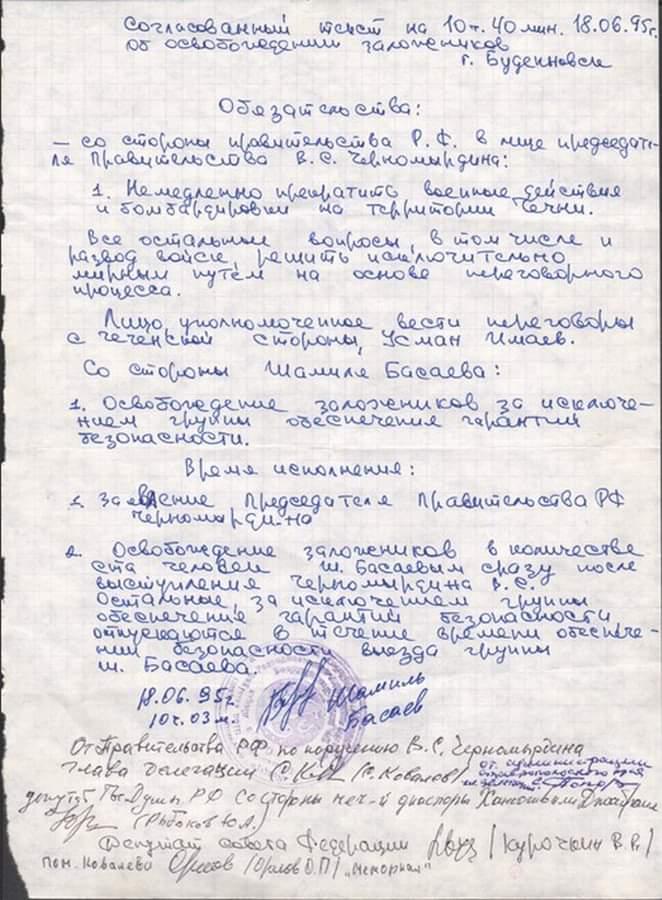
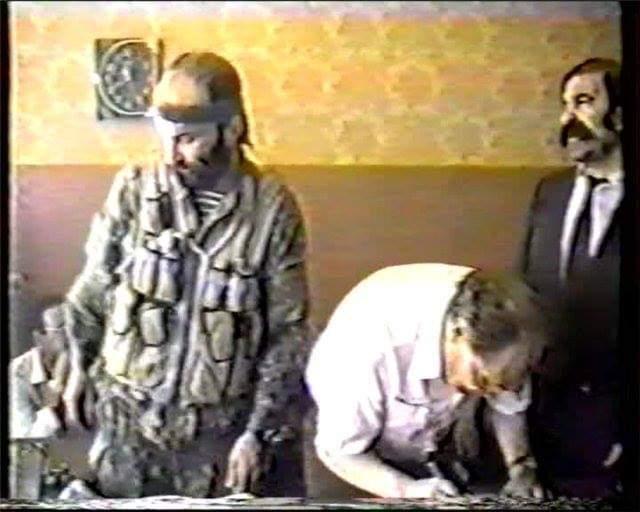
Text of the agreement drawn up by Gerikhanov.


The document, translated for us by Inna Kurochkina, says:

Agreed text for the time 10 hours 40 minutes 18.06.95.

On the release of the hostages, the city of Budyonnovsk.

Commitment:

-On the part of the Government of the Russian Federation represented by the Prime Minister

V.S. Chernomyrdin:

Immediately stop hostilities and bombardments of the territory of Chechnya.

All other issues, including the disengagement of troops, should be resolved exclusively by personal means on the basis of the negotiation process.

The person authorized to negotiate with the Chechen side is Usman Imaev.

-From Shamil Basayev:

Release of hostages, with the exception of the security assurance team.

Time of completion:

Statement by Chairman of the Government of the Russian Federation Chernomyrdin.

The release of the hostages in the amount of one hundred people Sh. Basaev immediately after the speech of Viktor Chernomyrdin.

The rest, with the exception of the security guarantee group, are released during the time for the security of the departure of Sh. Basayev’s group.

18.06.95

10 hours 03 minutes

Signatures:

Viktor Stepanivich Chernomyrdin

Shamil Basaev

From the Government of the Russian Federation on behalf of Viktor Chernomyrdin: Head of

the Delegation Sergey Kovalev

From the Administration of the Stavropol Kraj Member of the delegation Sergey Popov

Deputy of the State Duma of the Russian Federation Yuliy Rybakov

From the side of the Chechen diaspora Khangoshvili Dzhabrail

Federation Council Deputy Viktor Kurochkin

Assistant to Kovalev Oleg Orlov “Memorial”

Amendments to the first document

The document, translated for us by Inna Kurochkina, says:

Additional agreements to the text of the Agreement dated June 18, 1995.

The delegation of the Russian Federation and Shamil Basayev’s group agreed on the following:

All questions of a political settlement, including the question of the status of the Republic of Chechnya, its relations with the federal authorities of the Russian Federation, and the republics of the Russian Federation, and other issues, should be resolved exclusively by peaceful means, on the basis of international legal acts, legislation and agreements reached in the negotiations.

This procedure should be the subject of consideration by authorized officials of the Chechen Republic of Ichkeria and representatives of the Government and the Federal Assembly of

the Russian Federation.

18.06.95

11 hours 03 minutes

Signatures

Shamil Basaev

From the side of the Chechen diaspora Khangoshvili Dzhabrail

From the delegation of the Russian Federation:

Sergey Kovalev

Juliy Rybakov (Deputy of the State Duma)

Viktor Kurochkin (Member of the Federal Assembly)

Oleg Orlov (“Memorial”)

From the Administration of the Stavropol Kraj Sergey Popov

Akhmed Zakayev a Rimini (11/12/2022) “Da dove viene l’espressione ‘La Cecenia fa parte della Russia’?”

Quello che segue è il testo integrale dell’intervento presentato dal Presidente del Gabinetto dei Ministri del governo ceceno, Akhmed Zakayev, al Congresso Nazionale dei Radicali, svoltosi a Rimini tra il 9 e l’11 Dicembre 2022. Lo avevamo tradotto per l’occasione dall’inglese, affinchè potesse essere distribuito agli astanti. Lo riproponiamo ai lettori di questo blog.

11.12.2022 Rimini, Italia

Signor Presidente,

Signore e signori,

All’inizio del mio intervento, vorrei ringraziare gli organizzatori di questo forum. In particolare ” Radicali Italiani ”. così come tutti i membri del movimento.

Da più di 30 anni partecipo direttamente ai processi militari e politici in corso sia all’interno della stessa Cecenia, sia – ora – al di fuori della Cecenia. Le informazioni rilasciate dagli uffici stampa dei ministeri e delle agenzie russe hanno lo scopo di distogliere l’attenzione da fatti oggettivi. Gli ideologi del Cremlino praticano ancora la teoria totalitaria secondo cui se ripeti mille volte una bugia, diventerà la verità. Preferisco l’affermazione di Abraham Lincoln: che puoi ingannare alcune persone per sempre, e tutte le persone per qualche tempo, ma mai tutte le persone per sempre.

Il presente e il futuro di qualsiasi conflitto devono essere definiti innanzitutto dalla natura di quel conflitto. Probabilmente avrete sentito dozzine di versioni delle origini del conflitto tra Russia e Cecenia. Le riserve petrolifere e il terrorismo islamico internazionale hanno poco o nulla a che fare con l’origine del conflitto. Vorrei spiegare di cosa ha così paura il governo russo.

Dall’inizio della guerra russo-cecena, l’11 dicembre 1994, ogni tentativo della comunità mondiale di impegnarsi nella soluzione pacifica del conflitto è stato bloccato dalla tesi dell’integrità territoriale della Federazione Russa. Oggi che il nostro conflitto è degenerato in un circolo vizioso, è estremamente importante esaminarlo dal punto di vista della sua legalità. Epiteti come “autodichiarato”, “separatista”, “ribelle” o “non riconosciuto” sono spesso usati per descrivere la Repubblica cecena. Essi non si basano su fatti storici e legali.

Lo status sovrano della Repubblica cecena è legittimo quanto lo era l’URSS. Nell’aprile 1990, durante le riforme del sistema sovietico di Gorbaciov, il Soviet Supremo dell’URSS adottò due leggi di fondamentale importanza per le nazioni dell’Unione Sovietica.

Il 10 aprile 1990. “Sulla base dei rapporti economici tra l’URSS e l’Unione e le Repubbliche Autonome” Poi il 26 aprile 1990 “Sulla divisione dell’autorità tra l’URSS ei sudditi della Federazione”. Questa normativa conteneva, accanto a disposizioni più generali, una serie di articoli che modificarono radicalmente lo statuto delle repubbliche autonome. Da quel momento esse condivisero gli stessi diritti delle altre repubbliche sovrane. Entrambi i tipi di repubbliche godettero del diritto alla “libera autodeterminazione dei popoli”.

Il 27 novembre 1990 , a seguito di un editto ufficiale del Soviet Supremo dell’URSS, il Soviet Supremo della Repubblica ceceno-inguscia ha adottato una Dichiarazione sulla sovranità dello Stato.

Per tutta la vita dell’URSS, tutto ciò che aveva a che fare con lo status giuridico, la “statalità” ei confini delle varie entità etniche all’interno del paese era prerogativa esclusiva del Soviet Supremo dell’URSS.

Il motivo per cui sto entrando così nei dettagli è perché possiate capire che non c’è stata alcuna rivolta, nessuna presa del potere da parte di separatisti armati. La sovranità della Repubblica cecena è stata stabilita dall’adozione nell’URSS di diverse nuove leggi nell’aprile 1990, e quindi era assolutamente legale e legittima ai sensi del diritto sovietico, del diritto russo e del diritto internazionale.

Quindi, quando l’Unione Sovietica fu sciolta nel dicembre 1991, la Repubblica cecena esisteva da più di un anno come stato sovrano, riconosciuto nell’ordinamento giuridico dell’URSS, uguale a tutte le “Repubbliche dell’Unione” (Russia, Georgia , Ucraina, Stati baltici e altri) e si stava preparando a firmare il Trattato dell’Unione aggiornato.

Lo status paritario della Repubblica cecena è stato infatti riconosciuto dal governo della Russia nel 1992, in occasione della spartizione ufficiale delle armi e dei beni dell’ex esercito sovietico che si trovavano nella Repubblica di Cecenia. Una simile divisione delle armi e dei beni dell’esercito sovietico ebbe luogo tra la Russia e tutte le ex repubbliche dell’URSS.

Il 1992 è stato un anno chiave per la Repubblica cecena a causa di altri due eventi che hanno avuto luogo: il primo è stato l’adozione della nostra Costituzione, che ha confermato lo status della Repubblica cecena come Stato sovrano democratico. La seconda è stata la firma del Trattato federale in Russia, cui la Repubblica cecena non ha partecipato.

Akhmed Zakayev

Da dove viene l’espressione “la Cecenia fa parte della Russia”?

Nell’ottobre 1993 il presidente Eltsin ordinò alle truppe di sparare sul parlamento russo e disperse l’assemblea. Quando il presidente Eltsin ordinò un referendum per una costituzione russa, non esisteva né il parlamento russo né la costituzione russa. Poiché la Repubblica cecena aveva un parlamento dal 1991, il quale aveva adottato una costituzione nel 1992, la Repubblica cecena non ha partecipato al referendum russo. La Costituzione russa contiene un articolo in cui si afferma che lo Stato russo è uno Stato federale, composto da soggetti che hanno firmato volontariamente il Trattato federale. Un altro articolo afferma che la Repubblica cecena è un soggetto della Federazione Russa. La presidenza russa ha violato tutte le possibili norme legali quando ha incluso la Repubblica cecena come “soggetto” della Federazione Russa nella Costituzione russa.

Nel 1994, dopo tre anni e mezzo di terrorismo di stato, di ricatti, di tentativi di indebolire la leadership cecena, che non sono riusciti a far capitolare la Repubblica cecena, la Russia ha scatenato un’invasione militare su vasta scala. Questa guerra fu cinicamente dichiarata per “l’instaurazione dell’ordine costituzionale”, mentre in realtà fu una guerra che violava tutti i principi del diritto internazionale, comprese le Convenzioni di Ginevra che regolano le norme di guerra.

Nel 1996 la guerra finì e tutte le truppe russe furono ritirate dalla Repubblica cecena. Nel gennaio 1997, con l’attivo supporto metodologico e logistico dell’OSCE e in conformità con la Costituzione cecena del 1992, la Cecenia ha tenuto le elezioni presidenziali e parlamentari, ufficialmente riconosciute dal Consiglio d’Europa che ha inviato un gran numero di osservatori, e dalla stessa Federazione Russa.

Il 12 maggio 1997è stato firmato il documento più importante di tutta la storia dei rapporti tra Russia e Cecenia. Il trattato di pace che ha stabilito i principi fondamentali per le relazioni tra la Federazione Russa e la Repubblica cecena di Ichkeria .

Il difficile ma chiaramente promettente processo di creazione di relazioni interstatali reciprocamente accettabili tra la Russia e la Repubblica cecena fu interrotto nel 1998, quando il Consiglio di Sicurezza della Federazione Russa, presieduto da Putin, il quale era anche direttore dell’FSB, pose un clamoroso freno al processo negoziale.

Al nostro governo viene spesso rimproverata l’accusa di aver avuto il tempo e l’opportunità dopo la fine della prima guerra russo-cecena di rafforzare e affermare la nostra sovranità. Posso affermare con piena autorità che in realtà non abbiamo avuto né il tempo, né l’opportunità, e questo perché i servizi segreti russi hanno immediatamente avviato seri preparativi per una seconda guerra. Hanno scatenato una dura ondata di operazioni terroristiche contro la Cecenia, che includevano esplosioni, omicidi e rapimenti, in particolare di stranieri e giornalisti. Molti noti politici hanno dichiarato pubblicamente che la Cecenia doveva essere portata a uno stato tale da implorare in ginocchio di poter rientrare nella Federazione Russa.

Dopo lo scioglimento dell’URSS, i sostenitori di un forte governo centrale in Russia si lamentavano che non esisteva più un’idea unificatrice e quindi che ciò che restava del grande impero russo, la Federazione Russa, avrebbe potuto sgretolarsi. Il Cremlino ha trovato l’idea che era necessaria. Hanno sostituito l’idea di Marx di combattere il capitalismo con l’idea di combattere il terrorismo. Il vantaggio della nuova idea era che quando si trattava di teoria e pratica degli atti di terrore, la Russia era stata il leader mondiale per tutto il XX secolo, e in tutti i continenti.

Vi interesserà sapere che durante la prima guerra del 1994-1996 siamo stati etichettati come banditi, separatisti, fascisti, ogni sorta di cose, ma nessun politico russo si è sognato di chiamarci fondamentalisti o terroristi islamici, figuriamoci terroristi internazionali.

Il Cremlino aveva già esperienza nel collegare la questione cecena con i problemi internazionali. Stalin, ad esempio, quando affrontò la questione cecena nel 1944 (deportando l’intera nazione nelle steppe del Kazakistan e della Siberia), accusò il popolo ceceno di collaborare con i tedeschi fascisti, anche se i nazisti non riuscirono mai ad occupare la Cecenia. Gli alleati democratici di Stalin potevano allora trovare comprensibili le sue affermazioni. Nel nostro tempo, presentare la Cecenia come uno dei principali focolai del terrorismo islamico internazionale sembra adattarsi convenientemente all’opinione pubblica russa, ma anche a quella dell’Occidente.

Akhmed Zakayev parla alla Camera dei Deputati in Italia

Negli ultimi anni i liberal-democratici russi ci hanno parlato dei processi negativi che hanno avuto luogo e sono tuttora in corso in Russia. Sono profondamente convinto che ciò che il regime di Putin ha fatto in Russia sia la conseguenza e il riflesso di quanto è accaduto, e continua ad accadere, in Cecenia.

L’isteria anti-cecena fomentata dal Cremlino che gode dell’appoggio della maggioranza assoluta della società russa, democratici compresi.

Menzogne spudorate, illegalità e crimini crudeli sono gli strumenti della politica russa nei confronti della Cecenia. Infiammata dalla propaganda della Grande Potenza, la società russa acconsentì prontamente ai mezzi ovvi e malvagi usati contro i ceceni, e quando questi iniziarono ad essere usati contro gli stessi russi era già troppo tardi per cambiare qualcosa.

Una campagna di terrore contro una piccola nazione non può portare a risultati positivi. Le prevedibili conseguenze di una guerra criminale scatenata contro la Cecenia sono state una restrizione delle libertà democratiche, inclusa l’abolizione della libertà di parola, della libertà per l’attività imprenditoriale privata e della libertà per le minoranze religiose. Procedimenti penali politicamente motivati, persecuzione delle organizzazioni per i diritti civili, violazione dei diritti elettorali dei cittadini, fascismo sempre più forte e grave interferenza negli affari interni degli stati vicini: questi sono tutti risultati naturali della criminale guerra anti-cecena, che continua nel suo 28 anno.

Il rifiuto della Russia di riconoscere l’indipendenza della Repubblica cecena, e il conseguente scatenarsi di una guerra, ha creato false aspettative in molte persone riguardo alla possibile risoluzione dei conflitti post-sovietici. La Georgia, la Moldavia ei loro amici volevano vedere la Russia soggiogare la Cecenia il prima possibile, immaginando che dopo questo sarebbe stata ripristinata la loro “integrità territoriale”.

I bombardamenti a tappeto di villaggi e città, la violazione di ogni norma militare, le pulizie etniche e il genocidio commessi durante le due guerre anti-cecene erano tutti considerati affari interni della Russia.

Putin era fiducioso che gli attuali leader occidentali non avrebbero mai cambiato il loro atteggiamento pubblicamente dichiarato nei confronti della Russia , qualunque cosa faccia.

Il regime russo è emerso nella sua forma attuale in gran parte grazie all’incoraggiamento che la Russia ha ricevuto dagli stati occidentali nella sua barbara guerra contro la Cecenia, uno dei conflitti più sanguinosi e violenti in Europa dalla Seconda Guerra Mondiale. 300 mila civili , di cui oltre 40mila bambini , sono stati uccisi in Cecenia.

 Sono profondamente convinto che gli interessi economici di alcuni paesi e gli interessi politici di alcuni politici non debbano essere superiori al destino di un intero popolo. Sono anche assolutamente sicuro che la mancanza di un’adeguata reazione del mondo occidentale alla tragedia cecena sia la ragione principale per cui la Russia ha commesso un’aggressione militare contro la Georgia e l’Ucraina.

Sono lieto che il mondo si sia reso conto che la politica di pacificazione non può essere continuata e abbia condannato fermamente l’aggressione russa contro l’Ucraina.

I ceceni sono stati coinvolti in questa guerra dalla parte degli ucraini dal 2014. Putin, durante l’invasione su larga scala dell’Ucraina da parte della Russia, ha attirato i cosiddetti Kadyroviti nelle file degli occupanti russi. Questa decisione è stata presa con l’obiettivo di portare odio tra ceceni e ucraini. Ma grazie alla saggezza del popolo ucraino e alle azioni corrette del governo della CRI in esilio, Putin non è riuscito a raggiungere questo obiettivo. Il 26 febbraio Bruxelles ha ospitato una riunione del Comitato di Stato per la Disoccupazione della CRI, di cui sono a capo, in qualità di capo del governo della CRI in esilio. In questo incontro si decise di formare distaccamenti di volontari tra i ceceni in Europa per partecipare alla guerra a fianco degli ucraini. Lo stesso giorno, abbiamo annunciato questa decisione attraverso i media. Mi sono anche rivolto al presidente Zelensky sulla necessità di concludere un accordo sulla cooperazione militare tra le parti. In modo che la partecipazione dei ceceni a un conflitto armato non contraddica la Convenzione di Ginevra del 1949 e il protocollo aggiuntivo del 7 dicembre 1978 “Protezione delle persone che partecipano alle ostilità”, in modo che questa persona non rientri nell’articolo “mercenari” della suddetta Convenzione.

Il 28 maggio, nella città di Kiev, è stato firmato un accordo di mutua assistenza e sostegno tra i dipartimenti militari dell’Ucraina e la CRI. Da quel momento è in corso la formazione di una brigata separata per scopi speciali come parte della legione straniera dell’Ucraina. Due battaglioni sono lì dal 2014. Due battaglioni sono stati formati dopo la firma di un accordo interdipartimentale. E al momento, il terzo battaglione sta venendo reclutato.

Ora vorrei divagare leggermente dall’argomento principale e citare il primo presidente della Repubblica cecena di Ichkeria , Dzhokhar Dudayev, il quale ha detto nel 1995: “quando il sole della libertà sorgerà in Ucraina, verrà la fine dell’Impero russo”.

Infatti, oggi, in connessione con la guerra in Ucraina, il mondo si sta riorganizzando e l’Ucraina è diventata il leader del mondo libero.

La mia fiducia è rafforzata dal fatto che il 18 ottobre la Verkhovna Rada dell’Ucraina ha riconosciuto il genocidio del popolo ceceno e che il territorio della Repubblica cecena di Ichkeria è stato temporaneamente occupato dalla Russia. Questo è un evento epocale nella storia della formazione dello stato ceceno. Questo apre grandi opportunità per il governo della CRI in esilio.

Sono sicuro che oggi il mio popolo, come mai prima nella sua storia, è vicino al ripristino della propria statualità. E garantisco che con l’aiuto dell’Onnipotente, il nostro governo all’estero non perderà questa occasione storica.

Grazie a tutti.

Akhmed Zakayev

Presidente del Gabinetto dei Ministri della Repubblica Cecena di Ichkeria

Capo del Comitato per la De – Occupazione della Repubblica Cecena di Ichkeria

Approfondimento sulla Cecenia con Francesco Benedetti

Francesco Benedetti è ospite del canale Youtube Economia Italia per un approfondimento sulla storia della Cecenia ed alcune riflessioni sulla situazioni attuale in Ucraina.

Il contenuto è disponibile quì

Visita la pagina di EconomiaItalia, abbonati e guarda il video:

https://www.youtube.com/@EconomiaItalia

“Un manuale su come sconfiggere un impero” – Adriano Sofri presenta “Libertà o Morte!”

Il 13 Dicembre scorso, due giorni dopo l’uscita del secondo volume di “Libertà o Morte! Storia della Repubblica Cecena di Ichkeria, Adriano Sofri ha presentato il libro sulle colonne de Il Foglio, nella sua rubrica Piccola Posta. Riportiamo di seguito le sue parole, pubblicate anche su Facebook, su Conversazione con Adriano Sofri.

Adriano Sofri

Il singolare caso del giovane uomo che sa tutto della Cecenia e non si è mosso da Firenze

Segnalo oggi un caso culturale e umano piuttosto straordinario. Riguarda la Cecenia, e un giovane fiorentino che non ci è mai stato, non ne conosce la lingua, non conosce (ancora) il russo, ed è diventato lo studioso più autorevole della storia contemporanea di quel piccolo paese dai destini fatali. Francesco Benedetti è nato nel 1987, si è laureato in storia, ha una famiglia, una sua professione, una pratica musicale metal, e si appassionò presto alla vicenda di quel territorio grande, cioè piccolo, come una minore regione italiana, e popolato da poco più di un milione di persone, che si è ribellato per secoli all’impero russo e che, alla fine della versione imperiale sovietica, ha preteso l’indipendenza, ha sconfitto l’esercito russo in una devastante guerra aperta tra il 1994 e il 1996, e ne è stato sconfitto in una seconda guerra di sterminio nel decennio tra 1999 e 2009. Al costo della falcidie di un quinto della sua gente, dell’esilio di migliaia, della sottomissione dei rimasti alla corte di Putin, di cui sono diventati i pretoriani esosi ed efferati. Benedetti ha deciso di ricostruire su giornali, trasmissioni e memorie la cronaca quotidiana di questa vicissitudine, e di raccoglierne direttamente tutte le voci ancora disponibili, in ogni parte di mondo in cui si sono disseminate. Mette così insieme una mole impressionante di racconti, che va diventando il riferimento internazionale principale per chi voglia conoscere il conflitto fra Cecenia e Russia dopo il 1991, e per gli stessi protagonisti. Se ne è fatto editore, stampando (e vendendo, in volume, 15 euro, o kindle, 5,99) attraverso Amazon, e intanto mettendo in rete una profluvie di interviste e fonti su Facebook, al suo nome e a quello di Ichkeria.net – il nome della repubblica cecena.

Solo in certi bambini speciali o in certi inquietanti concorrenti al rischiatutto sorge e dura il proposito di sapere tutto di qualcosa. Un pezzo leggendario del Caucaso, Pushkin e Tolstoi e Lermontov – e Anna Politkovskaya – chi non vorrebbe? Senza una simpatia intima per il suo tema una simile ambizione non potrebbe esistere, e tuttavia nell’opera di Benedetti ai valori dell’audacia, della tenacia e della fiera tradizione montanara sono congiunti il disonore, la rivalità, il fanatismo e la violenza che nel corso di una lotta così strenua, impari e spietata si sono fatte strada. La Cecenia del ’91 aveva il suo passato tragico da vendicare, e lo rivendicò più presto che altri paesi, compresa l’Ucraina: dopo alla grande carestia del Holodomor ucraino negli anni ‘30, che aveva infierito anche nel Caucaso, venne la brutale deportazione del 1944 in Siberia e in Kazakistan: nessun ceceno dei nati fra il 1944 e il 1956 (e oltre) nacque in Cecenia. Il primo volume, “Libertà o morte. Storia della repubblica cecena di Ichkeria (1991-1994)”, 425 pagine, era uscito in italiano e in inglese (c’è una versione cecena in corso) nel febbraio 2020. Il secondo, “La prima guerra russo-cecena. 1994-1996”, 373 pagine, è uscito l’altroieri (in inglese a marzo). L’autore lo presenta così, in un modo che raccomando energicamente:

“La guerra in Ucraina è iniziata in Cecenia. Può sembrare una provocazione. Eppure, è la realtà che rivelano le pagine di questo secondo volume, interamente dedicato alla Prima Guerra Russo–Cecena. Genesi, sviluppo e svolgimento di questo sanguinoso conflitto sembrano la bozza del copione cui il mondo sta assistendo in questi mesi tra il Donbass e la Crimea. Anche allora, come oggi, la Russia invase uno stato libero, mascherando la guerra che stava scatenando dietro alla definizione di ‘operazione speciale’. Anche allora, come oggi, il nemico dello stato russo era stato etichettato e demonizzato: se Zelensky ed il suo governo sono chiamati oggi ‘nazisti’, Dudaev ed i suoi ministri furono chiamati allora ‘banditi’. Anche allora, come oggi, convinti della loro superiorità, i comandi militari marciarono sulla capitale, pretendendo di piegare un popolo alla loro volontà, come avevano fatto più volte in epoca sovietica. Ma anche allora, come oggi, furono costretti a ritirarsi, per poi scatenare una sanguinosa guerra totale, la più devastante guerra europea dal 1945.

La Prima Guerra Russo–Cecena fu il primo tragico prodotto del revanscismo russo: il ‘punto zero’ di una parabola che da Grozny porta a Kiev, passando dalla Georgia, dalla Crimea, dalla Bielorussia e dal Donbass. Con una differenza sostanziale: che quella prima guerra contro la Cecenia, i russi, la persero. Le loro ambizioni, poggiate sulle fondamenta logore di un impero fatiscente, finirono frustrate dalla caparbietà di una nazione immensamente inferiore, per numero e per mezzi, a quella ucraina, che oggi difende la sua terra dalla guerra scatenata da Putin.

Questa storia può impartire a chi avrà la pazienza di leggerla due importanti lezioni: cosa succede quando si assecondano le ambizioni di un impero, e come si fa a sconfiggerlo. Se è già tardi per mettere in pratica la prima, per la seconda siamo ancora in tempo”.

Freedom or death! History of the Chechen Republic of Ichkeria: The second volume in Italian is out today

The war in Ukraine started in Chechnya. It may seem like a provocation. Yet, this is the reality that the pages of this second volume reveal, entirely dedicated to the First Russo-Chechen War. The genesis, development and unfolding of this bloody conflict seem to be the draft of the script that the world has been witnessing in recent months between the Donbass and the Crimea.

Even then, as now, Russia invaded a free state, disguising the war it was waging behind the label of a “special operation.”

Even then, as now, the enemy of the Russian state had been labeled and demonized: if Zelensky and his government are called “Nazis” today, Dudayev and his ministers were then called “bandits”.

Even then, as today, convinced of their superiority, the military commands marched on the capital, claiming to bend a people to their will, as they had done several times in Soviet times. But even then, as now, they were forced to withdraw, only to unleash a bloody all-out war, the most devastating European war since 1945.

The First Russo-Chechen War was the first tragic product of Russian revanchism: the “zero point” of a parable that from Grozny leads to Kiev, passing through Georgia, Crimea, Belarus and Donbass. With one substantial difference: that the Russians lost that first war against Chechnya. Their imperial ambitions, resting on the worn foundations of a crumbling empire, ended up frustrated by the stubbornness of a nation immensely inferior in number and means, to that of Ukraine, which today defends its land from the war unleashed by Putin.

This story can teach those who have the patience to read it two important lessons: what happens when you indulge the ambitions of an empire, and how do you defeat it. If it is already too late to put the first into practice, we still have time for the second.

Purchase the volume here:

https://www.amazon.it/Libert%C3%A0-Storia-Repubblica-Cecena-Ichkeria/dp/B0BMSY666Y/ref=sr_1_4?crid=379QYOJIF1LQJ&keywords=libert%C3%A0+o+morte&qid=1670606213&sprefix=%2Caps %2C76&sr=8-4

Libertà o morte! Storia della Repubblica Cecena di Ichkeria – Esce oggi il secondo volume in italiano

La guerra in Ucraina è iniziata in Cecenia. Può sembrare una provocazione. Eppure, questa è la realtà che rivelano le pagine di questo secondo volume, interamente dedicato alla Prima Guerra Russo – Cecena. Genesi, sviluppo e svolgimento di questo sanguinoso conflitto sembrano la bozza del copione cui il mondo sta assistendo in questi mesi tra il Donbass e la Crimea.

Anche allora, come oggi, la Russia invase uno stato libero, mascherando la guerra che stava scatenando dietro alla definizione di “operazione speciale”.

Anche allora, come oggi, il nemico dello stato russo era stato etichettato e demonizzato: se Zelensky ed il suo governo sono chiamati oggi “nazisti”, Dudaev ed i suoi ministri furono chiamati allora “banditi”.

Anche allora, come oggi, convinti della loro superiorità, i comandi militari marciarono sulla capitale, pretendendo di piegare un popolo alla loro volontà, come avevano fatto più volte in epoca sovietica. Ma anche allora, come oggi, furono costretti a ritirarsi, per poi scatenare una sanguinosa guerra totale, la più devastante guerra europea dal 1945.

La Prima Guerra Russo – Cecena fu il primo tragico prodotto del revanscismo russo: il “punto zero” di una parabola che da Grozny porta a Kiev, passando dalla Georgia, dalla Crimea, dalla Bielorussia e dal Donbass. Con una differenza sostanziale: che quella prima guerra contro la Cecenia, i russi, la persero. Le loro ambizioni imperiali, poggiate sulle fondamenta logore di un impero fatiscente, finirono frustrate dalla caparbietà di una nazione immensamente inferiore per numero e per mezzi, a quella che ucraina, che oggi difende la sua terra dalla guerra scatenata da Putin.

Questa storia può impartire a chi avrà la pazienza di leggerla due importanti lezioni: cosa succede quando si assecondano le ambizioni di un impero, e come si fa a sconfiggerlo. Se è già tardi per mettere in pratica la prima, per la seconda siamo ancora in tempo.

Acquista il volume qui:

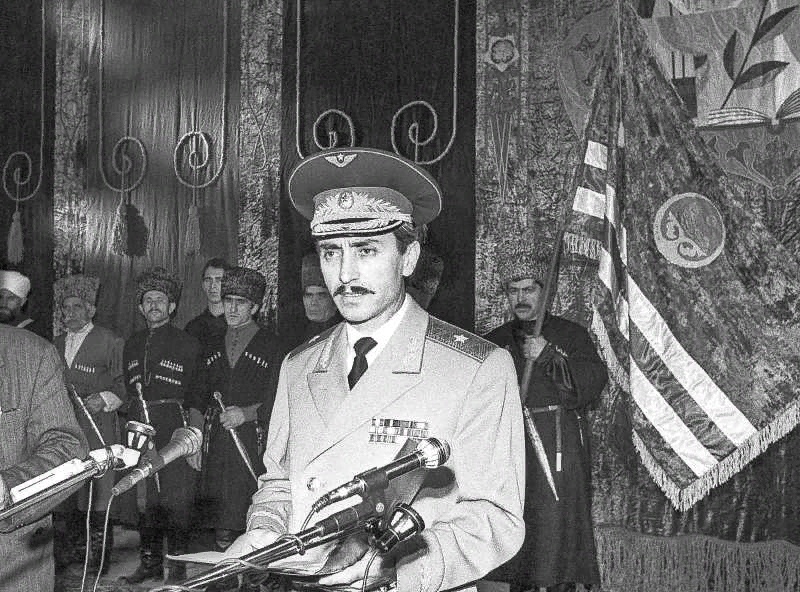
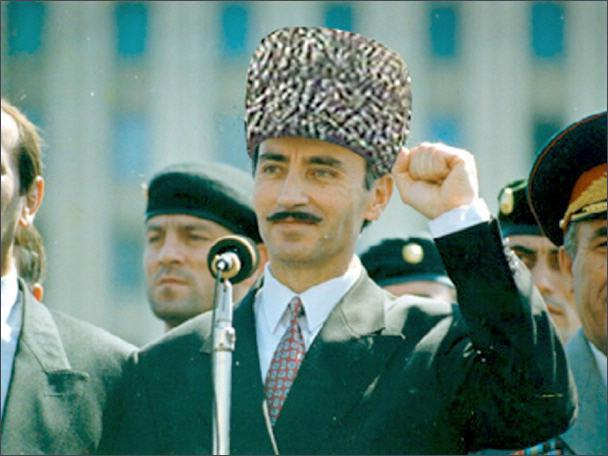
“Today we are a free nation!” Dudayev’s speech to the nation (December 31, 1993)

Another year of our life fades into the past, a year of great tests of the Chechen people’s endurance and steadfastness in defense of their won freedom. This year we celebrated the second anniversary of our bloodless revolution and independence. Having passed all the tests with dignity in the fight against internal and external enemies, we entered the third year, more stabilizing the political and economic situation, spiritually and morally strengthening, becoming more confident in an independent path of development of our statehood.

Looking back, summing up another year, we can say without a doubt that it was not in vain to strive for political independence. Our centuries-old history tells us that only political freedom and independence from anyone else is the guarantor of the peaceful life and prosperity of the nation. The vilest of all phenomena in the history of mankind is slavery and humility, against which our ancestors fought for centuries and bequeathed to their offspring not to abandon the freedom-loving spirit of the Vaynakh people.

We are well aware of the repeated attempts to destroy the gene pool of the Vaynakh nation under the Tsarist and then the Soviet-Communist empire. After centuries of persecutions and tragedies of the 19th century, 1944-1957, after the bloody massacre of Khaibach and after the hundreds of thousands of victims of the Soviet genocide, the Chechen people has nevertheless recovered, revived, preserving their national dignity, language and culture, although the Soviet totalitarian regime did everything to suppress his spirit, intimidate him and keep him in constant fear. The current generation skillfully uses the historical opportunity that has come their way to fulfill the dreams and aspirations of their ancestors.

The events that occurred after the collapse of the Soviet empire also show that sovereignty and independence are the only correct path chosen by the Chechen people. The intentions of the GKChP (if this coup succeeded) to repeat the 1944 public broadcast on television about the attack on our own parliament by large-caliber guns gives us another reason to reflect on whether we have done well, when we have decided two years ago to separate us from fascist Russia where it is not the laws that rule, but the attempts of each political group at the top of power, under the guise of a new “democracy”, to consolidate racism and fascism. For two years we have resisted a global blockade by the Russian authorities, their military invasion, internal confrontation of all kinds: sabotage, provocations, espionage. The whole world watches us with admiration. We are in his eyes an example and a model of courage, fortitude and love of freedom. And this spirit will never dry up among the Chechens. Yes, it’s hard for us. We have suffered setbacks, difficulties related to power structures that have not yet taken shape, lack of discipline, lack of organization, internal confrontation between destructive forces, criminal groups and mafias.

Many see only negative aspects in what is happening in Chechnya; disintegration, destruction, extremism, nationalism, etc. All this is actually a fiction. Is life easier in the CIS countries? Do those republics that have not separated from Russia feel calmer? Let’s remember the fate of our Ingush brothers, let’s look at what is happening in the neighboring republics and in Russia itself. There is an endless crisis: political, economic. The collapse of the economy, the impoverishment of a significant part of the population, rising prices, corruption and street crime, terrorism, the outflow of qualified personnel abroad. All branches of power are degrading, none of them are ready to cooperate with each other, none of them control the situation in the country. And with all this, seeing only our failures is, to put it mildly, simply not serious.

Despite all the obstacles posed, many positive steps were taken during the two years of independence to improve the political and economic situation of the republic. The people have breathed deeply for centuries the desired freedom. Fear and hypocrisy are gone forever. Many laws and resolutions have been passed to help stabilize the situation in Chechnya. Many practical steps are being taken to implement the government’s foreign and domestic policy agenda. Clear guidelines were outlined for the further development of the economy, for bringing the republic out of the crisis. We have no problem choosing the way to overcome the crisis. This path is clearly defined. The problem is only in our unity and harmony.

The stage of independent development has arrived, the main task of which is production and economic transformations, in which important structural and investment changes are expected to ensure the necessary market balance: rational use of our oil; urgent restructuring of all oil refineries to ensure a significant increase in oil refining, their technological re-equipment; solve the problem of creating new machine-building industries; make the rich reserves of raw materials productive for the production of building materials, use the enormous reserves of mountain fodder (for the production of livestock products), the development of which will allow to maintain 200 thousand heads of cattle and one million heads of sheep . Much attention will be paid to the construction of roads, residential buildings and stables, the laying of power and communication lines. A state program has been developed to improve soil fertility in the republic. The reconstruction and creation of enterprises for the processing of agricultural products, the introduction of technologies and the importation of equipment, the creation of a tourist and health complex are envisaged.

The chronic insolvability of many economic and social issues arouses feelings of dissatisfaction and pessimism in the population. This is a natural phenomenon and there is nothing to worry about. We have chosen a difficult road to freedom and we have no right to interrupt it. In the memory of the Chechen people, from generation to generation, the words spoken by their ancestors more than a hundred years ago are tenaciously preserved: “We plead guilty only before God and the Chechen people for not being able to restore the freedom granted to us by God”. And now the current generation of Chechens has managed to restore this freedom, to fulfill the precepts of their ancestors. And he’s determined to defend it until the end of his life, whatever the cost. These temporary hardships that have developed for all peoples on the territory of the former Soviet Empire are nothing compared to the shame and humiliation that the Chechen people have experienced for decades: sabotage of local authorities, violations of all kinds, policy of cruel staff that has provoked periodic protests, demonstrations demanding that the Ingush and Chechen be evicted again; refusal to hire Chechens to work in industrial enterprises and objects of strategic importance, in administrative bodies, prohibition of celebrating national and religious holidays; persecution and pressure on the intelligentsia; Gradual annihilation of the mother tongue in daily life; ban on studying the real history of the Vaynakhs. Here is a far from complete list of phenomena that have dishonored and humiliated this people.

Our goal of freedom and independence has been achieved. This should be appreciated and we should be proud of it. We are now building a sovereign democratic state based on the rule of law. There is no doubt that we will be able to accomplish this task too: unlike the Russian “democratic” state, where representatives of Caucasian nationalities are persecuted at every step, Chechens are terrorized, shot, deported from their homes, the authorities of the Chechen Republic will never allow anyone the slightest violation of the rights of a single person, no matter what nation he belongs to and no matter what god he prays to. All peoples inhabiting the republic are equal and worthy of respect and a better life.

The Chechen people have nothing to complain about or regret the previous regime, which left them with the highest infant mortality, unhealthiness and environmental pollution, the lowest life expectancy and the lowest standard of living. We don’t ask anyone for help. We ask and demand not to be disturbed.

DEAR CITIZENS OF THE CHECHEN REPUBLIC!

Our people are optimistic about their future, despite the intrigues of external and internal opponents against our sovereignty. We believe that sooner or later reason and wisdom will prevail in Russian leadership circles. We believe that the state flag of the Chechen Republic, which flies in front of the headquarters of the Unrepresented Peoples Organization, will soon be hoisted in front of the UN headquarters. We believe that PEACE, HEALTH and PROSPERITY will reign in long-suffering Chechnya. The Chechen state already has not only a history, but also a more real future. Vitality and strength, the ability to create and live with reason and talent – we confirmed ourselves in the most difficult tests of strength, building our state in the “mouth of a boa constrictor”.

Today we can proudly say that the desecrated honor has been restored and from yesterday’s homeless population, in the times of the USSR, today we are a free NATION.

LET THE END OF THE YEAR BRING WITH IT ALL OUR FRICTIONS, ALL OUR PROBLEMS!

HAPPY NEW YEAR TO YOU, DEAR COMPATRIOTS! WITH NEW HAPPINESS, WITH NEW SUCCESS AND GOOD HEALTH! MAY GOD HELP YOU!

Dzhokhar DUDAEV.

VERSIONE ITALIANA

“Oggi siamo una nazione libera!” Il Discorso di Dudaev alla nazione (31/12/1993)

Un altro anno della nostra vita sta svanendo nel passato, un anno di grandi prove di resistenza e fermezza del popolo ceceno in difesa della libertà conquistata. Quest’anno abbiamo celebrato il secondo anniversario della nostra rivoluzione e indipendenza senza sangue. Avendo resistito con dignità a tutte le prove nella lotta contro i nemici interni ed esterni, siamo entrati nel terzo anno, stabilizzando maggiormente la situazione politica ed economica, rafforzando spiritualmente e moralmente, diventando più fiduciosi su un percorso indipendente di sviluppo della nostra statualità.

Guardando indietro, riassumendo un altro anno, possiamo affermare senza ombra di dubbio che non è stato vano aspirare all’indipendenza politica. La nostra storia secolare ci dice che solo la libertà politica e l’indipendenza da chiunque altro è garante della vita pacifica e della prosperità della nazione. Il più vile di tutti i fenomeni nella storia dell’umanità è la schiavitù e l’umiltà, contro le quali i nostri antenati hanno combattuto per secoli e hanno lasciato in eredità alla loro progenie di non abbandonare lo spirito amante della libertà del popolo Vaynakh.

Siamo ben consapevoli dei ripetuti tentativi di distruggere il patrimonio genetico della nazione Vaynakh sotto l’impero zarista e poi sovietico-comunista. Dopo secoli di persecuzioni e tragedie del XIX secolo, 1944-1957, dopo il sanguinoso massacro di Khaibach e dopo le centinaia di migliaia di vittime del genocidio sovietico, il popolo ceceno si è comunque risollevato, ravvivato, conservando la propria dignità nazionale, lingua e cultura, sebbene il regime totalitario sovietico abbia fatto di tutto per sopprimere il suo spirito, intimidirlo e tenerlo in costante paura. L’attuale generazione usa abilmente l’occasione storica che le è capitata per realizzare i sogni e le aspirazioni dei suoi antenati.

Gli eventi occorsi dopo il crollo dell’impero sovietico mostrano anche che la sovranità e l’indipendenza sono l’unica strada corretta scelta dal popolo ceceno. Le intenzioni del GKChP (se questo colpo di stato fosse riuscito) di ripetere il 1944, la trasmissione pubblica in televisione riguardo l’attacco al nostro stesso parlamento da cannoni di grosso calibro ci danno un altro motivo per riflettere se abbiamo fatto bene, quando abbiamo deciso due anni fa di separarci dalla Russia fascista dove non comandano le leggi, ma i tentativi di ogni gruppo politico che si trova al vertice del potere, sotto le spoglie di una nuova “democrazia”, di consolidare razzismo e fascismo. Per due anni abbiamo resistito a un blocco globale da parte delle autorità russe, alla loro invasione militare, al confronto interno di ogni genere: sabotaggio, provocazioni, spionaggio. Il mondo intero ci guarda con ammirazione. Siamo ai suoi occhi un esempio e un modello di coraggio, fortezza e amore per la libertà. E questo spirito non si inaridirà mai tra i ceceni.Sì, è difficile per noi. Abbiamo subito battute d’arresto, difficoltà legate a strutture di potere che non hanno ancora preso forma, mancanza di disciplina, mancanza di organizzazione, confronto interno tra forze distruttive, gruppi criminali e mafiosi.


Molti vedono solo aspetti negativi in ​​ciò che sta accadendo in Cecenia; disintegrazione, distruzione, estremismo, nazionalismo, ecc. Tutto questo è in realtà una finzione. La vita è forse più facile nei paesi della CSI? Quelle repubbliche che non si sono separate dalla Russia si sentono più tranquille? Ricordiamo il destino dei nostri fratelli ingusci, guardiamo cosa sta succedendo nelle repubbliche vicine e nella stessa Russia. C’è una crisi senza fine: politica, economica. Il collasso dell’economia, l’impoverimento di una parte significativa della popolazione, l’aumento dei prezzi, la corruzione e la criminalità di strada, il terrorismo, il deflusso di personale qualificato all’estero. Tutti i rami del potere si stanno degradando, nessuno di essi è pronto a collaborare con gli altri, nessuno di loro controlla la situazione nel Paese. E con tutto questo, vedere solo i nostri fallimenti è, per usare un eufemismo, semplicemente non serio.

Nonostante tutti gli ostacoli posti, durante i due anni di indipendenza sono stati fatti molti passi positivi per migliorare la situazione politica ed economica della repubblica. Il popolo ha respirato a pieni polmoni per secoli la libertà desiderata. La paura e l’ipocrisia sono sparite per sempre. Molte leggi e risoluzioni sono state adottate per aiutare a stabilizzare la situazione in Cecenia. Si stanno compiendo molti passi pratici per attuare il programma di politica estera e interna del governo. Sono state delineate chiare linee guida per l’ulteriore sviluppo dell’economia, per far uscire la repubblica dalla crisi. Non abbiamo problemi a scegliere il modo per superare la crisi. Questo percorso è chiaramente definito. Il problema è solo nella nostra unità e armonia.

È arrivata la fase dello sviluppo indipendente, il cui compito principale è la produzione e le trasformazioni economiche, in cui sono attesi importanti cambiamenti strutturali e di investimenti per garantire il necessario equilibrio del mercato: uso razionale del nostro petrolio; ristrutturazione urgente di tutte le raffinerie di petrolio per garantire un significativo aumento della raffinazione del petrolio, il loro riequipaggiamento tecnologico; risolvere il problema della creazione di nuove industrie per la costruzione di macchinari; rendere produttive le ricche riserve di materie prime per la produzione di materiali da costruzione, utilizzare le enormi riserve di foraggi di montagna (per la produzione di prodotti zootecnici), il cui sviluppo consentirà di mantenere 200mila capi di bestiame e un milione di capi di pecore. Molta attenzione sarà dedicata alla realizzazione di strade, edifici residenziali e stalle, alla posa di linee elettriche e di comunicazione. È stato sviluppato un programma statale per migliorare la fertilità del suolo nella repubblica. Sono previste la ricostruzione e la realizzazione di imprese per la lavorazione dei prodotti agricoli, l’introduzione di tecnologie e l’importazione di attrezzature, la creazione di un complesso turistico e sanitario.

L’irrisolvibilità cronica di molte questioni economiche e sociali suscita nella popolazione sentimenti di insoddisfazione e pessimismo. Questo è un fenomeno naturale e non c’è nulla di cui preoccuparsi. Abbiamo scelto una strada difficile verso la libertà e non abbiamo il diritto di interromperla. Nella memoria del popolo ceceno, di generazione in generazione, si conservano tenacemente le parole pronunciate dai loro antenati più di cento anni fa: «Ci dichiariamo colpevoli solo davanti a Dio e al popolo ceceno per non aver saputo restituire la libertà concessaci da Dio”. E ora l’attuale generazione di ceceni è riuscita a ripristinare questa libertà, ad adempiere ai precetti dei loro antenati. Ed è determinato a difenderlo fino alla fine della sua vita, a qualunque costo. Queste difficoltà temporanee che si sono sviluppate per tutti i popoli sul territorio dell’ex impero sovietico non sono nulla in confronto alla vergogna e all’umiliazione che il popolo ceceno ha vissuto per decenni: sabotaggio delle autorità locali, violazioni di ogni tipo, politica del personale crudele che ha provocato proteste periodiche, manifestazioni nelle quali si è chiesto che ingusci e ceceni fossero sfrattati di nuovo; rifiuto di assumere ceceni per lavorare presso imprese industriali e oggetti di importanza strategica, negli organi amministrativi, divieto di celebrare feste nazionali e religiose; persecuzione e pressioni sull’’intellighenzia; Annientamento graduale della lingua madre nella vita quotidiana; divieto di studiare la vera storia dei Vaynakh. Ecco un elenco tutt’altro che completo di fenomeni che hanno disonorato e umiliato questo popolo.

Il nostro obiettivo di libertà e indipendenza è stato raggiunto. Questo dovrebbe essere apprezzato e di questo dovremmo essere orgogliosi. Ora stiamo costruendo uno stato democratico sovrano e di diritto. Non c’è dubbio che saremo in grado di portare a termine anche questo compito: a differenza dello Stato “democratico” russo, dove i rappresentanti delle nazionalità caucasiche sono perseguitati a ogni passo, i ceceni sono terrorizzati, fucilati, deportati dalle loro case, le autorità della Repubblica cecena non permetteranno mai a nessuno la minima violazione dei diritti di una singola persona, non importa a quale nazione appartenga e non importa quale dio preghi. Tutti i popoli che abitano la repubblica sono uguali e degni di rispetto e di una vita migliore.


Il popolo ceceno non ha nulla di cui lamentarsi o rimpiangere il precedente regime, il quale ha lasciato loro la più alta mortalità infantile, insalubrità e inquinamento ambientale, la più bassa aspettativa di vita e il più basso tenore di vita. Non chiediamo aiuto a nessuno. Chiediamo ed esigiamo di non essere disturbati.

CARI CITTADINI DELLA REPUBBLICA CECENA!


Il nostro popolo è ottimista riguardo al proprio futuro, nonostante gli intrighi degli oppositori esterni e interni contro la nostra sovranità. Crediamo che prima o poi la ragione e la saggezza prevarranno nei circoli della leadership russa. Crediamo che la bandiera di stato della Repubblica Cecena, che sventola davanti alla sede dell’Organizzazione dei Popoli Non Rappresentati, sarà presto issata davanti alla sede delle Nazioni Unite. Crediamo che PACE, SALUTE e PROSPERITÀ regneranno nella longanime Cecenia. Lo Stato ceceno ha già non solo una storia, ma anche un futuro più reale. Vitalità e forza, capacità di creare e vivere con ragione e talento: ci siamo confermati nelle più difficili prove di forza, costruendo il nostro stato nella “bocca di un boa constrictor”.

Oggi possiamo affermare con orgoglio che l’onore profanato è stato ripristinato e dalla popolazione senzatetto di ieri, ai tempi dell’URSS, oggi siamo una NAZIONE libera.


LASCIATE CHE L’ANNO CHE FINISCE PORTI CON SE TUTTI I NOSTRI ATTRITI, TUTTI I NOSTRI PROBLEMI!


BUON ANNO A VOI, CARI COMPATRIOTI! CON NUOVA FELICITÀ, CON NUOVO SUCCESSO E BUONA SALUTE! CHE DIO VI AIUTI!


Dzhokhar DUDAEV.

Back to the Constitution: Francesco Benedetti interviews Ikhvan Gerikhanov

Dr. Ikhvan Gerikhanov has served the Chechen Republic since 1991. Doctor in law and specialist in comparative studies in international law, with the statute od judge of the highest category, Gerikhanov was Member of the Executive Committee of the National Congress of the Chechen People, Deputy of Parliament on first convocation, and President of the Constitutional Court from 1993 to 1998. He was one of the main authors of the Constitution of 1992, which still today represents the Basic Law of the Chechen Republic of Ichkeria.

Today Gerikhanov is the head of the national war crimes tribunal in the Chechen Republic of Ichkeria. About this activity, he said: “The objective of our trinbunal is the collection and evaluation of evidence for the assessment of the presence of signs of genocide and ethnocide of the chechen people, starting from the the time of the Tsar’s autocracy, the communist regime and the modern russian invasion on our territory”.

He currently resides in France. The French government refused him and his family a few weeks ago, political refugee status.

We had a long conversation with him about the Constitution, the legitimacy of ChRI governments, as well as some of the most controversial laws, not forgetting his work as President of the Constitutional Court.

Ikhvan Gerikhanov in front of the text of the newly approved Constitution

Dr. Gerikhanov, when talk about a constitution started?

The first debates regarding the writing of the Constitution began at the moment of the creation of the Provisional Supreme Soviet, on September 7, 1991. This body was attended by former deputies of the Chechen-Ingush Supreme Soviet and popular representatives, and was headed by the future Speaker of the Parliament of the Chechen Republic, Hussein Akhmadov. Joint commissions were created, including a juridical commission for the elaboration of legislative projects concerning the election of the President and the Parliament of the Republic. As a member of the National Congress of the Chechen People (OKChN) and as the only legal scholar (at that time I was a district court judge of the Leninsky district of Grozny, and had recently defended a dissertation on international law at the University of Kiev) I was included in this legal commission, chaired by the former Second Secretary of the regional party committee, Lechi Magomadov. A wonderful person. Many people from all professional backgrounds participated in the discussion of these projects. The discussion was publicized in the media, including through television. Every citizen of the Republic was able to participate.

In 1994, when the war broke out, Magomadov would have been among the main exponents of the unionist government. Don’t you think that the work he did in the legal commission contradicts the choice to take the side of Russia during the First World War?

Magomadov was first of all a worthy and loyal person. Secondly, he fully supported the decisions of the Chechen People’s Congress. At that time he supported the reasons of the people, and did not participate in any opposition. From his work the Chechen nation only benefited. He died in Mecca during the pilgrimage.

If we had to judge people by the episodes, keep in mind that between 2010 and 2012 I directed the Arbitration Tribunal of the Chechen Republic, which is not part of the power system, but helps all those who turn to it in the resolution of civil cases . Due to conflicts with the local authorities, as well as the fact that I refused to pay the “tribute”, they tried to initiate a criminal case against me. And for this reason I was forced to leave my fatherland and my father’s house once again.

Therefore, one cannot judge people by episodes, as life makes its own adjustments, and sometimes a person is forced to live side by side with the enemy. Some supporters of independence still work in various structures today, while in the republic the protégés of the Kremlin rule. This does not mean that they have betrayed the idea of \u200b\u200bfreedom!

In the elections of 27 October 1991 you were elected deputy. Do you remember how Parliament developed the work on the Constitution?

I was elected in the Nadterechny constituency. Once formed, the Parliament adopted as a basis the draft already developed by the legal commission of the Provisional Supreme Soviet and, after a general discussion which also took place through the media, in the presence of journalists, jurists and simple interested parties, the Parliament adopted the Constitution of the Republic Chechen on March 12, 1991, a year and a half before Russia adopted its own. Personally, I was one of the main co-authors of the Constitution. The deputies did not have much time to adopt the Basic Law, since Russia had already declared the election of the President and Parliament illegal, and it was urgent to consolidate sovereignty by law, as promised to the Chechen National People’s Congress. Within the walls of the parliament of the Chechen Republic, in the body of lawyers’ deputies, there were very few lawyers, only four people out of 41 deputies, and it was not easy to adopt the Constitution when the body of deputies consisted of former farm workers and builders. But we all faced this task, and the Constitution of the Chechen Republic was adopted by the Parliament of the Chechen Republic, and we all rejoiced this holiday, regardless of profession and religion!

There were many opposition supporters in Nadterechny District. They declared that the elections were a farce and that they did not take place in their controlled areas. How do you respond to these accusations?

During the election period, there were opposition supporters in Nadterechny District, but only in one place, not everywhere. The population still did not realize what was happening, and was rather neutral. I have personally met with voters in two large settlements, where they know me well, and the electoral commission received the ballots and prepared the elections. Two representatives were elected in this constituency. Unfortunately my colleague died heroically in the First War!

After the promulgation of the constitution, the institutions foreseen by the Basic Law began to be established. One of these was the Constitutional Court, of which you were elected president in March 1993. How did this constitution process take place?


In early 1992, the Parliament of the Chechen Republic adopted the law “On the activities of the Constitutional Court of the Chechen Republic” and, according to it, the number of judges was determined at seven people. Well-known lawyers from the Republic, from the Ministry of Justice, from the Public Prosecutor’s Office and from the Supreme Court of the Republic took part in the election of the President of the Constitutional Court. Usman Imaev was nominated by the President of the Chechen Republic, while my fellow deputies convinced me to participate in these elections. I can say that all the judges of the Constitutional Court of the Chechen Republic were highly qualified specialists and experienced lawyers. I can be proud of all my colleagues who have had the opportunity to work with them, especially Judge Seda Khalidova, who went through a very difficult path with us and did not become a defector from another government, as some judges have done.

The three leaders of the first call parliament: from left to right, Bektimar Mezhidov (Vice-President), Hussein Akhmadov (President), Magomed Gushakayev (Vice-President)

Why did Dudayev want Imaev in that role?

Usman Imaev was a very knowledgeable lawyer and an excellent executor of all orders of Dzhokhar Dudayev. I would have been happy and satisfied if he had been elected head of the Constitutional Court, but the Parliament saw me, probably, not as an executor of someone else’s orders, but as a learned lawyer, and a person of principle. For example, once elected I was the first of the chechen leaders to meet V. Zorkin, President of the Russian Constitutional Court. On that occasion we prepared a joint agreement ready to be signed, but this was not possible due to the current crisis of power in the Republic.

What activities did the Constitutional Court perform?

The Constitutional Court of the Chechen Republic fulfilled its direct duties of protection of the constitutional order and in strict compliance with the provisions of the Constitution, regardless of the origin of the legislative acts, be it the President or the Parliament.

We have repeatedly made decisions on the inconsistency of our Constitution with the Decrees of the President and the Parliament of the Chechen Republic, which at first were taken for granted.
Then, when the confrontation between the legislative and executive bodies became an open conflict, the intervention of our court, and that of its president were not fully received correctly and each side wanted to see the Constitutional Court of the Chechen Republic as “partisan ”, which was impossible, because the court was established to protect the constitutional order and not the branches of power.

The Constitution establishes that Parliament holds the legislative power, and this has the right to approve presidential appointments and to control the work of civil servants. President Dudayev’s reluctance to follow these instructions has led to serious tensions between the president and parliament. What was the origin of these tensions?

The main reason for the confrontation between the legislature and the executive was the misunderstanding or non-acceptance of the fact that the Republic was parliamentary. Many members of the government, including the President, could not bear it. At the very beginning of the confrontation between these branches of power, the Constitutional Court and its chairman issued dozens of official statements on the need to follow the requirements of the Constitution of the Chechen Republic and on the fact that such an escalation of tension could lead to consequences unpredictable.

I don’t know the reason behind this non-acceptance of the parliamentary nature of the Republic, but I can say that around Dudayev there were many sycophants who could influence his decision. I myself was dumbfounded by his behavior, when he sent a late night messenger asking me or advice on key legal matters. After agreeing on these matters, Dzhokhar publicly stated the opposite, and when I asked him why he did this, he referred to unknown people who convinced him against our agreement!

Many members of the entourage of the President of the Chechen Republic literally influenced Dzhokhar Dudayev about the negative influence of the parliament of the Chechen Republic in state building, having their own personal and mercantile interests. Issues of a legislative nature were resolved at the household level, ignoring the requirements of the Constitution and other regulatory acts. First of all, it was a confrontation between the forces of order: the Public Prosecutor’s Office and the Ministry of Internal Affairs. Each of them resolved the issue from the point of view of his participation in the process of declaring sovereignty, and not from the legal point of view of fulfilling his direct duties.
All this led to chaos and mutual misunderstanding, while those who could not be authorized to manage state bodies also very actively intervened: various parties, organizations of the elderly, athletes and cultural figures, who were assigned positions in based on their popularity in their business field.


On April 10 and 17, 1993, President Dudayev issued a series of decrees establishing direct presidential rule and dissolving parliament, decrees which were declared illegal by the Constitutional Court. Do you remember exactly what these decrees contained and why he declared them illegal?

The Constitutional Court has recognized the President’s Decrees regarding the dissolution of the supreme legislative body as illegitimate, as they grossly contradict the provisions of the Constitution. The content of the decree of the President of the Chechen Republic on the dissolution of the supreme legislative body of the country stated that, in order to preserve the sovereignty and political system, and due to the loss of confidence in it, in accordance with Art. 73 of the Constitution of the Chechen Republic the Parliament of the Chechen Republic should have been dissolved. In truth, the art. 73 of the Constitution of the CRI does not guarantee the President these powers, not even in times of war. He could suspend the activities of all authorities by imposing martial law, but this was not done at the time, since there was no reason to do so. The action exercised by Dudayev, in legal language is called “seizure of power”. which is prohibited by art. 2 of the Constitution.

As mentioned above, the Constitutional Court has applied all means to resolve this conflict and, as the head of the highest legislative body, I have personally asked and spoken to the President of the Parliament and almost all the deputies, as well as the President of the Republic, so that this confrontation would not result in a violation of the Constitution of the Chechen Republic and in an armed conflict. However, each side considered itself on the right side, and we are all witnesses and eyewitnesses of what happened next. The Constitutional Court of the Chechen Republic, on the basis of the obligation to control and safeguard the state system, has correctly pronounced the illegitimacy of the acts of dissolution of the supreme legislative body, not being able otherwise by the judicial body, called to respond to violations of the Constitution of the Chechen Republic.


In the same period, the parliament called a referendum on trust in President Dudayev and in Parliament itself, which the Constitutional Court deemed acceptable. Was this referendum legitimate?


When the confrontation between legislative and executive authority reached a critical point, the Parliament made use of its constitutional right, provided for by paragraph 24 of art. 64 of the Constitution of the Chechen Republic on the popular vote, to hold a referendum on the issue of trust in the authorities and regarding the form of government of the state. This decision is the prerogative of the Parliament of the Chechen Republic and only it can take such a decision, if it deems it necessary, without the consent of any branch of power. These days the crisis of power, with the exception of the judiciary, was in full swing and turned into an open confrontation, with the subsequent armed intervention of the police forces during the dissolution of the Parliament of the Chechen Republic.

Dzhokhar Dudaev votes in the elections of 27 October 1991

On June 3, 1993, Dudayev rejected the opinion of the Constitutional Court regarding the legitimacy of the referendum, declaring it a “perversion of the law”. Why, in your opinion, was Dudayev so against the referendum?


We have tried to solve this process with all diplomatic methods, up to involving respected people and elders. A conciliation group was created headed by the president of the Academy of Sciences, doctor of physical and mathematical sciences Khamzat Ibragimov, in which I was also included. I spoke to Dzhokhar repeatedly on this matter, but after every conversation he did not operate as required by the Constitution. He believed, like everyone in his entourage, that the parliament of the Chechen Republic acts in favor of the opposition, and that the parliamentarians themselves are on several “barricades” of this crisis.

After the coup d’état of 4 June 1993, the Constitutional Court remained the only institution recognized by the Constitution on a permanent basis. On 18 June it issued a statement on the illegality of the government’s actions. Do you remember the contents of this court statement? What reactions has it elicited?


The Constitutional Court of the Chechen Republic suspended work on the administration of justice on my initiative, because after the court decision on the illegality of dissolving the Parliament of the Chechen Republic, our judges and staff began to fear retribution from the radicals , who saw in this decision only an opposition to the President of the Chechen Republic and nothing else. In this regard, this opinion still remains rooted in some supporters of sovereignty today, although there was and could not be any conflict between the Constitutional Court and the President, neither at an institutional level, nor at a personal level. The highest judicial body, within its powers, performed the duties assigned to it to protect the Constitution and the constitutional order, revealing violations that ignored the requirements of the Basic Law of the land, regardless of grades and degrees, and the position held in power and in this society.


How did relations develop between you and Dudayev, and between you and the government in general, after June 1993? Are you under pressure, threats or attempts on your life?

There was no, and there could be no public persecution and threats, since even to my detractors it was clear that I was fulfilling my duties, regardless of the roles and positions of violators of the requirements of the Constitution of the Chechen Republic.


With the outbreak of the First Russo-Chechen War the authorities of the Chechen Republic of Ichkeria were placed under martial law. As a lawman, and a senior state official, how did you serve the cause of independence?


Since the beginning of the first war in December 1994, I have been at the forefront of opponents of armed conflict and have organized national and international conferences, as well as roundtables on the cessation of hostilities in my Motherland, condemning Russia’s military and political leadership. Having the moral and institutional responsibility to preserve sovereignty, as well as to stop hostilities on our territory, as president of the Constitutional Court, I have adopted all the methods and means at my disposal to inform the world and the Russian public opinion about the crime of this war and about the existence of the ongoing genocide against my people. To do this, I involved Russian government officials, as well as personally holding press conferences and organizing international conferences, with the participation of world-renowned scientists, conflict specialists and experts from the United Nations.

A number of conferences were held in the building of the international organization “Federation of Peace and Accord”, which has an advisory office at the United Nations. I would like to take this opportunity to express my gratitude to the leadership of this organization, especially to the deputy chairman of the Society, MGIMO professor Andrey Melvil, who impartially helped me and provided every opportunity for the world to hear the voice of the Chechen people, who was being exterminated under carpet bombing by the Russian military forces.

Gerikhanov (right) participates in the negotiations for the release of hostages during the Budennovsk crisis

One of the events that saw you protagonist in the period 1994 – 1996 were the negotiations following the Budennovsk hostage crisis. Why were you involved in these negotiations, and how did they unfold?

During this time I was in Moscow and was approached by the Minister of Nationalities of Russia V. Mikhailov, who asked me for help in freeing the hostages, as I was one of the highest officials of the republic. Naturally I could not refuse this request, knowing that the hostages were women and children. Considering myself morally responsible and in general, as a lawyer and also as a simple person, not accepting this way of making war, I went to the place. Upon arrival in Budennovsk, I went to the headquarters for the release of hostages, where N. Yegorov, the Deputy Prime Minister of the Government of the Russian Federation, Stepashin, the director of the FSB and other officials of the Russian side were. Then I went to the hospital, and finally participated in the negotiations and drafting of the documents relating to the conditions for the release of the hostages. At the same time, I had to involve the Prime Minister of the Russian Federation V. Chernomyrdin in this process through Mikhailov in order to have guarantees that the conditions set by Shamil Basaev were met.

My participation in the release of the hostages was decisive, because knowing the situation, I assumed responsibility as an official and as a Chechen: without this happening it would have been impossible to complete this negotiation. I was helped in this by two other compatriots of mine, whom I thank for the courage shown in this situation, in which we were all risking our lives. The important thing was that the result was positive: the hostages were released (over 1200 hostages, mostly women and children) and hostilities on the territory of the republic were stopped, which saved tens and hundreds of civilian lives, and started a dialogue between the warring parties which ended with negotiations peacemakers of Khasavyurt.

Besides that, you worked for the establishment of an international tribunal for Chechnya.

In 1995-1996 I was one of the organizers of the Public International Tribunal for crimes against humanity and war crimes in the Chechen Republic. The presiding judge was Galina Starovoitova, who was killed for her civilian activity by war supporters. The books have been published for some time and are directly accessible via the Internet. The court worked in accordance with the current Russian Criminal Procedure Code, and the collection of materials and evidence took place in the court. The members of the court were former and current deputies of the State Duma of the Russian Federation, as well as well-known world-famous lawyers, both Russian and foreign. Among the observers were well-known specialists and distinguished diplomats.
By the way, one of the experts was Olof Palme’s brother Klaus Palme, and among the diplomats – the last USSR Foreign Minister Pankin. We have conducted several phases of the judicial investigation both inside and outside Russia and have examined evidence bordering on the genocide of the Chechen people. These judicial investigation materials are published in three printed books and are available on the Internet.