Russian ambition is vulnerable in what has always been the Empire’s soft underbelly: the North Caucasus. A conference in Kyiv sets a framework for opposition to Moscow’s imperialist legacy.
The following article was written by the Minister of Foreign Affairs of the Chechen Republic of Ichkeria, Inal Sharip, and published in the Kyiv Post at the following link:
The Kyiv conference “The North Caucasus as Europe’s Security Frontier” was timed to the third anniversary of Verkhovna Rada Resolution No. 2672-IX on the temporary occupation of the territory of the Chechen Republic of Ichkeria (ChRI). Its core conclusion is that Europe’s stability is inseparable from the fate of the peoples of the North Caucasus; therefore, the “Caucasus track” must move from declarations to a managed policy with institutional tools and clearly defined addressees.
The lineup underscored the political weight and attention to the topic. Participants included Verkhovna Rada Speaker Ruslan Stefanchuk and First Deputy Speaker Oleksandr Korniyenko; Ukraine’s third President Viktor Yushchenko; Mykhailo Podolyak, advisor to the Head of the Office of the President of Ukraine; Prime Minister of the ChRI Akhmed Zakayev; MEP Rasa Jukneviciene (former Lithuanian Minister of Defense, Vice-Chair of the EPP Group in the European Parliament); former Polish Foreign Minister Anna Fotyga; as well as members of the Ukrainian parliament and international experts. Such a roster widens the frame from a national to a pan-European and transatlantic level, signaling that the North Caucasus is entering the security mainstream.
Prime Minister of ChRI Akhmed Zakayev with the third President of the Republic of Ukraine, Viktor Andrijovych Yushchenko
The normative direction of the discussion was set by the adopted Kyiv Declaration.
First, it fixes a strategic lens: the North Caucasus is a critical link in pan-European security; the threats are transnational (hybrid aggression, repression, deportations, disinformation) and require coordinated international responses. This turn implies abandoning the “all-Russia prism” in favor of viewing the North Caucasus as a distinct macro-region with its own elites and trajectory.
Second, the declaration sets an operational framework – a four-track roadmap, which makes the conversation reproducible within EU/NATO policy and at national levels:
Legal (universal jurisdiction, documentation of crimes, support for applications to international courts);
Sanctions (expansion of personal and sectoral measures for repression, mobilization, deportations, and cultural erasure);
Humanitarian (protection of refugees and political prisoners, access to medical and psychological care, preservation of language and culture);
Communications (countering disinformation, supporting independent media and expert analysis).
Third, much attention was dedicated to the Ukrainian pillar. Participants called on the Verkhovna Rada to take steps enabling “Ichkerian entities” to function within Ukraine’s legal field: recognize ChRI citizenship; provide for representation of ChRI citizens in third countries pending international recognition; grant the State Committee for the De-Occupation of the ChRI official status as an organ of national-liberation struggle; and launch a regular parliamentary dialogue. They also propose energizing cross-party caucuses and supporting draft law No. 11402 on engagement with national movements of the Russian Federation’s colonized peoples. Taken together, this moves moral-political declarations toward legally operable mechanisms.
ChRI Prime Minister Akhmed Zakayev with the Speaker of the Ukrainian Parliament, Ruslan Stefanchuk
External addressees are divided into two groups. The first – the European Parliament, PACE/NATO PA, and national parliaments – are urged to strengthen the parliamentary dimension of de-occupation policy, initiate public hearings and evidence-gathering missions, establish systematic dialogue with national-liberation movements, and expand sanctions lists, including accountability for the use of North Caucasus natives in Russia’s war against Ukraine. The second – governments and institutions of the EU/UK/Canada/US – are encouraged to integrate North Caucasus issues into strategic reviews and deterrence plans, and to support human rights, cultural heritage, and the languages of the Caucasus peoples.
A key infrastructural outcome was the decision to build an expert network and a public monitoring panel, Caucasus Watch – a tool that links human-rights reporting, sanctions tracking, and analysis, thereby reducing information asymmetries for policymakers and regulators. A dedicated grant track is envisioned for researchers working on law, security, and culture in the North Caucasus.
The tone of the discussion was well captured by remarks from Laura Lindermann of the United States (Senior Fellow at the Atlantic Council’s Eurasia Center and Director of Programs at the Central Asia – Caucasus Institute at the American Foreign Policy Council). She noted Russia’s “strategic retrenchment” from the South Caucasus, the shift in the mediation architecture, and the vulnerability of three pillars of control in the North – hyper-securitization, budget transfers, and personal patronage networks (including the “Kadyrov model”). The weakening of these pillars increases the risks of local conflicts and terrorism, as well as the play of external actors; hence integrating the “Caucasus track” into the core of Euro-Atlantic strategies is a matter of prevention, not reaction.
From here flows the practical logic of the Kyiv Declaration: institutionalizing subjecthood, standardizing sanctions-legal work, producing verifiable data, and advancing parliamentary diplomacy. The expected outputs fall into three baskets:
Legal (building out universal-jurisdiction cases and treaty-based procedures);
Political (consolidating inter-parliamentary formats, including channels to movements and diasporas);
Informational (reducing reliance on fragmentary testimony through a single data window (Caucasus Watch)).
The risks are evident: sanctions fatigue and bureaucratization; limited access to sources and witness security; competing external agendas. However, the very shift to an operational framework with clear addressees and instruments is already significant. The political will of parliaments and the cohesion of expert networks will be the key variables – both for implementing the Ukrainian pillar (including decisions on ChRI citizenship and the State Committee’s status) and for embedding the “Caucasus track” in EU/NATO strategies.
Kyiv has offered new arguments as well as a policy infrastructure, from legislation to enforcement. The trajectory ahead will be measured not by the volume of statements but by the speed of institutional steps and the quality of interagency coordination.
The views expressed in this opinion article are the author’s and not necessarily those of Kyiv Post.
The text of the Declaration signed in Kyiv is available in English, Russian and Ukrainian at this link
You told me that you moved to Canada in 2004. Where did you go to live? Has the Canadian government helped you find accommodation and a form of livelihood?
Given the fact that our files were accepted by Canadian immigration authorities, we received the permanent residence cards right away when we landed in the Canadian airport. We landed in Halifax. Two weeks later upon our arrival, we moved to Québec because my mother knew Canadian filmmaker Helen Doyle. Helen was working on a documentary movie about my mother that was released in 2008. The name of the documentary is Birlyant, a chechen story.
When we arrived in Canada, the government gave us 4 000 cad$. But we had to pay back to the government the amount for plane tickets. We rented an apartment, and I was enrolled into a special language class, classe d’accueil.
The first time, I must admit, was very difficult. We had to start everything from zero. I didn’t have friends at school, I didn’t speak French at all. The first week of school, I had a conflict with one Russian guy, Maxim, who used to call me a “terrorist” every time he passed in the corridor during break-time. I went to complain to the director of the school. Later, my sister and my mother came – he stopped his verbal harassment. Even now, when I think about this guy, I feel awkward.
I spent 2 years in classe d’accueil, then I was transferred into regular class. It was very hard to study the French language. When I finally graduated from school and then from Cegep (French collage), I started to appreciate my years in university. I met wonderful people and wonderful professors.
Aset Sabdulaeva, Deputy Foreign Minister of the ChRI Government
Was Canadian society aware of what was happening in Chechnya? How did people you know react to your situation? Have you found people’s willingness to support you in your integration journey?
Canadian society was aware of what was happening in Chechnya. For example, in daily free journals “Metro” that were distributed every morning in the subway and in public buses to people, I often read short articles about Chechnya. However, I didn’t see any concrete steps made by Canadian society or the Canadian government to help Chechnya. Canadian society had a distant look on everything. Even now, Canadians think that their “far away” geography will protect them from any threat. They seem to lack understanding in geopolitics.
Canada has a history of immigration. It has organizations that deal with immigrants. There are government programs that grant social housing and social aid. People are generally open to immigrants, and they react to immigration as a normal process. The filmmaker, Helen, who knew my mom helped us. She and her husband helped me to get enrolled into a very good high school. I’m grateful to them. Apart from them, no one. My family dealt with everything on its own.
When did you start to feel the need to engage in politics, serving the cause of Chechen independence?
I was always on the side of Ichkeria. However, I started to actively take part in politicssince 2022, the year when Russia illegally invaded Ukraine.
The result of the war in Ukraine will change the balance of power in Eastern Europe. When Russia loses this war, it will be the end of the Russian Empire and the beginning of decolonization of captive nations. Without concrete changes in the center of the Empire, the Chechen Republic won’t be able to reestablish its democratic state because our people don’t have enough resources and capabilities for that. But our government can support Ukraine and is supporting Ukraine in all possible terms and that will help the process of disintegration of the Russian Empire. I want to contribute to the process of de-occupation of my motherland and disintegration of the Russian Empire and that is why I’m motivated to work for the government of Ichkeria.
Also, I know that the truth is on our side. The Chechen government of Ichkeria in exile is defending the legitimate right to self-determination of our people. The Chechen people already made a choice to build a sovereign country, and this choice was democratically articulated in the referendum in 1990. When the USSR made legislative reforms recognizing the right to self-determination of peoples, the Supreme Soviet of Checheno-Ingush republic adopted the Declaration of State Sovereignty on 27 November 1990. Our sovereignty was proclaimed in full accordance with USSR laws and with norms and principles of international law. The statehood of the Chechen Republic of Ichkeria is crystally clear and undoubtedly legitimate. The legitimacy of our state was further reinforced, when the Russian Federation and Chechen Republic of Ichkeria concluded the Peace Treaty in 1997 where both parties were designated as subjects of international law. The Peace Treaty is published on the official website of the United Nations (UN).
If I had any doubt about the legitimate struggle of our people, I would step down right away. Our land is occupied, our people are being held hostage by the Russian Empire that until today keeps over 100 000 Russian soldiers on chechen soil. The way Chechen people are treated is completely unjust and unacceptable and that is why I find it is important to defend our country, people and freedom.
What benefits do you think the deployment of ChRI armed forces alongside Ukrainian fighters can bring to the cause of independent Chechnya? And how can the Chechen diaspora in the West support their action?
The Armed Forces of Chechen Republic of Ichkeria play a key role in our resistance and they are fighting not only for Ukrainian victory and for the legitimate right to self-determination of Chechen people, but they are also fighting for the peace and security in Eastern Europe.
Russia threatens international security and is trying to destroy a sovereign Ukrainian state, Ukrainian identity, language and culture. If Russia is not stopped in Ukraine, it will expand its boundaries to other European countries. If Hitler was not stopped in 1945, the world would be dominated by fascism. If Putin is not stopped in Ukraine, Russian chauvinism, that Djokhar Dudaev called russism, will reach other European countries. Lenin wanted to build a Soviet Empire where communism was the absolute ideal and where all captive nations were insignificant subjects all fused into a one big Russian nation. Putin wants to keep this Empire but replace communism with russism and exploit captive nations and their territories the same way as Soviets did.
The fact that Chechen armed forces are fighting alongside Ukrainian fighters sends a powerful message to the world: the Chechen resistance is still alive and Chechens defend Ukraine to help Ukrainian people to defeat the Russian Empire that is threatening international security. The Ukrainian Army is training our troops with high military technology. Ukraine is helping our army to update war skills, use advanced military technology and increase expertise. The Chechen Army is becoming more efficient. Our Army is paving the way for the de-occupation of Ichkeria.
The Armed Forces of Chechen Republic of Ichkeria consist of very brave men that love freedom. Most of the soldiers in our Armed Forces belong to my generation (born in 1990 +). They are doing the best they can to liberate our motherland, to stop the Russian Empire, to help Ukraine and establish peace and security in Eastern Europe. I truly admire them the same way I admire those who defended and liberated Grozny on 6 august 1996.
The chechen diaspora can do a lot of things to help our army. The first and very important thing is to raise awareness about our troops because most people in the West know about Kadyrovtsy, russian puppets fighting within Russian Army against Ukraine, but do not know much about the Armed Forces of the Chechen Republic of Ichkeria. The diaspora should be more open to speak about our army, about our state, about our national tragedy. Also, I find that it is important to give moral support to our troops that are sacrificing their lives for the better future of our nation. Lastly, financial aid is crucial because military and transportation equipment costs money and this equipment is necessary for efficient warfare.
What activities do you mainly do in Canada, in support of Chechen independence? And what are the main problems of the Chechen diaspora in the West?
My role as a Vice Minister of Foreign Affairs is to connect with different people and politicians, seek their support and talk to them about Chechnya. We need diplomatic support from Western countries. On 18 October 2022, Verkhovna Rada of Ukraine recognized that Chechen Republic of Ichkeria is a territory temporarily occupied by Russia. The main goal of our foreign policy is to find support from Western Countries and invite them to follow the example of Ukraine and recognize the occupation of the Chechen State.
The major problem of our diaspora is the lack of expression of political will. The fear of denouncing injustice, oppression and Russian occupation is justifiable. We all have relatives in Chechnya. When Chechens express political opinions and speak against the Russian regime, the puppets of the Russian administration, kadyrovtsy, kidnap or kill relatives. Fear I think is the biggest problem. Yet, the truth is that if we want to change the status- quo of our occupied State, we must rise here, in the West.
What activities can the Chechen diaspora in the West do to influence Western society and governments, in your opinion?
The best thing that the diaspora can do is support its local Chechen leaders that are trying to get into local governments. The involvement of our local leaders into governments will help us to make hear our voices within western political establishments. For instance, soon there will be elections in Austria. We have a Chechen candidate running for a deputy office. His name is Laziz Vagaev. I’ve listened to his videos. He is highly educated person. It is an excellent opportunity for Chechens to elect a local leader that will represent them and be capable of making hear our voice in Austrian parlement.
Last year, Chechen diaspora in Belgium had a chance to vote for a Chechen candidate. Unfortunately, our diaspora didn’t participate much in elections. Our people should support local Chechen candidates and vote for them.
Aset Sabdulaeva (center) with MEP Anna Fotyga (left) and Akhmed Zakayev (right)
Some Chechens say that one of the main risks for Chechens living abroad is Islamic radicalism, and that the government is not doing enough to distance itself from this phenomenon. Do you agree that Chechens in Europe and America are at risk of radicalization? And what is your position as a member of the government on this issue?
I disagree with this statement. Our government is a democratic government and the rule of law is a core principle of our state.
The Russian intelligence agency (FSB) tries to drag some Chechens into radicalism, but our government is working on this problem, together with European governmental institutions. Chechens have a lot of educated and talented young people who live, work and study in Western schools, universities and companies. So I do not think that radicalization is a major problem.
It is true that we do not share the aggressive secularism of some Chechen social activists, but it does not mean that we support radicalism. Democracy gives a person the opportunity to live according to laws adopted by the majority of society. Democracy is not new to Chechen culture; it is part of our culture, and we inherited it since the 16th and 17th centuries. Chechen people lived in democracy, and we didn’t have any monarchs or social classes. While other European nations were subjects of monarchs that had absolute power over them, Chechens lived in mountains on equal terms, with equal rights and elected the executive Council of Elders. French writer Ernest Chantre writes about this in his book “Recherches Antropologiques: Le Caucase ” (1886).
Therefore, democratic principles exist in the Chechen cultural code. But some pseudo-democrats who live today in European countries are trying to replace democracy with liberalism. Democracy is a form of government that is the basis of Chechen statehood. These individuals do not make any distinction between liberal ideology and democracy. As you know, in Europe there are a lot of political parties that build their programs/manifesto on Christian values and ethics.
The Christian Democratic parties exist throughout the world. These parties successfully operate in Belgium, Germany, Great Britain, Italy, etc. The European People’s Party (Christian Democrats) won the elections to the European Parliament. This is normal in democracy. There is an insignificant minority of Chechen society that has not yet really understood democratic principles and is trying to impose strict secularism on the state and people. Their opinion is marginal not only for the Chechen people, but also for most European democratic countries.
Aset Sabndulaeva speaks at the Jamestown Foundation
How does the government act to keep the attention of the Chechen diaspora around the world on its activities?
Our government is transparent. We inform our diaspora about all the work we do through media resources such as Ichkeria News YouTube channel and the official government’s website www.thechechenpress.com. Also, we have the Council of Elders in Europe and official representation offices that keep close ties with local communities in different countries.
And it is true that we do not force anything on anyone because we believe that to serve our state is a matter of honor, dignity and free choice.
In an interview with IWPR, Maskhadov said that armed resistance by the rebels would continue as a means of “self-preservation” against the Russian army, but that he was seeking a political solution. Questions were sent by IWPR’s Caucasus Editor Thomas de Waal via an intermediary in March 2022, via a Chechen intermediary. The interview was recorded in late April in Chechnya, before the death was announced of the Arab warlord Khattab. Maskhadov’s answers, recorded on cassette, were returned to IWPR in London only last week.
Thomas de Waal
What is the general situation in Chechnya at the moment? What can you say about the ‘clean-up’ operations by Russian troops, about the level of resistance of Chechen fighters, about losses on both sides?
The general situation in Chechnya is dictated by the logic of a protracted war that is senseless for the men who began it. Almost three years after the beginning of the second war, the Russian side has not achieved any of its aims. At least they have not managed to break the resistance of our warriors and they will not be able to. As a result of this all the rage and cruelty of the occupiers is falling on the civilian population. And recent months have been especially hard for the inhabitants of the foothills and mountains of Chechnya. Every day Russian troops are carrying out endless ‘clean-up’ operations in these places, with robberies, murders and disappearances. General Moltenskoi devised his new tactic (ceaseless brutal clean-ups) with the idea of bringing people to the point where they would catch our warriors themselves and give them up to Russian forces. But it seems that the general is ill acquainted with the history and mentality of our people. And he also forgets that the men whom he is asking to be given up are the brothers, sons, husbands and fathers of the people his soldiers are subjecting to daily tortures and humiliations.
Russian special forces policeman patrols a street in Chechen town of Gudermes, 29 March 2001, as Chechen family looks at him, standing in front of the gates of their house, with bullet marks on them. The situation in Chechnya is set to improve significantly in the near future, the head of the pro-Moscow administration in Chechnya Akhmad Kadyrov said today, adding that Russian President Vladimir Putin as maintaining “an uncompromising line” with Chechen separatists and that there was “no question of talks” with rebel President Aslan Maskhadov. (Photo by ALEXANDER NEMENOV / AFP) (Photo by ALEXANDER NEMENOV/AFP via Getty Images)
Recently [at the end of March] the general, wishing to come across as a champion of human rights, issued an order requiring the search operations be carried out in the presence of a member of the prosecutor’s office and the local administration, that the armoured vehicles which took part in the operation have numbers on their hulls and the soldiers identify themselves in the houses of people they were making checks. This order was advertised by [Sergei] Yastrzhembsky [the main Russian spokesman on Chechnya] in the media pretty much as though it was the UN Declaration of Human Rights. However in reality it turned out to be just a propaganda trick. In the latest operations in Tsatsan-Yurt, Kurchaloi, Gekhi and other places the same scenes were repeated – there were armoured personnel carriers without numbers, OMON troops in masks, beatings, robberies and dozens of people disappeared without trace.
Even if General Moltenskoi wanted to, he is incapable of reining in the fighters who are out of control and long ago forgot what army regulations and order are. From the beginning they are recruited to carry out punitive operations against civilians and have turned into real bandit formations under cover of being state structures.
As I said before, the Russian side has completely turned on the civilian population. They keep away from the places where our units are deployed. Even though attacks on Russian army columns and checkpoints have not stopped for a single day. Diversionary raids are carried out on the points where enemy units are deployed. The daily losses of Russian forces vary between ten and 50 in men killed alone. There are losses on our side. That is a fact of war. But they are significantly fewer than the enemy’s because we are using partisan tactics and act in small groups and do not allow large numbers of men to be concentrated in one place.
What is your status now, as your presidential term has expired, but new elections have not yet been held? How do you see the resolution of this problem?
There cannot be some special solution for this problem in our republic. We strictly follow the dictates of international law and our constitution. Until fighting ends and there are conditions, which allow the free expression of will by the people, there can be no elections and elections are not held in these circumstances anywhere in the world. As soon as the fighting stops and the right conditions are created I will be the first with the initiative to hold elections in the republic. I assure you, it would be much more pleasant for me to be an ordinary voter in peaceful Chechnya than the president of a republic at war. So, whether the Russian authorities like me or not, to end the war they will have to hold negotiations with the legally elected authorities of Chechnya, headed by President Maskhadov. If they want to keep on repeating that the puppet regime of [Russian-appointed leader Akhmad] Kadyrov is the lawful authority in the republic, let them summon him to Moscow and sign any agreement with him on ending the fighting. We’ll see how that works out.
Do you have any contact with any Russian officials and, if so, what are you discussing?
I do not have any direct contacts with the Russian leadership. I have appointed Chechnya’s deputy prime minister Akhmed Zakayev to make these contacts. He met the president of Russia’s representative for the Southern Federal District, Vladimir Kazantsev and keeps up contact with him. But it has not got beyond general conversation. The Russian side is too afraid of its generals to have serious concrete discussions with him.
In the opinion of many people in Chechnya and outside Shamil Basayev and Khattab bear a large degree of responsibility for the second war in Chechnya. Do you believe they still enjoy support in Chechnya and it is possible to seek a way out of the situation by removing them from the game?
It would be naïve to suppose that the fifty or so volunteers who set off with Basayev to Dagestan, which was at that time totally gripped by an internal conflict (in the Tsumada and Botlikh regions and the villages of Karamakhi and Chebanmakhi), were the reason for such a wide-scale war, which has lasted for almost three years. In case the Russian public was not convinced that this was reason enough to begin a massive war (Dagestan is far away and few people understand what goes on there), they also engineered the explosions against buildings in Moscow and other Russian cities and blamed them on the Chechens. So the war against Chechnya was planned before and was not the result of a chain of accidental events.
But that does not mean that the leadership of Chechnya welcomed or encouraged Basayev’s actions in Dagestan. Quite the opposite. I called for an early meeting with the leaders of Dagestan and the other North Caucasian republics to combine our efforts and work out ways of not letting such conflicts occur. The first man to reject the idea of this meeting was the leader of Dagestan, as strong pressure was put on him from Moscow; for them the whole planned invasion of Chechnya would have been put under threat if the meeting had taken place. All these things are now well known to the public thanks to the revelations of one of the players of this game, Boris Berezovsky. The current Russian leadership is trying to present it as though only he was responsible for all this. But he is only one of the players in the game and not the main one.
As for Basayev and Khattab, they are active participants in the resistance movement and their removal from the game, as you put it, can only weaken overall resistance and not bring the end of the war any closer.
From left to right: Abu Al – Walid, Shamil Basayev, Ibn Al – Khattab and Ramzan Akhmadov
Everyone understands that this time Russian forces will not simply leave Chechnya and that in both Russia and Chechnya many people are suffering a great deal because of this. What concessions are you ready to make in order for the bloodshed to stop? Are you ready, for example, to agree to a freezing of your independence declaration in return for genuine negotiations?
As we understand it, independence means above all independence from the whim of bureaucrats, who sit in Moscow offices somewhere and decree the fates of our people without facing any punishment. Genocide has continued for several centuries now and no one has borne any responsibility for it (true, the recently formed UN Human Rights Criminal Tribunal does inspire some hope).
Armed resistance is a means of self-preservation when no other methods of defence are available. International institutions, charged with defending us and created specially for that purpose are unable to do so. Nor can the world community, which can raise its voice in defence of the Bosnians, the Timorese, the Hutus and Tutsis, the Kosovars, the Croatians and so on. In their case prominent states have the courage to send peacekeeping forces to the conflict region, impose sanctions on aggressor countries, establish international tribunals and so on. In our case, all our efforts lead only to statements by the Parliamentary Assembly of the Council of Europe and human-rights organizations and a handful of politicians, whose conscience and civil courage does not permit them to remain silent about the horrific crimes which are being committed in Chechnya.
So ending resistance will not guarantee for us ending the genocide. Rather the opposite. Being undefended would make us even more vulnerable in the face of the arbitrary behaviour of the Russian military machine. I want to be understood correctly. Independence is not a whim or an ambition. It is the necessary condition of our survival as an ethnic group. If Russia is prepared to undertake internationally, through the mediation of other states or international organizations, that from henceforth it will not allow itself any more armed aggression against Chechnya, if Putin is replaced by Ivanov or Ivanov by Sidorov, or in the case of any political change-over, then we are ready to discuss any questions with the Russian side, including questions of independence. Of course we well understand that we are not situated on some island, somewhere in the ocean, but next door to Russia and in some places our border runs down a country road or through a ploughed field. We are in the same economic, energy and ecological space as Russia. We share the same water resources, transport communications and many other links. So, if good will can be found, no obstacles are insuperable.
Ruslan Gelayev
What can you say about Ruslan Gelayev, his presence in the Pankisi Gorge and his raid into Abkhazia last year? In whose name was and is he acting?
In any war and especially in one so bloody and protracted as the current one in Chechnya transformations occur which are hard to understand for a person who is far away from events. Ruslan Gelayev has long been absent from Chechnya and I cannot say whether he is in the Pankisi Gorge or somewhere else. I have not given him any order to leave the territory of Chechnya and I await his explanations.
On Saturday 1 April, Russia assumed the presidency of the United Nations Security Council. As an aggressor country in the war in Ukraine, there are many questions about the role that Russia can have in supervising a body created to maintain international peace and security.
Francesco Benedetti interviewed the former President of the Constitutional Court of the Chechen Republic of Ichkeria, Ikhvan Gerikhanov, doctor of law and specialist in international law.
This interview begins many years before the invasion of Ukraine. And precisely in 1945, when the Charter of the United Nations was officially adopted…
We begin with a preamble, that is, with the history of the birth of this organization, designated as the United Nations Organization. Firstly, the UN was established after the end of the Second World War, to replace the League of Nations, and with the same aim of preventing future conflicts. In this sense, the UN is practically its legal successor. It is interesting to note that the initiative came mainly from the representatives of the military coalition which had fought against fascism. In the euphoria of victory, its organization was not discussed by anyone, since the primacy in the victorious war belonged to the USSR, the USA, Great Britain and France. The statute of the organization was drawn up between April and October 1944, before the capitulation of the fascist regime, and only China, the Soviet Union and the United States participated. I believe that the dictation of conditions was mainly elaborated by these last two states. From this point of view, it is easy to recognize impositions such as the right of veto, applicable by the so-called “permanent members of the Security Council”. In this very important body, the three signatories of the statute were determined as permanent members together with Great Britain and France. Finally, the Charter of the United Nations was proposed to another fifty states, who signed it on June 26 of the same year.
The system was very similar to the one with which the League of Nations had been established. In 1919, immediately after the end of the First World War, it was established to prevent new local and global conflicts. The initiators of this organization were the winners of that war. The UN, like the League of Nations before it, was formed to safeguard world peace.
The Charter of the United Nations, as I indicated above, was created and adopted in 1944, the USSR existed then, and it was the superpower that defeated fascism. Under Article 4 of the UN Charter there is a procedure for accepting new members. No one has ever changed it, or deleted it. According to this procedure, the admission of new members “is carried out by the General Assembly on the recommendation of the Security Council”. This procedure has been followed to date for 192 states, but not for the Russian Federation, as a subject of international law.
Therefore, proceeding from the UN Charter procedure, the Russian Federation cannot be a member of the United Nations, much less the Security Council as a permanent member. There is only one answer to your question : the Russian Federation is not included in the Charter of the United Nations, because its admission to the UN has not been discussed as required by the Charter, and its admission has never been accepted.
The day before the resignation of President MS Gorbachev, the USSR Ambassador Yu Vorontsov sent a letter to the UN Secretary General Javier Perez de Cuellar from the President of the RSFSR BN Yeltsin, which states: on joining the Union Soviet Socialist republics in the UN, including the Security Council and all other bodies and organizations of the UN system, continue from the Russian Federation (RSFSR) with the support of the countries of the Commonwealth of Independent States. In this regard, I ask you to use the name “Russian Federation” in the United Nations instead of the name “Union of Soviet Socialist Republics”. The Russian Federation bears full responsibility for all rights and obligations of the USSR under the Charter of the United Nations, including financial obligations. Do you think this is “legal succession”?
I have already referred to the requirement of art. 4 of the UN Charter, adopted with the participation of the USSR, and this legal provision is no exception to any of the world powers. Succession is the transfer of rights and duties from the predecessor to the successor in an identical manner, with only the change of name. In our case, the “succession” arose through a violent change of state power and its membership was not discussed, as required by the UN Charter itself when accepting a new member into its composition. Russia is not the USSR, neither in status, nor in territory, nor in the content of its Constitution. And if we add to this the fact that the Russian Federation arose through the violent overthrow of the legitimate power of the USSR, it would be wrong to say that it is a subject of international law.
The letter you indicated, in accordance with the requirements of the UN Charter, should have been examined by the UN General Assembly and, based on the results of the vote, possibly accepted. Which was not done. Which means that the Russian Federation was an illegitimate member of the United Nations, if the rules of the organization are followed to the letter and in spirit.
Also the letter you mention was sent by a person. Even if this person was the President of the Federation, his intervention could not have resolved the matter by itself, without going through the relevant procedure. Going further, the letter refers to the RSFSR (Russian Soviet Federative Socialist Republic) and not to the Russian Federation.
Churchill, Roosevelt and Stalin in Yalta (1945)
However, Yeltsin’s letter, sent by the then UN Secretary to the tables of the other members of the Security Council, was tacitly approved by all. Why, in your opinion?
I don’t know the real reason, but in my opinion everyone was satisfied with the collapse of a world power like the USSR and were glad that the main and most influential rival in world politics no longer exists on the world map. The UN members themselves should have put the matter to the UN General Assembly, especially to the members of the Security Council, noting that a new state had arisen and that the procedure for admitting a new member had to be followed at the UN. Not only was this issue not raised, but on the contrary, they granted the right to participate in UN meetings to a person not designated in their Charter, and even accepted from him the right of veto on questions of peace and war!
Moreover, against the background of the war in Ukraine which has lasted for more than a year, not a single state has deigned to raise the question of the legality of the stay of the Russian Federation in the UN and its permanent membership in the Security Council ! And this is based on the requirements of Article 2, Clause 4 of the Charter of the United Nations, where it is firmly stated that “all members of the United Nations shall refrain in their international relations from the threat or use of force against the territorial integrity or the political independence of any state, or any or in any other way inconsistent with the purposes of the United Nations”.
As an academic lawyer and specialist in international law, I do not understand the position of 192 states of the world regarding the fact that a separate state can participate in the establishment of world order by unleashing wars and exclusively in its own interests. Here reside other interests: political, economic and territorial, which go against the fundamental principles and norms of international law. The UN has fulfilled its task and it is necessary to move to a new world order and with the creation of a different international structure, as was done with the transition from the League of Nations, which lasted 26 years, to the creation of the UN, which has been pursuing the fulfillment of its tasks for more than 78 years.
IV If the Russian Federation had been born “by exclusion”, ie as a consequence of the abandonment of the USSR by all the states that made it up except the RSFSR, would the succession of Russia to the Security Council have been legitimate?
Above, I partially mentioned the lack of legal basis for a succession of Russia! the USSR could not authorize Russia to succeed even from the League of Nations to the newly created UN structure, as the USSR was not a member of the League of Nations when the UN Charter was approved. Similarly, the forced seizure of power does not give rise to succession, rather it excludes this right on the basis of the modalities and means of this transfer of rights and obligations from the entitled party to the successor. On this occasion, many Russian diplomats and jurists deliberately keep silent about the fact that the USSR was expelled from the League of Nations on December 14, 1939 at the 20th session of the Assembly of the League of Nations in Geneva, due to the invasion of the sovereign state of Finland . By the way, even then the USSR was a permanent member of the Council of the League of Nations.
And now the answer to the question:
First, illegally considering itself the legal successor of the League of Nations, the USSR, as the winner of fascism, dictated the conditions for the creation of the UN Charter and practically imposed itself and the members of the anti-fascist coalition as permanent members of the Security Council. It is like in legal practice, when a legal structure is created, there must be a constituent assembly, whose organizers remain on a permanent basis. But this does not mean that by moving to a new legal structure such as the (UN) Association, they can violate the adopted Charter with impunity and sanctions cannot be applied to them. Secondly, we must not forget that the Russian Federation arose on the world map from the violent overthrow of state power of the USSR and has long violated the international obligations of the USSR and defiantly ignores the requirements of the UN Charter and the international obligations assumed by its predecessor, the USSR.
Logo of the Security Council of the UN
Professor Rein Mullerson , Professor and Chair of International Law at King’s College London, stated that the succession was legitimate, identifying three reasons : “Firstly, after the dissolution, Russia is [ sic ] still remains one of the most largest in the world geographically and demographically.Secondly, Soviet Russia after 1917 and especially the Soviet Union after 1922 was treated as a continuation of the same state that existed under the Russian Empire.These are objective factors to show that Russia is the continuation of the Soviet Union.The third reason that constitutes the subjective factor is the behavior of the state and the recognition of continuity by third states.” What do you think of this statement?
It is difficult for me to evaluate such a statement, although I am a professor . He confuses practice and opportunity with legal provisions, without which no legal structure, regardless of its status, can exist. No one disputes that Russia is a huge country and has incalculable wealth in its assets and human resources reach more than 150 million. However , from a legal point of view, the USSR cannot be considered a continuation of the Russian empire, as the tsarist autocracy was swept away by those who built the “new world” and destroyed the empire to its foundations. Thirdly, I do not see confirmation of the professor’s words that third states recognized the succession of Russia from the Soviet Union. If there is a claim , then there must be legal documents or justification for that claim. Any statement, if it is not empty talk, must be based on facts and documents relating to that succession. In addition to objective and subjective factors, there must be specific actions that comply with the legal provisions of the subject itself!
Journalist Mohamed Sid-Ahmed, on the other hand, noted that “one of the five powers enjoying veto prerogatives in the Security Council underwent a fundamental identity change. When the Soviet Union became Russia, its status changed from that of a superpowerat the head of the communist camp to that of a society which aspires to join the capitalist world. Russia’s permanent membership of the Security Council is no longer taken for granted. The global ideological struggle that has dominated the international scene for so long is no more and the new realities need to be translated into a different set of global institutions.” What do you think of his words?
I agree with the journalist’s opinion that the organization itself, like the UN, should go out of business, as it does not monitor many violations of the Charter and world order. To be objective, the reaction to the outbreak of war in Afghanistan, Iraq, Syria and other states should have been the condemnation and exclusion of the United States from the UN as a guilty party. Thus, impunity gives rise to new conflicts, and the fundamental principle of the existence of world order is ignored as a solution of controversial issues exclusively by peaceful means. The UN silently observed the actions of the aggressor during the two Russian-Chechen wars and did not even condemn the military and financial assistance of the United States and other states for the total destruction of the Chechen people on the basis of nationality and ‘ethnicity. And today the UN cannot influence the continuation of Russia’s imperial policy and the violation of the territorial integrity of Ukraine. On the contrary, the UN gives the right to an officially recognized sponsor of terrorism to chair the Security Council! The UN must be reorganized and, taking into account the reality, transferred to a more serious and influential institution, which leverages the behavior of its members.
In the light of all this, does the existence of the veto right in the UN Security Council always make sense to you? Russia , for example, says a veto is necessary for “balanced and sustainable decisions”. However, Russia has used its veto on issues relating to conflicts in which it is directly involved, as have other permanent members. This directly violates Articles 27 and 52 of the United Nations Charter and paralyzes the United Nations system as a whole by undermining its purpose as set out in Article 1, and equally the purpose of the Security Council as set out in Articles 24 and 25. For example, at the outset of the 2022 Russian invasion of Ukraine draft resolution S/2022/155 condemning the invasion and rearticulating Ukrainian sovereignty was vetoed by the Russian Federation on 25 February 2022, while Russia was none other than the chairman of the Security Council, undermining the council’s capabilities regarding the situation.
The right of veto arose in ancient Rome, in the field of the legislative process, when the tribunes of the people could overrule the decision of the Senate. There is another procedure for imposing a veto – this is the refusal of the monarch or the president to sign a law adopted by the legislator. The procedure for vetoing decisions taken by the UN, in my opinion, is meaningless and should not be included in the system of legal methods and procedures of this collective organization. The UN as an international organization was created to establish world order and exclude any conflicts, both regional and international. According to the art. 2 of the Charter of the United Nations, the organization is founded “on the principle of the sovereign equality of all its members”. So what kind of equality can we talk about when only one country can impose a veto at its discretion, without disputes and discussions with other members of the organization. Where is the sovereign equality, when five members of the UN Security Council exist on a permanent basis, that is, they are not replaceable, and the other ten are temporary! Many articles of the UN Charter clearly contradict each other and sometimes are mutually exclusive. Therefore, it has long been necessary to replace this establishment with another international institution!
Logo of the League of Nations
After the 2022 Russian invasion of Ukraine , Ukrainian Ambassador to the UN Sergiy Kyslytsya and some membersof the US Congress have called for the suspension or expulsion of Russia from the United Nations and its organs and the removal of its veto power, which violated Article 6 of the Charter. In your opinion, Russia should be expelled from the UN?
Russia is not legally a member of the United Nations, but actually participates in its work. Therefore, in practice, Russia should have pointed to the door from the United Nations building even during the first Russo-Chechen War, when my people’s right to self-determination was ignored, making use of the weapons of destruction of mass prohibited by international law. It had to be expelled due to the creation of filter camps on the territory of a sovereign republic, in which torture and humiliation of human dignity were carried out, when destruction of the environment and social sphere of Chechnya , monuments history and culture of his people. How it is that the founders of the UN Charter, represented by the USSR and the USA, did not provide for liability for violation of the Charter and the obligations undertaken, one can only guess – they were the first to begin to ignore and violate statutory obligations and law international!
In the Charter of the League of Nations, in article 16, it is provided that “if a member of the League resorts to war, contrary to the obligations …”, he is considered to have committed an act of war against all members of the League of Nations . I do not understand, as a lawyer, and as a person who has lived a long life, who is still preventing the adoption of a resolution on Russia’s actions against Ukraine today, why such an issue was not put to the vote before the General Assembly of United Nations, even under the current expulsion procedure from the UN and all its structures!
Therefore, I repeat once again that the UN as a structure designed to restore world order has exhausted itself and it is necessary to create a new structure with real levers of influence on the negative behavior of its members.
President of Ukraine Volodymyr Zelensky received the highest state awards from the government of the Chechen Republic of Ichkeria in exile – the Order of Honor of the Nation (Qoman Sij) and the Order named after Dzhokhar Dudayev.
The head of the Ukrainian state was honored for outstanding services and selfless deeds for the sake of freedom and democracy throughout the world and for personal services to the Chechen people.
“His political steadfastness and loyalty to his native country managed to mobilize the Ukrainian people in the face of the imminent threat of Russia’s secular enemy and bloodthirsty monsters who seized power by terrorist methods,” says the decree signed by the head of the government of the Chechen Republic of Ichkeria in exile, Akhmed Zakayev, on 27 November last year.
The awards were personally presented to the Head of State by the head of the Main Intelligence Directorate of the Ministry of Defense of Ukraine, Kyrylo Budanov.
The Order of Dzhokhar Dudayev is awarded to holders of the Order of Honor of the Nation. Chechen politicians Aslan Maskhadov and Zelimkhan Yandarbiyev, as well as Lithuanian statesman Vytautas Landsbergis were awarded this order.
A few days ago Francesco Benedetti met Inna Kurochkina in Florence. The interview that emerged takes up the speeches addressed in another chat, which took place more or less a year ago, shortly before Russia invaded Ukraine. In the course of this year many things have changed, Francis’ work has moved forward and with it his awareness of how important the history of Chechnya is for the West.
We reproduce the video of the interview, attaching the transcript in English.
ENGLISH TRANSCRIPTION
First of all I would like to congratulate you from all visitors, subscribers who have already read your first volume. From today it is possible to have this second volume. How is it possible to have it?
First of all thanks to you, and thanks to all those who appreciated the first volume, and who gave me this consideration. The book is currently available in Italian, on Amazon, but will soon be available in English, thanks to the collaboration of Orts Akhmadov, son of Ilyas Akhmadov, who is working with me on the English version, and will soon also be available in Russian and Chechen, as for the first volume.
The other time we met and talked about your book was December 2021 and perhaps we were expecting war, this tragedy. Then we met in Brussels on the first day of the war, when both we and you met Akhmed Zakayev for the first time. With your help we attended some Radicali Italiani events, these very good people who organized Akhmed Zakayev’s visit to Italy, so somehow you are involved in our activities and in Ichkeria’s. How has your life changed during this year?
I have certainly had more real experiences with respect to this theme. I was a simple student of the history of the Chechen Republic of Ichkeria, but my experience was purely theoretical, abstract, not concrete, material. Since that day I have had the opportunity to speak with many people, and this second book is also written thanks to the memoirs of about a hundred people with whom I have spoken. Thus, my knowledge of that historical experience and of the human experience of the Chechens has grown enormously. From February to today I have given faces, names and lives to an experience that for me until then had only been theoretical.
You and I are working on the history of the Chechen Republic of Ichkeria, because I am also doing a cycle of chronicles. Do you understand the expression “in your skin”? How did you feel firsthand how the war was coming to Chechnya?
One of the questions I ask myself while studying the history of Chechnya, and in particular when studying this period, was “how would I have felt if I had found myself in that situation?” And I ask myself this question almost every day, because my study is based on the memories of the people I interview, and my interviews focus precisely on this aspect of every historical event: naturally I ask for information, names, dates, etc., but the first question I asked in almost every interview was “how did you feel at that moment?” “How did you spend the period between 26 November and 11 December (the time between the storming of Grozny by the pro-Russian opposition and the invasion). Personally, I try every day to imagine what the feelings of the people waiting for the war were, what they were thinking: their children, their families, how to save their families, how to save their things, their money, their cars, their homes. An event like this can completely destroy life, change people’s lives forever. I think I’m quite an empathic person, and I assure you that writing this book I suffered a lot. Like any author, I often re-read the book I’ve read, and every time I have the same feeling of tragedy on the one hand, and admiration on the other for those people who survived the war, in this case managing to win it, against their invaders .
I would like to understand how you frame the nature of the Chechen people. I was born in Georgia, I’m Ukrainian. I would like to work for the Georgian people, or for the Chechen people, but my whole heart now belongs to the Chechen people, I don’t know why. How could you describe your feeling towards the Chechen people? Because if you fell in love with this people, you did it because you have a passion in you.
I understand what you think because, when I think about it, what happened to me is really strange. I live in Tuscany, and I have no family, economic or any other connection with Chechnya. Yet ever since I was a child, something happened the first time I heard the name “Chechnya”. I don’t know exactly what, an elective affinity that has grown inside me, and I don’t know exactly why.
What I love about the Chechen people about this story is their ability to show happiness in tragedy. In them I have seen people who don’t want to be considered victims, but people who manage to find the beauty of life in everything. They have shown the world how to laugh in the face of death, and how to preserve humanity even in a situation which, if I imagine myself in their place, would strip humanity away from me as well. If a war destroyed my life maybe I’d go crazy. I have spoken to many people who have fought a war and have not gone mad, but rather have kept their kindness, their being good people. I don’t know if I would be able to keep these qualities in myself, fighting a war. I think this character trait of the Chechens is beautiful: the fact that they have managed to keep their happiness and will to live despite going through such bitter experiences.
Knowing this special character trait of this people, let’s think about how much Russia has gone to destroy them. It’s a biblical story for me. What do you think about it?
When a bully tries to hit a victim, and the victim smiles at him, the bully will become even more angry, but will ultimately be defeated by his victim’s resilience. In this sense I loved the struggle of the Chechens who showed the Russians that their spirit would never break.
In this last year we realized that the Ukrainians didn’t understand what the war in Chechnya was, just like the Russians they didn’t care about it. Now they have understood, and the Ukrainian parliament has recognized the independence, the state of occupation and the genocide of the Chechen people. What needs to happen for even Russian liberals to understand this tragedy? In their view of life there is no Chechen war and no Chechen tragedy, and of course there is no Ichkeria. What do you think?
I think Russian liberals are also part of the Russian empire. Maybe they want a “liberal empire”? Maybe it’s nonsense. I don’t think that in this sense there is much difference between the radical parties and the moderate or liberal ones. Everyone wants the same thing: to strengthen the empire, in one form or another. Maybe Russian liberals don’t want to fight the war in Ukraine, but they also don’t want to lose the integrity of their empire. I don’t see anything strange in this. I’m more used to studying and reading the news of another empire, the American one, and the liberals of the American empire are no less angry and aggressive than the nationalists. Citizens of an empire grow up thinking the only way to preserve the country is to stick together and squash any dissonant voices.
I was very surprised by your “hobby”. I’m going to show snippets from one of your band’s videos, which is called “Inner Code”. Tell me about this song about empire. I’m so surprised because you’re from Florence, we can’t relate the concept of “empire” with the city of Rome, which is so beautiful.
Rome in this song is the archetype of the empire. When we think of the Roman Empire we think of the empire by definition. The Russian Empire itself is inspired by the Roman Empire. The word “Tsar” is the translation of the Latin “Caesar”, the Kaiser of the German Empire is the Germanic translation of “Caesar”, and so on. “He will burn Rome” speaks of the fall of Rome, but by extension it speaks of the fall of all empires. No matter how big and strong, every empire will fall sooner or later. When I listen to this song I find a connection with the story we are talking about, being a story that can work with any empire, even the Russian one. However, I recommend listening to the song at a low volume!
[…]
Basically, everything we are talking about revolves around the word “Freedom”. You are a free person in all respects, as I see. Do you see the freedom of Ichkeria under attack? Do you think the imperial forces, the FSB , want to cancel this goal of freedom? We perceive these attacks, for example those that are being carried out against Akhmed Zakayev, a person who is a symbol of freedom of Ichkeria. Do you perceive these attacks from Italy?
I guess this behavior is consistent with the situation. I have an indirect perception of this, because unfortunately Italian newspapers don’t report much on what is happening in Chechnya or in the Chechen diaspora. However, having some contact with members of the Chechen diaspora due to my studies, I imagine that these people are talking about present and future plans to achieve independence and freedom for Chechnya and sometimes they do it in heated discussions, or getting angry. I speak as an Italian, I don’t think I have the right to tell the Chechens what they have to do. Only, seeing what is happening in the Chechen diaspora from the outside, I notice that there are “unresolved issues” and it is possible that the FSB , or anyone who does not want an independent Chechnya, could emphasize these divisions on the pro-independence front to weaken it. I hope people don’t fall into this trap. I don’t know if Chechnya’s independence is far or near, but it is important that at every step we find ourselves in the best condition to gather all our strength together to win freedom.
In recent months, also thanks to you and to the Italian Radicals (I am thinking of the meeting in Rome between Zakayev and Benedetto della Vedova, the speech to the Italian parliament, the recognition of Ichkeria by the Ukrainian parliament, the just finished speech by Zakayev at the European Parliament etc.) we have seen an evolution in the proposal of the government of Ichkeria. In Brussels, Zakayev presented a project for the reconstitution of the Republic of the Mountain, established in 1918 and dissolved by the Bolsheviks, and which Zviad Gamsakhurdia and Dzhokhar Dudaev at the time wanted to reconstitute in the 1990s. Now Zakayev is carrying out this idea, this project, and the Minister of Foreign Affairs, Inal Sharip has gone to Washington DC and is presenting it there. As a historian, do you think this project of the Mountain Republic is safer, more feasible than independent Chechnya? Do you think Chechnya alone could survive its monstrous neighbors?
I think creating a confederation is very difficult, but if it is led by a strong center, it can multiply the strength of every single member. If the confederation is a simple sum of subjects I don’t think it will last long. An example can be that of the European Union: a sum of countries, but its strength is not equivalent to the sum of the forces that compose it. Because each country defends its interests, and this is a problem because a state built like this cannot resist the forces of countries like the United States, Russia, China. The problem with our confederation is that we don’t have a center, a nation that holds all the others together. And every time one of the European nations takes supremacy, the others fight against it. So our European confederation is politically weak. If the Chechens want to lead a confederation they don’t have to do it like the Europeans did. If they are credible enough to attract other nations into a confederation of which they are the centre, not as an imperial centre, but as the place of those who believe most of all in this project, and who are ready to sacrifice themselves for it more than the others to keep everyone together, then I think this is a political project that can last. Like, for example, the United States, which is a confederacy that, after some major problems, has become the most powerful nation on earth. A confederation, therefore, can last, but you need a center that has the credibility and strength to hold all the others together, not by force but by setting an example. I think the Chechens have shown the world great examples more than once.
In 1997 Russia and Chechnya signed a peace treaty which was later betrayed. What do you think about the desire of the world community to persuade Ukraine to sign a similar treaty with Russia?
Looking at history, it is perfectly understood that the real value of documents depends on whether or not they reflect the real situation. In 1997 Russia signed a peace treaty, but while it was signing it was preparing its second invasion. In my opinion, if he now accepts a compromise with Russia, this compromise will in no case fix any situation, because I don’t think the Russians would be satisfied, and neither would the Ukrainians. I believe that a compromise now would only be a way of moving the war forward by three or four years. I believe that this is a moment in which it is necessary to solve a problem that was born in Chechnya. In a wonderful review by Adriano Sofri, an Italian who knows Chechnya well, and who wrote a wonderful article on this book, he says that what happened in Ukraine is a remake of what happened in Chechnya and Georgia, and that Ukraine is the end of a line that starts in Chechnya. It is time to break this line once and for all, otherwise we will have to add another point to this line in four or five years. As a European I reflect on the fact that this line does not go away from Europe, but from Chechnya towards Europe. The next point will be even closer to our home, not further away. I think Europe should think about this. If they don’t stop this process now, they will face it again even closer to home.
Last October, the municipality of Krivoy Rog (Krivij Rih in Ukrainian) renamed 150 streets, roads and city squares. Among these, 5 stand out, dedicated to the memory of some of the main Chechen leaders who fell during the Russo-Chechen wars (Dudaev, Gelaev, Arsanov) as well as one dedicated to Sheikh Mansour, Chechen national hero and one dedicated to the free Chechen, Free Ichkeria Street .
The street dedicated to the memory of Dzhokhar Dudaev
The street dedicated to the memory of Ruslan Gelayev
The street dedicated to the memory of Vakha Arsanov
Quello che segue è il testo integrale di un’intervista realizzata dalla giornalista Monica Perosino de La Stampa al Presidente del Gabinetto dei Ministri della Repubblica Cecena di Ichkeria.
Monica Perosino
Ahmed Zakayev non ha perso il timbro morbido dell’attore, il russo forbito degli studi a Mosca, le maniere pacate da uomo di cultura e diplomazia. Ma oggi, in una casetta di legno in Ucraina, indossa una maglia militare e la voce trema impercettibilmente quando parla di Mariupol, che «sembra Groznyj», la “sua” Groznyj. Il leader del governo ceceno in esilio è il volto di quello che avrebbe potuto essere la Cecenia ma non è. Lui, uno dei pochi comandanti sopravvissuti alle due guerre con la Russia post-sovietica, della battaglia contro la voracità di Mosca ha fatto ragione di vita: «Dai tempi degli zar a Vladimir Putin la Russia è lo stesso impero colonialista. L’invasione dell’Ucraina non è che una conseguenza delle sue ambizioni imperiali, come lo era la guerra contro la Cecenia e come saranno le prossime guerre finché questa idea imperialista non si dissolverà». In questi giorni Zakayev è in Ucraina, per coordinare i battaglioni ceceni che combattono a fianco delle forze di Kiyv. Neanche un mese fa il parlamento ucraino aveva riconosciuto la Repubblica Cecena di Ichkeria. «Si tratta di un gesto molto più che formale» ha scritto Zakayev in una lettera inviata ai Radicali Italiani, che da anni si battono per l’autodeterminazione del popolo ceceno e lottano per l’incriminazione davanti al Tribunale dell’Aja di Vladimir Putin per i crimini di guerra compiuti in Ucraina. «Il popolo ucraino ha riconosciuto nella nostra battaglia la sua stessa battaglia, nelle nostre sofferenze le sue stesse sofferenze, nel nostro destino il suo stesso destino. Non potrà mai esserci libertà per nessuno, finché un solo popolo, e addirittura un solo uomo, dovrà subire la schiavitù».
Presidente Zakayev, nella sua prima vita faceva l’attore, poi il ministro della Cultura. A un certo punto si è trovato con un fucile in mano.
<C’è stato un tempo in cui svolgevo una professione pacifica e creativa: dopo il diploma in Teatro ho lavorato per anni come attore, poi sono diventato ministro della Cultura. Ma quando nel 1994 la Russia ci ha aggrediti io, come migliaia di altri ceceni – medici, insegnanti, cantanti, scrittori, poeti –, ho dovuto imbracciare le armi. Quando le bombe sono iniziate a cadere e i veicoli corazzati sono entrati nelle nostre città non abbiamo avuto altra scelta che cercare di proteggere le nostre famiglie, di difendere la nostra libertà>.
Negli anni di Gorbaciov la formazione di uno Stato ceceno sembrava possibile?
<Sì, continuavo a ripetere: la formazione del nostro Stato è perfettamente in linea con le leggi adottate dal Soviet Supremo dell’URSS nell’aprile 1990 e coerente con i principi e le norme del diritto internazionale. La creazione di una nostra statualità era assolutamente legittima, così come i processi politici in atto nella nostra repubblica in qui tempi. Sono state le riforme avviate da Gorbaciov che ci hanno permesso, come altre Repubbliche dell’Unione Sovietica, di dichiarare la Sovranità di Stato>.
Mikhail Gorbachev
Che cosa significa per la Cecenia – ma anche per la Georgia, ad esempio – essere indipendenti dalla Russia?
<L’indipendenza dalla Russia è la garanzia di poter avere un futuro. La liberazione dalla mano coloniale della Russia è l’unica strada per garantire ai popoli di Ucraina, Georgia, Cecenia-Inguscezia, Repubblica cecena di Ichkeria, e altre repubbliche nazionali la sicurezza e libertà, presente e futura>.
Lei ha combattuto anche durante il terribile assedio di Grozny, l’attacco che l’esercito della Federazione Russa mise in atto fra la fine di dicembre del 1994 e gli inizi di marzo 1995 nell’ambito della Prima guerra cecena. Cose le viene in mente oggi, quando ci pensa?
<A Mariupol. Mariupol è la Grozny ucraina. Entrambe le città sono state rase al suolo, nello stesso identico modo. A Mariupol i russi hanno agito esattamente come a Grozny>.
Secondo lei perché l’Occidente ha chiuso gli occhi di fronte alla tragedia della guerra cecena?
<Perché l’Occidente era sicuro che la Russia si sarebbe fermata in Cecenia. Non capivano che la Russia, dopo il crollo dell’Unione Sovietica, non era cambiata nella sua essenza: le ambizioni russe sono sempre state ambizioni imperiali e tali sono rimaste. Ma l’Occidente fu ingannato dalla leadership russa, in particolare da Eltsin e dal Kgb. Parlando al Congresso degli Stati Uniti nel 1992, dopo il crollo dell’URSS, mentre lodava l’America (“la grande terra di libertà e democrazia”) Eltsin dichiarò che tutti gli orrori del mostro comunista non si sarebbero mai più ripetuti, che la Russia aveva
spezzato la spina dorsale a questo mostro. E l’Occidente gli ha creduto. C’è stata una connivenza criminale, che ha consentito a Eltsin di distruggere interi Paesi nel cuore dell’Europa, con la scusa di normalizzare le relazioni con Mosca. Il destino della Cecenia, di una nazione intera, è stato tradito e barattato in cambio del benessere e in cambio delle risorse energetiche che l’Occidente e l’Europa ricevevano dalla Russia. Non è stato un errore, è stato un crimine contro il popolo ceceno>.
Manifestazione indipendentista a Grozny
È corretto dire che la guerra scatenata da Putin in Ucraina è una sorta di prosecuzione di quella cecena?
<Assolutamente sì. La guerra scatenata dalla Russia contro l’Ucraina è una continuazione della guerra della Russia contro la Cecenia. Negli ultimi anni la Russia, dopo aver rafforzato le forze armate, ha iniziato a impadronirsi e a conquistare i Paesi vicini. È partita dalla Repubblica cecena di Ichkeria e oggi è già arrivata in Ucraina. Se il mondo avesse fermato la Russia allora, non ci sarebbe stata la guerra in Georgia nel 2008, né oggi in Ucraina. Quella di oggi è la continuazione della guerra che la Russia ha scatenato nel 1994”.
Lei sa che in Occidente, molto spesso parla di «ceceni» e si pensa ai <kadiroviti>, non le fa rabbia?
<Quelli che chiamate “kadiroviti” sono un prodotto russo, quello che Mosca ha fatto a una parte di ceceni con il tacito consenso dell’Occidente. Perché in tutti questi 22 anni di occupazione e fino al 24 febbraio l’Occidente ha sostenuto sia Putin che il regime di Kadyrov in Cecenia. I ceceni sono stati le vittime di questa tragedia, dell’occupazione, dell’ingiustizia. Siamo rimasti soli con questo mostro, anzi, peggio, siamo stati semplicemente traditi. Il mondo si è schierato dalla parte del nostro carnefice. E in tutti questi anni l’ha nutrito e lo ha sostenuto, definendo lo sterminio del popolo ceceno “un affare interno della Russia”. Quando nel 1944 tutti i ceceni, che si opponevano alla sovietizzazione, vennero deportati (in Kazakhistan e Kirghizistan, ndr), perché, spiegò Stalin agli alleati, “avevano collaborato con i nazisti”. L’Occidente chiuse un occhio, aveva ben presente cosa significasse “nazista”. Stesso schema nel 1994, quando hanno cercato di dire che i ceceni erano affiliati alla mafia ceca, stesso schema per tutti gli Anni 90, quando per qualsiasi crimine fosse commesso in Russia fosse incolpato un ceceno. Poi, dopo l’11 settembre, venne il momento degli “islamisti radicali”. Putin e l’Fsb avevano bisogno di ridurre il “problema ceceno” al problema dei “radicali musulmani”. Il 24 ottobre 2001 Putin dichiarò, mentre la seconda guerra in Cecenia era in corso, di essere pronto ad entrare a far parte della coalizione internazionale per combattere il terrorismo internazionale, ma in cambio voleva che la situazione in Cecenia fosse stata considerata nel contesto della lotta al terrorismo internazionale. E questo, a un certo punto, ha influenzato la comprensione dei politici occidentali, che hanno chiuso un occhio su ciò che Putin sta facendo in Cecenia.
Ramzan Kadyrov stringe la mano a Vladimir Putin
E Ramzan Kadyrov?
<È un collaborazionista, un traditore nazionale, come Quisling. Nei Paesi conquistati ci sono sempre persone che tradiscono il proprio popolo. Kadyrov è un traditore totale, un deviato senza educazione e senza scrupoli, di una spudoratezza e di una violenza senza limiti. Putin ha compreso bene la sua essenza, e lo ha nominato dopo aver eliminato suo padre>
Se Putin non ci fosse le cose sarebbero diverse?
“Certo che no. Finché esisterà l’idea di un impero russo queste guerre non si fermeranno. La strategia per l’Ucraina, per la Georgia, per la Cecenia, è stata sviluppata quando Putin lavorava ancora come taxista. Putin, che ora è al potere, sta semplicemente implementando questa strategia. Quindi, spostare la responsabilità solo su Putin e contare sul fatto che con un cambio di regime la situazione cambierà è un grosso errore. Per fare in modo che la Russia cessi di rappresentare una minaccia per il resto del mondo, non solo per i suoi vicini e per l’Ucraina, questo paese nella forma in cui esiste oggi, deve semplicemente cessare di esistere. Come si può fare? Non lo so, ma so che sarà possibile solo dopo la sconfitta militare della Russia in Ucraina, perché cesserà di esistere per come la conosciamo>
A Londra ha conosciuto Alexander Litvinenko, che rapporto c’era tra di voi?
<Eravamo molto amici, lavoravamo insieme. Nel 2004, il presidente della CRI Aslan Maskhadov mi ha nominato presidente della Commissione per le indagini sui crimini di guerra commessi dalla Russia in Cecenia e su mio suggerimento, Aslan ha incluso in questa commissione sia Alexander Litvinenko che Anna Politkovskaya. Anna Politkovskaya, trovandosi nel territorio della Repubblica cecena, sapeva dove e in quali luoghi erano dislocati i militari russi e chi li comandava, e Alexander Litvinenko conosceva queste persone in servizio, faceva parte del quartier generale, che si trovava a Nalchik, durante la prima guerra russo-cecena – il quartier generale principale della direzione dell’FSB per il la Cecenia. E conosceva tutti quelli coinvolti nella guerra. Penso che, in larga misura, la morte di Alexander e di Anna sia legata alla Commissione sui crimini di guerra>.
Alexander Litvinenko
Cosa le è rimasto impresso di Litvinenko?
<Stavamo parlando delle esplosioni del 1999 (una serie di attentati che hanno colpito quattro condomini nelle città russe di Buynaksk, Mosca e Volgodonsk, che hanno causato la morte di oltre 300 persone, e che, insieme all’invasione del Daghestan, hanno innescato la seconda guerra cecena, ndr). Io non credevo che gli attentati fossero stati fatti dall’Fsb, all’epoca diretto da Putin, era troppo difficile credere che i russi, che gli stessi servizi speciali russi, potessero far saltare in aria i loro cittadini. Ma Litivinenko la pensava diversamente. Mi disse: “Akmed, metti alla prova la tua fantasia e pensa a qualcosa di terribile, la cosa peggiore che una persona possa fare, la più spaventosa. Qualunque cosa ti venga in mente ti dimostrerò che i servizi russi – dallo zarista Okhrana all’Fsb di oggi – l’ha già fatta. La cosa più terribile che il cervello umano possa immaginare, l’hanno già fatta”. E da quel momento in poi non metto in dubbio nulla per quanto riguarda i servizi speciali russi. Possono fare di tutto per salvare questo sistema. Possono sacrificare chiunque per salvare questo sistema. Questo è ciò che il mondo intero dovrebbe ricordare”.
Secondo lei come finirà questa guerra?
<Sono appena tornato dal Kherson, e posso dire con sicurezza che l’Ucraina non si tirerà indietro. Anche se l’Occidente dovesse stancarsi e la lasciasse sola contro la Russia, l’Ucraina non si arrenderà mai. L’Ucraina si batterà per i suoi territori, per la sua terra e per il suo futuro. Non ci sono dubbi su questo. Sono altrettanto sicuro che l’Occidente sosterrà l’Ucraina fino alla fine, ormai è troppo coinvolto e che alla fine l’Ucraina vincerà. Nel farlo libererà il mondo dalla minaccia dell’Impero russo, perché persa la guerra l’Impero russo cesserà di esistere>.
A seguito del riconoscimento della Repubblica Cecena di Ichkeria da parte del Parlamento ucraino, il Primo Ministro Akhmed Zakayev si è rivolto ai Radicali Italiani per ringraziarli del loro sostegno. Nel Giugno scorso i Radicali avevano organizzato una visita a Roma per il Primo Ministro ceceno, durante la quale era stato ricevuto in via ufficiale dal Sottosegretario di Stato agli Esteri Benedetto della Vedova.
Ai nostri amici italiani di Radicali Italiani
A Silvja Manzi e Igor Boni
A Benedetto della Vedova e Riccardo Magi
18 ottobre 2022
Oggi il Parlamento ucraino ha riconosciuto la Repubblica Cecena di Ichkeria. Si tratta di un gesto molto più che formale: il popolo ucraino ha riconosciuto nella nostra battaglia la sua stessa battaglia, nelle nostre sofferenze le sue stesse sofferenze, nel nostro destino il suo stesso destino. Non potrà mai esserci libertà per nessuno, finché un solo popolo, e addirittura un solo uomo, dovrà subire la schiavitù.
Oggi gli Ucraini combattono per la loro indipendenza, così come i ceceni fanno ormai da ventidue lunghi anni. L’Europa, che prima non aveva capito l’importanza della nostra battaglia, oggi comincia a riconoscere che la guerra che oggi si combatte sulle sponde del Dnepr e nel Donbass è iniziato molti anni prima, quando la Russia ha preteso di piegare il nostro spirito spezzando i corpi dei nostri fratelli, dei nostri bambini, con i cingoli dei suoi carri armati.
In questo giorno così importante per la nostra nazione, che segna il primo, concreto passo verso la riconquista della nostra libertà dall’oppressione, rivolgo a voi, che in tutto questo avete creduto fin dall’inizio, il mio sentito ringraziamento per il sostegno che avete dato, e che continuate dare, alla nostra lotta. Spero che la purezza dei vostri ideali possa illuminare le coscienze di tutti gli uomini liberi.
Sarete benvenuti come fratelli nella Cecenia libera.
Akhmed Zakaev,
Primo Ministro della Repubblica Cecena di Ichkeria
ENGLISH VERSION
Following the recognition of the Chechen Republic of Ichkeria by the Ukrainian Parliament, Prime Minister Akhmed Zakayev addressed the Italian Radicals to thank them for their support. Last June the Radicals had organized a visit to Rome for the Chechen Prime Minister, during which he was officially received by the Undersecretary of State for Foreign Affairs Benedetto della Vedova.
To our Italian friends of Radicali Italiani
To Silvja Manzi and Igor Boni
To Benedetto della Vedova and Riccardo Magi
October 18, 2022
Today the Ukrainian Parliament recognized the Chechen Republic of Ichkeria. It is a much more than formal gesture: the Ukrainian people recognized their own battle in our battle, their own sufferings in our sufferings, their own destiny in our destiny. There can never be freedom for anyone, as long as a single people, and even a single man, has to suffer slavery.
Today the Ukrainians are fighting for their independence, just as the Chechens have been fighting for twenty-two long years now. Europe, which previously did not understand the importance of our battle, is now beginning to recognize that the war being fought today on the banks of the Dnieper and in the Donbass began many years earlier, when Russia tried to bend our spirit. breaking the bodies of our brothers, of our children, with the tracks of his tanks.
On this very important day for our nation, which marks the first concrete step towards regaining our freedom from oppression, I extend to you, who have believed in all this from the beginning, my heartfelt thanks for the support that you have given, and continue to dare, to our struggle. I hope that the purity of your ideals can enlighten the consciences of all free men.
You will be welcome as brothers in free Chechnya.
Akhmed Zakaev,
Prime Minister of the Chechen Republic of Ichkeria





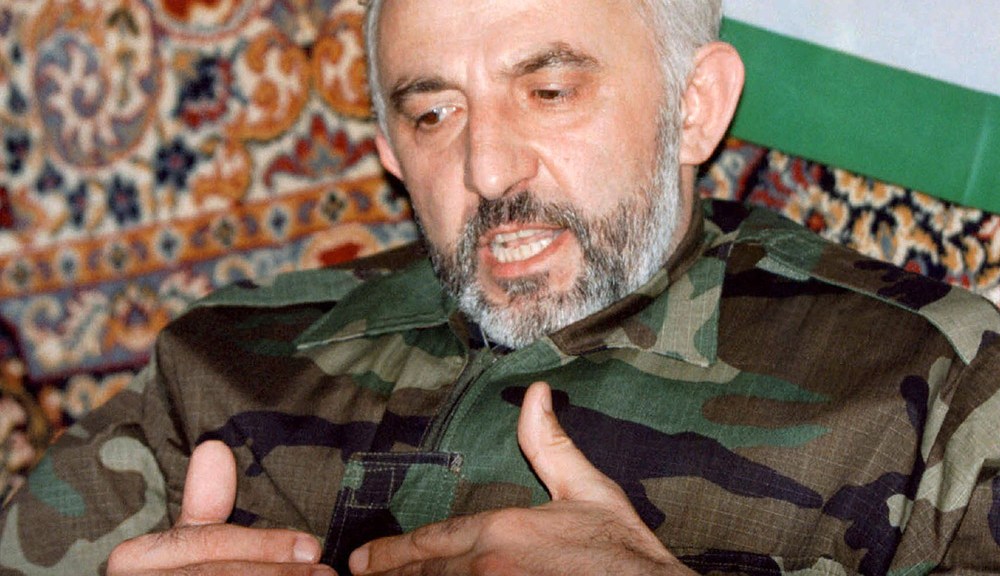


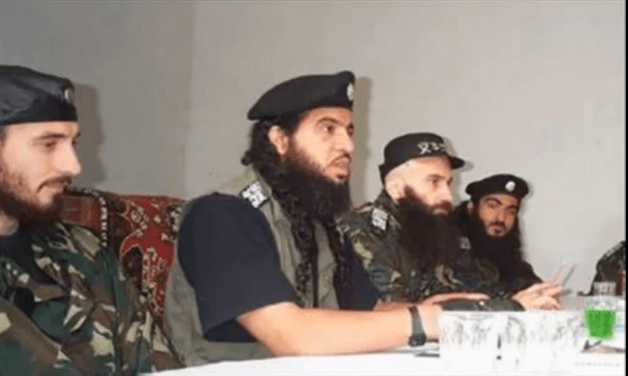

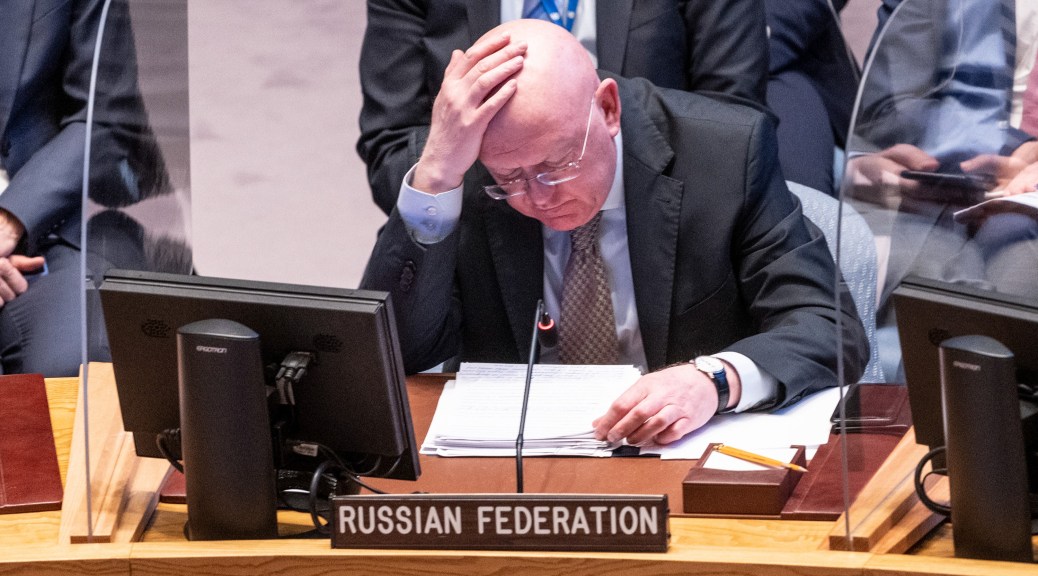


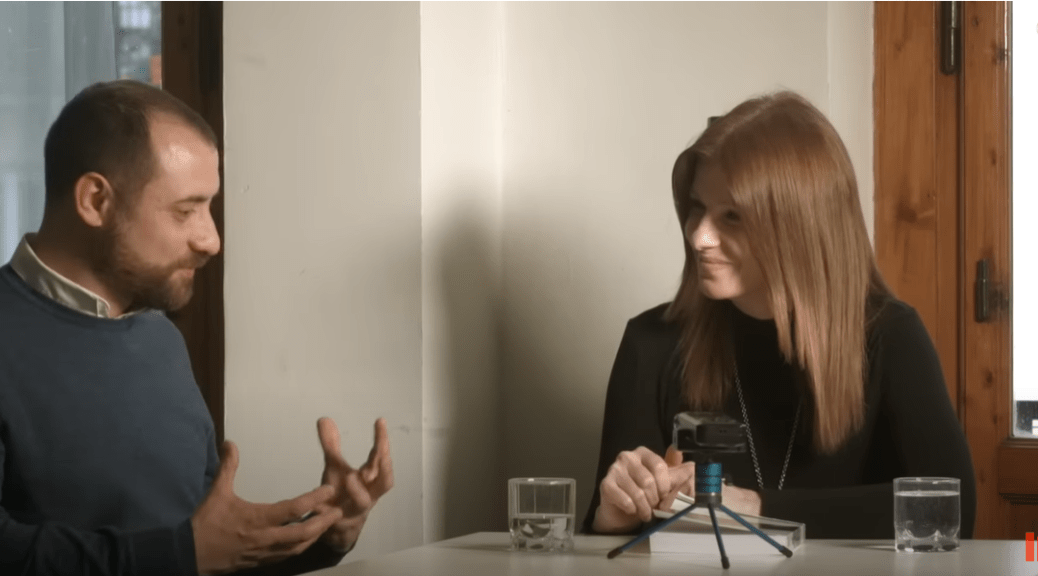


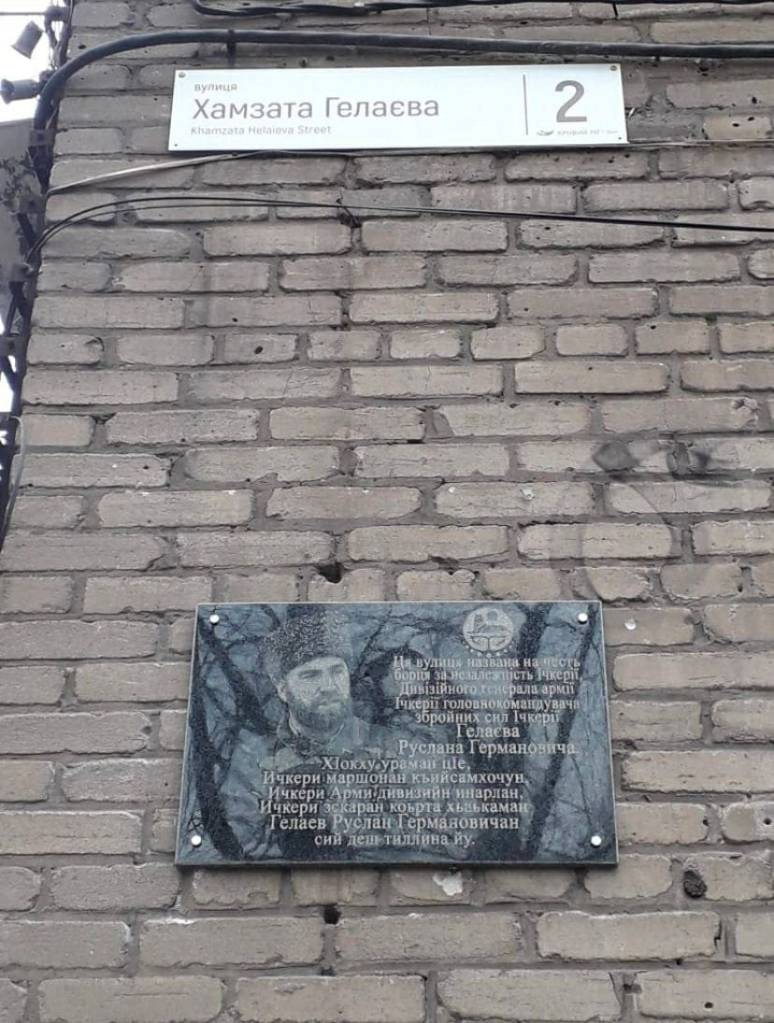




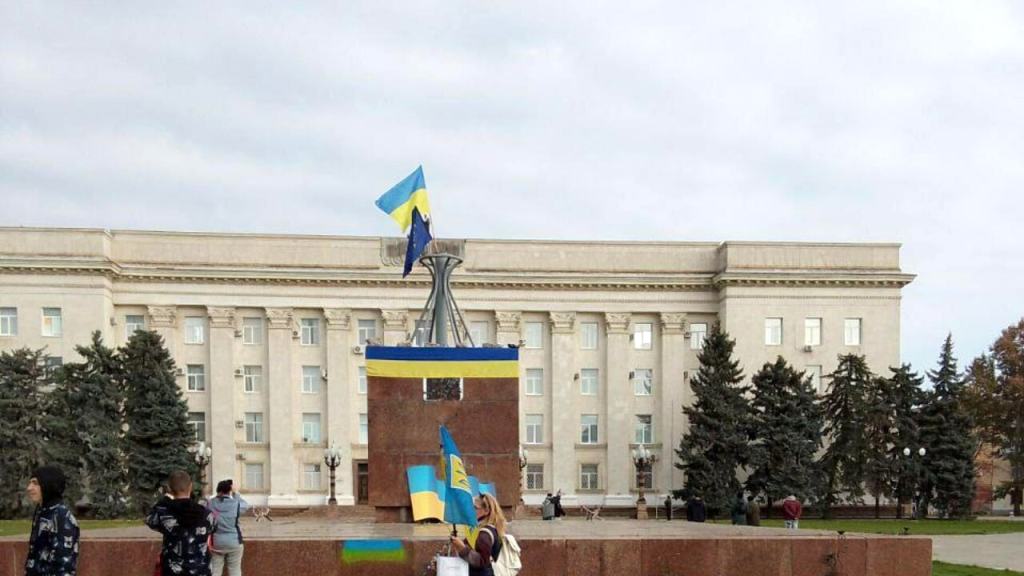
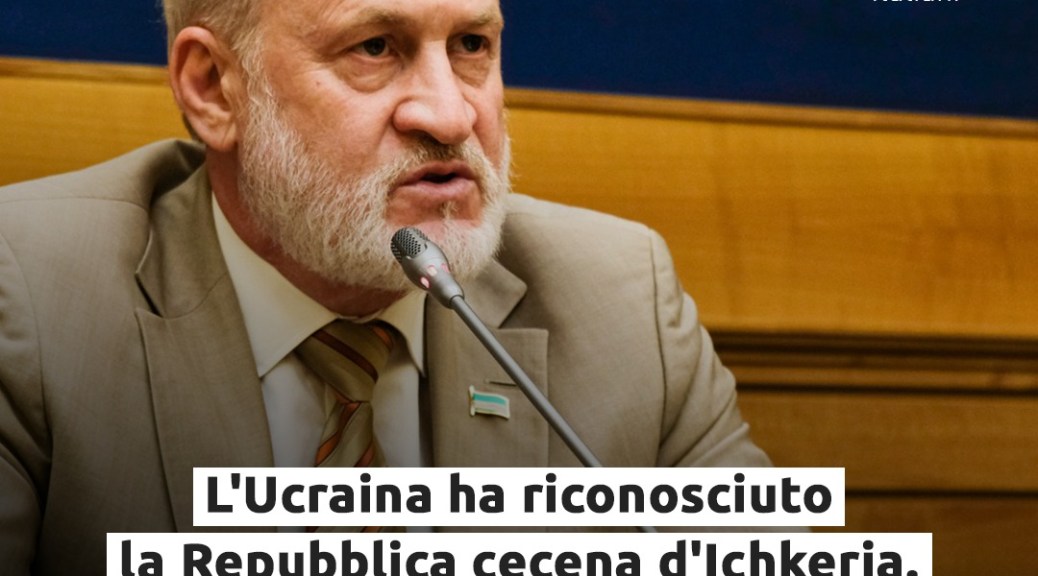
 Ichkeria Digital Archive