Zakayev: “quanto accade in Ucraina è ennesima tappa del colonialismo russo, iniziato negli anni ’90 da Eltsin. Putin deve essere giudicato all’Aja per i suoi crimini; non per vendetta ma per giustizia”.
Si è tenuto al “Polo del ‘900” di Torino il convegno “Dalla Cecenia all’Ucraina”, in cui è intervenuto anche il primo ministro in esilio della Repubblica cecena di Ickeria, Akhmed Zakayev, per la prima volta a Torino. Insieme a lui lo storico Francesco Benedetti e il giornalista Andrea Braschayko.
Nel suo intervento Zakayev ha ripercorso in modo analitico e preciso tutte le aggressioni militari compiute già negli anni ’90 del secolo scorso dalla Federazione Russa contro gli Stati vicini (Inguscezia, Azerbaigian, Moldova, Cecenia, Georgia); le guerre coloniali russe di Eltsin furono la riproposizione dell’imperialismo sovietico, senza alcuna soluzione di continuità. Putin ha preso il testimone da Eltsin e ha continuato l’opera: seconda guerra cecena, occupazione del 20% della Georgia, occupazione del 20% dell’Ucraina (senza dimenticare il fondamentale appoggio militare al regime siriano del criminale Assad).
Zakayev ha poi ribadito che la Corte Penale Internazionale dell’Aia deve processare Vladimir Putin per i suoi crimini, “non per vendetta ma per impedire a Putin di commettere altri crimini e per impedire ad altri di imitare Putin”. E a proposito di crimini russi, al termine del suo intervento, Zakayev ha consegnato nelle mani di Igor Boni (presidente di Europa Radicale) la piu’ alta onorificenza cecena, assegnata (alla memoria) ad Antonio Russo, giornalista di Radio Radicale, ucciso barbaramente in Georgia nel 2000 mentre stava documentando i crimini russi nella vicina Cecenia.
Igor Boni e Silvja Manzi hanno dichiarato:
“Dobbiamo ringraziare Akhmed Zakayev tre volte. La prima perché, dopo oltre trent’anni di lotta incessante per il diritto alla vita del suo Paese, non ha perso una briciola della sua intelligenza politica e della sua passione civile.La seconda per i riconoscimenti reiterati all’impegno dei radicali per la difesa dei valori di libertà e democrazia dalla minaccia putiniana.
Ma soprattutto ringraziamo Zakayev per non avere dimenticato Antonio Russo, “un radicale giornalista” (come lo definì Pannella). E questo proprio nel momento in cui Radio Radicale lotta per la propria sopravvivenza, che è la sopravvivenza di un enorme patrimonio di informazione e conoscenza. Consegneremo l’onorificenza alla direzione di Radio Radicale, per arricchire tale patrimonio”.
A career officer in the Soviet Navy, Alkhazur Abuev (also transliterated as Olkhazur Abuev) was born in the Chechen-Ingush Socialist Republic in the first half of the 1950s.
In 1972, he graduated from the M. V. Frunze Higher Naval Academy in Leningrad, a prestigious Soviet Navy academy, obtaining the rank of Captain First Rank (капитан первого ранга). He served in the Black Sea Fleet and later in the Caspian Flotilla, where he held technical and staff positions.
He left his military career in the early 1990s, during the collapse of the USSR, and returned to Chechnya, apparently in March 1992, where he was immediately appointed by President Dzhokhar Dudaev to the organizational chart of the nascent Chechen national army, obtaining the position of deputy head of the Operational Directorate of the Armed Forces General Staff and, from June 1993, head of the same directorate. At the outbreak of the First Russian-Chechen War, however, Abuev did not take up arms but left the country.
Maskhadov’s Army
Upon his return to his homeland, he was called back by President Aslan Maskhadov to help reorganize the regular army, which, according to the plans of the new head of state, was to be called the National Guard and consist of eight specialized regiments. Maskhadov appointed Abuev Chief of Staff immediately after his election as President. According to Timur Muzaev’s reconstruction, on March 13, 1997, Maskhadov established the National Guard, and on May 15, 1997, Abuev signed the general reorganization of the army, abolishing the previous front commands and centralizing the chain of command.
The Chechen National Guard in 1997
The measures taken by the new Chief of Staff had their own abstract logic and were in line with the President’s desire to professionalize the army, but they did not take into account the important changes that had affected the armed forces during the war. Dudaev’s death had accentuated the tendency of units to rally around their field commanders, and Abuev appeared to be ‘disconnected’ from the natural hierarchies that were forming. The new General Staff’s claim to establish a professional system in an army that resembled more an advanced popular militia than a classic armed force clashed with the convictions (and interests) of many field commanders, who preferred to consider their units in ‘permanent mobilization’, both because they were convinced that war with Russia would soon resume and because they wanted to maintain the privileges and impunity that some of them had acquired.
The friction between Abuev, who was pushing for the demobilization of the armed units, and the main brigade generals, who wanted to avoid it, led to an institutional crisis that, in October 1998, resulted in Abuev’s resignation. He was replaced by Maskhadov with the “veteran” Abubakar Bantaev.
Retirement and final years
At the outbreak of the Second Chechen War (1999), Abuev retired to Baku, Azerbaijan, where he lived for almost ten years. On April 23, 2008, according to Kommersant and RBC News, he voluntarily surrendered to the Russian federal authorities, claiming that he had not participated in armed activities since 1999. The authorities confirmed that, despite having served as Chief of Staff in 1997-1998, he was not involved in war crimes. Akhmed Zakayev commented on his surrender as follows: “I don’t understand why he had to surrender. He could have returned home without announcing it, and there would have been no charges against him.” This position was confirmed by one of Abuev’s relatives, who commented: “In Chechnya, only the laziest or the illiterate are unaware that Olkhazar never fought against the federal forces […] Olkhazar was a naval officer and only arrived in Chechnya after the end of the first war, leaving before the start of the second military campaign. Why turn him into a militant commander?”
After a brief interrogation, he was released and not prosecuted.
Press sources indicated that he still lives in Chechnya under discreet surveillance, maintaining a low profile and staying out of public life.
The Chechen National Guard in 1999
Profile and assessment
Alkhazur Abuev was one of the most atypical figures in the Ichkerian military elite: a Soviet-trained technician, uninterested in religious or revolutionary rhetoric, focused on rebuilding a modern state military structure. He was the main architect of the attempt to transition from a guerrilla army to a regular force, which was thwarted by the fragmentation of the armed forces in 1998 and then by the second Russian invasion of Chechnya. His story—from his career in the USSR Navy to his command of the Ichkerian forces, to his retirement in Baku and surrender in 2008—reflects the trajectory of a generation of Chechen officers who sought to reconcile military professionalism and national identity, only to be crushed between the two logics.
Inal Sharip is the Minister of Foreign Affairs of Ichkeria. Born in 1971, he is a chess champion, a film director and producer, and between the first and second Chechen wars he was Deputy Minister of Culture and head of the Film Department.
Being born in 1971, You had the opportunity to observe the evolution of the situation in Chechnya from the independence until the outbreak of the war in 1994. What was the climate in the country in those years? And what impression did you have of Dudaev’s government?
I lived in Grozny until I graduated from university in 1993. Then I went to Moscow to take my first steps in the cinema. I remember Grozny as an ordinary post-Soviet city no different from other cities in the former USSR or Eastern Europe. As in other cities of the post-Soviet space there was an economic difficult situation. But Dzhokhar Dudayev began to stimulate medium and small businesses and abolished taxes and duties on imported goods. Direct flights were also established from Grozny to cities in the United Arab Emirates and other cities in eastern countries from where the goods were transported. Thanks to this Grozny became in a short time the trade center of the North Caucasus.
When the war started, I was in Moscow, taking my first steps in documentary filmmaking. Many things fade from memory, but what I remember well is the anxiety of realizing that terrible events were coming. Many of my feelings were portrayed in one of my first movies, “My Grozny City”. The piercing pain of what was done to my hometown, which remained only in my memory.
Inal Sharip, Minister of Foreign Affairs of Ichkeria
How did you spend the two years of war? And what did you do after?
At the first opportunity I came to Grozny. I established a secret connection with Akhmed Zakayev. (I met Akhmed Zakayev when I was writing music for the theater, in 1992. We were introduced by our mutual friend, Hussein Guzuev, a theater director. Before the war, Dzhokhar Dudayev appointed him director of television and he was one of the first to be killed at the beginning of the First Chechen War. Akhmed was then a theater artist and became at first chairman of the Chechen Union of Theater Workers. A few months before the war started, Dzhokhar Dudayev appointed Zakayev Minister of Culture. When the war started, Akhmed led the people’s militia.) And he coordinated his activities while in Moscow and Grozny. After the first war, Akhmed returned to work as Minister of Culture and invited me to be Deputy Minister.
Akhmed appointed me head of the Department of Cinematography of the Chechen Republic with the rank of Deputy Minister of Culture. I worked there for about a year. Maskhadov then created a commission on education, science and culture (a prototype of the UNESCO commission) to work on accession and cooperation with UNESCO, and to search for and return cultural property from museums that the Russians had illegally exported to Russia in violation of all international conventions. I was appointed head of this commission. Before leaving Chechnya, I was in charge of this commission.
I was the only member of the commission. It was I who initiated the creation of this commission, because we had to enter international organizations, and UNESCO was an organization we could enter, although without the right to vote in this organization at the first stage. In addition, the Russians have taken many museum exhibits out of Chechnya. Including paintings, a collection of 17th-18th century edged weapons, etc. It was necessary to track them down and return them. The international UNESCO conventions that regulate this kind of situation were an ideal tool, given that Russia had ratified all UNESCO conventions. Maskhadov wrote a decree creating this commission and appointing me to head it. Other than that, I received nothing, no funding, no office, nothing. Few among the military at that time understood the significance of this organization. At that time, everything was focused on the military aspect. That’s why I couldn’t hire people. I could work without a salary, other people could not.
Akhmed Zakayev in 1996
Speaking of the period between 1996 and 1999, what was your impression of the situation? In your opinion, was the Maskhadov government doing a good job? What was the general opinion of the people, in your opinion?
This is one of the most difficult periods in the history of modern Chechnya. Of course, Maskhadov’s government was not ideal, but we must understand the situation it found itself in. Russia was secretly preparing for a second war. It was actively recruiting agents from among the supporters of independence. It was deliberately corrupting Chechen officials. Russian special services were in direct contact with independent commanders of military units, persuading them to commit criminal acts. Russian agents in the Middle East, who specialize in working in the Islamic world, were redirected to Chechnya to split Chechen society along religious lines. In the conditions of post-war devastation and economic crisis, Russia managed to split Chechen society. Of course, at that time few people understood what was really happening. I also did not understand and did not like many things, so in 1998 I left Chechnya and returned to film production.
Now that we have collected information, we see how many FSB agents have infiltrated Chechen society, and we can draw conclusions. Suffice it to say that the Chief Mufti of Chechnya Kadyrov was an FSB agent, but no one talked about it at the time, and the leaders of Chechnya trusted him. In addition, it should be noted that few in Maskhadov’s government understood how world politics actually worked, both in the West and in the East, since there was no international experience. There was no information, no Internet. There was great trust in the Muslim world, based on the myth of the Muslim Brotherhood, but there was no understanding that the governments and intelligence services of most Muslim countries were using religion for their own political and geopolitical interests. Perhaps historians will analyze this period of Chechen history more deeply in the future, but today we can say for sure that Maskhadov was under great pressure from all sides, primarily with the goal of splitting Chechen society.
Boris Eltsin and Vladimir Putin
In 1999, Russia invaded Chechnya for the second time. Shortly before, Vladimir Putin had appeared on the political scene. Do you remember how public opinion experienced his rise to power?
At that time, Russians were tired of crime, corruption and disorder. It seems that discrimination against democracy was deliberate and directed by someone. Of course, what happened in Russia in the nineties has nothing to do with democracy, but it was presented to the people as democratic processes. That is why the people began to miss a strong authoritarian leader, like Stalin, Andropov and others who were leaders of the USSR. A situation was created when the people wanted to get their master back, who would determine their fate for them. In exchange, the new master had to restore order and feed the people. That is why the explosions of apartment buildings, Putin’s harsh rhetoric, all this is part of the scenario of creating a new authoritarian leader of Russia. It should be noted, I say this as a director, that Putin was not the best candidate for this role. He does not have natural charisma. But the circumstances developed in such a way that he was chosen as a collective decision of several influential groups in the Kremlin.
Putin, at the beginning of his career, was a compromise figure for different Kremlin clans. Every Russian billionaire or oligarch has a KGB-FSB general as his head of security. The KGB-FSB nominated three presidential candidates: Primakov, Stepashin, Putin. All of them were from the KGB and all of them were presidential candidates. The least known person, who did not have his own team and was considered harmless for different clans, was Putin, and he was elected. In 25 years, he created his clan, dealt with other clans and now he is the undisputed master in the Kremlin. The problem is that over these 25 years, Russian propaganda has been cultivating Great Russian chauvinism in the people. Chauvinism is constantly present in the Russian people, so cultivating Great Russian chauvinism in the people was not difficult. Putin has created for himself a Putin electorate, which was created for the greatness of Russia, the successor of the tsarist empire, the Soviet empire. Therefore, having removed one tsar, the people will in any case want another tsar and demand revenge for the defeat in Ukraine. Quite recently, Putin said in an interview that the collapse of the USSR is a great geopolitical tragedy. He said this because this is the mood of the people and he expressed the opinion of the Russian people. Therefore, the matter is much more complicated than in one person.
Yes, for a period of time for several years the war may stop, but then preparations for a military revenge in Ukraine will begin. Russians will never forgive the defeat in Ukraine. Just as they could not forgive the defeat from Chechnya in 1996. When they signed a peace treaty with Chechnya, at the same moment they began to prepare for the Second Chechen War. The same will happen in Ukraine. Russia must lose and transform into another democratic state. For example, the leader of the Russian opposition Navalny, who was killed in prison, did not recognize Crimea as Ukrainian. Because in the future he planned to participate in the presidential election campaign, and he must be guided by the opinion of the people. And 90 percent of the population of Russia considers Crimea to be Russia.
So, if I understand correctly, power in Russia is organized as an alliance of clans, and the President is the one who “moderates” the relations between clans. And in this system the FSB is a “clanized” apparatus or is it in competition with these clans?
This was the case before the war in Ukraine. Each major clan had its own people in the FSB leadership. But there was also an FSB clan that included both former and current FSB officers. All this was done with Putin’s approval. Putin was interested in creating a situation where different clans opposed him, and he was at the center of this structure and was an arbiter. In this way, he ensures his own security, and the clans were interested in Putin. But the war in Ukraine changed the balance of power in Russia. Prigozhin’s march on Moscow had a particular impact on these changes. Today, the FSB controls almost everything in Russia. With Shoigu’s departure from the Ministry of Defense, the FSB began a purge of generals and thus the FSB took control of the army. The only person the FSB cannot defeat yet is Kadyrov. Putin supports Kadyrov so that at least someone inside Russia would oppose the FSB. But I assume that the FSB will achieve its goal, and sooner or later the FSB will defeat Kadyrov.
Ramzan Kadyrov hugs Vladimir Putin
Why, in your opinion, does it (the FSB) not control Kadyrov?
Because Putin is interested in this. Putin knows what the KGB and the FSB are, and he knows that they can play their game at any moment. Putin and his clan have stolen hundreds of billions of dollars. Some “patriotic” generals may not like this, and they may try to stage a coup. Therefore, he is trying to minimize the risks. To do this, he must separate the different clans and do everything so that they do not unite. There are Chechen generals in the FSB who have always served Russia and whom the FSB would like to put in charge of Chechnya. But the FSB is not succeeding, because Putin has placed his bet on Kadyrov, whom he allows to commit any crimes, which helps strengthen him. The FSB was counting on the fact that Ramzan Kadyrov and his father are temporary workers, whom they are temporarily using to transfer the Chechen people’s struggle for independence from Russia into a civil war between Chechens. Kadyrov is not a career FSB employee, he is pursuing his own independent policy in the republic, which the FSB does not like.
In this regard, clashes between the FSB and Kadyrov’s men are constantly taking place in Russia, in which Putin has to act as an arbitrator. But so far there has not been a single situation where Putin has infringed on Kadyrov’s interests. The FSB expects that Putin will have to hand over Kadyrov sooner or later. But there is no doubt that Putin will have to choose between the FSB and Kadyrov. The FSB is getting stronger because of the war in Ukraine and is a state-forming institution, so I have no doubt that they will defeat Kadyrov in the future.
As Prime Minister of the Government and Chairman of the State Committee for the De-Occupation of the Chechen Republic of Ichkeria, I would like to express my sincere gratitude for the invitation and the opportunity to participate in this conference. Your work in organizing this important event deserves the highest praise. Your efforts contribute to the strengthening of international cooperation and exchange of experience, which is especially important in our times. I am confident that the results of our joint work will contribute to further progress and strengthening of international relations.
Today I want to begin my speech not with the history of the centuries-long struggle of the Chechen people for independence, but with the war in Ukraine, from which I came to this conference yesterday.
This crisis is not a local problem. It affects the entire international community because it threatens the foundations of a world order based on respect for sovereignty, territorial integrity and human rights. Russia, using military force, has invaded a sovereign State, violating principles that we all have an obligation to defend.
Russia’s military action in Ukraine has resulted in countless human suffering. Thousands of civilians have been killed, millions have been forced to flee their homes, towns and villages have been destroyed. This is a humanitarian catastrophe that requires an immediate and decisive response from the international community.
The Chechen delegation at United Nations in Geneva
For us Chechens, this situation is particularly painful. We know what it means to suffer aggression, violence and occupation. We know the price of freedom and independence, and we cannot stand aside when another people is experiencing similar tragedies. Our hearts and thoughts are with the people of Ukraine, who are showing incredible courage and resilience in this struggle.
Units of the Chechen Republic of Ichkeria are today fighting as part of the international legion of the Armed Forces of Ukraine. Although our homeland is under temporary occupation, we are fighting in Ukraine because it is there that the fate of all humanity is being decided. We realize that today’s world is divided, just as it was during the Second World War. The world after this war will no longer be the same as it was after the Second World War. We are on the threshold of great changes, and we must be ready for them.
Democratic reforms in Russia went downhill not yesterday and not today. We all witnessed how Russia began its departure from democratic reforms after it attacked the Chechen Republic of Ichkeria. Some 300,000 people died in that brutal war, 42,000 of whom were children. The Western world, following its morality and logic, believed that this was a forced measure in the process of developing democracy in Russia. However, this was a delusion. The world did not realize that this was the essence of the Russian empire, which was alien to democratic reforms. It only needed time and Western resources for rebirth and revenge.
Today we can say that there is, in fact, a third world war going on. This conflict affects not only Ukraine and Russia, but the whole world. In many countries there is an economic recession, instability is growing, social and political tensions are increasing. The conflict is expanding and taking on increasingly global proportions.
The world, and the United Nations in particular, must think today about the future of humankind. We need to rethink and strengthen international institutions so that they can effectively prevent such conflicts in the future. We need to create conditions in which aggression and violence will not be possible.
Our struggle, the struggle of the Chechen people, is reminiscent of the Resistance movement led by Charles de Gaulle in France during the Second World War. Back then, the true voice of France was heard through de Gaulle, who was accepted into the anti-Hitler coalition despite his lack of control over the territory. The collaborationist Vichy government collaborated with Hitler, but the true voice of France was de Gaulle’s.
Today, we, Chechens under occupation but fighting in the anti-Putin coalition, are also the true voice of the Chechen people. We hope that here, in the UN building, this voice will sound special and will be heard by all members of the United Nations.
After Russia failed to execute a blitzkrieg and take Kiev in three days, the war dragged on for two and a half years with no clear victories for Russia. As the military campaign continued, Russia faced increased Western coalition support for Ukraine. Under these circumstances, Russia has an interest in destabilizing the world to divert international attention from supporting the Ukrainian people.
One of the clearest examples of such destabilization was the recent conflict in the Middle East. It is quite obvious that the beneficiary of this destabilization is Vladimir Putin. The situation in the Middle East has contributed to the redistribution of resources and attention of the world community, which ultimately weakened the focus on the events in Ukraine.
Using and supporting extremist groups fits into the Kremlin’s long-term strategy of creating chaos and disunity on a global scale. This not only distracts the international community from the war in Ukraine, but also weakens the West by forcing it to allocate forces and resources to several conflicts simultaneously.
In pursuit of global destabilization, Russia is counting on decreased support for Ukraine and the possibility of improving its position in this protracted conflict. However, such actions lead to an even greater escalation of tensions in the world, jeopardizing the security and stability of multiple regions.
From left to right: Iyad Youghar, Akhmed Zakayev, Burak Otzas
We are following with deep concern the unfolding humanitarian catastrophe in Gaza. The violence and suffering endured by civilians require an immediate and decisive response. We are opposed to any form of violence and terror, regardless of the slogans or justifications behind it. Its victims are civilians, including the elderly, women and children. Such actions not only fail to resolve the conflict, but also cause irreparable damage to human life and dignity. We call on all parties to respect international humanitarian law and to cease hostilities immediately.
The way out of this long-standing conflict in the Middle East may be the implementation of the UN resolution on the establishment of a Palestinian state. This solution will not only resolve the long-standing Israeli-Palestinian conflict, but also reduce the level of tension in the region, which in turn will reduce the opportunities for external players to use the situation to their advantage. The establishment of a Palestinian State will be an important step towards peace and stability in the Middle East.
The government of the Chechen Republic of Ichkeria has reasonable suspicions that Vladimir Putin used Ramzan Kadyrov to finance terrorist organizations. These suspicions are supported by the fact that Kadyrov has concentrated significant financial resources in the Middle East, including billions of dollars that could be used to support extremist groups.
Ramzan Kadyrov and his religious extremist sect Akhmat are accused of committing crimes against humanity in the Chechen Republic of Ichkeria and in Ukraine. Their actions include gross human rights violations, murder and torture of civilians, and financing of terrorist groups.
We welcome the International Criminal Court’s (ICC) announcement of the international wanted list for high-ranking Russian figures such as Vladimir Putin, Sergei Shoigu, and Valery Gerasimov. The decision reflects the serious allegations made against these individuals in the context of international crimes. Such a decision inevitably provokes strong political reactions both in Russia and in the international arena, emphasizing the importance of international justice and the principle that even high-ranking leaders are not immune from prosecution for serious crimes. It should be remembered that a wanted notice is the initial stage of the judicial process. In any case, this event emphasizes the importance of the rule of law in the international arena and the desire of the world community for accountability for serious crimes.
In this regard, we hope that the political leadership of Ukraine will soon decide to establish an international tribunal against Ramzan Kadyrov and his terrorist religious sect Akhmat. We call for the appointment of a special representative with whom we will work to coordinate efforts to bring these criminals to justice. The establishment of an international tribunal is an important step towards restoring justice and ensuring peace and security in the region. We stand ready to provide all necessary information and to cooperate with international organizations to achieve that goal.
The international community must unite and take decisive action to stop this aggression. We must strengthen sanctions, provide the necessary support to Ukraine and send a clear message: aggression will never go unanswered. We must do everything possible to restore peace and justice.
History teaches us that evil triumphs when good people fail to act. We cannot afford the luxury of inaction. We must act now to protect our common home, planet Earth, from the destructive forces of aggression and violence.
As I stand here in the United Nations building, I feel a deep sense of gratitude to the Verkhovna Rada of Ukraine. This respected institution has taken a historic step that will go down in the history of the Chechen people by recognizing the territory of the Chechen Republic of Ichkeria as temporarily occupied by Russia.
This act of recognition is an important and courageous step towards justice and freedom for the Chechen people. It symbolizes international solidarity and support in the struggle for human rights and self-determination.
I urge all UN members to support this initiative of the Verkhovna Rada of Ukraine and also recognize the occupation of the Chechen Republic of Ichkeria. Your recognition and support will send an important signal of the international community’s unwavering commitment to the principles of justice, freedom and respect for the sovereignty of peoples.
Recognition of the temporary occupation of the Chechen Republic of Ichkeria would not only underline the importance of international law, but would also be an act of solidarity with the Chechen people, who have been fighting for their freedom and independence for many years.
In conclusion, I would like to express my deep gratitude to all those countries and peoples who support Ukraine in these difficult times. Your solidarity and support is a source of hope and strength for all of us. Let us work together to create a better future where peace, justice and respect for every human being prevail.
Thank you for your attention.
Akhmed Zakayev, Chairman of the Government of the Chechen Republic of Ichkeria
Quella che segue è la trascrizione della prima parte dell’intervista tra Francesco Benedetti ed Akhmed Zakayev realizzata da Inna Kurochkina per INEWS (alleghiamo il link al video originale, che presto sarà accompagnato da sottotitoli in inglese ed italiano)
1. Il 6 dicembre 1994, pochi giorni prima che l’esercito federale invadesse la Cecenia, una delegazione nominata da Dudayev si recò a Vladikavkaz per conferire con il ministro russo per le Nazionalità, Mikhailov. Nelle sue memorie lei dice che un certo numero di imprenditori petroliferi si è unito alla delegazione guidata dal ministro dell’Economia Abubakarov. Quale pensa fosse lo scopo della loro presenza? È possibile che tra le proposte che la delegazione avrebbe dovuto presentare ci fosse un accordo sullo sfruttamento del petrolio ceceno o sullo sfruttamento delle raffinerie cecene?
In quel momento e durante quel periodo, la presenza in questa delegazione del Ministro dell’Economia e delle Finanze Abubakarov, e del Vice Primo Ministro Amaliyev, non era associata ad alcun possibile accordo sul funzionamento delle raffinerie di petrolio. Erano i nostri rappresentanti e delegati di Dzhokhar Dudayev. Non solo hanno “aderito”, ma sono stati inclusi in questa delegazione. E da lì sono andati da Kizlyar a Mosca, per approfondire la questione della prevenzione dell’aggressione militare dalla Russia, per prevenire una guerra. Dzhokhar ha fatto tutto il possibile per prevenire lo scoppio delle ostilità in Cecenia. E praticamente la nostra delegazione era a Mosca, guidata da Tyushi Amaliyev, con Abubakarov, il ministro delle finanze e dell’economia, quando la Russia ha iniziato a bombardare Grozny. L’11 dicembre, nonostante tutto, Eltsin ha firmato un decreto sull’introduzione delle truppe e l’inizio di una campagna militare. Quindi, in quel momento e in quel periodo, non si trattava del funzionamento dei pozzi petroliferi, o meglio, dell’utilizzo delle raffinerie di petrolio, o del petrolio ceceno che si produceva in quel momento.
2. Allo scoppio della guerra lei si è messo al servizio del presidente Dudayev e nel giro di pochi mesi le è stato affidato il compito di allestire un fronte autonomo. All’epoca lei era Ministro della Cultura, di certo nessuno si aspettava che prendesse le armi e facesse la guerra. Perché ha deciso di arruolarsi?
(ride)
Il fatto è che non sono andato al servizio di Dudayev. Sono stato nominato ministro della cultura della Repubblica cecena di Ichkeria con decreto di Dudayev. Nessuno ha servito nessuno. Abbiamo lavorato per il nostro stato e Dzhokhar Dudayev, in qualità di presidente, aveva l’autorità di nominare e revocare. La mia nomina fu in ottobre, quando Dzhokhar Dudayev mi ha offerto di lavorare nella sua squadra. L’ho accettata nonostante tutto quello che è successo. Dico solo nel mio libro che per me non c’era differenza, era assolutamente ovvio che ci sarebbe stata una guerra. E ho detto a Dzhokhar: “Dzhokhar, non fa differenza per me in quale veste difenderò la nostra patria, il mio posto è qui, con la mia gente. Come un bidello, o come un ministro .. ” Dzhokhar ha poi detto, ricordo le sue parole, ne ho appena scritto. Egli ha detto: “No, non ci sarà nessuna guerra. Il mondo non lo permetterà. Non lo permetterò. Non ci sarà la guerra, dobbiamo fare un lavoro creativo. E il tuo posto è esattamente in questa direzione. E quindi devi accettare la mia offerta. Ho accettato questa offerta. Sono tornato nella repubblica e già il primo giorno, il 18 novembre, sono andato ufficialmente a lavorare e il 26 novembre è iniziata la guerra.
In linea di principio, questa è la prima invasione delle truppe russe con il pretesto della ‘”opposizione cecena” nella città di Grozny, dove furono sconfitte. E ora per la seconda parte della domanda. Il fatto è che secondo la nostra legislazione, penso che sia lo stesso in Italia, i membri del governo, se inizia una guerra, diventano responsabili del servizio militare, indipendentemente dalla loro posizione. Cultura, o arte, non importa, tutti diventano responsabili del servizio militare. Io, in linea di principio, prima di essere nominato comandante del settimo fronte, mi sono unito alla milizia popolare. Ricordo quel giorno, il 28 dicembre, quando fu bombardato il mio ufficio del Ministero della Cultura, nel palazzo del Sindaco, e lo stesso giorno io… C’era gente in piazza che si arruolava volontaria nella milizia popolare. Mi sono iscritto alla milizia e solo l’11 gennaio Dzhokhar mi ha richiamato dalla carica di ministro della Cultura, perché era prevista una riunione del governo. E sono tornato dalle mie posizioni alla riunione del governo l’11 gennaio. E in questo giorno Dzhokhar mi ha affidato un altro compito, ne ho scritto anche nelle mie memorie, e poi, già a marzo, quando la città è stata abbandonata e ci siamo ritirati a piedi, a quel tempo Dzhokhar firmò il Decreto sulla creazione del Settimo Fronte e mi nominò Comandante. Cioè, abbiamo iniziato a formare questo fronte, in generale, da zero.
3. Dopo la caduta di Grozny in mano russa, e il ritiro delle forze cecene sulla linea di difesa della montagna, il governo è stato riorganizzato per sopperire alle defezioni di alcuni alti funzionari, ma anche per funzionare in modo più snello in un contesto di guerra totale. Questo “governo di guerra” ha continuato a funzionare per tutto il durata del conflitto, e superò la morte di Dudayev, mettendosi a disposizione del Presidente ad interim, Yandarbiev. Come ha operato questo governo, e come è riuscito a incontrarsi, a tenersi in contatto con il Presidente?
Il Governo Militare, quello che tu chiami il Governo Militare, era il Comitato di Difesa dello Stato, formatosi con Decreto Presidenziale quando iniziò l’aggressione militare. E questo corpo era l’organo supremo dello Stato. Il Parlamento ha interrotto la sua attività legislativa. Il governo era già stato trasferito su una base militare e il Comitato di difesa dello Stato era stato formato come Organo supremo del potere statale. Comprendeva membri del Governo, membri del Parlamento, il Comando Militare Principale rappresentato dallo Stato Maggiore Generale, i Comandanti di Fronti e Direzioni. E questo governo ha funzionato per tutto questo periodo. Come sono stati gli incontri? Naturalmente, sapevamo tutti dove si trovava il comandante in capo supremo, in quale parte della repubblica. E periodicamente convocava una riunione del Comitato per la difesa dello Stato, e discutevamo questioni relative alla continuazione della resistenza. Sono state discusse questioni di natura militare in relazione alla preparazione di operazioni militari o attacchi al territorio nemico. Tutti questi punti sono stati discussi durante la riunione del Comitato per la difesa dello Stato, che ha funzionato in modo molto efficace. Era un piccolo numero di persone, ma erano persone direttamente coinvolte in tutti i processi: questioni politiche, militari, economiche. Questi compiti non erano gli unici che avevamo, perché dovevamo anche fornire alle unità le disposizioni necessarie, anche questo era di competenza del Comitato per la difesa dello Stato. E tutte queste questioni sono state discusse e hanno funzionato in modo molto efficace proprio per il fatto che Dzhokhar Dudayev non è andato sottoterra, nelle foreste, nelle montagne, dove sarebbe stato impossibile rintracciarlo, ma ha tenuto incontri personali con tutte le unità, no solo con il Comitato di Difesa dello Stato ma anche con le unità militari. È andato in prima linea, al fronte, ha incontrato soldati ordinari. E tutta la nostra difesa e tutti i nostri combattenti della resistenza, hanno assunto un atteggiamento molto responsabile perché dietro di loro c’era Dzhokhar Dudayev. Voglio dire, lungo la linea del fronte, dove si svolgevano le ostilità attive, i soldati sapevano che dietro di loro, dietro le loro spalle, c’era già il quartier generale del comandante supremo.
Quando [Dudaev] attraversava l’Argun, andando dall’altra parte, le Forze Armate [che operavano lì] hanno annunciato con orgoglio che il Comandante Supremo era ora dalla loro parte del fronte. C’era un’atmosfera molto amichevole. Quando ricordo questi tempi, questo periodo, noto che nonostante tutte le difficoltà che abbiamo vissuto allora, c’era una guerra, ma le persone erano diverse. Eravamo diversi. I ceceni erano completamente diversi. Erano diversi dai ceceni di oggi, quelli che vivono nel territorio e quelli che sono fuori. E tutto ciò era collegato, credo, al fatto che siamo stati sotto l’occupazione sovietica per settant’anni e per la prima volta abbiamo avuto la possibilità di costruire il nostro stato. Stato indipendente. E il leader di questo movimento e dello stato, e in seguito il leader della Difesa e il leader del movimento di liberazione nazionale, ha ispirato in molti modi e non solo i combattenti, ma l’intero popolo ceceno a resistere e respingere l’aggressione. Erano tempi semplicemente fantastici nella storia del popolo ceceno, quando l’intero popolo ha effettivamente compiuto un’impresa. È stato grazie all’impresa del popolo ceceno che siamo riusciti a preservare le strutture di potere che ciò che stavamo costruendo. E fondamentalmente a vincere.
4. Tra marzo e maggio 1995, secondo quanto lei riferisce nelle sue memorie, lei si è occupato di allestire, a tempo di record e con mezzi pressoché inesistenti, il cosiddetto “Settimo fronte” a sud di Urus – Martan, che avrebbe dovuto essere il punto di contatto tra la roccaforte di Bamut e il resto dello schieramento ceceno. Nel suo libro racconta di come è nato il Settimo Fronte. Potrebbe spiegarci come si è sviluppato, quali unità lo componevano e quali operazioni ha svolto fino al giugno 1995?
Questo è successo a marzo, Dzhokhar Dudayev ha firmato un decreto. A questo punto tutte le nostre unità si erano spostate ai piedi delle montagne, perchè la parte pianeggiante era già principalmente sotto il controllo degli aggressori russi, e rimanevano i contrafforti, a partire da Bamut e ad Alkhazurovo, in questa direzione, e lì più in alto, verso la regione di Grozny, a Chishki, a Dacha Borzoi. Questa parte non era ancora occupata dai russi, ed era necessario creare una difesa unificata in questa direzione, da Bamut ad Alkhazurovo. E lo scopo del Settimo Fronte, il compito del Settimo Fronte, era proprio questo. Questo è il cosiddetto distretto di Urus – Martanovsky. Si credeva che quest’area fosse fedele alla Russia, agli aggressori russi, perché lì funzionava il regime di occupazione, le strutture del potere di occupazione, guidate da Yusup Elmurzaev, l’allora prefetto, che fu nominato dalle autorità di occupazione. Il compito principale di questo fronte era la creazione di basi militari in tre gole: Martan Chu, Tangi Chu, Roshni Chu. Fu in queste tre gole che in pochi mesi formammo tre basi militari. Sebbene al momento della firma del decreto, non vi fossero praticamente unità militari (c’erano solo milizie, persone che facevano parte della milizia popolare, ma non c’era un comando centralizzato) noi in breve tempo, da quelle unità, da quelle milizie popolari che erano allora in questa regione, creammo questo Settimo Fronte, e un’unità militare centralizzata, sotto il comando del Comandante in Capo Supremo Dzhokhar Dudayev. Successivamente, questo Settimo Fronte fu trasformato in Settori del Fronte Sud-Occidentale: Il Primo, il Secondo, e ilTerzo Settore. Questi settori erano sotto la mia responsabilità. Successivamente sono stato responsabile del Terzo Settore del Fronte Sudoccidentale. Citando i cognomi, questi sono, in linea di massima, i nostri giovani comandanti di medio livello, Dokka Makhaev, Dokka Umarov, Khamzat Labazanov, Isa Munaev, questi ragazzi …
Akhyad (non lo chiamerò con il suo cognome, perché è vivo ed è sul territorio), Khusein Isabaev, erano questi ragazzi l’anello intermedio dei comandanti che guidavano questi settori e questa direzione. Sebbene fosse già un’unica unità militare, che faceva parte delle Forze Armate ed era già stata strutturata nello Stato Maggiore delle Forze Armate della CRI.
5. Nella primavera del 1995 lei poteva considerarsi uno dei principali ufficiali dell’esercito della ChRI, ed era sicuramente monitorato dall’FSB e dall’intelligence dell’esercito russo. In che modo le forze federali hanno cercato di impedire a lei e ad altri alti ufficiali di partecipare alla resistenza? E come siete riusciti a eluderle?
Prima di tutto, Dio ci ha protetti. E, in secondo luogo, sono stati i ceceni e il popolo ceceno. Eravamo a casa. Eravamo nei nostri villaggi nativi, nei nostri insediamenti nativi. E, naturalmente, il popolo ceceno era la principale protezione di coloro che erano allora nelle forze armate. E il presidente Dzhokhar Dudayev, sai, la repubblica è piccola, per tutto questo tempo è stato tra i ceceni, era in diversi insediamenti, in ogni villaggio dove i combattenti si sono fermati, anche se c’erano anche persone di mentalità opposta e codarde. Ma in generale, i nostri sostenitori, sostenitori e indipendenza, e coloro che hanno sostenuto il nostro movimento di liberazione nazionale, erano molto più forti ed erano molto più numerosi. Riuscirono a sventare sia i tentativi di assassinio che quegli agguati che tesero non solo me, ma anche coloro che allora furono coinvolti ed erano inseriti nei ranghi, come hai detto, nella più alta composizione del Comando. Tutti erano protetti dal Popolo ceceno. E, naturalmente, non tutto era sotto il controllo né dell’FSB né dei russi. La vita e la morte sono nelle mani di Dio. E quelle ragioni, quelle azioni che sono state intraprese da noi per sopravvivere, e cosa hanno fatto i ceceni con noi, il popolo ceceno, proteggendo i loro comandanti, le persone che hanno difeso la loro patria, la loro patria e se stesse.
President of Ukraine Volodymyr Zelensky received the highest state awards from the government of the Chechen Republic of Ichkeria in exile – the Order of Honor of the Nation (Qoman Sij) and the Order named after Dzhokhar Dudayev.
The head of the Ukrainian state was honored for outstanding services and selfless deeds for the sake of freedom and democracy throughout the world and for personal services to the Chechen people.
“His political steadfastness and loyalty to his native country managed to mobilize the Ukrainian people in the face of the imminent threat of Russia’s secular enemy and bloodthirsty monsters who seized power by terrorist methods,” says the decree signed by the head of the government of the Chechen Republic of Ichkeria in exile, Akhmed Zakayev, on 27 November last year.
The awards were personally presented to the Head of State by the head of the Main Intelligence Directorate of the Ministry of Defense of Ukraine, Kyrylo Budanov.
The Order of Dzhokhar Dudayev is awarded to holders of the Order of Honor of the Nation. Chechen politicians Aslan Maskhadov and Zelimkhan Yandarbiyev, as well as Lithuanian statesman Vytautas Landsbergis were awarded this order.
A few days ago Francesco Benedetti met Inna Kurochkina in Florence. The interview that emerged takes up the speeches addressed in another chat, which took place more or less a year ago, shortly before Russia invaded Ukraine. In the course of this year many things have changed, Francis’ work has moved forward and with it his awareness of how important the history of Chechnya is for the West.
We reproduce the video of the interview, attaching the transcript in English.
ENGLISH TRANSCRIPTION
First of all I would like to congratulate you from all visitors, subscribers who have already read your first volume. From today it is possible to have this second volume. How is it possible to have it?
First of all thanks to you, and thanks to all those who appreciated the first volume, and who gave me this consideration. The book is currently available in Italian, on Amazon, but will soon be available in English, thanks to the collaboration of Orts Akhmadov, son of Ilyas Akhmadov, who is working with me on the English version, and will soon also be available in Russian and Chechen, as for the first volume.
The other time we met and talked about your book was December 2021 and perhaps we were expecting war, this tragedy. Then we met in Brussels on the first day of the war, when both we and you met Akhmed Zakayev for the first time. With your help we attended some Radicali Italiani events, these very good people who organized Akhmed Zakayev’s visit to Italy, so somehow you are involved in our activities and in Ichkeria’s. How has your life changed during this year?
I have certainly had more real experiences with respect to this theme. I was a simple student of the history of the Chechen Republic of Ichkeria, but my experience was purely theoretical, abstract, not concrete, material. Since that day I have had the opportunity to speak with many people, and this second book is also written thanks to the memoirs of about a hundred people with whom I have spoken. Thus, my knowledge of that historical experience and of the human experience of the Chechens has grown enormously. From February to today I have given faces, names and lives to an experience that for me until then had only been theoretical.
You and I are working on the history of the Chechen Republic of Ichkeria, because I am also doing a cycle of chronicles. Do you understand the expression “in your skin”? How did you feel firsthand how the war was coming to Chechnya?
One of the questions I ask myself while studying the history of Chechnya, and in particular when studying this period, was “how would I have felt if I had found myself in that situation?” And I ask myself this question almost every day, because my study is based on the memories of the people I interview, and my interviews focus precisely on this aspect of every historical event: naturally I ask for information, names, dates, etc., but the first question I asked in almost every interview was “how did you feel at that moment?” “How did you spend the period between 26 November and 11 December (the time between the storming of Grozny by the pro-Russian opposition and the invasion). Personally, I try every day to imagine what the feelings of the people waiting for the war were, what they were thinking: their children, their families, how to save their families, how to save their things, their money, their cars, their homes. An event like this can completely destroy life, change people’s lives forever. I think I’m quite an empathic person, and I assure you that writing this book I suffered a lot. Like any author, I often re-read the book I’ve read, and every time I have the same feeling of tragedy on the one hand, and admiration on the other for those people who survived the war, in this case managing to win it, against their invaders .
I would like to understand how you frame the nature of the Chechen people. I was born in Georgia, I’m Ukrainian. I would like to work for the Georgian people, or for the Chechen people, but my whole heart now belongs to the Chechen people, I don’t know why. How could you describe your feeling towards the Chechen people? Because if you fell in love with this people, you did it because you have a passion in you.
I understand what you think because, when I think about it, what happened to me is really strange. I live in Tuscany, and I have no family, economic or any other connection with Chechnya. Yet ever since I was a child, something happened the first time I heard the name “Chechnya”. I don’t know exactly what, an elective affinity that has grown inside me, and I don’t know exactly why.
What I love about the Chechen people about this story is their ability to show happiness in tragedy. In them I have seen people who don’t want to be considered victims, but people who manage to find the beauty of life in everything. They have shown the world how to laugh in the face of death, and how to preserve humanity even in a situation which, if I imagine myself in their place, would strip humanity away from me as well. If a war destroyed my life maybe I’d go crazy. I have spoken to many people who have fought a war and have not gone mad, but rather have kept their kindness, their being good people. I don’t know if I would be able to keep these qualities in myself, fighting a war. I think this character trait of the Chechens is beautiful: the fact that they have managed to keep their happiness and will to live despite going through such bitter experiences.
Knowing this special character trait of this people, let’s think about how much Russia has gone to destroy them. It’s a biblical story for me. What do you think about it?
When a bully tries to hit a victim, and the victim smiles at him, the bully will become even more angry, but will ultimately be defeated by his victim’s resilience. In this sense I loved the struggle of the Chechens who showed the Russians that their spirit would never break.
In this last year we realized that the Ukrainians didn’t understand what the war in Chechnya was, just like the Russians they didn’t care about it. Now they have understood, and the Ukrainian parliament has recognized the independence, the state of occupation and the genocide of the Chechen people. What needs to happen for even Russian liberals to understand this tragedy? In their view of life there is no Chechen war and no Chechen tragedy, and of course there is no Ichkeria. What do you think?
I think Russian liberals are also part of the Russian empire. Maybe they want a “liberal empire”? Maybe it’s nonsense. I don’t think that in this sense there is much difference between the radical parties and the moderate or liberal ones. Everyone wants the same thing: to strengthen the empire, in one form or another. Maybe Russian liberals don’t want to fight the war in Ukraine, but they also don’t want to lose the integrity of their empire. I don’t see anything strange in this. I’m more used to studying and reading the news of another empire, the American one, and the liberals of the American empire are no less angry and aggressive than the nationalists. Citizens of an empire grow up thinking the only way to preserve the country is to stick together and squash any dissonant voices.
I was very surprised by your “hobby”. I’m going to show snippets from one of your band’s videos, which is called “Inner Code”. Tell me about this song about empire. I’m so surprised because you’re from Florence, we can’t relate the concept of “empire” with the city of Rome, which is so beautiful.
Rome in this song is the archetype of the empire. When we think of the Roman Empire we think of the empire by definition. The Russian Empire itself is inspired by the Roman Empire. The word “Tsar” is the translation of the Latin “Caesar”, the Kaiser of the German Empire is the Germanic translation of “Caesar”, and so on. “He will burn Rome” speaks of the fall of Rome, but by extension it speaks of the fall of all empires. No matter how big and strong, every empire will fall sooner or later. When I listen to this song I find a connection with the story we are talking about, being a story that can work with any empire, even the Russian one. However, I recommend listening to the song at a low volume!
[…]
Basically, everything we are talking about revolves around the word “Freedom”. You are a free person in all respects, as I see. Do you see the freedom of Ichkeria under attack? Do you think the imperial forces, the FSB , want to cancel this goal of freedom? We perceive these attacks, for example those that are being carried out against Akhmed Zakayev, a person who is a symbol of freedom of Ichkeria. Do you perceive these attacks from Italy?
I guess this behavior is consistent with the situation. I have an indirect perception of this, because unfortunately Italian newspapers don’t report much on what is happening in Chechnya or in the Chechen diaspora. However, having some contact with members of the Chechen diaspora due to my studies, I imagine that these people are talking about present and future plans to achieve independence and freedom for Chechnya and sometimes they do it in heated discussions, or getting angry. I speak as an Italian, I don’t think I have the right to tell the Chechens what they have to do. Only, seeing what is happening in the Chechen diaspora from the outside, I notice that there are “unresolved issues” and it is possible that the FSB , or anyone who does not want an independent Chechnya, could emphasize these divisions on the pro-independence front to weaken it. I hope people don’t fall into this trap. I don’t know if Chechnya’s independence is far or near, but it is important that at every step we find ourselves in the best condition to gather all our strength together to win freedom.
In recent months, also thanks to you and to the Italian Radicals (I am thinking of the meeting in Rome between Zakayev and Benedetto della Vedova, the speech to the Italian parliament, the recognition of Ichkeria by the Ukrainian parliament, the just finished speech by Zakayev at the European Parliament etc.) we have seen an evolution in the proposal of the government of Ichkeria. In Brussels, Zakayev presented a project for the reconstitution of the Republic of the Mountain, established in 1918 and dissolved by the Bolsheviks, and which Zviad Gamsakhurdia and Dzhokhar Dudaev at the time wanted to reconstitute in the 1990s. Now Zakayev is carrying out this idea, this project, and the Minister of Foreign Affairs, Inal Sharip has gone to Washington DC and is presenting it there. As a historian, do you think this project of the Mountain Republic is safer, more feasible than independent Chechnya? Do you think Chechnya alone could survive its monstrous neighbors?
I think creating a confederation is very difficult, but if it is led by a strong center, it can multiply the strength of every single member. If the confederation is a simple sum of subjects I don’t think it will last long. An example can be that of the European Union: a sum of countries, but its strength is not equivalent to the sum of the forces that compose it. Because each country defends its interests, and this is a problem because a state built like this cannot resist the forces of countries like the United States, Russia, China. The problem with our confederation is that we don’t have a center, a nation that holds all the others together. And every time one of the European nations takes supremacy, the others fight against it. So our European confederation is politically weak. If the Chechens want to lead a confederation they don’t have to do it like the Europeans did. If they are credible enough to attract other nations into a confederation of which they are the centre, not as an imperial centre, but as the place of those who believe most of all in this project, and who are ready to sacrifice themselves for it more than the others to keep everyone together, then I think this is a political project that can last. Like, for example, the United States, which is a confederacy that, after some major problems, has become the most powerful nation on earth. A confederation, therefore, can last, but you need a center that has the credibility and strength to hold all the others together, not by force but by setting an example. I think the Chechens have shown the world great examples more than once.
In 1997 Russia and Chechnya signed a peace treaty which was later betrayed. What do you think about the desire of the world community to persuade Ukraine to sign a similar treaty with Russia?
Looking at history, it is perfectly understood that the real value of documents depends on whether or not they reflect the real situation. In 1997 Russia signed a peace treaty, but while it was signing it was preparing its second invasion. In my opinion, if he now accepts a compromise with Russia, this compromise will in no case fix any situation, because I don’t think the Russians would be satisfied, and neither would the Ukrainians. I believe that a compromise now would only be a way of moving the war forward by three or four years. I believe that this is a moment in which it is necessary to solve a problem that was born in Chechnya. In a wonderful review by Adriano Sofri, an Italian who knows Chechnya well, and who wrote a wonderful article on this book, he says that what happened in Ukraine is a remake of what happened in Chechnya and Georgia, and that Ukraine is the end of a line that starts in Chechnya. It is time to break this line once and for all, otherwise we will have to add another point to this line in four or five years. As a European I reflect on the fact that this line does not go away from Europe, but from Chechnya towards Europe. The next point will be even closer to our home, not further away. I think Europe should think about this. If they don’t stop this process now, they will face it again even closer to home.
Quello che segue è il testo integrale dell’intervento presentato dal Presidente del Gabinetto dei Ministri del governo ceceno, Akhmed Zakayev, al Congresso Nazionale dei Radicali, svoltosi a Rimini tra il 9 e l’11 Dicembre 2022. Lo avevamo tradotto per l’occasione dall’inglese, affinchè potesse essere distribuito agli astanti. Lo riproponiamo ai lettori di questo blog.
11.12.2022 Rimini, Italia
Signor Presidente,
Signore e signori,
All’inizio del mio intervento, vorrei ringraziare gli organizzatori di questo forum. In particolare ” Radicali Italiani ”. così come tutti i membri del movimento.
Da più di 30 anni partecipo direttamente ai processi militari e politici in corso sia all’interno della stessa Cecenia, sia – ora – al di fuori della Cecenia. Le informazioni rilasciate dagli uffici stampa dei ministeri e delle agenzie russe hanno lo scopo di distogliere l’attenzione da fatti oggettivi. Gli ideologi del Cremlino praticano ancora la teoria totalitaria secondo cui se ripeti mille volte una bugia, diventerà la verità. Preferisco l’affermazione di Abraham Lincoln: che puoi ingannare alcune persone per sempre, e tutte le persone per qualche tempo, ma mai tutte le persone per sempre.
Il presente e il futuro di qualsiasi conflitto devono essere definiti innanzitutto dalla natura di quel conflitto. Probabilmente avrete sentito dozzine di versioni delle origini del conflitto tra Russia e Cecenia. Le riserve petrolifere e il terrorismo islamico internazionale hanno poco o nulla a che fare con l’origine del conflitto. Vorrei spiegare di cosa ha così paura il governo russo.
Dall’inizio della guerra russo-cecena, l’11 dicembre 1994, ogni tentativo della comunità mondiale di impegnarsi nella soluzione pacifica del conflitto è stato bloccato dalla tesi dell’integrità territoriale della Federazione Russa. Oggi che il nostro conflitto è degenerato in un circolo vizioso, è estremamente importante esaminarlo dal punto di vista della sua legalità. Epiteti come “autodichiarato”, “separatista”, “ribelle” o “non riconosciuto” sono spesso usati per descrivere la Repubblica cecena. Essi non si basano su fatti storici e legali.
Lo status sovrano della Repubblica cecena è legittimo quanto lo era l’URSS. Nell’aprile 1990, durante le riforme del sistema sovietico di Gorbaciov, il Soviet Supremo dell’URSS adottò due leggi di fondamentale importanza per le nazioni dell’Unione Sovietica.
Il 10 aprile 1990. “Sulla base dei rapporti economici tra l’URSS e l’Unione e le Repubbliche Autonome” Poi il 26 aprile 1990 “Sulla divisione dell’autorità tra l’URSS ei sudditi della Federazione”. Questa normativa conteneva, accanto a disposizioni più generali, una serie di articoli che modificarono radicalmente lo statuto delle repubbliche autonome. Da quel momento esse condivisero gli stessi diritti delle altre repubbliche sovrane. Entrambi i tipi di repubbliche godettero del diritto alla “libera autodeterminazione dei popoli”.
Il 27 novembre 1990 , a seguito di un editto ufficiale del Soviet Supremo dell’URSS, il Soviet Supremo della Repubblica ceceno-inguscia ha adottato una Dichiarazione sulla sovranità dello Stato.
Per tutta la vita dell’URSS, tutto ciò che aveva a che fare con lo status giuridico, la “statalità” ei confini delle varie entità etniche all’interno del paese era prerogativa esclusiva del Soviet Supremo dell’URSS.
Il motivo per cui sto entrando così nei dettagli è perché possiate capire che non c’è stata alcuna rivolta, nessuna presa del potere da parte di separatisti armati. La sovranità della Repubblica cecena è stata stabilita dall’adozione nell’URSS di diverse nuove leggi nell’aprile 1990, e quindi era assolutamente legale e legittima ai sensi del diritto sovietico, del diritto russo e del diritto internazionale.
Quindi, quando l’Unione Sovietica fu sciolta nel dicembre 1991, la Repubblica cecena esisteva da più di un anno come stato sovrano, riconosciuto nell’ordinamento giuridico dell’URSS, uguale a tutte le “Repubbliche dell’Unione” (Russia, Georgia , Ucraina, Stati baltici e altri) e si stava preparando a firmare il Trattato dell’Unione aggiornato.
Lo status paritario della Repubblica cecena è stato infatti riconosciuto dal governo della Russia nel 1992, in occasione della spartizione ufficiale delle armi e dei beni dell’ex esercito sovietico che si trovavano nella Repubblica di Cecenia. Una simile divisione delle armi e dei beni dell’esercito sovietico ebbe luogo tra la Russia e tutte le ex repubbliche dell’URSS.
Il 1992 è stato un anno chiave per la Repubblica cecena a causa di altri due eventi che hanno avuto luogo: il primo è stato l’adozione della nostra Costituzione, che ha confermato lo status della Repubblica cecena come Stato sovrano democratico. La seconda è stata la firma del Trattato federale in Russia, cui la Repubblica cecena non ha partecipato.
Akhmed Zakayev
Da dove viene l’espressione “la Cecenia fa parte della Russia”?
Nell’ottobre 1993 il presidente Eltsin ordinò alle truppe di sparare sul parlamento russo e disperse l’assemblea. Quando il presidente Eltsin ordinò un referendum per una costituzione russa, non esisteva né il parlamento russo né la costituzione russa. Poiché la Repubblica cecena aveva un parlamento dal 1991, il quale aveva adottato una costituzione nel 1992, la Repubblica cecena non ha partecipato al referendum russo. La Costituzione russa contiene un articolo in cui si afferma che lo Stato russo è uno Stato federale, composto da soggetti che hanno firmato volontariamente il Trattato federale. Un altro articolo afferma che la Repubblica cecena è un soggetto della Federazione Russa. La presidenza russa ha violato tutte le possibili norme legali quando ha incluso la Repubblica cecena come “soggetto” della Federazione Russa nella Costituzione russa.
Nel 1994, dopo tre anni e mezzo di terrorismo di stato, di ricatti, di tentativi di indebolire la leadership cecena, che non sono riusciti a far capitolare la Repubblica cecena, la Russia ha scatenato un’invasione militare su vasta scala. Questa guerra fu cinicamente dichiarata per “l’instaurazione dell’ordine costituzionale”, mentre in realtà fu una guerra che violava tutti i principi del diritto internazionale, comprese le Convenzioni di Ginevra che regolano le norme di guerra.
Nel 1996 la guerra finì e tutte le truppe russe furono ritirate dalla Repubblica cecena. Nel gennaio 1997, con l’attivo supporto metodologico e logistico dell’OSCE e in conformità con la Costituzione cecena del 1992, la Cecenia ha tenuto le elezioni presidenziali e parlamentari, ufficialmente riconosciute dal Consiglio d’Europa che ha inviato un gran numero di osservatori, e dalla stessa Federazione Russa.
Il 12 maggio 1997è stato firmato il documento più importante di tutta la storia dei rapporti tra Russia e Cecenia. Il trattato di pace che ha stabilito i principi fondamentali per le relazioni tra la Federazione Russa e la Repubblica cecena di Ichkeria .
Il difficile ma chiaramente promettente processo di creazione di relazioni interstatali reciprocamente accettabili tra la Russia e la Repubblica cecena fu interrotto nel 1998, quando il Consiglio di Sicurezza della Federazione Russa, presieduto da Putin, il quale era anche direttore dell’FSB, pose un clamoroso freno al processo negoziale.
Al nostro governo viene spesso rimproverata l’accusa di aver avuto il tempo e l’opportunità dopo la fine della prima guerra russo-cecena di rafforzare e affermare la nostra sovranità. Posso affermare con piena autorità che in realtà non abbiamo avuto né il tempo, né l’opportunità, e questo perché i servizi segreti russi hanno immediatamente avviato seri preparativi per una seconda guerra. Hanno scatenato una dura ondata di operazioni terroristiche contro la Cecenia, che includevano esplosioni, omicidi e rapimenti, in particolare di stranieri e giornalisti. Molti noti politici hanno dichiarato pubblicamente che la Cecenia doveva essere portata a uno stato tale da implorare in ginocchio di poter rientrare nella Federazione Russa.
Dopo lo scioglimento dell’URSS, i sostenitori di un forte governo centrale in Russia si lamentavano che non esisteva più un’idea unificatrice e quindi che ciò che restava del grande impero russo, la Federazione Russa, avrebbe potuto sgretolarsi. Il Cremlino ha trovato l’idea che era necessaria. Hanno sostituito l’idea di Marx di combattere il capitalismo con l’idea di combattere il terrorismo. Il vantaggio della nuova idea era che quando si trattava di teoria e pratica degli atti di terrore, la Russia era stata il leader mondiale per tutto il XX secolo, e in tutti i continenti.
Vi interesserà sapere che durante la prima guerra del 1994-1996 siamo stati etichettati come banditi, separatisti, fascisti, ogni sorta di cose, ma nessun politico russo si è sognato di chiamarci fondamentalisti o terroristi islamici, figuriamoci terroristi internazionali.
Il Cremlino aveva già esperienza nel collegare la questione cecena con i problemi internazionali. Stalin, ad esempio, quando affrontò la questione cecena nel 1944 (deportando l’intera nazione nelle steppe del Kazakistan e della Siberia), accusò il popolo ceceno di collaborare con i tedeschi fascisti, anche se i nazisti non riuscirono mai ad occupare la Cecenia. Gli alleati democratici di Stalin potevano allora trovare comprensibili le sue affermazioni. Nel nostro tempo, presentare la Cecenia come uno dei principali focolai del terrorismo islamico internazionale sembra adattarsi convenientemente all’opinione pubblica russa, ma anche a quella dell’Occidente.
Akhmed Zakayev parla alla Camera dei Deputati in Italia
Negli ultimi anni i liberal-democratici russi ci hanno parlato dei processi negativi che hanno avuto luogo e sono tuttora in corso in Russia. Sono profondamente convinto che ciò che il regime di Putin ha fatto in Russia sia la conseguenza e il riflesso di quanto è accaduto, e continua ad accadere, in Cecenia.
L’isteria anti-cecena fomentata dal Cremlino che gode dell’appoggio della maggioranza assoluta della società russa, democratici compresi.
Menzogne spudorate, illegalità e crimini crudeli sono gli strumenti della politica russa nei confronti della Cecenia. Infiammata dalla propaganda della Grande Potenza, la società russa acconsentì prontamente ai mezzi ovvi e malvagi usati contro i ceceni, e quando questi iniziarono ad essere usati contro gli stessi russi era già troppo tardi per cambiare qualcosa.
Una campagna di terrore contro una piccola nazione non può portare a risultati positivi. Le prevedibili conseguenze di una guerra criminale scatenata contro la Cecenia sono state una restrizione delle libertà democratiche, inclusa l’abolizione della libertà di parola, della libertà per l’attività imprenditoriale privata e della libertà per le minoranze religiose. Procedimenti penali politicamente motivati, persecuzione delle organizzazioni per i diritti civili, violazione dei diritti elettorali dei cittadini, fascismo sempre più forte e grave interferenza negli affari interni degli stati vicini: questi sono tutti risultati naturali della criminale guerra anti-cecena, che continua nel suo 28 anno.
Il rifiuto della Russia di riconoscere l’indipendenza della Repubblica cecena, e il conseguente scatenarsi di una guerra, ha creato false aspettative in molte persone riguardo alla possibile risoluzione dei conflitti post-sovietici. La Georgia, la Moldavia ei loro amici volevano vedere la Russia soggiogare la Cecenia il prima possibile, immaginando che dopo questo sarebbe stata ripristinata la loro “integrità territoriale”.
I bombardamenti a tappeto di villaggi e città, la violazione di ogni norma militare, le pulizie etniche e il genocidio commessi durante le due guerre anti-cecene erano tutti considerati affari interni della Russia.
Putin era fiducioso che gli attuali leader occidentali non avrebbero mai cambiato il loro atteggiamento pubblicamente dichiarato nei confronti della Russia , qualunque cosa faccia.
Il regime russo è emerso nella sua forma attuale in gran parte grazie all’incoraggiamento che la Russia ha ricevuto dagli stati occidentali nella sua barbara guerra contro la Cecenia, uno dei conflitti più sanguinosi e violenti in Europa dalla Seconda Guerra Mondiale. 300 mila civili , di cui oltre 40mila bambini , sono stati uccisi in Cecenia.
Sono profondamente convinto che gli interessi economici di alcuni paesi e gli interessi politici di alcuni politici non debbano essere superiori al destino di un intero popolo. Sono anche assolutamente sicuro che la mancanza di un’adeguata reazione del mondo occidentale alla tragedia cecena sia la ragione principale per cui la Russia ha commesso un’aggressione militare contro la Georgia e l’Ucraina.
Sono lieto che il mondo si sia reso conto che la politica di pacificazione non può essere continuata e abbia condannato fermamente l’aggressione russa contro l’Ucraina.
I ceceni sono stati coinvolti in questa guerra dalla parte degli ucraini dal 2014. Putin, durante l’invasione su larga scala dell’Ucraina da parte della Russia, ha attirato i cosiddetti Kadyroviti nelle file degli occupanti russi. Questa decisione è stata presa con l’obiettivo di portare odio tra ceceni e ucraini. Ma grazie alla saggezza del popolo ucraino e alle azioni corrette del governo della CRI in esilio, Putin non è riuscito a raggiungere questo obiettivo. Il 26 febbraio Bruxelles ha ospitato una riunione del Comitato di Stato per la Disoccupazione della CRI, di cui sono a capo, in qualità di capo del governo della CRI in esilio. In questo incontro si decise di formare distaccamenti di volontari tra i ceceni in Europa per partecipare alla guerra a fianco degli ucraini. Lo stesso giorno, abbiamo annunciato questa decisione attraverso i media. Mi sono anche rivolto al presidente Zelensky sulla necessità di concludere un accordo sulla cooperazione militare tra le parti. In modo che la partecipazione dei ceceni a un conflitto armato non contraddica la Convenzione di Ginevra del 1949 e il protocollo aggiuntivo del 7 dicembre 1978 “Protezione delle persone che partecipano alle ostilità”, in modo che questa persona non rientri nell’articolo “mercenari” della suddetta Convenzione.
Il 28 maggio, nella città di Kiev, è stato firmato un accordo di mutua assistenza e sostegno tra i dipartimenti militari dell’Ucraina e la CRI. Da quel momento è in corso la formazione di una brigata separata per scopi speciali come parte della legione straniera dell’Ucraina. Due battaglioni sono lì dal 2014. Due battaglioni sono stati formati dopo la firma di un accordo interdipartimentale. E al momento, il terzo battaglione sta venendo reclutato.
Ora vorrei divagare leggermente dall’argomento principale e citare il primo presidente della Repubblica cecena di Ichkeria , Dzhokhar Dudayev, il quale ha detto nel 1995: “quando il sole della libertà sorgerà in Ucraina, verrà la fine dell’Impero russo”.
Infatti, oggi, in connessione con la guerra in Ucraina, il mondo si sta riorganizzando e l’Ucraina è diventata il leader del mondo libero.
La mia fiducia è rafforzata dal fatto che il 18 ottobre la Verkhovna Rada dell’Ucraina ha riconosciuto il genocidio del popolo ceceno e che il territorio della Repubblica cecena di Ichkeria è stato temporaneamente occupato dalla Russia. Questo è un evento epocale nella storia della formazione dello stato ceceno. Questo apre grandi opportunità per il governo della CRI in esilio.
Sono sicuro che oggi il mio popolo, come mai prima nella sua storia, è vicino al ripristino della propria statualità. E garantisco che con l’aiuto dell’Onnipotente, il nostro governo all’estero non perderà questa occasione storica.
Grazie a tutti.
Akhmed Zakayev
Presidente del Gabinetto dei Ministri della Repubblica Cecena di Ichkeria
Capo del Comitato per la De – Occupazione della Repubblica Cecena di Ichkeria
Tra il 30 Giugno ed il 2 Luglio 2022 Akhmed Zakayev si è recato in visita a Roma, su invito dei Radicali Italiani, per partecipare ad alcuni eventi politici e ad una visita ufficiale con le autorità Italiane. Ho partecipato personalmente a questo ciclo di incontri, avendo il privilegio di essere incluso nella delegazione che ha incontrato il Sottosegretario agli Affari Esteri, Benedetto della Vedova. Di seguito pubblico un resoconto della visita.
La mattina del 30 Giugno, appena dopo le 8:00, Akhmed Zakayev ha incontrato la stampa, rilasciando un’intervista ad Askronos (reperibile quì). I passaggi salienti del suo intervento:
“La vittoria dell’Ucraina ci sarà, ne sono sicuro. E sarà la fine della Russia di Putin. Il presidente russo ha fatto tutta la prima parte della sua carriera grazie alla guerra in Cecenia. A questo, punto con la fine di Putin, la Cecenia potrebbe aspirare all’indipendenza. Assieme agli ucraini dobbiamo fare di tutto per far cessare il suo ruolo nel governo della Russia. Stiamo combattendo per gli ucraini ma anche per la nostra libertà”. Lo ha detto all’Adnkronos Akhmed Zakayev, primo ministro della non riconosciuta Repubblica Cecena di Ichkeria, aggiungendo che la guerra fra ceceni coinvolti nel conflitto russo-ucraino “la vedo come la terza guerra cecena. I ceceni che combattono contro l’Ucraina stanno morendo e per noi questo è un fatto tragico. La Cecenia è occupata dalla Russia, così come alcune regioni dell’Ucraina. Quegli ucraini che sono sotto la Russia soffrono molto e adesso tutto il mondo deve fare il possibile per far cessare questa guerra. Ma senza cercare di salvare la faccia di Putin – avverte – Dobbiamo far cessare la guerra, ma soprattutto mostrare al mondo i crimini commessi da Putin senza salvare la sua reputazione”.
Akhmed Zakayev rilascia la sua intervista ad Adnkronos
Nel pomeriggio si è svolta presso la Camera dei Deputati una conferenza stampa dal titolo: “From Chechnya to Ukraine, 20 Years of Unpunished Crimes”. Davanti alla sala gremita Zakayev ha ricordato gli eventi legati alla guerra in Cecenia, ed ha presentato i tragici parallelismi con la attuale situazione in Ucraina. Sono intervenuti anche Alessandro Magi, Deputato e co-relatore insieme a Zakayev, Oless Horodestkyy, Presidente dell’Associazione Cristiana degli Ucraini in Italia, Marco Perduca, ex Senatore, i radicali Igor Boni e Massimiliano Iervolino. Un piccolo spazio è stato gentilmente dedicato anche a Libertà o Morte! Storia della Repubblica Cecena di Ichkeria.
Akhmed Zakayev parla alla Camera dei Deputati
Igor Boni Presenta “Libertà o Morte!” al pubblico durante la conferenza stampa alla Camera dei Deputati
Nel corso della giornata (e di quella successiva) Zakayev ha rilasciato numerose interviste, tra le quali una per La Stampa, a cura di Flavia Amabile, una per Il Foglio, e ancora una per Il Dubbio ed altre testate, oltre ad una lunga intervista a Radio Radicale che pubblichiamo quì sotto:
In serata i componenti della delegazione cecena hanno partecipato assieme ad alcuni simpatizzanti dei Radicali Italiani ad una cena comunitaria in un ristorante Ucraino.
Gli organizzatori della conferenza stampa alla Camera dei Deputati, al termine dei lavori
ENGLISH VERSION
ICHKERIA IN ITALY: Akhmed Zakayev’s visit to Rome (30/06 – 02/07 2022)
Between 30 June and 2 July 2022 Akhmed Zakayev visited Rome, at the invitation of the Italian Radicals, to participate in some political events and an official visit with the Italian authorities. I personally participated in this series of meetings, having the privilege of being included in the delegation that met the Undersecretary for Foreign Affairs, Benedetto della Vedova. Below I publish an account of the visit.
On the morning of June 30, just after 8:00, Akhmed Zakayev met the press, giving an interview to Askronos (available here). The salient passages of his speech:
“There will be a victory for Ukraine, I’m sure. And it will be the end of Putin’s Russia. The Russian president made the whole first part of his career thanks to the war in Chechnya. At this point, with the end of Putin, Chechnya could aspire to independence. Together with the Ukrainians we must do everything to end his role in the government of Russia. We are fighting for the Ukrainians but also for our freedom ”. This was told to Adnkronos Akhmed Zakayev, prime minister of the unrecognized Chechen Republic of Ichkeria, adding that the war between Chechens involved in the Russian-Ukrainian conflict “I see it as the third Chechen war. The Chechens fighting Ukraine are dying and for us this is a tragic fact. Chechnya is occupied by Russia, as are some regions of Ukraine. Those Ukrainians who are under Russia suffer a lot and now the whole world must do everything possible to stop this war. But without trying to save Putin’s face – he warns – We must stop the war, but above all show the world the crimes committed by Putin without saving his reputation ”.
Subsequently, the Chechen delegation visited the headquarters of the Italian Radicals, where it issued some statements in preparation for the subsequent public meeting, to be held in the afternoon at the Chamber of Deputies. Furthermore, Akhmed Zakayev signed the petition presented by the Italian Radicals on the indictment of Vladimir Putin.
In the afternoon a press conference was held at the Chamber of Deputies entitled: “From Chechnya to Ukraine, 20 Years of Unpunished Crimes”. In front of the packed hall, Zakayev recalled the events linked to the war in Chechnya, and presented the tragic parallels with the current situation in Ukraine. Also present were Alessandro Magi, Deputy and co-rapporteur together with Zakayev, Oless Horodestkyy, President of the Christian Association of Ukrainians in Italy, Marco Perduca, former Senator, the radicals Igor Boni and Massimiliano Iervolino. A small space was also kindly dedicated to Freedom or Death! History of the Chechen Republic of Ichkeria.
During the day (and the day after) Zakayev gave numerous interviews, including one for La Stampa, edited by Flavia Amabile, one for Il Foglio, and one more for Il Dubbio and other newspapers, as well as a long interview to Radio Radicale that we publish below:
In the evening the members of the Chechen delegation participated together with some sympathizers of the Italian Radicals in a community dinner in a Ukrainian restaurant.

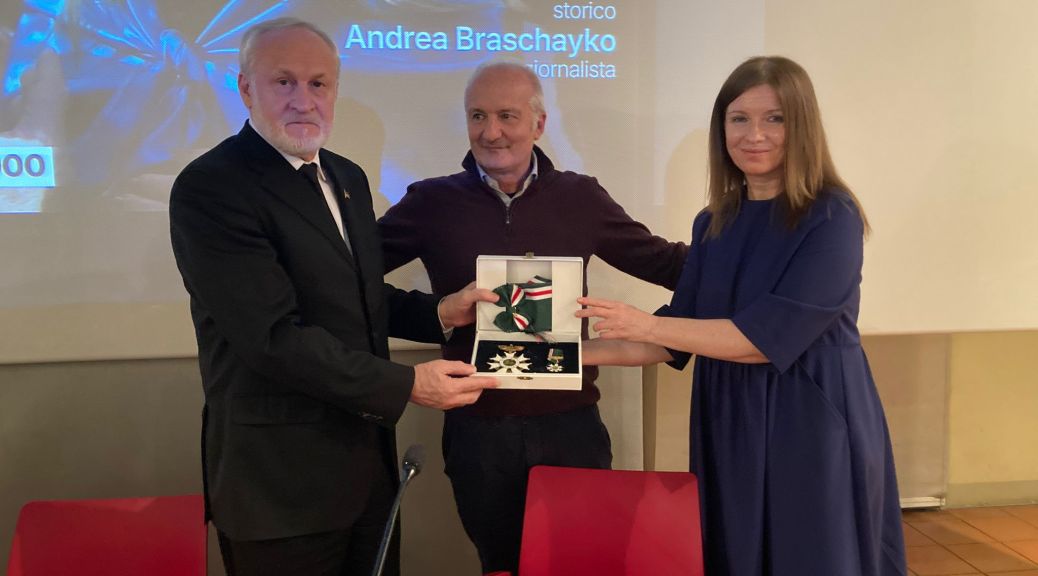
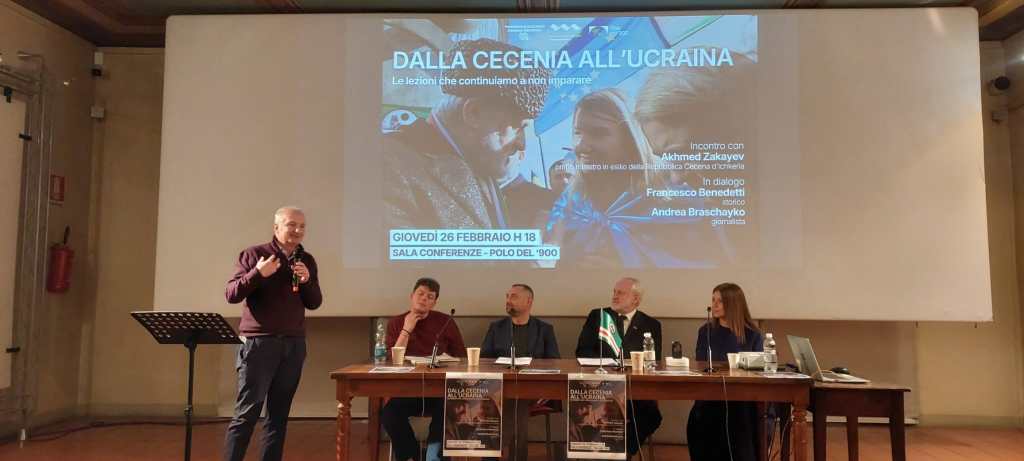
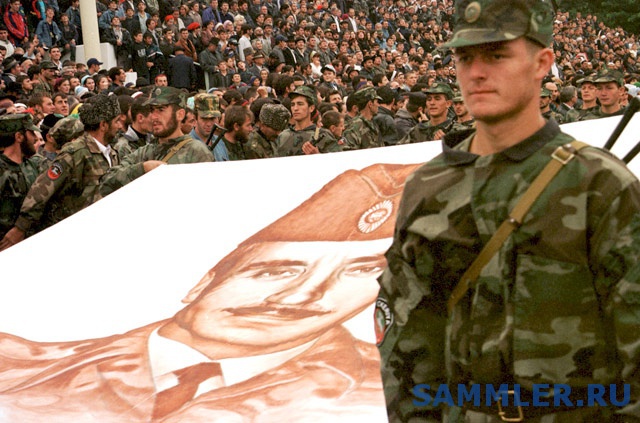

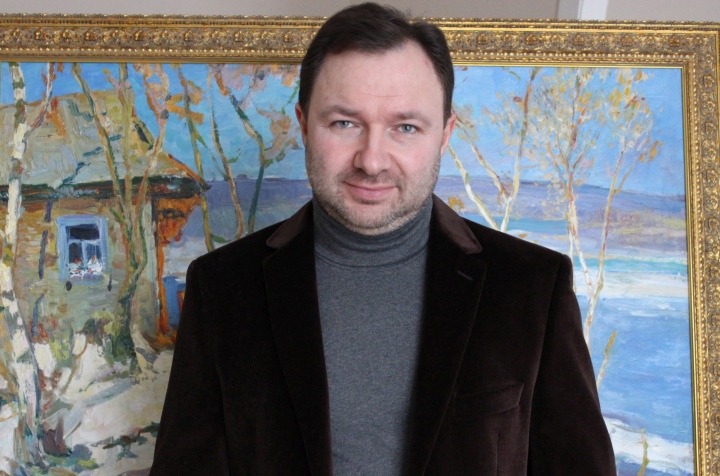

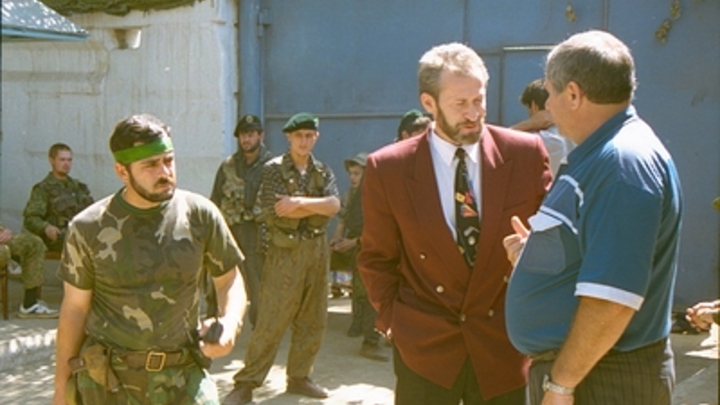


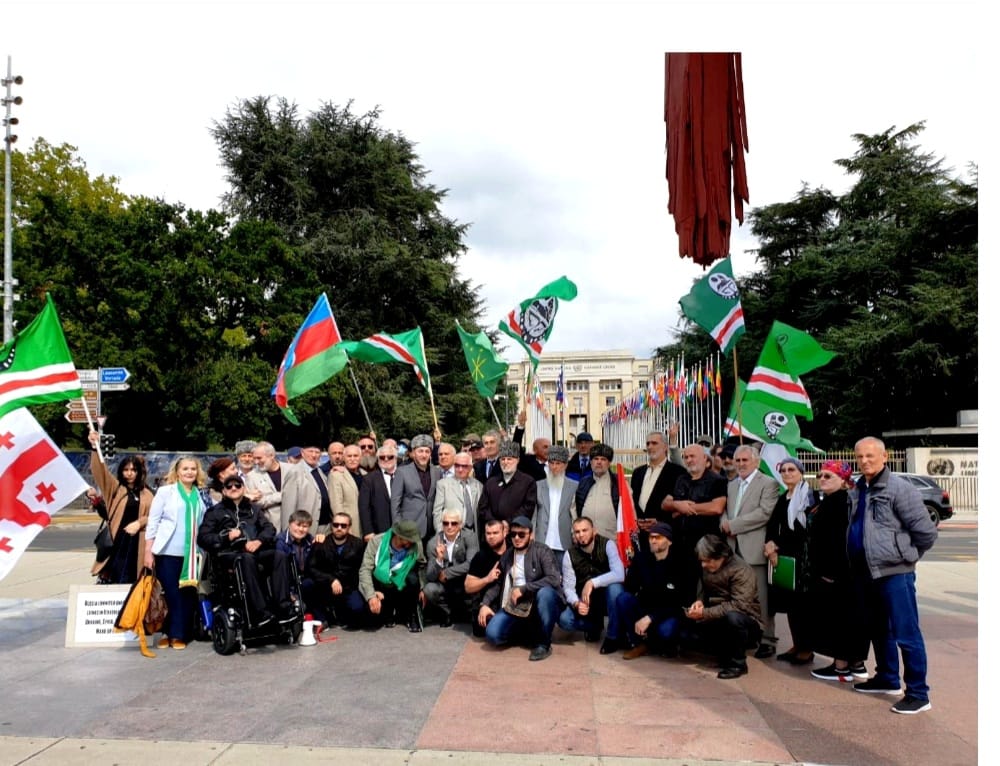
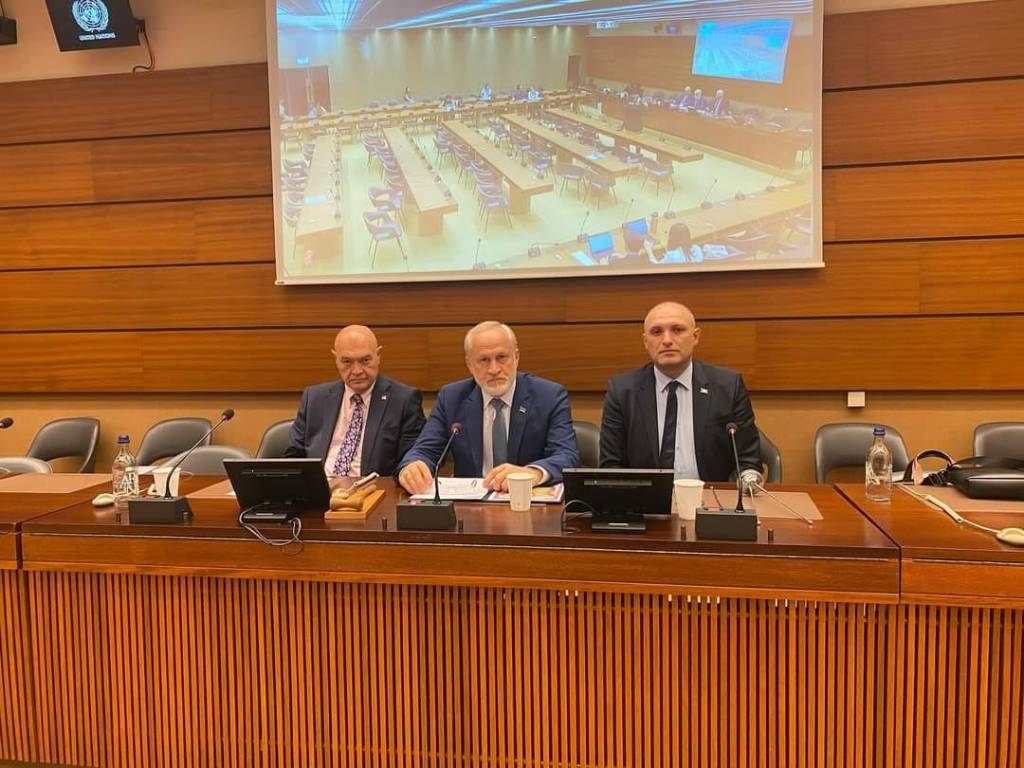

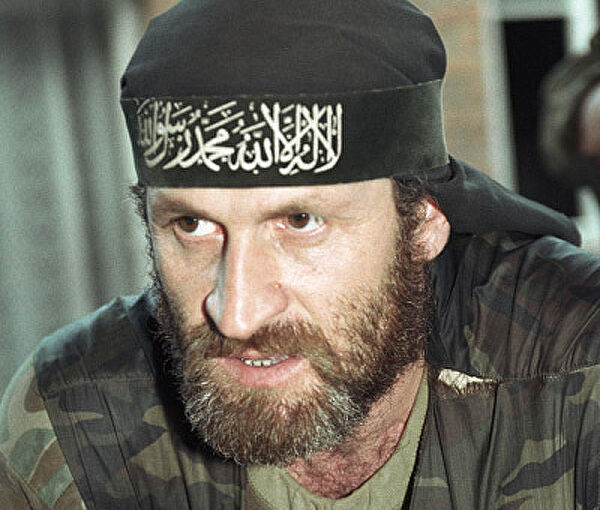
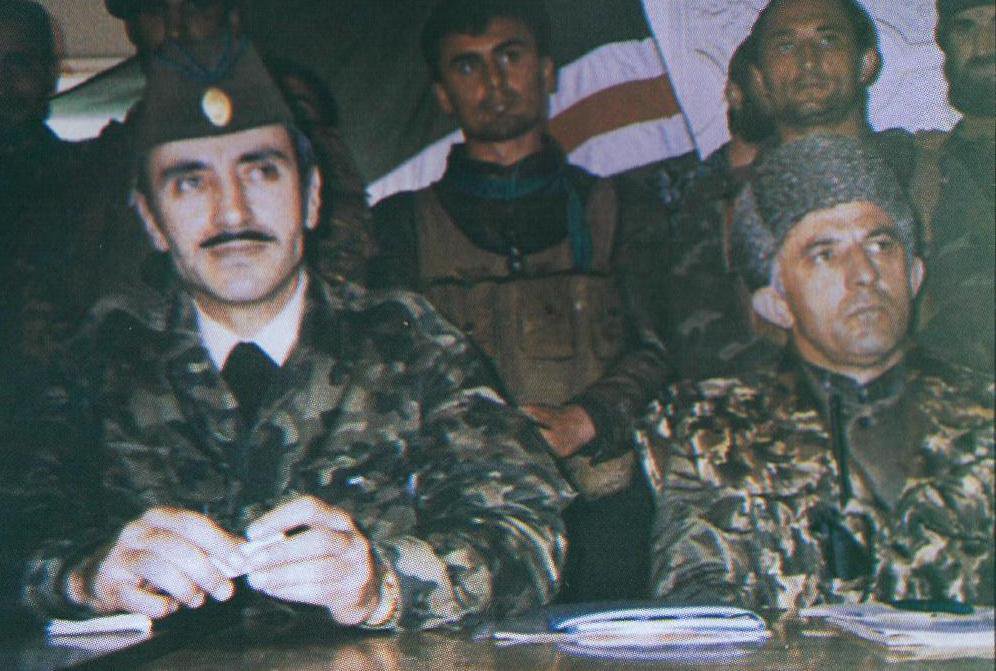


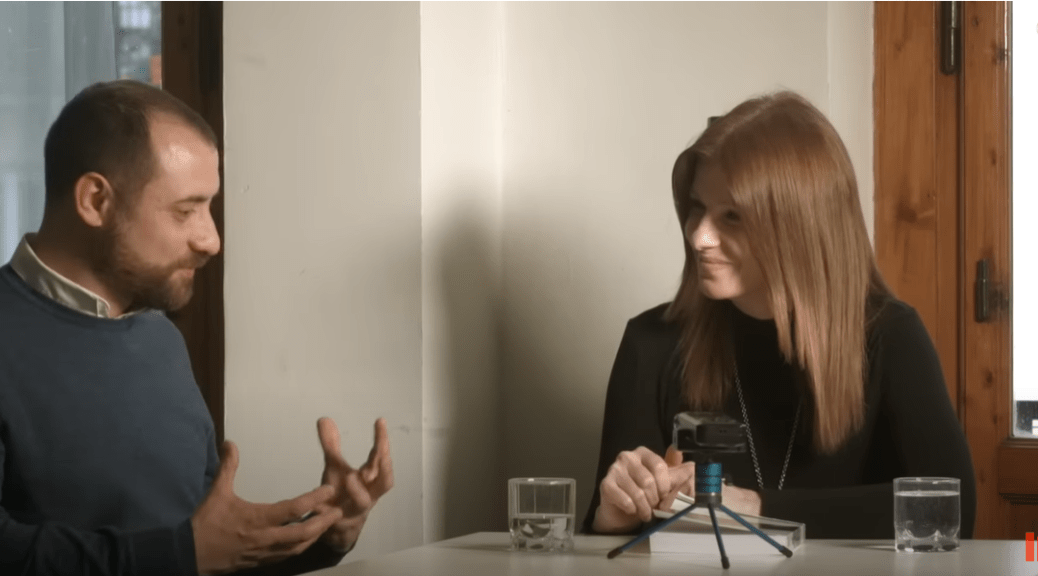


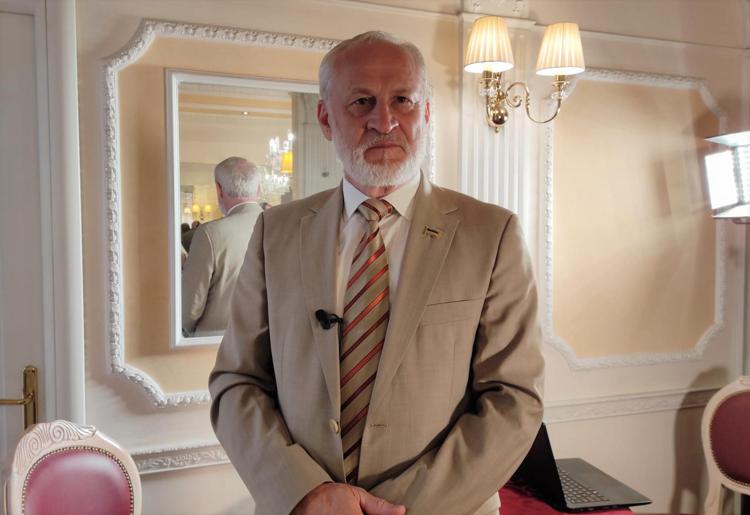


 Ichkeria Digital Archive