There are very little information about him in the press, and we were unable to find a personal photo of him. All we know about him is that he was born in 1954, that he graduated from Voronezh State University with a degree in law, and that, according to our sources, he is still alive.
Before Chechnya’s independence, Abdulkharimov worked as a law enforcement officer in the Chechen-Ingush Autonomous Soviet Socialist Republic. During the period between 1991 and 1994, he had the opportunity to establish himself in the oil business, acquiring skills and contacts that earned him the government’s interest.
It is not known what his political position was with respect to the issue of Chechen independence, and whether or not he participated (and if so in what form) in the defense of the country during the First Russo-Chechen War. It is known, however, that after the withdrawal of Russian troops from the country, he moved closer to government positions, beginning a notable political rise.
Institutional roles
Presidential Advisor for Oil Production (since 1996): After the end of the First Chechen War and the election of Aslan Maskhadov, Abdulkharimov was appointed Presidential Advisor for Oil Production, taking on a key role in managing the country’s energy resources.
Minister of Oil Production and Energy (03/07/1998 – 10/10/1998): During this short period, he headed the ministry responsible for energy policies, in a context of reconstruction and political instability.
First Deputy Chairman of the Cabinet of Ministers with responsibility for oil production (since 10/10/1998): Subsequently, he was promoted to First Deputy Chairman of the Cabinet of Ministers, maintaining responsibility for oil production.
Director of the State Enterprise “ChechenTEK” (since September 1998): He took over the management of ChechenTEK, the state enterprise responsible for the management of the oil sector, at a time when Chechnya was trying to consolidate its economy.
Member of the collaborationist government
After the conquest of Chechnya by the Russian army and the installation of the collaborationist government of Ramzan Kadyrov, Abdulkharimov was appointed Minister of Industry and Energy, by nomination of Kadyrov himself, replacing Amadi Temishev.
Temishev had repeatedly criticized the policy of “plunder” carried out by the Russian state oil company, Rosneft, complaining about the systematic violation of the contractual agreements signed in 2002 between the company and the collaborationist government, at the time led by Akhmat Kadyrov, Ramzan’s father, the disinterest of the Russian administration in the economic and environmental fate of the Republic, and the lack of investment in the restoration of Chechen industrial infrastructure. His last public interview, dated October 11, 2006, was an explicit indictment of Moscow. It is not surprising, therefore, that in April 2007 Ramzan Kadyrov (newly elected President of the Chechen Republic by decree of Vladimir Putin) decided to remove him from government, replacing him with a figure supposedly less cumbersome and more “available” towards the Russian imperial center.
Inal Sharip is the Minister of Foreign Affairs of Ichkeria. Born in 1971, he is a chess champion, a film director and producer, and between the first and second Chechen wars he was Deputy Minister of Culture and head of the Film Department.
Being born in 1971, You had the opportunity to observe the evolution of the situation in Chechnya from the independence until the outbreak of the war in 1994. What was the climate in the country in those years? And what impression did you have of Dudaev’s government?
I lived in Grozny until I graduated from university in 1993. Then I went to Moscow to take my first steps in the cinema. I remember Grozny as an ordinary post-Soviet city no different from other cities in the former USSR or Eastern Europe. As in other cities of the post-Soviet space there was an economic difficult situation. But Dzhokhar Dudayev began to stimulate medium and small businesses and abolished taxes and duties on imported goods. Direct flights were also established from Grozny to cities in the United Arab Emirates and other cities in eastern countries from where the goods were transported. Thanks to this Grozny became in a short time the trade center of the North Caucasus.
When the war started, I was in Moscow, taking my first steps in documentary filmmaking. Many things fade from memory, but what I remember well is the anxiety of realizing that terrible events were coming. Many of my feelings were portrayed in one of my first movies, “My Grozny City”. The piercing pain of what was done to my hometown, which remained only in my memory.
Inal Sharip, Minister of Foreign Affairs of Ichkeria
How did you spend the two years of war? And what did you do after?
At the first opportunity I came to Grozny. I established a secret connection with Akhmed Zakayev. (I met Akhmed Zakayev when I was writing music for the theater, in 1992. We were introduced by our mutual friend, Hussein Guzuev, a theater director. Before the war, Dzhokhar Dudayev appointed him director of television and he was one of the first to be killed at the beginning of the First Chechen War. Akhmed was then a theater artist and became at first chairman of the Chechen Union of Theater Workers. A few months before the war started, Dzhokhar Dudayev appointed Zakayev Minister of Culture. When the war started, Akhmed led the people’s militia.) And he coordinated his activities while in Moscow and Grozny. After the first war, Akhmed returned to work as Minister of Culture and invited me to be Deputy Minister.
Akhmed appointed me head of the Department of Cinematography of the Chechen Republic with the rank of Deputy Minister of Culture. I worked there for about a year. Maskhadov then created a commission on education, science and culture (a prototype of the UNESCO commission) to work on accession and cooperation with UNESCO, and to search for and return cultural property from museums that the Russians had illegally exported to Russia in violation of all international conventions. I was appointed head of this commission. Before leaving Chechnya, I was in charge of this commission.
I was the only member of the commission. It was I who initiated the creation of this commission, because we had to enter international organizations, and UNESCO was an organization we could enter, although without the right to vote in this organization at the first stage. In addition, the Russians have taken many museum exhibits out of Chechnya. Including paintings, a collection of 17th-18th century edged weapons, etc. It was necessary to track them down and return them. The international UNESCO conventions that regulate this kind of situation were an ideal tool, given that Russia had ratified all UNESCO conventions. Maskhadov wrote a decree creating this commission and appointing me to head it. Other than that, I received nothing, no funding, no office, nothing. Few among the military at that time understood the significance of this organization. At that time, everything was focused on the military aspect. That’s why I couldn’t hire people. I could work without a salary, other people could not.
Akhmed Zakayev in 1996
Speaking of the period between 1996 and 1999, what was your impression of the situation? In your opinion, was the Maskhadov government doing a good job? What was the general opinion of the people, in your opinion?
This is one of the most difficult periods in the history of modern Chechnya. Of course, Maskhadov’s government was not ideal, but we must understand the situation it found itself in. Russia was secretly preparing for a second war. It was actively recruiting agents from among the supporters of independence. It was deliberately corrupting Chechen officials. Russian special services were in direct contact with independent commanders of military units, persuading them to commit criminal acts. Russian agents in the Middle East, who specialize in working in the Islamic world, were redirected to Chechnya to split Chechen society along religious lines. In the conditions of post-war devastation and economic crisis, Russia managed to split Chechen society. Of course, at that time few people understood what was really happening. I also did not understand and did not like many things, so in 1998 I left Chechnya and returned to film production.
Now that we have collected information, we see how many FSB agents have infiltrated Chechen society, and we can draw conclusions. Suffice it to say that the Chief Mufti of Chechnya Kadyrov was an FSB agent, but no one talked about it at the time, and the leaders of Chechnya trusted him. In addition, it should be noted that few in Maskhadov’s government understood how world politics actually worked, both in the West and in the East, since there was no international experience. There was no information, no Internet. There was great trust in the Muslim world, based on the myth of the Muslim Brotherhood, but there was no understanding that the governments and intelligence services of most Muslim countries were using religion for their own political and geopolitical interests. Perhaps historians will analyze this period of Chechen history more deeply in the future, but today we can say for sure that Maskhadov was under great pressure from all sides, primarily with the goal of splitting Chechen society.
Boris Eltsin and Vladimir Putin
In 1999, Russia invaded Chechnya for the second time. Shortly before, Vladimir Putin had appeared on the political scene. Do you remember how public opinion experienced his rise to power?
At that time, Russians were tired of crime, corruption and disorder. It seems that discrimination against democracy was deliberate and directed by someone. Of course, what happened in Russia in the nineties has nothing to do with democracy, but it was presented to the people as democratic processes. That is why the people began to miss a strong authoritarian leader, like Stalin, Andropov and others who were leaders of the USSR. A situation was created when the people wanted to get their master back, who would determine their fate for them. In exchange, the new master had to restore order and feed the people. That is why the explosions of apartment buildings, Putin’s harsh rhetoric, all this is part of the scenario of creating a new authoritarian leader of Russia. It should be noted, I say this as a director, that Putin was not the best candidate for this role. He does not have natural charisma. But the circumstances developed in such a way that he was chosen as a collective decision of several influential groups in the Kremlin.
Putin, at the beginning of his career, was a compromise figure for different Kremlin clans. Every Russian billionaire or oligarch has a KGB-FSB general as his head of security. The KGB-FSB nominated three presidential candidates: Primakov, Stepashin, Putin. All of them were from the KGB and all of them were presidential candidates. The least known person, who did not have his own team and was considered harmless for different clans, was Putin, and he was elected. In 25 years, he created his clan, dealt with other clans and now he is the undisputed master in the Kremlin. The problem is that over these 25 years, Russian propaganda has been cultivating Great Russian chauvinism in the people. Chauvinism is constantly present in the Russian people, so cultivating Great Russian chauvinism in the people was not difficult. Putin has created for himself a Putin electorate, which was created for the greatness of Russia, the successor of the tsarist empire, the Soviet empire. Therefore, having removed one tsar, the people will in any case want another tsar and demand revenge for the defeat in Ukraine. Quite recently, Putin said in an interview that the collapse of the USSR is a great geopolitical tragedy. He said this because this is the mood of the people and he expressed the opinion of the Russian people. Therefore, the matter is much more complicated than in one person.
Yes, for a period of time for several years the war may stop, but then preparations for a military revenge in Ukraine will begin. Russians will never forgive the defeat in Ukraine. Just as they could not forgive the defeat from Chechnya in 1996. When they signed a peace treaty with Chechnya, at the same moment they began to prepare for the Second Chechen War. The same will happen in Ukraine. Russia must lose and transform into another democratic state. For example, the leader of the Russian opposition Navalny, who was killed in prison, did not recognize Crimea as Ukrainian. Because in the future he planned to participate in the presidential election campaign, and he must be guided by the opinion of the people. And 90 percent of the population of Russia considers Crimea to be Russia.
So, if I understand correctly, power in Russia is organized as an alliance of clans, and the President is the one who “moderates” the relations between clans. And in this system the FSB is a “clanized” apparatus or is it in competition with these clans?
This was the case before the war in Ukraine. Each major clan had its own people in the FSB leadership. But there was also an FSB clan that included both former and current FSB officers. All this was done with Putin’s approval. Putin was interested in creating a situation where different clans opposed him, and he was at the center of this structure and was an arbiter. In this way, he ensures his own security, and the clans were interested in Putin. But the war in Ukraine changed the balance of power in Russia. Prigozhin’s march on Moscow had a particular impact on these changes. Today, the FSB controls almost everything in Russia. With Shoigu’s departure from the Ministry of Defense, the FSB began a purge of generals and thus the FSB took control of the army. The only person the FSB cannot defeat yet is Kadyrov. Putin supports Kadyrov so that at least someone inside Russia would oppose the FSB. But I assume that the FSB will achieve its goal, and sooner or later the FSB will defeat Kadyrov.
Ramzan Kadyrov hugs Vladimir Putin
Why, in your opinion, does it (the FSB) not control Kadyrov?
Because Putin is interested in this. Putin knows what the KGB and the FSB are, and he knows that they can play their game at any moment. Putin and his clan have stolen hundreds of billions of dollars. Some “patriotic” generals may not like this, and they may try to stage a coup. Therefore, he is trying to minimize the risks. To do this, he must separate the different clans and do everything so that they do not unite. There are Chechen generals in the FSB who have always served Russia and whom the FSB would like to put in charge of Chechnya. But the FSB is not succeeding, because Putin has placed his bet on Kadyrov, whom he allows to commit any crimes, which helps strengthen him. The FSB was counting on the fact that Ramzan Kadyrov and his father are temporary workers, whom they are temporarily using to transfer the Chechen people’s struggle for independence from Russia into a civil war between Chechens. Kadyrov is not a career FSB employee, he is pursuing his own independent policy in the republic, which the FSB does not like.
In this regard, clashes between the FSB and Kadyrov’s men are constantly taking place in Russia, in which Putin has to act as an arbitrator. But so far there has not been a single situation where Putin has infringed on Kadyrov’s interests. The FSB expects that Putin will have to hand over Kadyrov sooner or later. But there is no doubt that Putin will have to choose between the FSB and Kadyrov. The FSB is getting stronger because of the war in Ukraine and is a state-forming institution, so I have no doubt that they will defeat Kadyrov in the future.
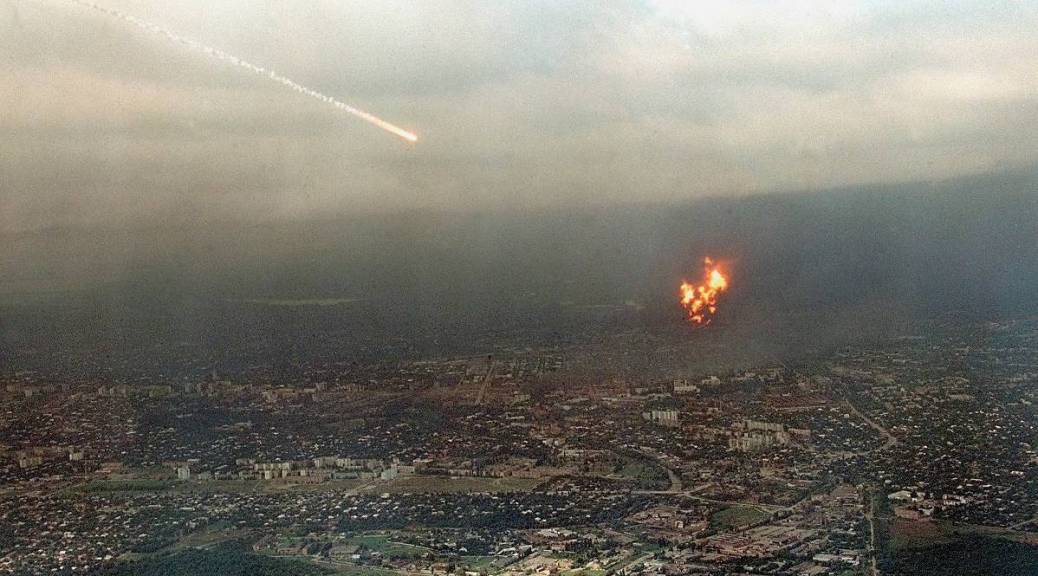
L’8 Aprile scorso la città ucraina di Kramatorsk è stata colpita da un attacco missilistico che, con molta probabilità, è stato messo a segno dalle forze separatiste filo – russe del Donbass. La vicenda non è ancora definitivamente chiarita, ma ciò che è certo è che almeno due missili ad alto potenziale distruttivo hanno colpito la stazione ferroviaria cittadina, in quel momento affollata da centinaia di profughi in fuga dai combattimenti, provocando almeno cinquanta morti ed un numero imprecisato di feriti. Il copione è tristemente simile a quello di molti altri bombardamenti missilistici occorsi in aree di guerra nelle quali le forze dell’esercito russo erano presenti, come operatori diretti o come consiglieri militari. C’è n’è uno, in particolare, che ricordiamo oggi: quello del 21 ottobre, passato alla storia come la “strage del mercato di Grozny”.
I PRIMI MISSILI DI PUTIN
Dalla fine di Agosto del 1999 l’aereonautica federale iniziò a bombardare Grozny, preparando il terreno per l’invasione di terra, la quale sarebbe scattata nell’Ottobre seguente. La città, già ridotta ad un cumulo di macerie dalla prima guerra, terminata appena tre anni prima, si trovò ad affrontare un secondo martellamento, che divenne ancora più catastrofico quando l’artiglieria campale russa occupò le colline del cosiddetto Terek Ridge, godendo così di una comoda postazione di tiro sulla capitale della ChRI. A dirigere l’invasione c’era un “giovane” Vladimir Putin, appena nominato Primo Ministro da un sempre più debilitato Boris Eltsin.
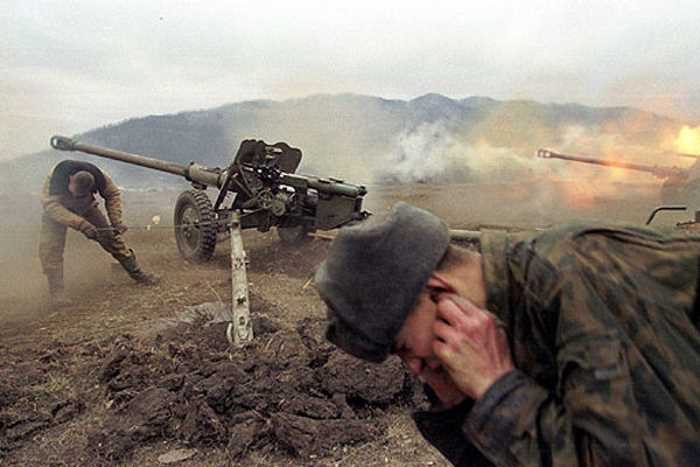
Artiglieria russa in bombardamento
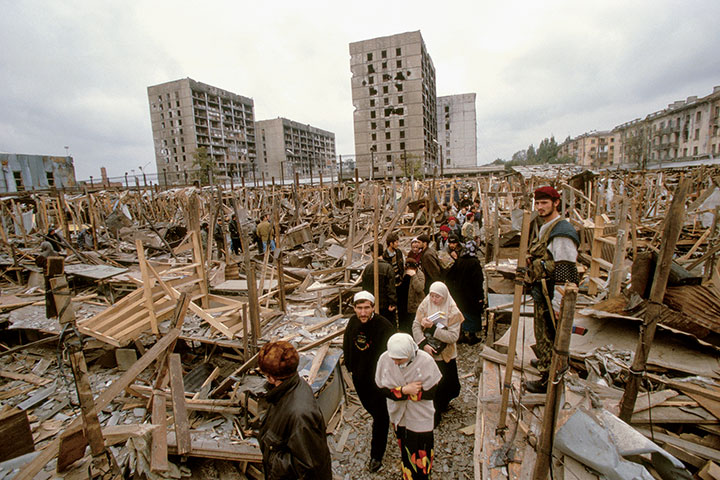
Nonostante l’assedio imminente, decine di migliaia di civili erano ancora dentro Grozny quando l’artiglieria prese a cannoneggiare la città. Uno dei centri di aggregazione più importanti per i cittadini era il mercato centrale, nel quale si commerciava ogni sorta di prodotto, dai generi alimentari ai vestiti, fino alle armi da fuoco. Il 21 Ottobre una pioggia di missili SCUD si abbatté sulla città: due di questi esplosero poco lontano dall’unico reparto di maternità funzionante nella città, a pochi passi dal compound presidenziale e dall’ufficio postale centrale, uccidendo una trentina di persone tra le quali giovani madri con i loro neonati. Un altro colpì una moschea del sobborgo di Kalinina, uccidendo 41 fedeli intenti a pregare. Altri tre missili caddero nel quartiere del mercato centrale. La prima esplosione avvenne ad una cinquantina di metri dal bazar, e distrusse Mira Street, proiettando una pioggia di schegge che falciarono chiunque si trovasse in giro in quel momento. Poco dopo altri due missili caddero ad una distanza di circa 80 metri l’uno dall’altro, colpendo in pieno il mercato ed uccidendo una novantina di civili, molti dei quali residenti di etnia russa. I soccorsi raggiunsero prontamente il luogo della strage ma un’ora dopo sulla piazza cadde ancora un altro missile, falciando i soccorritori ed i giornalisti accorsi a documentare il disastro. Morirono altre decine di persone, tra le quali il giornalista del Groznensky Rabochy Supian Ependyev. Fu il primo di una lunga serie di giornalisti che avrebbero perso la vita nel tentativo di raccontare la seconda guerra cecena.
LA PRIMA STRAGE DI PUTIN
Oltre ai più di cento morti l’assalto provocò dai 250 ai 500 feriti, molti dei quali gravissimi. Alcuni, caricati su mezzi di fortuna si diressero in convoglio verso l’Inguscezia, ma i numerosi checkpoint russi lungo la strada impedirono alla maggior parte di questi di raggiungere celermente gli ospedali ingusci. Il bombardamento provocò una nuova ondata di profughi che dalla città iniziarono a defluire confusamente verso nord. Un convoglio di questi, dopo essere stato fermato e costretto a fare dietrofront, venne erroneamente bombardato dall’aereonautica federale, che lo aveva scambiato per un distaccamento militare.
I russi negarono qualsiasi coinvolgimento, dichiarando che le esplosioni fossero frutto di un regolamento di conti tra bande illegali o l’esplosione di un magazzino di armi adiacente al mercato, ma le numerose registrazioni video del luogo della strage, nelle quali erano ben presenti i resti di missili balistici ed i crateri da impatto delle loro testate, smentirono la versione del Cremlino. Si trattò a tutti gli effetti di un bombardamento su obiettivi prevalentemente civili: anche ammettendo che nel bazar fossero in vendita delle armi, la stragrande maggioranza degli stand vendevano generi alimentari e vestiario, ed in quel momento erano affollati da civili in cerca di beni di consumo. Il bombardamento sollevò la prima forte reazione da parte della comunità internazionale: il Presidente del Parlamento Europeo, Lord Russell – Johnston, si disse “scioccato” ed accusò il governo russo di violare i diritti umani e le leggi di guerra. Simili condanne giunsero dal Presidente dell’Unione Europea, il finlandese Paavo Lipponen, e dal Cancelliere tedesco Gerard Schroder. Il Consiglio d’Europa chiese a Putin di riferire quanto prima i suoi piani per porre fine al conflitto. Il Segretario di Stato americano Madeleine Albright definì l’azione “deplorevole ed inquietante”. Le proteste dei leader occidentali, blandamente supportate dall’ONU, non fermarono comunque l’invasione.
VIdeo che mostra il bombardamento del Mercato di Grozny del 21 Ottobre 1999
Tra il 20 ed il 22 Luglio del 2001 si tenne a Genova un vertice del G – 8 , il gruppo delle principali potenze economiche della Terra (G – 7) implementato (dal 1997 al 2013) dalla presenza della Russia. In vista di questo incontro, il Presidente della Repubblica Cecena di Ichkeria, Aslan Maskhadov, inviò una lettera ai rappresentanti di quei governi, che riportiamo integralmente, in italiano e in inglese.
Come nei riguardi delle parole di Dudaev sulla futura guerra in Ucraina, quelle di Maskhadov sull’ondivago rapporto delle democrazie occidentali con il regime di Vladimir Putin suonano tristemente concrete in questi giorni.
VERSIONE ITALIANA
Gentili Eccellenze,
Io, Aslan Maskhadov, presidente democraticamente eletto della Repubblica cecena di Ichkeria, scrivo questo appello disperato in nome del mio popolo, vittima di una guerra genocida il cui omicidio quotidiano deve ancora risvegliare la coscienza del mondo che guidate. Siamo miserabili, sanguinanti e schiavi come voi siete ricchi, potenti e liberi. Presto vi riunirete a Genova tra lo splendore e la cerimonia che si addice al vostro posto, in prima fila tra le nazioni. Guardie d’onore vi saluteranno, vi incontrerete nei palazzi e il mondo ascolterà ogni vostra parola. Io vi scrivo da un luogo di sterminio putrido, di carneficina, e come i miei fratelli rimango un braccato nel mio paese. Anch’io ho avuto dalle urne il privilegio e la responsabilità di guidare la mia nazione, ma Mosca mi definisce un bandito, un terrorista e un criminale. Al di là dei confini del mio piccolo paese, le mie parole sembrano contare poco, così come il grido angosciato del mio popolo vi lascia ancora sorprendentemente muti e sordi. Quindi continuerò a scrivere finché il silenzio non sarà squarciato.
Converrete al vostro vertice per considerare la riduzione del debito per i paesi poveri del mondo in via di sviluppo. Questo è un obiettivo lodevole, ed è senza dubbio la speranza di milioni di persone che la preoccupazione umanitaria motivi i forti a cercare di porre fine alla miseria a contratto per i deboli. Ma se riconoscete la silenziosa violenza della povertà sugli indigenti e sugli affamati, perché vi allontanate da noi? Noi che moriamo tra le fiamme della sporca guerra del Cremlino, siamo meno degni di compassione? Cosa ci ha reso invisibili a voi? Temo di conoscere la risposta. Temo che le fredde esigenze della realpolitik assicurino le vostre inazioni e condannino il nostro destino. Per non danneggiare una relazione incerta con una nuova Russia fragile e instabile, siete disposti a trascurare l’annientamento del mio popolo. Ai vostri occhi, per il bene di interessi più grandi, siamo una nazione sacrificabile. Quindi concedete un posto a tavola a un ospite d’onore, il presidente russo Vladimir Putin, e gli stringete la mano come leader di una grande democrazia, applaudendolo come un riformatore che condivide i vostri valori.
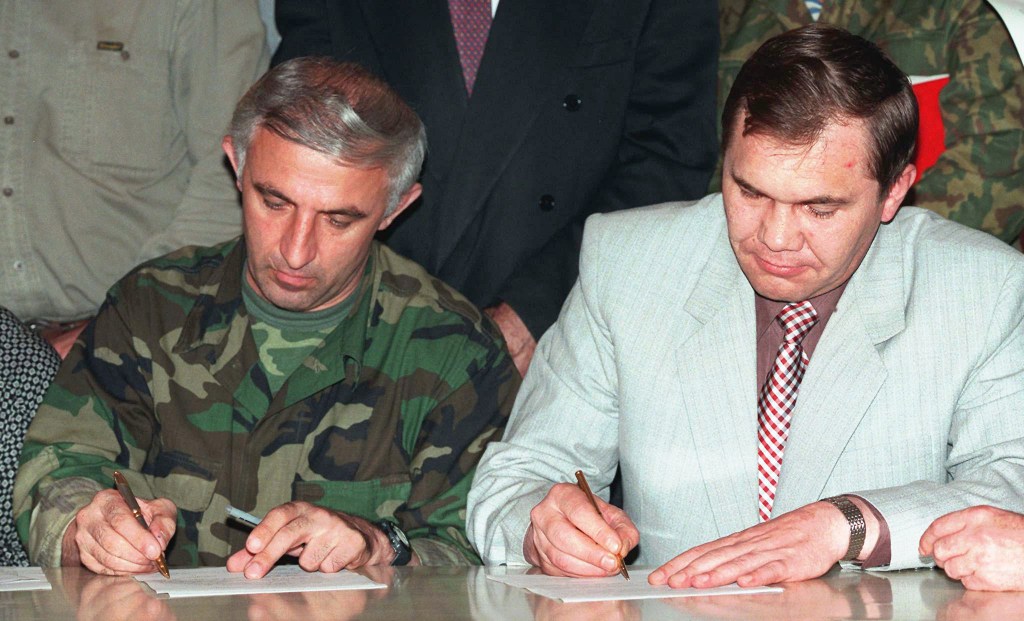
Aslan Mahadov (a sinistra) e Alexander Lebed (a destra) firmano gli Accordi di Khasavyurt
Se poteste sopportare di vedere il vero volto della Cecenia sotto l’agonia dell’occupazione russa, potreste sinceramente continuare a offrire tali lodi? Su una popolazione che un tempo contava un milione di persone, un ceceno su sette è ora morto. 250.000 dei nostri civili sono rifugiati. Privi dei beni di prima necessità, molti sono devastati da malattie e denutrizione, soprattutto anziani e giovani. Più di 20.000 civili e membri della resistenza subiscono la prigionia nei nuovi Gulag, i cosiddetti campi di filtrazione. Costretti in condizioni disumanizzanti e primitive con poche o nessuna assistenza medica, il che supera di gran lunga i peggiori standard del sistema penale russo, la vita nei campi improvvisati vede l’uso sadico e sistematico della tortura. Bruciature con le sigarette, percosse paralizzanti, soffocamento, annegamento negli escrementi umani, mutilazioni con coltelli, scosse elettriche ad alto voltaggio e abusi sessuali sono solo alcune delle pratiche comuni. Alla fine molti prigionieri vengono uccisi. Sicuramente per alcuni questa deve essere una gradita liberazione dall’inferno.
Le nostre donne vengono spesso radunate a caso e violentate in gruppo. In una politica comune sulla terra bruciata, i villaggi vengono saccheggiati, poi rasi al suolo e i maschi normodotati, compresi i ragazzi di età pari o inferiore a 15 anni, vengono portati via e scompaiono. Qualsiasi ceceno può essere arrestato senza accusa o ricevere la pena capitale senza processo. Le esecuzioni sommarie sono all’ordine del giorno per uomini, donne e bambini di tutte le età. I corpi dei morti vengono spesso mutilati deliberatamente e lasciati in mostra, la loro sepoltura vietata. I nostri morti servono anche come nuova forma di moneta, con i soldati russi che costringono i parenti a pagare ingenti riscatti prima che possano ottenere i resti dei loro cari. Innumerevoli fosse comuni giacciono nascoste in un paesaggio costellato da villaggi rasi al suolo e rovine in fiamme. Le nostre infrastrutture non esistono più. Solo nelle ultime due settimane una dozzina di villaggi nel sud-est e nell’ovest della Cecenia sono stati nuovamente terrorizzati, oltre 300 civili uccisi in una perquisizione sistematica e altre migliaia imprigionati, torturati e violentati. Abbiamo informato il Consiglio d’Europa, ma inutilmente. Questa è la verità più oscura della realpolitik. Terrore, macellazione e follia sono il prezzo che paghiamo per garantire il pragmatismo della diplomazia internazionale.
Grozny distrutta dai bombardamenti
Nel 1945 avete sconfitto i mali del militarismo, del fascismo e del nazismo. Quelle nazioni tra voi che avevano dato vita al mostruoso colosso e all’olocausto della guerra mondiale, hanno giurato di non ripetere mai gli stessi errori fatali e si sono forgiati con uno spirito nuovo per stare con orgoglio tra le democrazie più antiche. In oltre mezzo secolo di progressi insieme avete costruito nuove istituzioni per la comunità delle nazioni, l’ONU, la NATO, l’UE e l’OSCE, tra gli altri organismi regionali e globali, volte a un futuro più equo e più sicuro. Avete impedito il giorno del giudizio di un conflitto nucleare e il vostro esempio ha abbattuto il muro di Berlino, sollevando il giogo del comunismo e ponendo fine a una lunga guerra fredda. Avete smantellato i vostri imperi coloniali e avete permesso che i popoli ex sudditi fossero liberi. Avete combattuto il razzismo in patria e all’estero e le vostre voci hanno contribuito a sconfiggere la macchia dell’apartheid. Più e più volte avete incoraggiato le virtù della democrazia a trionfare sulla dittatura. Forse soprattutto, a Norimberga hai risposto ai tuoi più nobili istinti stabilendo lo stato di diritto ei diritti umani come principi inviolabili e universali che riterrebbero per sempre la barbarie responsabile di un codice di condotta civile.
Allora, com’è possibile celebrare Slobodan Milosevic che finalmente affronta il giudizio all’Aia ma abbracciare Putin come un partner credibile? Com’è possibile che vi siete mobilitati per affrontare la nuda aggressione durante la Guerra del Golfo, che siete intervenuti quando avete assistito alla pulizia etnica e alla ferocia in Bosnia, Kosovo, Timor e Sierra Leone e ora pronunciate raramente la parola Cecenia? Condannate e isolate il regime dello SLORC in Myanmar e i talebani in Afghanistan. Fate pressione sulla Cina per i suoi abusi in Tibet e la sua persecuzione di intellettuali dissidenti e seguaci religiosi, ma non dite nulla sull’omicidio di massa di civili ceceni. Praticate un’instancabile diplomazia cercando di assicurare la pace in Medio Oriente, Irlanda del Nord, Macedonia, Kashmir, Congo, persino in Sudan, dov’è la vostra iniziativa di pace cecena?
Artiglieria russa spara nei dintorni di Tolstoy – Yurt, Novembre 1999
In nome di una nazione morente vi prego di non abbandonarci più. Chiedo che adottiate collettivamente misure per favorire la ripresa dei negoziati di pace e l’emanazione di un cessate il fuoco immediato garantito e monitorato da parti neutrali. Vi prego inoltre di chiedere, in conformità con il diritto internazionale, il dispiegamento di aiuti umanitari, personale sanitario e medico disperatamente necessari. Vi imploro inoltre di chiedere il ritorno senza ostacoli degli investigatori dei diritti umani delle ONG, degli osservatori delle istituzioni internazionali e di tutti i membri della stampa mondiale attualmente esclusi dall’entrare in Cecenia. Mi rivolgo a voi, come leader del mondo libero, a raccogliere il coraggio morale in armonia con le tradizioni democratiche che rappresentate e che avete giurato di sostenere per fare pressione sulla Russia affinché cessi lo sterminio del mio paese, per ritenerlo responsabile del genocidio e per imporre sanzioni se Mosca non desisterà.
La ferocia che dobbiamo sopportare non è nuova. Ricordiamo le miniere di sale di Stalin, le sue torri di guardia, il filo spinato e le tombe anonime. Il dolore dell’esodo e del genocidio lo abbiamo già conosciuto. Così riconosciamo gli altri con i quali condividiamo una terribile fratellanza di orrore. Gli scheletrici ebrei e rom nei forni di Dachau e Auschwitz. La carne da baionetta di Nanchino. Gli antichi figli del Biafra dagli occhi sbarrati. La madre implorante e il bambino di fronte ai fucili a My Lai. Gli arabi di palude dell’Iraq soffocati dalle nuvole di gas mostarda. I tutsi del Ruanda massacrati sulla strada di Kigali dai coltelli dell’Interhamwe. Sono tutti i nostri fratelli e sorelle martiri nell’eredità di un omicidio senza senso. Solo il nostro massacro, la nostra morte non è di ieri, appartiene all’incubo vivente del presente. Quanti ceceni saranno morti nel tempo che impiegherete a leggere questa lettera? Quanti altri dovremo seppellire prima della fine del vostro vertice? Non mancate di parlare, per amore dell’umanità e della giustizia agite ora sulla vostra coscienza o nel tempo anche la storia vi segnerà con una pagina di vergogna. Se continuate a restare inerti mentre il mio popolo svanisce in un bagno di sangue, se non agite con convinzione e determinazione come avete fatto in Ruanda, i fantasmi ceceni macchieranno il vostro onore come fanno con quello russo.
Possa Dio concedervi la saggezza e la visione per servire la causa della pace e della giustizia
Rispettosamente
Aslan Maskhadov
Presidente della Repubblica Cecena di Ichkeria
ENGLISH VERSION
Dear Excellencies,
I, Aslan Maskhadov, the democratically elected President of the Chechen Republic of Ichkeria, write this desperate appeal in the name of my people, the victims of a genocidal war whose daily murder has yet to awaken the conscience of the world you lead. We are as wretched, bloody and enslaved as you are rich, mighty and free. You will soon gather in Genoa amidst the splendor and ceremony that befits your place in the front rank of nations. Guards of honour will salute you, you will meet in palaces and the world will listen to your every word. But I write you from a killing ground putrid with slaughter and like my brethren I remain a hunted man in my own country. I too won the privilege and responsibility of leading my nation from the ballot box, but Moscow calls me a bandit, a terrorist and a criminal. Beyond the confines of my tiny country, my words seem to count for little, just as the anguished cry of my people still astonishingly leaves you mute and deaf. So I will continue to write until the silence is pierced.
You will join in your summit to consider debt relief for the impoverished developing world. This is a laudable aim, and it is the hope no doubt of countless millions that humanitarian concern motivates the strong to seek an end to indentured misery for the weak. But if you acknowledge the quiet violence of poverty upon the destitute and the hungry why do you turn away from us? We who die in the flames of the Kremlin’s dirty war, are we less worthy of compassion? What has made us invisible to you? I fear I know the answer. I fear the cold exigencies of realpolitik ensure your inaction and seal our fate. Lest you damage an uncertain relationship with a fragile and volatile new Russia, you are willing to overlook the annihilation of my people. In your eyes, for the sake of larger interests we are an expendable nation. So you grant a seat at the table to an honoured guest, Russian President Vladimir Putin, and shake his hand as the leader of a great democracy, applauding him as a reformer who shares your values.
Fossa comune in Cecenia
If you could stand to see the true face of Chechnya under the agony of Russian occupation, could you sincerely continue to offer such praise? Out of a population that once numbered a million, one in seven Chechens is now dead. 250,000 of our civilians are refugees. Bereft of the most basic necessities, many are ravaged by disease and malnutrition, especially the elderly and the young. More than 20,000 civilians and resistance members endure imprisonment in the new Gulags, the so-called filtration camps. Held in dehumanizingly foul and primitive conditions with little or no medical care that far exceed the worst standards of the Russian penal system, life in the improvised camps sees the sadistic and systematic use of torture. Burning with cigarettes, crippling beatings, suffocation, drowning in human excrement, mutilation with knives, high voltage electric shock and sexual abuses are only some of the common practices. Many prisoners are ultimately killed. Surely for some this must be a welcome deliverance from hell.
Our women are often rounded up at random and gang raped. In a common scorched earth policy villages are looted then razed and the able bodied males including boys 15 and under are swept up and disappeared. Any Chechen can be arrested without charge or receive capital punishment without trial. Summary executions are an everyday occurrence for men, women and children of all ages. The bodies of the dead are often deliberately mutilated and left on display, their burial forbidden. Our dead also serve as a new form of currency, with Russian soldiers forcing relatives to pay large ransoms before they can obtain the remains of their loved ones. Countless mass graves lie hidden in a landscape dotted by flattened villages and burning ruins. Our infrastructure no longer exists. Only in the last two weeks a dozen villages in south eastern and western Chechnya were again terrorised, over 300 civilians murdered in a systematic sweep and thousands more imprisoned, tortured and raped. We informed the Council of Europe but to no avail. This is the darker truth of realpolitik. Terror, butchery and madness is the price we pay to ensure the pragmatism of international diplomacy.
In 1945 you defeated the evils of militarism, fascism and Nazism. Those nations among you that had given birth to the monstrous juggernaut and holocaust of world war, vowed never to repeat the same fatal errors and forged yourselves in a new spirit to stand proudly among the elder democracies. Over half a century of progress together you built new institutions for the community of nations, the UN, NATO, the EU, and the OSCE, among other regional and global bodies, aimed towards a more equitable and safer future. You prevented the doomsday of a nuclear conflict and your example brought down the Berlin Wall, lifting the yoke of communism and ending a long cold war. You dismantled your colonial empires and allowed former subject peoples to be themselves. You fought racism at home and abroad and your voices helped to vanquish the stain of apartheid. Time and again you fostered the virtues of democracy to triumph over dictatorship. Perhaps above all, at Nuremberg you responded to your most noble instincts establishing the rule of law and human rights as inviolable, universal principles that would forever hold barbarism accountable to a civilised code of conduct.
So how is it that you celebrate Slobodan Milosevic at last facing judgement at the Hague but embrace Putin as a credible partner? How is it possible that you mobilised to confront naked aggression during the Gulf War, intervened when you witnessed ethnic cleansing and savagery in Bosnia, Kosovo, Timor and Sierra Leone and now seldom even utter the word Chechnya? You condemn and isolate the SLORC regime in Myanmar and the Taliban in Afghanistan. You pressure China over its abuses in Tibet and its persecution of dissident intellectuals and religious followers, but you say nothing about the mass murder of Chechen civilians. You practice tireless diplomacy trying to secure peace in the Middle East, Northern Ireland, Macedonia, Kashmir, the Congo, even the Sudan, where is your Chechen peace initiative?
In the name of a dying nation I beg you not to forsake us any longer. I ask that you collectively take steps to foster the resumption of peace negotiations and the enactment of an immediate cease-fire guaranteed and monitored by neutral parties. I beseech you further to demand in accordance with international law the deployment of desperately needed humanitarian aid, health and medical personnel. I further implore you to seek the return without hindrance of NGO human rights investigators, observers from international institutions and all members of the global press currently being barred from entering Chechnya. I appeal to you as leaders of the free world to muster the moral courage in keeping with the democratic traditions you represent and have sworn to uphold to pressure Russia to cease its extermination of my country, to hold it accountable for genocide, and to impose sanctions if Moscow will not desist.
The savagery we must bear is not new. We remember Stalin’s salt mines, his guard towers, barbed wire and unmarked graves. The pain of exodus and genocide we have known before. So we recognise the others with whom we share a terrible kinship of horror. The skeletal Jews and Romany in the ovens of Dachau and Auschwitz. The bayonet fodder of Nanjing. The ancient, wide-eyed children of Biafra. The pleading mother and baby facing the rifles at My Lai. The marsh Arabs of Iraq choked by the clouds of mustard gas. The Tutsi of Rwanda butchered on the Kigali road by the knives of the Interhamwe. They are all our martyred brothers and sisters in the legacy of senseless murder. Only our slaughter, our death is not yesterday’s, it belongs in the living nightmare of the present. How many Chechens will have died in the time you take to read this letter? How many more must we bury by the time your summit is over? Do not fail to speak, for the sake of humanity and justice act now upon your conscience or in time history will also mark you with a page of shame. If you continue to stand idly by while my people vanish in a bloodbath, if you fail to act with conviction and resolve as you did in Rwanda, Chechen ghosts will stain your honour as surely as they do Russia’s.
May God grant you the wisdom and vision to serve the cause of peace and justice.
Respectfully,
Aslan Maskhadov President of the Chechen Republic of Ichkeria
Ilyas Akhmadov fu appuntato Ministro degli Esteri da Maskhadov il 27 Giugno 1999, pochi mesi prima dello scoppio della Seconda Guerra Cecena. Akhmadov fu scelto per il fatto di non aver partecipato a nessuna delle azioni terroristiche (Budennovsk e Klizyar in primis) che avevano resto tristemente celebre la resistenza separatista durante il primo conflitto. In questo modo egli avrebbe potuto muoversi con maggior facilità tra le cancellerie occidentali senza incorrere nel rischio di essere arrestato per terrorismo. Nella sua veste di alto rappresentante della diplomazia cecena, Akhmadov si diresse dapprima in Turchia, poi in Belgio, poi ancora negli Stati Uniti, girando in lungo e in largo nel tentativo di coinvolgere i governi occidentali in un negoziato trilaterale con la Federazione Russa (per approfondire, leggi il libro “Libertà o Morte! Storia della Repubblica Cecena di Ichkeria, acquistabile QUI).
Ilyas Akhmadov the Minister of Foreign Affaires for the Chechen rebel government. (Photo by Alex Smailes/Sygma via Getty Images)
Presto fu tuttavia chiaro che nessuno dei governi in grado di fare la differenza in una trattativa con la Russia sarebbe intervenuto, appoggiando tout – court la posizione dei secessionisti. Così, dal 2001, il Ministro degli Esteri si mise ad elaborare un piano di pace che ponesse in essere le premesse di una separazione senza costringere il Cremlino ad accettarla sul piano formale. Il progetto, che pubblichiamo in versione italiana (scaricabile QUI in PDF) si basava sull’idea di trasformare la Cecenia in una sorta di protettorato, sotto il mandato delle Nazioni Unite, per un periodo di 10 o 15 anni, durante i quali il paese sarebbe stato ricostruito e le istituzioni democratiche sarebbero state implementate, sul modello di quanto stava succedendo in Kosovo ed a Timor Est. Maskhadov avrebbe rassegnato le sue dimissioni, l’esercito russo si sarebbe ritirato e le forze armate cecene avrebbero smobilitato. Una volta che la situazione si fosse stabilizzata e le istituzioni democratiche avessero iniziato a funzionare sotto la protezione delle forze armate dell’ONU, nuove elezioni avrebbero portato alla costituzione di una Cecenia indipendente.
Il piano girava tutto intorno al concetto di “indipendenza condizionata”:
“Il riconoscimento condizionato di un governo o di uno Stato è il principio che consiste nel rendere il riconoscimento dell’entità in questione soggetto all’adempimento di condizioni precedentemente convenute. Una appropriata applicazione di questo principio attraverso il meccanismo di una amministrazione internazionale può risolvere il conflitto russo – ceceno con un approccio in cui vincono entrambe le parti. L’idea è semplice: la trasformazione della Cecenia in uno Stato realmente democratico e pacifico attraverso un periodo di transizione di diversi anni di amministrazione internazionale. Questa formula può non essere un miracolo, ma fornisce un modo per risolvere la sfida di soddisfare le legittime aspirazioni della Cecenia andando simultaneamente incontro alle autentiche esigenze di sicurezza della Russia, come alle preoccupazioni relative alla sicurezza della Georgia ed alla sicurezza ed agli interessi complessivi della comunità internazionale.
UNA STRADA IN SALITA
Il piano era di difficile attuazione, perché avrebbe dovuto passare dal Consiglio di Sicurezza dell’ONU, del quale la Russia faceva parte, e difficilmente il Cremlino avrebbe accettato la presenza di forze di pace entro quelli che considerava i propri confini. Un segnale incoraggiante comunque giunse da Putin, che in relazione al piano proposto rispose: “Oggi la questione dell’indipendenza o meno della Cecenia dalla Russia è assolutamente non di fondamentale importanza. Ciò che è di fondamentale importanza per noi è soltanto una questione. Non vogliamo permettere che questo territorio venga usato ancora una volta come testa di ponte per un attacco alla Russia.” in questi termini, Putin poteva essere teoricamente disponibile a congelare nuovamente la questione dell’indipendenza in cambio della completa smilitarizzazione della Cecenia. Il piano venne sottoposto a Maskhadov qualche settimana dopo, sponsorizzato dallo scrittore francese Andrè Glucksmann e dal politico belga Olivier Dupuis, che si dissero disponibili a farsene relatori presso le autorità europee ed all’ONU. Esso tuttavia era debole per due motivi: prima di tutto la situazione della Cecenia non poteva essere assimilata a quella del Kosovo, perchè Russia non era la Serbia né in fatto di peso politico né in fatto di rapporti con l’occidente.
Vladimir Putin, Presidente della Federazione Russa. Allo scoppio della Seconda Guerra Cecena giustificò l’intervento armato come un’operazione volta a garantire la sicurezza della Russia. Il “Piano Akhmadov” muoveva dalla necessità di garantire a Putin il riconoscimento delle sue “ragioni di sicurezza” senza ledere il diritto della Cecenia all’autodeterminazione.
In secondo luogo, come spiegò Maskhadov nella sua risposta alla proposta di Akhmadov, “La mentalità della resistenza cecena era sempre più religiosa e sempre più frustrata rispetto all’Occidente ed alla democrazia, rispetto a quanto non fosse durante la prima guerra. […] dovete capire che quello che la gente vede riguardo alle democrazie occidentali sono dichiarazioni preoccupate di routine, gestualità vuote, che irritano soltanto la gente. Dovete capire che questo è tutto quello che hanno visto di codeste democrazie”. Maskhadov confidò che non sarebbe riuscito a tenere insieme il fragile fronte indipendentista se un simile piano fosse stato sponsorizzato da lui. In particolare, una simile soluzione avrebbe messo la resistenza in rotta di collisione coi suoi finanziatori, che erano per lo più comunità religiose mediorientali le quali mai avrebbero supportato finanziariamente un movimento che andava a braccetto con l’ONU, vista dai più come una sovrastruttura al servizio del potere occidentale. Rispose quindi che il piano poteva essere presentato, ma come una iniziativa personale di Akhmadov e dei suoi amici, e non come un documento ufficiale della ChRI.
IL PIANO NAUFRAGA
Anche all’interno di ciò che restava della gerarchia repubblicana, il dibattito sul piano fu acceso ed i funzionari non riuscirono a trovare un accordo. Laddove Umar Khambiev, Ministro della Sanità ed inviato personale di Maskhadov in Europa, appoggiò entusiasticamente il piano, Akhyad Idigov, ex Presidente del Parlamento dudaevita, lo attaccò pesantemente accusando Akhmadov di voler vendere l’indipendenza della Cecenia e di attentare alla costituzione. Akhmadov propose il piano in via personale nel marzo 2003, ma proprio in quei mesi iniziò la seconda invasione americana dell’Iraq, e la questione cecena finì nelle ultime pagine dei giornali. Olivier Depuis, raccolse comunque le firme per presentare il piano alle Nazioni Unite, e per la metà del 2003 ne aveva già raccolte 30.000. L’azione di Depuis, che era un deputato del Partito Radicale Transnazionale, avrebbe portato, nel febbraio del 2004, il Parlamento Europeo a varare una risoluzione nella quale per la prima volta si riconosceva l’Ardakhar del 1944 come “genocidio”, ma oltre all’adozione di questa risoluzione, non ci sarebbe stato altro di politicamente rilevante. In ogni caso la discussione del “Piano Akhmadov” non riuscì neanche a decollare, giacché l’11 settembre 2001 Osama Bin Laden aveva lanciato il suo attacco terroristico agli Stati Uniti. Da quel momento il timore del terrorismo islamico si era impadronito delle società occidentali, ed anche i secessionisti ceceni avevano finito per essere considerati parte del fenomeno.
Alhyad Idigov, Deputato al Parlamento di I e II Convocazione e rappresentante del Parlamento all’Estero, criticò duramente il “Piano Akhmadov”, accusando il Ministro degli Esteri di voler sacrificare l’indipendenza della Cecenia, secondo il suo parere già acquisita nel 1991 e confermata nel Trattato di Pace del 1997. La mancanza di unità nel fronte secessionista fu una delle principali cause del naufragio della proposta di pace.
Come scrive Akhmadov: “Le cose sono cambiate radicalmente dopo l’11 settembre 2001, quando la maggior parte delle persone in Occidente, e certamente la maggior parte dei governi, ha iniziato a guardarci attraverso la lente dell’antiterrorismo. Il pretesto che l’uccisione di massa di civili ceceni da parte della Russia abbia contribuito alla guerra contro il terrorismo ha permesso all’Occidente di mantenere stretti rapporti con la Russia e di assolvere la sua coscienza collettiva ignorando le atrocità. Vedere questa guerra come uno dei fronti di guerra contro il terrorismo globale ha liberato l’Occidente dai suoi obblighi al rispetto dei diritti umani e del diritto internazionale nei suoi rapporti con la Russia.”. La resistenza cecena, che per parte sua aveva compiuto atti di terrorismo e che, radicalizzandosi, aveva assunto i turpi connotati del fanatismo religioso, fu pesantemente colpita dai nefasti effetti dell’azione di Al Qaeda, che gli alienarono completamente le simpatie dell’occidente, fatta eccezione per qualche giornalista, qualche associazione umanitaria e qualche uomo politico di scarso peso. Le autorità russe si resero conto di avere campo libero nel portare a termine la loro invasione e chiusero a qualsiasi negoziato che potesse portare anche soltanto ad una tregua.








 Ichkeria Digital Archive