Archivi tag: Soviet Union

April 16, 1996: The Battle of Yarish Mardy (From “Freedom or Death! Volume II)


On 16 April, a few hundred meters from the village Yarish-Mardy in the Argun Gorge, the Russians suffered one of their worst setbacks. At 2:20 p.m., after a several hours’ march from Khankala Military Base, an armored column of thirty fighting vehicles,[1] four oil trucks, and numerous supply trucks, hit a bottleneck between the villages Chishki and Zony. The area was the only along the route without a permanently-manned Russian checkpoint and, due to the differences in height between the road and hills, without radio coverage too. Waiting there instead were Chechen units led by an obscure young commander of Arab origin. He had arrived in Chechnya in mid-1995 leading a small group of foreign fighters. Now with 80-160 men, his name was Samir Saleh Abdullah but went by Ibn Al Khattab.[2]
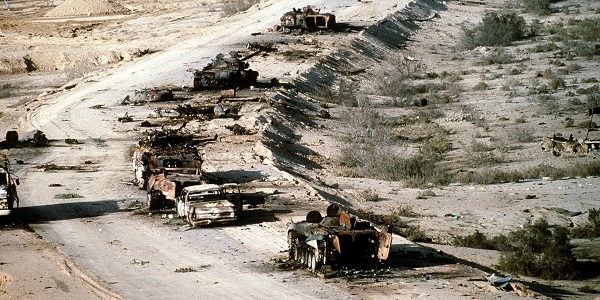
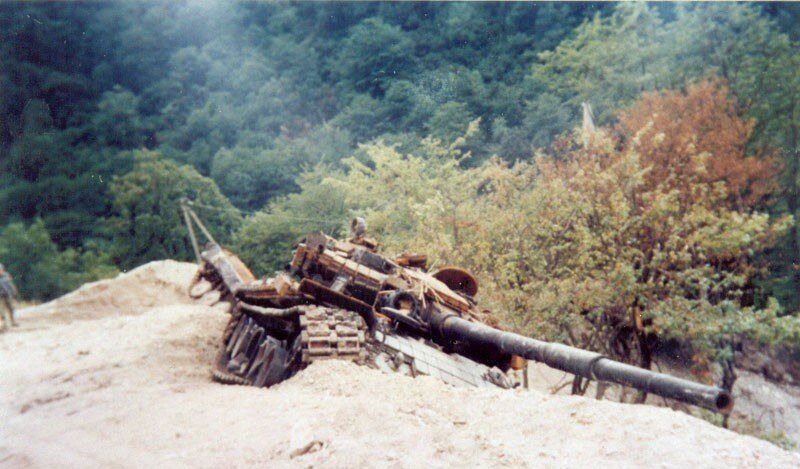
The ambushers jammed the radios of the passing unsuspecting Russians before detonating a powerful anti-tank mine, stranding the forward vehicle. The hills began spewing down on the column, now stretched for almost a kilometer and a half, destroying the leading and trailing vehicles, and a few minutes later killing the commander and deputy commander, Major Terzovets and Captain Vyatkin. Most of the infantry and vehicles were destroyed eventually too. A nearby platoon of Russian soldiers set off to investigate the explosions. Hearing the nearby explosions, a platoon of Russian soldiers set off to investigate but came under heavy fire too and took up defensive positions. The command hurriedly organized a task force with battle tanks and heavy machine guns to relieve their trapped comrades. Simultaneously, a second relief column supported by combat helicopters was racing to the south. The two rescue teams made contact with the Chechens around five o’clock and fled to the woods an hour later. They had arrived at the ambush site to the smell of a hundred of their dead comrades burning. Of the initial 30 vehicles 21 were destroyed, and of the 200 men only 13 were unharmed. The Chechens lost twenty at most.[3] This was a defeat which blew up the tottering diplomatic bridge unilaterally constructed by Yeltsin. The day after the ambush, the Russian president backtracked, vowing not to “deal with the gangsters.”  Meanwhile, Yarish-Mardy projected a hitherto unknown name, Al Khattab, onto the fresco of freedom fighters. With the advent of the internet, he had prudently brought a troupe of cameramen to record for a propaganda film, resulting in global clicks and new sympathizers for the Chechens. For the first time, footage out of Chechnya showed not helpless victims of Russian bombardment or desperate fighters, but a formidable fighting force winning true battles against Russia. The video of the Yarish-Mardy ambush evidently reached Parliament in Moscow: deputies requested an immediate report from Grachev and ordered the creation of a parliamentary commission of inquiry. As a result, formal accusations were brought against commanders of the devastated unit, but also the unified command of forces in Chechnya, for authorizing the column’s mission without properly assessing risks, even Grachev could not escape an accusation. Tough lessons went unheeded though, with another ambush on a Russian column destroying 15 combat vehicles and an unknown number of men on 5 May.
Khattab, whose fame would continue to grow with such attacks, needs to be put into context. He was a follower of Salafism, a radical current of Islam of which some fringes, called Wahhabism, openly preached global Jihad while supporting terrorist organizations such as Al Qaeda. Born in Arar, Saudi Arabia in 1969, he grew up passionate about Islam’s great figures, developing a radical vision of religious commitment that had led him to join, at seventeen years old, the Afghan Mujahedeen’s war against the Soviet Union. Earning the nom de guerre inspired by Caliph Omar Ibn Al- Khattab, he bore a permanent mark of that war after carelessly handling explosives and almost losing his entire right hand. According to his memoirs, between 1993 and 1995 he served in Tajikistan alongside the Islamic opposition and then moved to Bosnia.[4] More than just a strong fighter, he was an astute strategist and diplomat, skillfully commanding media to build a network of financiers. Cameramen captured the successes of his Jihad to show to the fringes of the Islamic world. Khattab was the first and certainly the main non-native commander to attract news in Chechnya.[5] After entering under the guise of a Jordanian journalist with his crew, he connected with Faith Al-Sistani, the commander of an Islamic battalion who led him to  Dudaev.[6] With the president’s approval he settled down with some of his followers in an old Soviet Young Pioneer camp near Serzhen-Yurt.[7] Here Khattab set up a training course using his experience on previous battlefields: guerrilla warfare, explosives, and ambushes, focusing on how to transform a band of militiamen into a deadly combat force.[8] Though, what set his and other Chechen units apart was a strict adherence to the dictates of Islam. The war planted the seeds of Islamic formations by increasingly radicalizing the rural population.[9] According to Khattab, his “Jamaat’s (literally “community”, as was customary to call Islamist guerrilla military cells) first action was an ambush near Kharachoy, feeding a Russian column through the meat grinder. The initial success attracted new blood for the Yarish-Mardy ambush already described. Inflicting this second debacle on the Russians, Khattab won respect as a field commander and a seat on the Defense Council, the executive body through which Dudaev directed his armed forces. His invitation to the Defense Council marked the beginning of the so-called “Islamization of the resistance.” Until then, nationalism had been the common denominator across Chechen military groups.
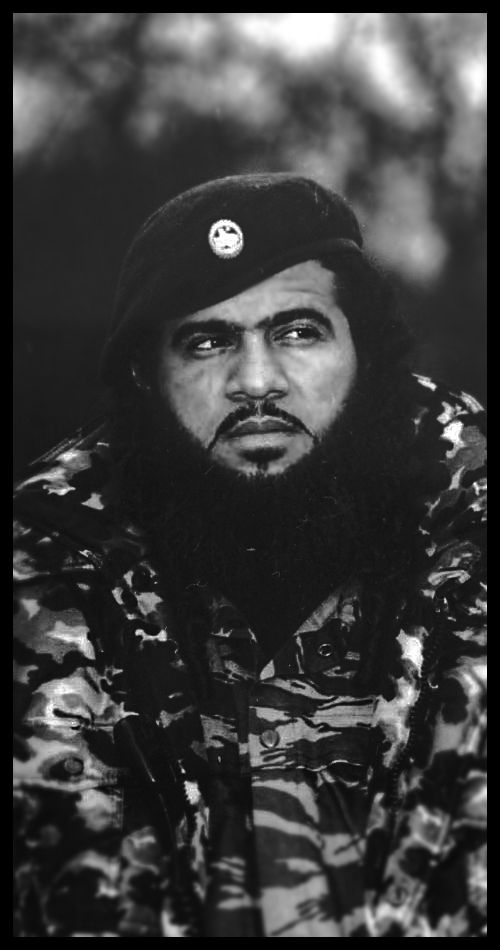
Khattab

Two overwhelming factors encouraged the gradual Islamization of the Chechen resistance: the population’s suffering and the successes of field commanders associated with Islamic radicalism. In 1996, the sectarian view of the war for independence was in its infancy but growing fast. It is unsurprising that, with most of the population displaced, ravaged by poverty, and grieving over lost loved ones, people turned to extremism. Yandarbiev’s and Ugudov’s rhetoric fed the public with a holy war of independence against “Russian infidels.” The rule of law having died, Islam was a a simple and easily understandable replacement for a nation unaccustomed to the law of war. Next, political isolation incentivized supporting Jihad as desperate tool for gaining financial support from numerous religious networks across the Arab world. In exchange, these backers demanded the Chechens fight not for simply national aspirations but divine above all.


[1]According to The War in Chechnya, the column carried 199 men, mostly contract soldiers.

[2]According to what Khattab himself later reported, his contingent did not exceed 50 people. The Polish journalist Miroslav Kuleba, who entered the independence guerrilla, declared in his book The Empire on its knees the figure of 43 men, including Khattab.

[3]As reported by Ibn Al Khattab in his book of memoirs, the Shahid (“martyrs”) were 9, and 21 were wounded. On the Russian side, Chechen losses were never ascertained with certainty. The only certain data were the bodies of 7 militants from the Shatoy District, identified on the battle site in the following days.

[4]Most of Khattab’s autobiographical notes are contained in a book of memoirs, Memories of Amir Khattab , some extracts of which can be found on www.ichkeria.net in the Insights- Memoirs section.

[5]About his choice to participate in the war in Chechnya, Khattab says: “While we were preparing for the next year, the events in Chechnya began. I watched TV: the fight against the Russians was led by the communist general Dzhokhar Dudayev, or so we imagined. We thought it was a conflict between communists, we didn’t see Islamic prospects in Chechnya. One day I went back to the rear to nurse my wounded right arm. There a Chechen Mujahideen came to me and offered to take me to Chechnya for a week or two. We looked at the map of Chechnya. It was a small republic of 16,000 square kilometers. It was even hard to find on the map. I thought its population was a thousand […].”

[6]Regarding this meeting, Khattab recalls: I met Dudayev during a visit to Sheikh Fathi. […] Dzhokhar began to ask questions. […] He asked: “Why don’t they come to help us in your area?” I replied, “The truth is that the reasons for the war are not clear, and people don’t know what we are fighting for.” He told me: “Brother […] this is an Islamic land. Isn’t that enough for you?” […] I sat down next to them (Dudayev and Al – Sistani, ed.) and asked Dudayev the first question: “What is the purpose of your battle? Do you fight for Islam?” He replied: “Every son of Chechnya and the Caucasus, oppressed for decades, dreams that one day Islam will return not only to his homeland, but to the whole Caucasus. And I am one of these children.[…].”

[7]We have already mentioned this field in the paragraph concerning the Battle of Serzhen- Yurt.

[8]Regarding the establishment of the Serzhen Yurt camp, Khattab recalls: […] I remember that at the first meeting there were more than 80 mujahideen who have now become Emirs. I remember what I told them (and Fathi translated): “If any of you want to be Emir, then he must offer his fighting program and we will obey him.” Nobody said anything. In those days the battle was approaching the mountains. So I told them, “I’m not telling you that I have knowledge. I only have combat experience in Afghanistan and Tajikistan. Maybe it’s time to get to work. I have a program staggered into three phases: preparation, arming and operations. If we are not ahead of you in battle you can shoot us. We will be in front of you after the course. After arming, we will start implementing the combat program. We will always go ahead of you, I and the brothers who are with me.”

[9]Again we quote Khattab’s recollections, contained in his memoir: The fighting soon approached our area. The young people argued whether it was a Jihad, the Sufi mullahs declared that it was not, that it was a showdown between Dzhokhar Dudayev and the Communists, and the hypocrites added fuel to the fire […]. The puppets of the Russians (the anti-Dudayevite opposition, ed.) said that this was a problem between them and Dudayev, and that we shouldn’t have intervened. […] I didn’t really know the situation because I hadn’t studied it. I had a video camera and started filming people, asking them what they were fighting for. That’s how I met Shamil Basayev. Some people thought I was a reporter. I have seen sincere people and, I swear by Allah, I cried when I asked an old woman, “How long will you bear these hardships?” and she replied: “We want to get rid of the Russians.” I asked her “What are you fighting for?” and she replied: “We want to live as Muslims and we don’t want to live with Russians.” So I asked her. “What can you give to the Mujahideen?” And she: “I have only this jacket on.” I cried: if this old woman can help by having only this, why do we allow ourselves to be afraid and doubtful? From that day I decided with my brothers to start preparing people for battle, as a first step.

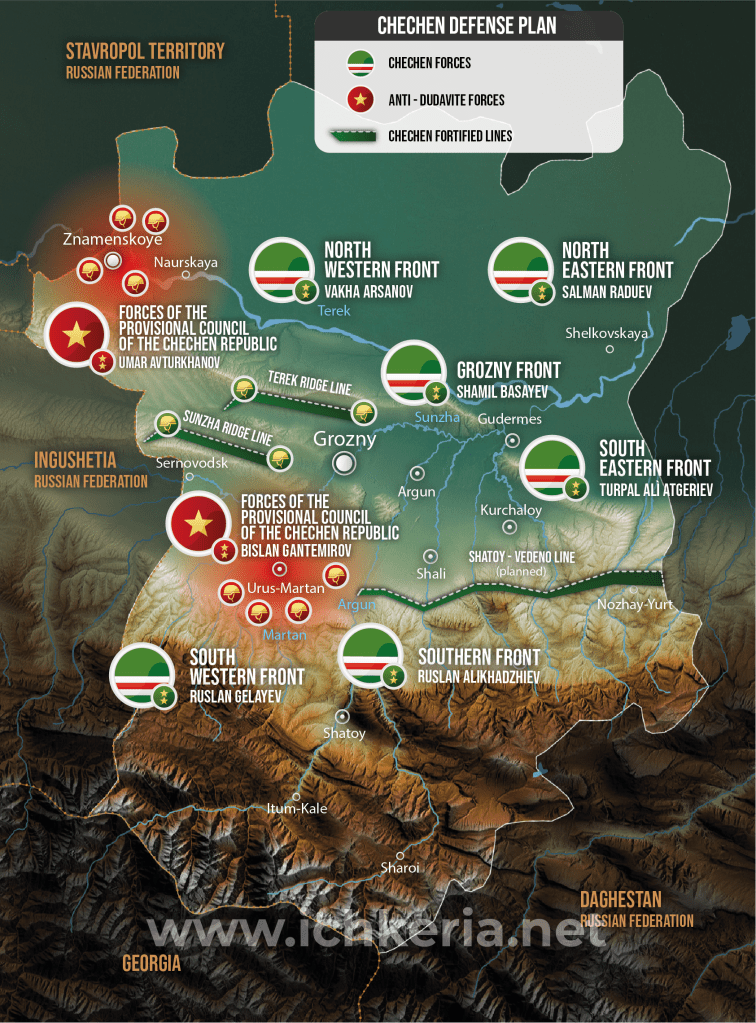
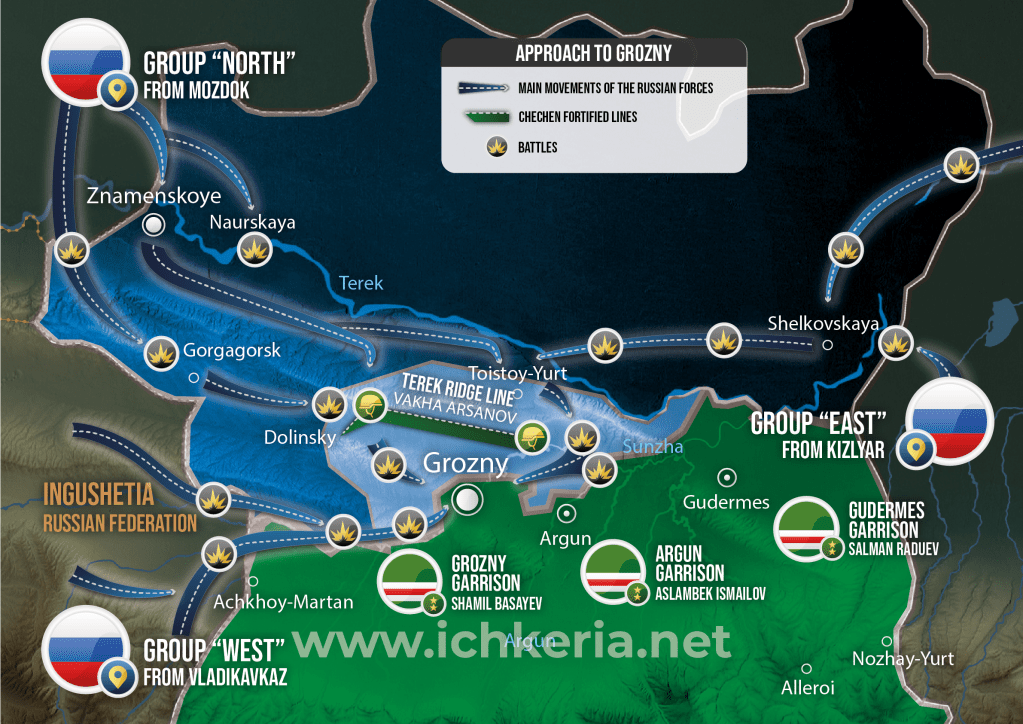
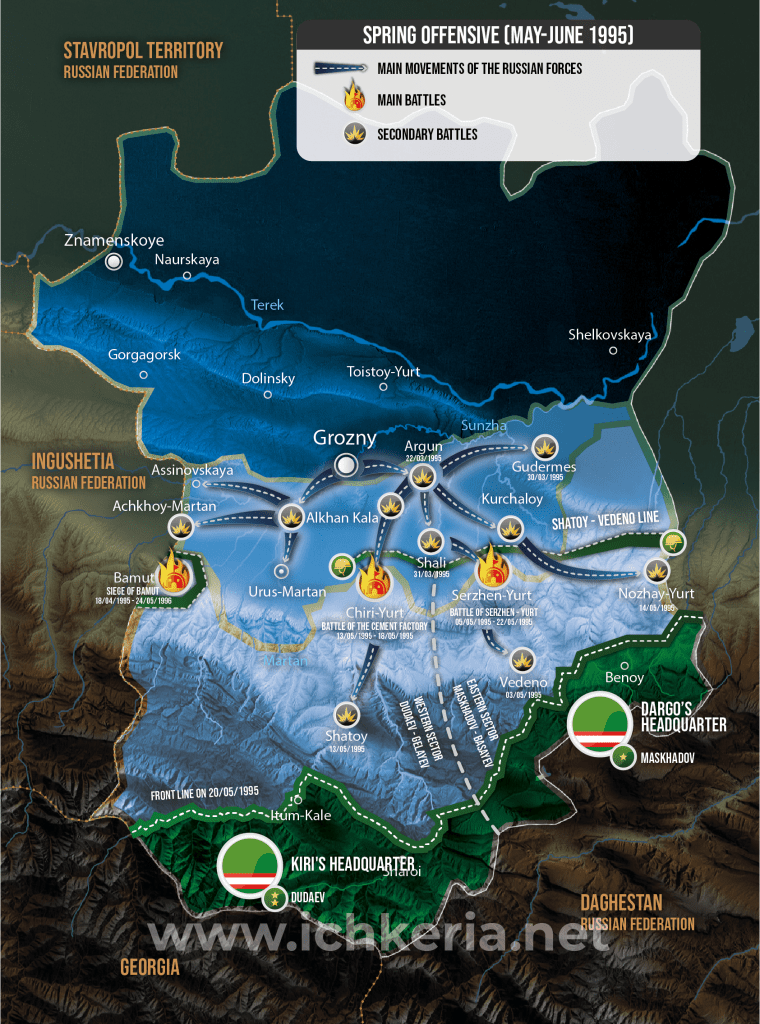
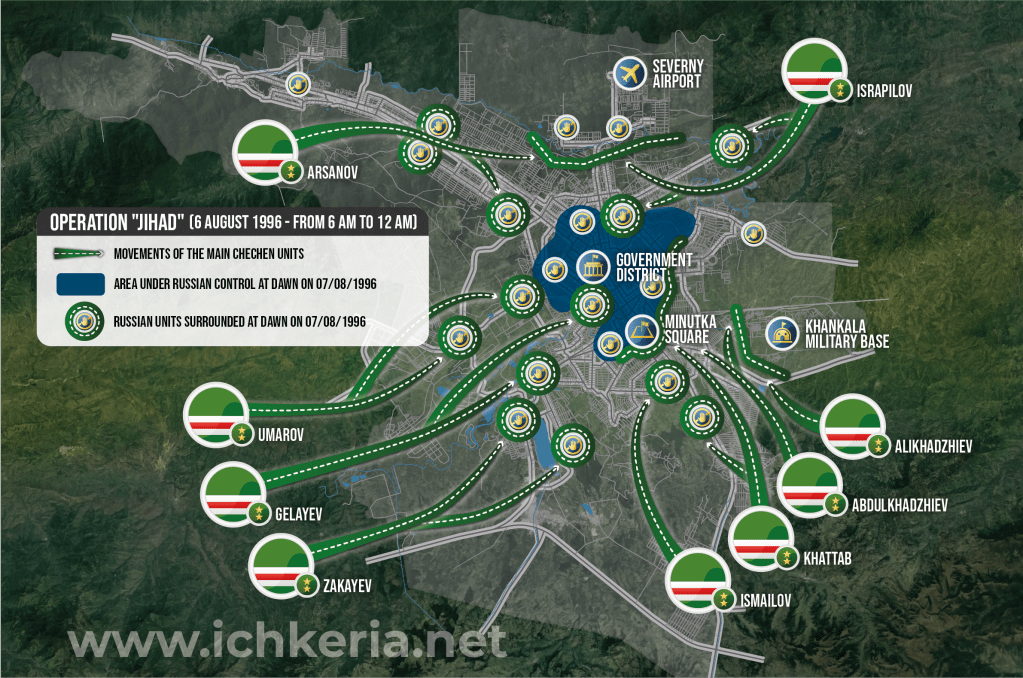
The English maps of the second volume are online

In view of the upcoming publication of the second volume of “Freedom or Death! History of the Chechen Republic of Ichkeria” we are publishing the maps in English, which will be available to readers via the QR code printed in the book.

Where is Chechnya going? Political reflections by Dzhokhar Dudayev (part 2)

That is why the archaic for modern foreign political science linguistics terminology “good, honest, decent, fair”, etc. as applied to our new power structures does not have even approximately unambiguously identified semantic content, because a million people will give exactly a million different interpretations to it. For some reason, for example, when speaking about the performing skills of a musician, we use quite natural and characteristic definitions such as “talented” or “skillful”, but not at all “virtuous” or “crystal honest”. This, as they say, is from a different opera.

Why is it that in politics everything is put upside down and professionalism is advanced to the “good guy”? Any specialist is very jealous of dilettantish talks about the subtleties of his profession. In politics, strangely enough, everything is allowed.

If we give in to the verbal exercises and tempting enticements of the rather proliferated “elementary educated” and use as state-building material such abstracted criteria thrown by Satan himself, we will probably not build anything good…ANY community of people at all times is differentiated, and the real basis of its division is the multiplicity of human aspirations, principles of behavior, potentialities and influential moments. Integrating by one or another criteria into groups and categories, they constitute those real natural forces and movements in society. In this connection, it is probably worth recalling that the formation and development of the state, which is also true for any individual, is based on these four characteristic driving factors, conventionally named: STIMULUS, MOTIVE, POWER AND FACILITIES.

STIMULUS is usually understood as a value reflecting the vector sum of its components, such as all kinds of Interests, Desires, Feelings, etc. MOTIVE is a potential value integrating Intellect, Knowledge, Experience, Know-How, etc. Another vector value is POWER, which integrates Power and Strength. And finally, FACILITIES is another potential value, the components of which are Money, Resources, Funds, etc. Predominantly operating with such concepts, which are “political bricks, mortar, armature and concrete”, and not with dilettantish abstract ones – “honesty, decency” or even “competence”, will always help any statesman and not only him to get a sufficiently objective dialectically verified analytical picture of any socio-political processes, to have the basis that does not allow making inexcusable and irreparable mistakes of political nature. The tools used for dismantling and destruction, as a rule, are unsuitable for construction and creation. That is why all appeals to “reason, brotherhood, understanding, unity, consensus…” etc. are useless. Only those who will be able to satisfy the Stimulus of the people, using the Means through the Motive of specialists, will be able to increase the Power of the state.
 Further. Many people thought, and are still strongly convinced of it, that it is worth to adopt the external attributes of the so-called civilized democracies, i.e. to elect a Parliament, a President and a Constitutional Court, delegating there the “best” representatives of the people, and all problems are solved. This is a monstrous misconception, and in conditions of collegial state capitalism, which today is certainly not only the Chechen Republic, but also Russia, these institutions turn out to be nothing more than the well-known “Hottabych’s telephone!” Absolutely identical to the prototype in all externally visible parameters and banally completely empty inside, without the electronic and mechanical stuffing that makes the apparatus work. We think, i.e. “call”, that we govern, while the people live under the influence of their objective social laws of evolutionary development.

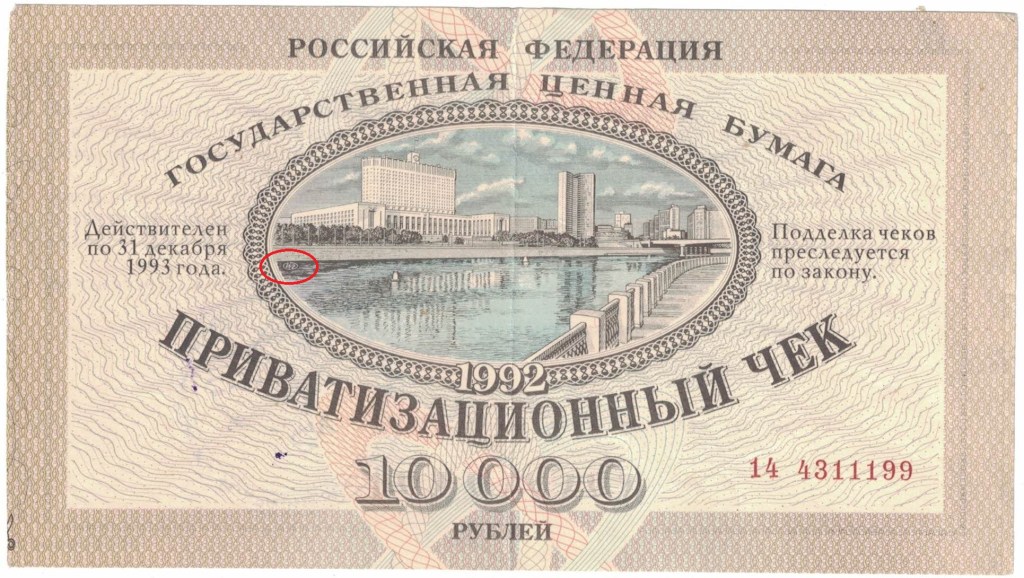
Photo of a voucher (privatization check, 1992) with an indication of the place where the monogram of the artist Igor Krylkov is located on the banknote (letters I and K in an oval).

Parliaments, Senates, Congresses, as a rule, are only a symbol of POWER in the hands of the explicit (authoritarianism) or implicit (non-authoritarianism) MASTER and, at best, serve as a laboratory practice for practicing the legislature set by the Master or giving legitimate form to his wishes.

As for the Presidential Structures, Cabinets or Councils of Ministers, other possible state bodies of executive power, they, as a rule, fulfill the function of these Wishes. Naturally, any form of state governance is characterized by a greater or lesser divergence in the directions of vectors of interests of the Master and the People. Except that in authoritarian state capitalism the change of the direction of the latter in its direction is performed by the Master mainly at the expense of the Power component of the Power factor, and in collegial private capitalism through the predominant use of the components of the Means factor. Unfortunately, and this is probably characteristic of most citizens of the former USSR, we are still in the deep captivity of nostalgic illusions about that executive power, which was exercised thanks to years of clearly defined totalitarian system, which had a wide range of appropriate tools: from fiscal bodies for suppression of dissent to institutions for “ideological straightening of brains”, from the stick to the carrot. Even the most ardent Western “anti-Sovietists” recognized at the time that totalitarianism ensured greater efficiency, discipline, and order. This is achieved, of course, at the expense of such characteristically dominant in authoritarian state capitalism worst components of the Stimulus, such as fear, fear, a sense of hopelessness, powerlessness, etc. Another question, of course, is what we have come to as a result of all this….

Let’s imagine hypothetically that the notorious Power overnight completely and completely passes into one hands: either the President, or the Parliament, or someone else. And let us be ruled by the ideal in each case, either presidential X. or the many-faced parliamentary Y, or nameless Z. What does this mean in practice? And that in this case all the national wealth, all the country’s resources and all its economic potential “falls under the monopoly of X. Y-a, or Z. That is, they will manage and distribute what they personally do not really own, but the owner – the people have very ephemeral economic rights! Together with the entire ministerial team, the governing echelon of the government can hardly constitute even one tenth of a percent of the population. But the psychology of behavior and programmed attitude of any manager – non-private co-owner, especially in the conditions of decline in economic production and deterioration of living standards of the poor part of the population, consists in instinctive efforts to keep the place under the sun by justifying the motives of their activities, referring to the difficulties of objective and subjective plan, as well as criticism of various formal and informal objects that create allegedly insurmountable problems. Remember N. Ryzhkov, V. Pavlov or T. Gaidar. V.Chernomyrdin is bound to follow this path.

Boris Eltsin

Naturally, and it is inherent in human nature, that the dissatisfied and offended, “who know better how the country should be run and what the people need”, necessarily starting with derogatory criticism, can move on to much more serious and active actions to “restore justice”. What is the response for the ruling elite? To tighten the screws? But this is a return to totalitarianism, from which they fled and have not yet had time to catch their breath. Make personnel reshuffles? Nothing will change significantly. Then the System itself must be replaced! But, as it seems, we changed it by dismantling the “unified party-parameter room” and creating a modernized one with “separate warheads”. This is where another stumbling block turned out to be. Having flown out at first in one “anti-imperial missile”, we ended up like those “swan, crayfish and pike”, with our spatially differently oriented vectors of Stimulus and Power, different baggage of Motive and Means.

Yes, sometimes power is divisible. And its rank gradation is possible both vertically and horizontally. But on a national scale, it always has pyramidal differentiation, strengthening from the base to the top. And two or even three pyramids in a country is a competition of authoritarian authorities. Reasonable peace or peaceful compromise in such unnatural conditions is nonsense. Artificial attempts of horizontal separation of powers, i.e. to make several Masters at the same time, is an objective doom for “family-economic” strife, which will continue until the unstable balance will not take its more natural stable state, peculiar only under one definite Master, until the divided pyramids will finally merge into one. Many people mistakenly see the antagonism of “divided powers” as a personal factor. Then imagine, for example, that we swapped places with the Chairman of the Parliament of the Chechen Republic. In half a year, if not sooner, having mastered and gotten up to speed, having been in a “different skin”, each of us will defend new positions, noticing a grain of sand in someone else’s eye and not seeing a log in our own. And there is nothing surprising or tragic in this, it is simply the natural nature of a person to defend the interests of a certain (“his”) group and category of people or, if you like, a part of society. I am sure that the same metamorphosis would have happened if B. Yeltsin and R. Khasbulatov had been swapped.

Former Soviet Parliament Chairman Ruslan Khasbulatov, seen here second-left in 1993

What then is the reason for stability in the collegial private capitalist camp? Is their “collective economy” quiet and smooth and God’s grace? Not at all. And here interests and motives may differ greatly, and various storms and tsunamis may occur. But in the world, where “the dominance of private property” rules, the communicative language of business invariably develops a mutually acceptable solution, which, having passed through “their” structures of power, is always implemented, as it is refined by the filter of economic expediency and the state Guarantor of Private capital. The only way of civilized solution to any conflict, which has been worked out for centuries, is to make it more profitable for the disputing parties to stop the conflict than to continue it. We have yet to master such methods.

Thus, implying a change of the System, in fact we have changed only its external Form, its Attributes. The System itself remained inviolable – state-capitalist! To finally dispel the last illusions about its viability, let us consider the question: “Will such a competitive government be able to effectively realize its management mission in the period of transition to market relations, so that the sheep would be safe and the wolves would be fed? What, in general, is its potential future, if neither M. Gorbachev and the Union Parliament, nor B. Yeltsin and the Supreme Soviet of the Russian Federation, nor other CIS republics have been able to do so so far – one does not need to go far for examples….

LA PACE PRECARIA – Il trattato di pace Russo – Ceceno

Il 12 Maggio 1997 la Repubblica Cecena di Ichkeria e la Federazione Russa firmarono un trattato di pace con il quale intendevano porre fine alla Prima Guerra Russo – Cecena. Nonostante che in esso la Russia riconoscesse De Jure la Repubblica Cecena di Ichkeria, le clausole contenute nell’accordo furono interpretate in maniera assai differente dalle due parti. Il diverso approccio tenuto da Mosca e da Grozny rispetto al Trattato di Pace avrebbe impedito la risoluzione pacifica del conflitto, e creato le premesse per una nuova guerra.

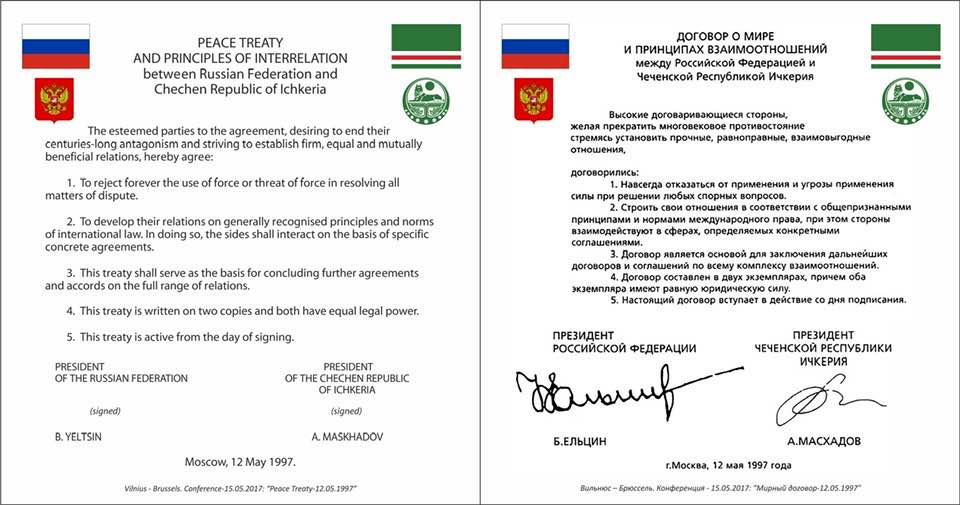
Il testo del trattato in inglese e in russo

IL TRATTATO DI MOSCA

Il 12 Maggio1997 la delegazione cecena, composta da Maskhadov, Ugudov e Zakayev raggiunse Mosca, dove procedette alla firma solenne del Trattato di Pace tra la Federazione Russa e la Repubblica Cecena di Ichkeria. La firma del Trattato fu un evento epocale: per la prima volta in quattrocento anni di guerre e tensioni il governo di Mosca e quello di Grozny si promettevano ufficialmente la pace. Vennero firmati due documenti: il primo si intitolava “Trattato di Pace e Principi di Relazione tra la Federazione Russa e la Repubblica Cecena di Ichkeria”, il secondo si chiamava “Accordo tra il governo della Federazione Russa e il governo della Repubblica Cecena di Ichkeria sulla cooperazione economica reciprocamente vantaggiosa e la preparazione delle condizioni per la conclusione di un trattato su vasta scala tra la Federazione Russa e la Repubblica Cecena di Ichkeria”. I due documenti, dagli altisonanti titoli, avrebbero dovuto essere la base giuridica sulla quale si sarebbero costruiti i rapporti tra Russia e Cecenia. Il “Trattato di Pace” iniziava con un epico preambolo riguardo la reciproca volontà di “[…] Porre fine al confronto secolare, cercando di stabilire relazioni forti, uguali e reciprocamente vantaggiose […]”. Un iniziò di tutto rispetto, dal quale ci si aspetterebbe un lungo ed articolato Trattato. E invece niente di questo. Il Documento si costituiva di cinque articoli, e soltanto tre contenevano qualcosa di politicamente rilevante. In essi Russia e Cecenia si impegnavano:

  • A rinunciare in modo permanente all’uso ed alla minaccia dell’uso della forza come forma di risoluzione di eventuali controversie;
  • A Costruire le loro relazioni conformemente ai principi ed alle norme generalmente riconosciuti dal diritto internazionale, e ad interagire in aree definite da accordi specifici;
  • A considerare il Trattato come base per la conclusione di qualsiasi altra negoziazione.

Di per sé le tre affermazioni possono essere considerate solide basi di negoziazione politica, ma a ben guardare si prestano a molteplici interpretazioni, come tutti gli altri “documenti”, “dichiarazioni” e “protocolli” firmati fino ad allora dalla marea di delegazioni che fin dal 1992 avevano cercato di trovare un accordo tra le parti. In particolare Maskhadov considerò il Trattato come il riconoscimento dell’Indipendenza cecena, dichiarando che la sua sottoscrizione apriva “Una nuova era politica per la Russia, il Caucaso e l’intero mondo musulmano”. Uno dei funzionari della politica estera cecena, delegato in Danimarca per conto della Repubblica Cecena di Ichkeria, Usman Ferzauli, quando venne inviato da Maskhadov a firmare le Convenzioni di Ginevra, dichiarò: “[…] La Russia, firmando nel maggio 1997 il Trattato di Pace con la Repubblica Cecena di Ichkeria di fatto ha riconosciuto la Repubblica. Abbiamo il diritto di considerarci un soggetto di diritto internazionale. […].”. Anche alcuni ricercatori internazionali, come Francis A. Boyle, professore presso il College Law dell’Università dell’Illinos, produssero ricerche giuridiche sul Trattato. Nella discussione di Boyle si legge: “L’elemento più importante del trattato è il suo titolo: “Trattato sulla pace e i principi delle interrelazioni tra la Federazione russa e l’Ichkeria della Repubblica cecena”

Maskhadov ed Eltsin si stringono la mano

IL PARERE FAVOREVOLE

Secondo i principi di base del diritto internazionale, un “trattato” è concluso tra due stati nazionali indipendenti. In altre parole, il CRI viene trattato dalla Federazione Russa come se fosse uno stato nazionale indipendente ai sensi del diritto e delle prassi internazionali. […] Allo stesso modo, l’uso del linguaggio “Trattato sui … principi di interrelazione” indica che la Russia sta trattando la CRI come uno stato nazionale indipendente anziché come un’unità componente della Federazione Russa. Normalmente, “i principi delle interrelazioni” tra uno stato federale come la Federazione Russa e un’unità componente sono determinati dalla Costituzione dello stato federale. Questo documento non dice nulla della Costituzione della Federazione Russa.  […]Certamente l’elemento più importante del titolo del Trattato è l’uso del termine “Repubblica Cecena di Ichkeria”. Questo è il nome preciso che il popolo ceceno e il governo ceceno hanno deciso di dare al loro stato nazionale indipendente. In altre parole, ancora una volta, la Federazione Russa ha fornito ai Ceceni il riconoscimento di fatto (anche se non ancora di diritto) come stato nazionale indipendente alle loro condizioni. […] L’articolo 1 del trattato è sostanzialmente in linea con il requisito dell’articolo 2, paragrafo 4 della Carta delle Nazioni Unite secondo cui gli Stati membri “si astengono dalle loro relazioni internazionali dalla minaccia o dall’uso della forza ….” Allo stesso modo, la Carta delle Nazioni Unite Articolo 2, paragrafo 3, impone agli Stati membri di “risolvere le loro controversie internazionali con mezzi pacifici ….” Quindi, con questo Trattato, la Federazione Russa ha formalmente riconosciuto il suo obbligo di trattare la CRI in conformità con questi due requisiti fondamentali della Carta delle Nazioni Unite. […] Il secondo articolo dell’accordo è estremamente importante: “Costruire le nostre relazioni corrispondenti ai principi e alle norme generalmente accettati del diritto internazionale …” Secondo la mia opinione professionale, l’unico modo in cui l’articolo 2 del presente trattato può essere correttamente letto alla luce di tutto ciò che è stato detto in precedenza nel suo testo è che la Federazione russa sta trattando l’IRC come se fosse di fatto (anche se non ancora de jure) stato nazionale indipendente ai sensi del diritto e delle prassi internazionali, con una propria personalità giuridica internazionale. Solo gli stati nazionali indipendenti sono soggetti ai “principi e norme generalmente accettati del diritto internazionale”.  […].”

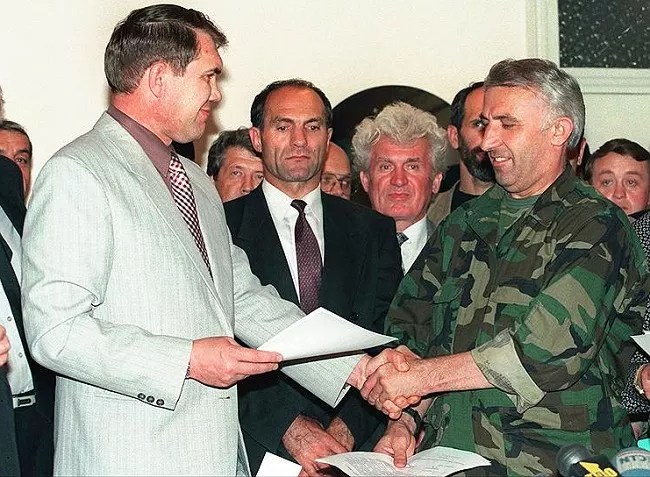
Accordi di Khasavyurt: Maskhadov e Lebed si stringono la mano

IL PARERE CONTRARIO

Il governo Russo negò questa interpretazione, considerando l’assenza di qualsiasi affermazione chiara in merito. Rispetto a questo, negli anni successivi sarebbe sorto un lungo dibattito, il che già di per sé dimostra quanto generici fossero gli impegni assunti dalle parti e quanto poco chiaro fosse il documento in se. In una sua trattazione del tema, il ricercatore russo Andrei Babitski scrisse:

“L’essenza di questo documento è semplice. E’ solo un documento sulla cessazione delle operazioni militari. […] Non menziona la capitolazione da parte di nessuna delle parti, non proclama nessuno vincitore e non formula principi chiari per governare le relazioni tra Russia e Cecenia. La risposta a queste domande è stata rinviata. La cosa più importante era terminare la guerra.”.

Silvia Serravo, ricercatrice esperta in questioni caucasiche, specificò in un’intervista:

“Il documento contiene la possibilità di interpretazioni diverse. […] L’indipendenza della Cecenia non è stata riconosciuta. Tuttavia, il documento ha reso possibile, almeno per la parte cecena, interpretarlo come il riconoscimento da parte della Russia dell’indipendenza cecena. […] Il trattato può certamente essere considerato un risultato. […] Tuttavia si può sempre speculare sulla misura in cui le parti erano sincere quando fu firmato questo documento e se la conclusione del Trattato si basava su alcuni motivi fraudolenti.”

INDIPENDENZA “SOSPESA”

Il secondo documento, collaterale al primo, conteneva un altra generica serie di intese difficilmente realizzabili. In esso si definiva l’attuazione dei contenuti degli Accordi di Khasavyurt in fatto di ripristino dei servizi vitali per la popolazione civile, il regolare pagamento delle pensioni e degli stupendi pubblici da parte della Federazione Russa,  il pagamento di un risarcimento alle vittime dei combattimenti, la “piena attuazione del programma di ripristino del complesso socioeconomico” del paese, il rilascio di ostaggi e prigionieri, e lo scioglimento della Commissione Governativa congiunta riguardo alla gestione del periodo interbellico, contemporaneamente all’entrata in vigore del Governo uscito dalle Elezioni del Gennaio precedente.

Se il primo documento, come abbiamo visto, poteva lasciar pensare che la Russia volesse trattare la Cecenia come uno Stato indipendente, il secondo assomigliava molto ad un accordo interfederale tra una repubblica autonoma bisognosa di aiuto ed un governo centrale che intendeva corrisponderglielo. Particolarmente evidente era l’impegno, da parte di Mosca, di erogare gli stipendi pubblici dell’amministrazione cecena. Questo passo è fondamentale, perchè accettandolo Maskhadov riconobbe implicitamente l’autorità di Mosca di mantenere la struttura amministrativa della Cecenia esattamente come faceva ai tempi dell’Unione Sovietica. Non un solo accenno era previsto riguardo al riconoscimento, anche formale, all’indipendenza del paese. Il Trattato di Pace firmato da Maskhadov fu un documento utile ad accreditare lui presso l’opinione pubblica ma fallì nel rappresentare uno strumento diplomatico utile a risolvere alcunchè. Certamente pose ufficialmente fine alla guerra e ad ogni palese ingerenza del governo federale sulla politica interna del paese, ma niente oltre a questo.

Il Trattato non riconobbe in maniera inequivocabile l’indipendenza del paese, ma si limitò a stabilire gli strumenti tramite i quali i due stati avrebbero comunicato tra loro. Dette ampia libertà di interpretazione sia al governo ceceno, che vide in quelle poche righe un implicito riconoscimento da parte di Mosca, che al governo russo, che ci riconobbe esclusivamente l’impegno assunto a riportare su binari politici il conflitto. Sul momento comunque sia Maskhadov che Eltsin poterono dirsi soddisfatti: il primo tornava in patria con un trattato di pace tra le mani, qualcosa che i Ceceni non avevano mai visto in tutta la loro storia. Il secondo tirava un sospiro di sollievo e metteva un temporaneo tampone a quella emorragia di consensi che era stata la Prima Guerra Cecena.

La crisi istituzionale del 1993 – Russia e Cecenia a Confronto (Parte 1)

LA FINE DELLA PERESTROJKA

Agli inizi del 1993 il processo innescato dalla Perestrojka e proseguito col collasso dell’URSS poteva dirsi completo. In ogni ex repubblica sovietica il comunismo era stato travolto ed il regime a partito unico era stato sostituito da sistemi democratici. Si trattava di governi giovani, instabili, nei quali alle istituzioni parlamentari si contrapponeva l’autoritarismo dei leader che le avevano create. Esattamente come stava succedendo in Cecenia, dove la straripante figura del Generale Dudaev veniva a stento contenuta dal Parlamento, anche in Bielorussia, Georgia, Armenia, Azerbaijan e nella stessa Russia si innescarono conflitti istituzionali. I risultati furono di due tipi: dove vinse la corrente parlamentare si instaurarono democrazie di stampo occidentale. Dove invece vinsero i leader nazionalpopolari nacquero repubbliche dalla spiccata vocazione presidenziale o regimi semi – dittatoriali. Sia in Russia che in Cecenia l’evoluzione del conflitto avrebbe portato al medesimo epilogo.

In Cecenia Dudaev si trovava sempre più isolato. I suoi sostenitori, per la maggior parte componenti dell’entourage presidenziale e nazionalisti del VDP, si arroccavano a difesa di posizioni radicali, in contrasto con la propensione al compromesso dei nazionalisti moderati. Una crescente opposizione extraparlamentare, poi, rifiutava di partecipare alla vita politica. In Russia la situazione non era molto diversa: le politiche del governo Gaidar erano in pieno svolgimento e presentavano ai russi un conto salatissimo. Nel corso del 1992 il PIL del paese era franato del 14,5%, e le stime per il 1993 non lasciavano sperare in meglio. La crisi economica aveva lasciato sul lastrico metà della popolazione. Tutti i comparti della spesa pubblica erano stati tagliati, a cominciare dai sussidi sociali, dal sistema sanitario, e ovviamente dall’esercito, ridotto all’ombra di sé stesso. La terapia d’urto stava costando ad Eltsin un vistoso calo di consensi, e gli aveva ormai allontanato il supporto del Presidente del Soviet Supremo, il già citato politico ceceno Ruslan Khasbulatov. Questi, inizialmente vicino alle posizioni del presidente, soprattutto nei giorni confusi del Putsch di Agosto, si era allineato su posizioni socialdemocratiche, critiche verso il liberismo di Gaidar. Intorno a lui la maggioranza dei deputati del Soviet aveva aderito a correnti, movimenti e partiti favorevoli ad una moderazione delle politiche governative.

Ruslan Khasbulatov

La strada per una “controrivoluzione liberale” sembrava aperta, e passava prima di tutto dalla abrogazione dei poteri d’emergenza che Eltsin aveva chiesto ed ottenuto per attuare la sua manovra “lacrime e sangue”, i quali sarebbero scaduti naturalmente entro la fine del 1992. Il Presidente ne chiedeva il prolungamento, ma questa richiesta cozzava con le intenzioni di buona parte dei deputati ostili al governo Gaidar e con quelle di Khasbulatov, che quei poteri voleva revocarli quanto prima. Pertanto la richiesta di Eltsin sbatté contro il rifiuto del Congresso che, anzi, il 9 dicembre 1992 sfiduciò Gaidar dalla guida dell’esecutivo. Al pari di quanto stava succedendo in Cecenia, anche in Russia il potere presidenziale, fautore di una politica radicale, si scontrava con quello parlamentare, intenzionato a difendere l’ordinamento costituzionale.

ELTSIN CONTRO KHASBULATOV

La reazione di Eltsin non si fece attendere, ed il 10 dicembre il Presidente tenne un rabbioso discorso, accusando il Soviet Supremo di voler sabotare le riforme e riportare la Russia nell’era sovietica. Propose infine un referendum popolare sulla fiducia dei cittadini nel Presidente, nel governo e nel Parlamento[1]. Dopo due giorni di reciproche bordate, Khasbulatov ed Eltsin raggiunsero un compromesso per il quale il Presidente avrebbe accettato di sottoporre il suo operato ad un voto popolare di fiducia, ed avrebbe operato un cambio della guardia nell’esecutivo, in cambio dell’estensione di quasi tutti i poteri d’emergenza fino al giorno del referendum, da tenersi nell’aprile del 1993. Lì per lì sembrò che l’accordo tenesse: Elstin licenziò Gaidar e lo sostituì con Viktor Chernomyrdin, personaggio eclettico e politicamente volubile, presidente della principale società produttrice di petrolio e gas naturale della Russia ed una delle più importanti del pianeta, la Gazprom.

I NEGOZIATI DI GENNAIO

Impantanato com’era nella crisi col Parlamento, Eltsin non aveva né il tempo né l’opportunità di occuparsi della Cecenia. Per questo lasciò che il suo plenipotenziario Sergei Shakhrai, che già nel 1992 lo aveva rappresentato nei numerosi incontri con le delegazioni separatiste, si occupasse di portare avanti le trattative con la controparte, con l’unico imperativo di non lasciare che la piccola repubblica caucasica riuscisse ad ottenere un riconoscimento come stato indipendente. Shakhrai aveva tre opzioni tra le quali scegliere: appoggiare l’opposizione extraparlamentare e favorire una ribellione armata nella repubblica, aprire un ciclo di negoziati con Dudaev, o tentare di aggirarlo portandogli via il sostegno del suo stesso Parlamento. La terza soluzione gli parve la più efficace, perché indeboliva il principale ostacolo al reintegro della Cecenia (Dudaev appunto) pur senza “sporcarsi le mani” con operazioni sotto copertura. Ad armare qualche ribelle per mandarlo ad uccidere il presidente ceceno si era sempre in tempo. Dividere il fronte indipendentista, invece, era possibile farlo solo ora che tra il generale e gli esponenti del Parlamento di Grozny i rapporti erano compromessi. Così, per tutto il mese di dicembre, Shakhrai lavorò a tenersi vicini sia Mamodaev sia il più energico tra deputati ceceni, Soslambekov, ormai ostile al Presidente.  

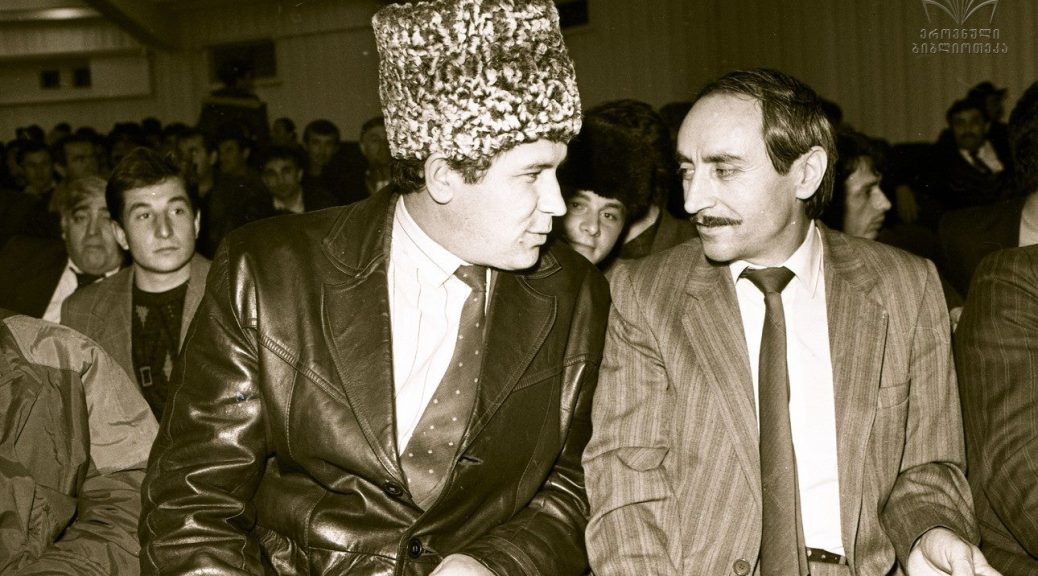
Yusup Soslambekov e Dzhokhar Dudaev

Shakhrai, Mamodaev e Soslambekov si incontrarono prima a Vladikavkaz, poi a Mosca, predisponendo una bozza di Trattato Federativo che avrebbe visto la Cecenia aderirvi come uno stato indipendente. Il primo risultato di questa rinnovata intesa fu la promessa di Shakhrai di allentare il blocco economico e ricominciare a pagare pensioni e sussidi ai cittadini ceceni, non appena la bozza del Trattato fosse stata approvata a Grozny. Sembrò che dopo tanta acredine un terreno comune di negoziato fosse stato raggiunto. Ma come sempre era stato fino ad allora, le speranze dei negoziatori ceceni sbatterono contro il cocciuto rifiuto di Dudaev, il quale non intendeva aderire ad alcun trattato federativo, di nessuna natura, a nessuna condizione. Per il momento, in ogni caso, le consultazioni andarono avanti. Del resto per Shakhrai non era tanto importante giungere ad un accordo immediatamente, quanto isolare il più possibile Dudaev.  Il 6 gennaio Mamodaev dichiarò di aver presentato un progetto di trattato tra Russia e Cecenia, e di averne discusso a grandi linee con il Vice – Ministro russo per le nazionalità Ramzan Abdulatipov. Il documento, che avrebbe dovuto essere discusso nei giorni seguenti, avrebbe determinato il trasferimento di numerosi poteri da parte dello stato ceceno alla Federazione Russa. Come c’era da aspettarsi, Dudaev rispose con un categorico No. Shkahrai e Soslambekov si accordarono comunque per proseguire le trattative sulla base del principio federativo “tra pari”, sperando che la fazione parlamentare riuscisse ad avere la meglio su Dudaev, ed il divorzio russo – ceceno riuscisse a ricomporsi. I due decisero di incontrarsi nuovamente a Grozny il 14 gennaio.

Non appena la delegazione russa giunse nella capitale cecena subito fu chiaro agli occhi di tutti in quale difficile clima si sarebbero svolti i negoziati. L’aeroporto era militarizzato, ed il corteo diplomatico fu sorvegliato da miliziani di Dudaev armati fino ai denti fino all’arrivo all’edificio del Parlamento, dove si sarebbero tenuti i colloqui. Giunta a destinazione la delegazione russa iniziò i negoziati con quella cecena, composta dal Presidente del Parlamento, Akhmadov, dal Vicepresidente Mezhidov, dal Presidente della Commissione Affari Esteri, Soslambekov e dal rappresentante della Cecenia a Mosca, Sherip Yusupov. Nel giro di pochi minuti un distaccamento della Guardia Presidenziale raggiunse l’edificio del Parlamento in assetto da combattimento. Sembrava che Dudaev fosse deciso ad interrompere i negoziati ad ogni costo, se necessario arrestando tutti i presenti. Akhmadov e Soslambekov mobilitarono chiunque potesse aiutarli, parenti e amici compresi. L’intervento di una folla di parlamentari e civili, che si assieparono di fronte all’edificio ed impedirono alle forze speciali di intervenire, permise il proseguimento dei colloqui.

I PRODROMI DELLA CRISI ISTITUZIONALE IN CECENIA

Il fatto in sé rimaneva comunque inaudito, ed indicativo del clima di reciproco sospetto che ormai aleggiava tra il Presidente ed il Parlamento. Le due delegazioni alla fine firmarono un protocollo di preparazione ad un trattato sulla mutua delegazione e divisione dei poteri. Il protocollo dava ai Ceceni la vittoria di un riconoscimento della loro repubblica come un soggetto del diritto. Parimenti, garantiva ai russi la prospettiva di un trattato che mantenesse la Cecenia entro lo spazio economico e politico della Russia. Su questa base, la Cecenia avrebbe potuto cedere porzioni della sua sovranità alla Federazione Russa non in quanto soggetto di livello inferiore, ma in quanto soggetto paritetico che volontariamente aderiva ad una federazione di repubbliche sovrane. Sul piano giuridico la differenza era effettivamente importante: si riconosceva l’ingresso della Cecenia come volontario, e non come una costrizione dovuta all’applicazione del principio di supremazia. Sul piano pratico (che era quello che interessava più a Dudaev) tuttavia, significava il ritorno della Cecenia alla Russia, la perdita dell’indipendenza ed il riconoscimento del primato politico di Mosca. Il 19 gennaio la stampa cecena pubblicò la bozza del trattato, facendo infuriare Dudaev. Questi ripudiò il protocollo, dichiarando che nessun accordo avrebbe potuto essere raggiunto prima del riconoscimento del Paese come repubblica indipendente, facendo infuriare a sua volta Soslambekov ed Akhmadov.

Frustrato dall’atteggiamento di Dudaev, Soslambekov dichiarò che se il generale si fosse opposto ai negoziati il Parlamento avrebbe tenuto un referendum popolare, costringendo il Presidente a firmare il trattato federativo. Stiamo costruendo uno stato non per il Presidente e non per il Parlamento, ma per l’intero popolo della repubblica, le sue future generazioni dichiarò alla stampa. Anche il terzo delegato del Parlamento, il Vice – Presidente Bektimar Mezhidov, si scagliò contro il Presidente, accusandolo di non voler trovare un linguaggio comune. Dudaev rispose per bocca del suo Ministro dell’Informazione, Ugudov, il quale dichiarò: Mentre, nel complesso, il governo supporta la conduzione di negoziati russo – ceceni, non concorda con una serie di formule del protocollo firmato dalla delegazione russa e dai rappresentanti del parlamento ceceno il 14 gennaio.  Yandarbiev gli fece eco, sostenendo che il tenore del documento firmato abbassava il livello del negoziato così come era stato impostato tra marzo e maggio del 1992.  Soslambekov tentò allora di rettificare i punti contestati, redigendo una bozza di trattato in base al quale la Cecenia avrebbe aderito alla Federazione Russa da soggetto indipendente.

Sergei Shakhrai

[1] Descrivendo lo scopo del referendum in una conferenza stampa, Eltsin propose il suo quesito: Quale corso sostengono i cittadini della Russia? Il corso del Presidente, un corso di trasformazione, o il corso del Congresso, del Soviet Supremo e del suo Presidente, un corso volto a piegare le riforme ed in ultima analisi verso l’aggravamento della crisi?