The work on this biography is carried out in collaboration with the Instagram page “Qoman Sij”, based on information received from the former deputy of the Minister of Foreign Affairs of the Chechen Republic of Ichkeria, Ilyas Musaev, verified with the sources at our disposal.
Born in Germenchuk in 04/12/1962, Aslanbek Abdulkhadzhiev joined the National Guard in 1991, during the Chechen Revolution. Volunteer in Abhazhia between 1992 and 1993, he served in the International Brigades of the Confederation of Peoples of the Caucasus, becoming Shamil Basayev’s trusted man. Appointed by the President Dudayev as Military Commander of the Shali District at the outbreak of the First Russian – Chechen war, he commanded a large detachment.
Aslanbek Abdulkhadzhiev, nicknamed “Big Aslanbek”
Nicknamed “Big Aslanbek” (in recognition of his comrade in arms Islanbek Ismailov, nicknamed “Little Aslanbek”) Abdulkhadzhiev was one of the main organizers of the historic raid by Chechen fighters on the Russian city of Budennovsk in June 1995, which forced the Russian authorities to agree to a temporary cessation of the war and the beginning of peace negotiations. For this military operation, among the first, he was awarded the highest state order of the CHRI Qoman Sij (Honor of the Nation), by the first President of the Chechen Republic of Ichkeria, Dzhokhar Dudayev.
One of the main commanders in the Battle of Pervomaiskoye (January 1996) in the Operation Retribution (March 1996) and in the Operation Jihad (August 1996), after the reconquest of Grozny he was appointed military commander of he Capital as Military Commissioner. For his war merits he was appointed Brigader General and decorated with the Honor of the Nation.
Elected Deputy in the parliamentary elections of January 1997, he attempted to gain the presidency of the assembly, but was overtaken by the pro-government candidate Ruslan Alikhadzhiev. Supporter of the nazional – radical party, he promoted the “Law of lustration” with which it was intended to remove from public officies all those who had collaborated with the pro – Russian government during the war. The delays in the approval of this law were the cause of his resignation in 1998.
Preident of the state company Chechenkontrakt since June 1997, at the outbreak of the Second Russian – Chechen War he formed an unit of around 80 men, with whom he fought in the Siege of Dzhokhar (1999 – 2000). After the fall of the city in Russian’s hands, he retreated in the Argun Gorge, leading the partisan fight.
On August 26, 2002, following a denunciation by a Russian informer, the house in the city of Shali, where Aslanbek Abdulkhadzhiev was hiding, was surrounded by Russian occupiers and local collaborators.
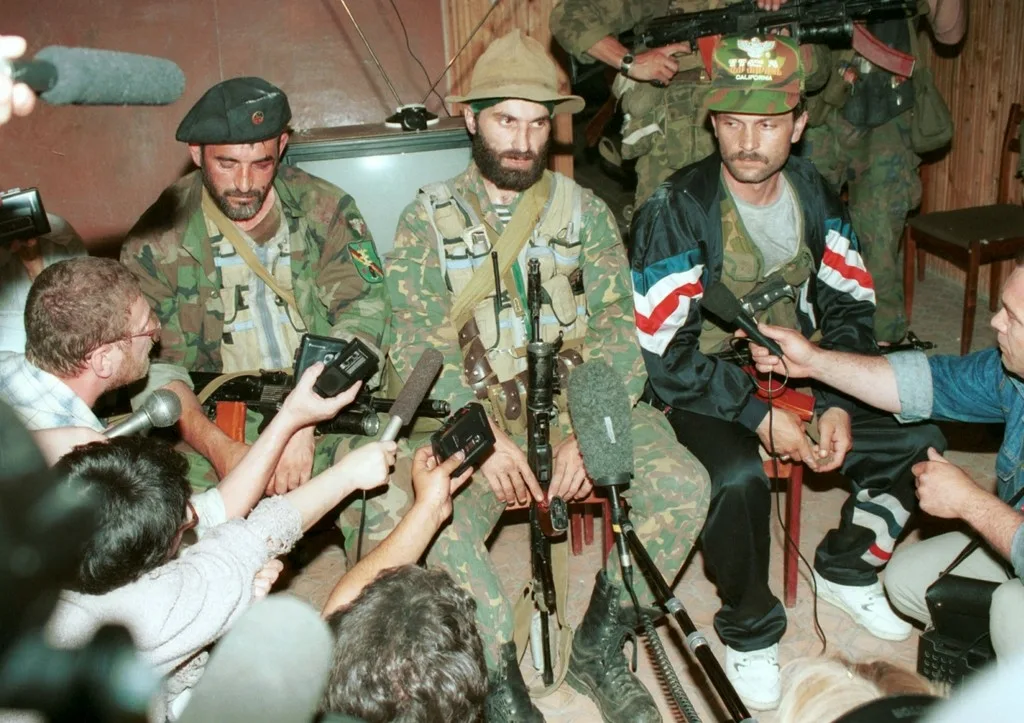
Aslanbek Abdulkhadzhiev attends a press conference together with Shamil Basayev (center) and Aslanbek Ismailov (“Little Aslanbek”, right). June 1995
According to the reports of his death:
The senior FSB officer leading the Russian occupiers through a loudspeaker told the Chechen commander to surrender, to which there was an immediate response from a Stechkin submachine gun. In response, Russian punitive forces began firing grenade launchers and machine guns. Having used up all his ammunition, the Chechen commander began throwing grenades and lemons at the invaders. In turn, the aggressors opened fire from heavy machine guns located on armored personnel carriers. This actually predetermined the outcome of the unequal battle. Aslanbek was seriously wounded. The enemies, having learned about this, tried to take him alive.
However, the Russian punitive forces were not destined to mock the wounded Chechen commander. Aslanbek, who was losing consciousness, at the last moment managed to pull out the pin of the grenade, which exploded in his hands. The blast wave generated by the grenade explosion carried away several occupiers who were close to the Chechen commander. According to Shali residents, at least four occupiers were killed and seven wounded during the night battle in the city of Shali. This is how the life of 41-year-old Chechen general Aslanbek Abdulkhadzhiev heroically ended.
Do you know what basic conditions were constantly and ambiguously put forward by the West in almost all negotiations with state leaders of the USSR in 1989 – 1991, when it came to providing credit and charitable assistance, and this was not publicized in the Union press? Yes, the creation of that very financial oligarchy (5-10% of the population), capable of controlling up to 60% of the country’s total potential, with the guaranteed establishment of the institution of private property and protection of large-scale foreign investments and foreign property!
Then, strangely enough, the first to realize it and tried to take it into account, albeit limitedly. N.Nazarbayev, but M.Gorbachev for a long time was floundering and hesitated, grasping for various alternatives that were saving in his opinion, but miraculous, as it turned out later, until the whole feud with GKChP broke out, mainly because of irreconcilable differences of opinion among his entourage….
As long as the society reforming towards collegial privatcapitalism does not decisively overcome the transition stage of non-authoritarian state capitalism, which is dangerous because of its instability and centrifugal forces, chaos, crime, economic collapse and general ungovernability in public spheres may reach its peak, followed by monstrous armed conflicts and historically irreversible processes. The example of the collapse of the USSR, the “critical boiling points” in Russia and the CIS countries, and, thank God, only sensitive echoes in the Chechen Republic serve as impressive proof of this.
Dzhokhar Dudaev
Back then, in 1984, nothing seemed to foreshadow that such a powerful empire could collapse in such a short period of time by historical standards. And only the highest echelons of power were aware of the fact that the cumbersome and non-adaptive to the ever-increasing demands of the country’s economy management system was failing more and more catastrophically every year, its “slippages” were throwing the USSR further and further away from the advanced countries of the capitalist world in terms of economic development. The “cosmetic repairs” of the state apparatus did not save it, nor did the desperate reshuffling of personnel in it produce any results. That is why, finally, M. Gorbachev, relying on the brave and radical wing of his entourage, decided to reform the state structure. The general public is well aware of the deplorable results of the experiment for the President of the USSR. But what was M. Gorbachev’s mistake, why did he fail to skip the dangerous stage of non-authoritarian state capitalism, even introducing elements of private property and legalizing entrepreneurial activity? Were the centrifugal forces so strong, and the aspirants to the future “financial aces” were still just playing “nursery cooperatives”? Yes, probably. But this was not the only factor.
If one imagines authoritarian state capitalism in the form of the famous Ostankino TV tower, the stability of which is created by the extremely tight steel rope running through it, then the “cable of political stability” of the former USSR consisted of many strands of “unfreedoms” that created the necessary strength. In his attempt to throw the rope bridge from the “top of the Soviet system” to the “Western model”, M. Gorbachev weakened to a greater or lesser extent many of the steel strings, such as freedom of speech, press, information, expression of will, national self-expression…. and even entrepreneurial activity, while leaving the “inviolable” but coveted private property 100% tightened. And while the West was feverishly winding some ropes on its “bay of democracy”, the construction of the Soviet tower staggered and collapsed. The ropes that had already been thrown over did not help; they sagged and plunged us all into the swamp of collegial state capitalism.
The main and also fatal mistake of M. Gorbachev (if only this ERROR!?), was in the FOLLOWING loosening of the strings stretched on the “soviet fingerboard”. The example of “communist China” is clear evidence of this. They do the opposite there and apparently play the “guitar of economic reforms” quite well.
WHAT is the fate of the Russian Federation now? Will “Yeltsin’s sappers” be able to overcome the unfortunate”minefield”for the Union, or is the explosion imminent? Or maybe “Khasbulatov’s” frightened parliament will be able to pull everything back to more familiar circles? What if it all comes back to bite us in Chechnya? Nowadays, few people probably remember the December 1991 speech of Boris Yeltsin. His program speech, made on the 28th after the famous Belovezhskoe deed, although it was verified in parliamentary language and slightly diplomatically veiled for potential Russian tycoons, shone a long-awaited green light as a signal for the most active actions, as an indulgence for the ideals of private property. Behind it stood the little-known fact that the current processes in the Russian Empire (USSR, CIS and the Russian Federation proper) were financed. And it was done by target purpose “under Yeltsin”, who unlike M. Gorbachev, who was bluffing. He gave his consent to the West for the birth of the Russian Financial Oligarchy! International capital already then paid for the first stage, when a person who cannot swim is thrown into the water, seducing him with the pleasure of market relations, which can be obtained on an equal footing with others who have previously mastered swimming in the sea of capital. If he doesn’t drown at once and continues to swim, we will help him a little more, but if he goes to the bottom, we will always find another candidate. It makes no difference who will continue the line of M.Gorbachev and B.G.Yeltsin, be it L.Rutskoy or R.Khasbulatov, but they will not give up what they have, c’est la vie, but that is the logic of the powerful.
Another, and by no means unimportant factor is the fact that Russia has significant healthy forces, high intellectual potential, desire and means to complete the radical reforms that have been initiated. That is, a complete set – Stimulus, Motive, Means and Power.
That is why, summarizing, we can say with great confidence that the young Moscow guild of capitalists, which is emerging and growing stronger day by day, coupled with a foreign armada of “associates”, together with Boris Yeltsin’s team, although rather shabby in battles, but resilient, will bring the matter to its logical conclusion. What is in store for us? Will the mutant virus of the management tools of authoritarian state capitalism (last time in our country it had a variation under the name of “Soviet partam pa ratnoy”), which is stubbornly fighting for living space in the Parliament of the Chechen Republic, as well as in the Supreme Soviet of the Russian Federation, still give rise to incurable metastasis. After all, such a cancerous contagion inevitably dooms the representative bodies of the authorities to become a kind of “reanimated Chechen regional party committee”, taking over from its deceased predecessor the rudimentary functions of control, management and distribution in the sphere of production and consumption, and usurping the right of “the only connoisseur of the interests and problems of the people”.
MIkhail Gorbachev
So what should be our priorities? How, what forces and means should we use in the first place? These are not easy questions, but there are visible answers to them.
Let us first of all realize once and for all one simple axiom. Not a single Parliament of the world and not a single President, sitting in their palaces or residences and issuing only laws and decrees, have not fed a single nation or created commodity abundance for anyone in the history of the world. The welfare of their people is brought, usually by special initiative people (large organizers and entrepreneurs, businessmen and business scientists) who, thanks to their efforts, abilities and talent, often at their own expense and at their own risk and risk, create in society special mechanisms of social and state development, known to them alone and, at first, only understood by them, using as a creative driving force the factor of satisfying the interests of the largest and most productive part of the population. Exactly they, using the personal factor of Means, through the Motive of the attracted specialists, maximally include the factor of Interest of the Producer People, strengthening the factor of Power of the State, which in turn contributes to the next similar cycle, but already at a higher level. As a result, new jobs and guaranteed wages appear in the country, the share of “buy-and-sell” business begins to give way to creative and service business, etc. In short, it is what is called “economic recovery”, the main thing is to legally allow them to do it! And if we can’t do anything to help, it is important not to hinder it, shielding this saving layer of society from aggressive attacks of the “socialist virus” of equality without the rich and hatred of “bloodsuckers”.
That is why there is no more important task for us today than to create the most possible conditions for the intensive development of the business class, from which domestic Vainakh tycoons of financial and industrial capital will inevitably emerge, the future flagships of the Chechen ship, the guarantors of stability and prosperity of society. It is all the more urgent because, unfortunately, unlike Russia, no one will finance us. Believe me, to the great joy of the Metropolis and not without its handiwork, there are no countries in the world that at this stage would fill the empty niche of the Chechen financial oligarchy as an external friend. The vectors of geostrategic interests of Russia and those states that could actually do it are very different in their directions. The dominant Russian factor of Power and its known unpredictability leaves no one in doubt here. There is no alternative “adrenaline” for us today, and unfortunately there is no minimum necessary start-up capital. At one time we missed a very important moment when COUNCH could have made timid steps and prerequisites for the creation of oligarchic structures, but in the Parliament of the Chechen Republic we defeated the syndrome of the mental deficit acquired from the Bolsheviks. There were other missed opportunities. However, there is a deep conviction, based again on the laws and examples of social development, that the Vainakh people, having unlimited potential reserves, will be able to dispose of them rationally, that a part of the excessive willpower of the present Chechen population will necessarily transform into the missing factors and compensate for any emerging inhibitory moments on its way. And there is no other Alternative to this!
Finally, the last hot topic of discussion of the day is the legitimacy of the current form and content of the state structure of the Chechen Republic. This is a kind of self-branded tablecloth for our political cooks who are losers. Grief-experts of both the domestic and Moscow variety go to what extremes and grave extremes, looking for a speck in someone else’s eye. In order to prevent the “worm of doubt” about the legality of Chechnya from tormenting some people and to finally knock the labeled “trump card” out of the hands of others, the following clarifications are required. If we take a dialectical approach, then legal professionals know that a reference to any law of any country can always be challenged, whether on historical, legal, moral and ethical, or other aspects, due to the fact that jurisprudence is essentially eclectic, i.e. “no wisdom is simple enough”, since one can always find a counterargument to any argument if desired.
It is impossible to create any small-minded code of laws without explicit or implicit contradictions. Humanity has not yet developed a universally-identified, logically adequate and legally sterile language, like computer linguistics, free from such shortcomings. And then on the scales of the disputing parties, in principle, there will always be strong enough competent justifications in their favor, but the adoption of judicial, arbitration, socio-political or any other “legal” decision depends predominantly on the balance of forces and opinions in society, on the power and force positions of the disputing and verdict parties, finally, on the prevailing realities. This has always been the case everywhere, at any level, from the “village council” to the UN General Assembly,
Boris Eltsin
There is no doubt that Russia has not been able to “crush” us after the 1991 secession, but it is also indisputable that Chechnya has not yet won back its position in this dispute. Today we are like two tired wrestlers on the mat who, having entered the clinch, have taken a wait-and-see stance for the final victory throw. A difficult precarious balance for the country. But, remember that Unrecognized Permanent Reality tends to be legitimized sooner or later. It is only a question of time and stamina, and the effort to make it happen. Apparently, just as scientists pharmacists take a long time to reach the required prescription for a new and unexpected disease, our way of choosing the establishment and implementation of rationally effective public administration is also long. It is just that a sick person always wants to get well as soon as possible.
Personally, I see us in collegial privatcapitalism, which, of course, has nationally distinctive features, and I am convinced that the Chechen state has not only a history, but also a real, “not banana” big future, all we need to do is to set the “good Gene Capital” free. If we don’t do it, others will do it.
In closing, I would like to remind you of one thing. Do not forget. The TRUTH is like an infinite mosaic panel consisting of innumerable pieces of “truths”. Truth is one, cognizance of all the immense depth of which, apparently, is not given to a mere mortal, to know it in its entirety is destined only to the Almighty Himself. We are destined to perceive only its separate fragments. Each individual has his own set of “truths”, from which he can make his own part of the canvas of truth. How much of it will he really display, of what components is it composed of, and what should they be? These and other similar questions, have not yet been identified in our society.But I believe in the collective Vainakh capabilities, in the Chechen Stimulus and Motive, capable of painting the necessary picture of the Truth, however small in size and large in number its components may be, because behind each of them stands our Man with his priceless destiny
Uno dei primi effetti estetici di ogni rivoluzione è sempre stata la ridenominazione di strade, città, edifici ed istituti. La rivoluzione cecena non ha eccezione.
Fin dall’Ottobre del 1991 i rivoluzionari iniziarono una accesa campagna volta ad attribuire ai principali edifici di Grozny un nuovo volto nominale, più in linea con le coordinate ideologiche del nuovo regime. Ancor prima che il governo provvisorio guidato da Dzhokhar Dudaev si insediasse nel “Reskom” (il palazzo sede del Comitato Regionale del PCUS, prontamente ribattezzato “Palazzo Presidenziale”) l’aereoporto di Grozny, originariamente chiamato “Severny” (“Settentrionale”) e Piazza Lenin erano state dedicate alla figura di Mansur Usurma, eroe nazionale ceceno e mito fondativo della resistenza anti – russa.
Nel corso del periodo prebellico furono molti gli edifici ed i viali dedicati a figure di alto valore storico e politico per i nazionalisti: per quanto la maggior parte dei decreti di ridenominazione siano andati perduti, i testimoni di allora citano una moltitudine di strade e piazze, tra le quali uno dei viali principali di Grozny, intitolato nel 1993 alla memoria di Isa Arsamikov, deputato di prima convocazione caduto durante il colpo di stato del 4 Giugno 1993.
Lo scoppio della guerra produsse un’ulteriore accelerazione del processo di ridenominazione: il primo di cui si ha notizia fu varato da Dudaev per onorare uno dei primi villaggi ad essersi opposti all’invasione delle truppe federali. Si trattava del villaggio di Lomaz – Yurt, al confine nordorientale tra la Cecenia e la Russia. In onore della fiera resistenza mostrata dalle unità volontarie che difendevano il villaggio, Dudaev rinominò l’insediamento Turpal – Yurt (“Villaggio degli Eroi”).
Con la morte di Dudaev il mito del primo Presidente della Cecenia indipendente divenne quasi un culto religioso. In particolare il suo successore, Zelimkhan Yandarbiev, decise di onorare la sua memoria rinominando addirittura la capitale del paese, il cui nome era un retaggio della dominazione russa (“Grozny”, letteralmente “Formidabile” era il nome di una fortezza russa costruita sulle macerie di alcuni villaggi preesistenti, e presso i ceceni la città era chiamata Solzha – Ghala) in “Dzhokhar – Ghala”, La Città di Dzhokhar [Dudaev].
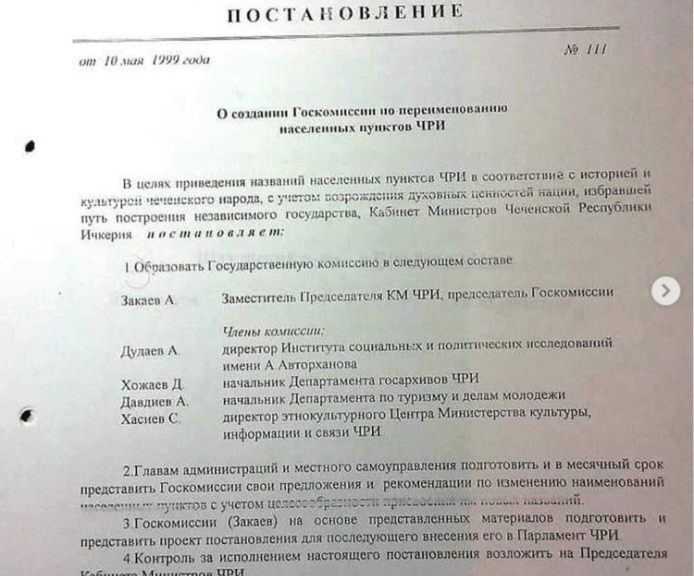
Nel dopoguerra le iniziative volte al recupero della tradizione nazionale nella denominazione degli insediamenti divennero molto frequenti, tanto che nel Marzo del 1999 il terzo presidente della ChRI, Aslan Maskhadov decise la creazione di un’apposita commissione, la Commissione di Stato per la Ridenominazione degli Insediamenti, al vertice della quale nominò il Ministro della Cultura Akhmed Zakayev. A far parte della Commissione furono chiamati anche Dalkhan Khozaev, Capo del Dipartipento Archivistico di Stato, Aslambek Davdiev, capo del Dipartimento Gioventù e Turismo, A. Dudaev, Direttore del Centro di Studi Culturali e Politici “A. Avtorkhanov” e Magomed Khasiev, Direttore del Centro Etnoculturale Ceceno.
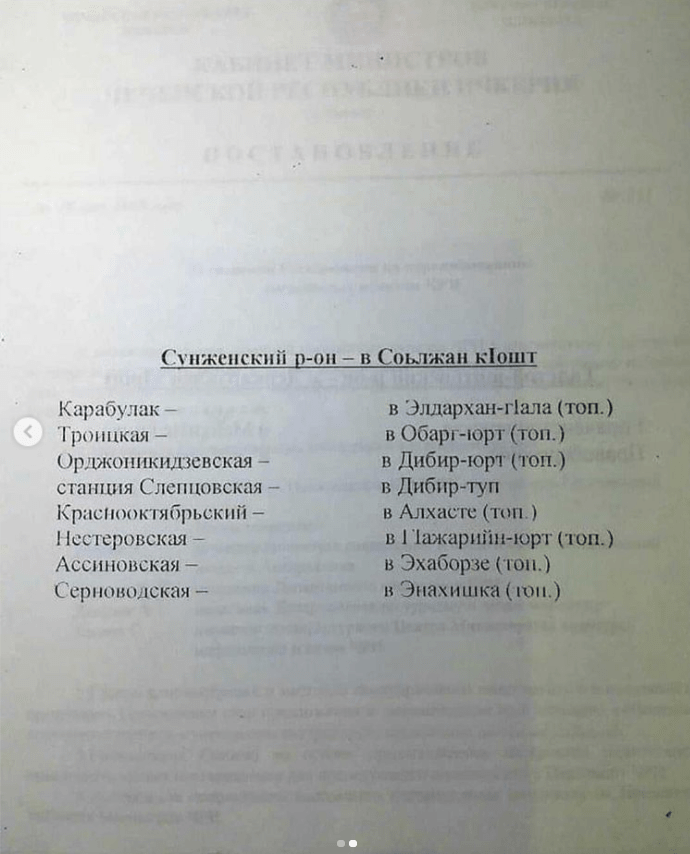
Recentemente ha iniziato a circolare sui social la foto di un documento, risalente al 10 Marzo 1999, nel quale la commissione decreta alcune ridenominazioni. Come vedremo si tratta di interventi messi in atto sugli insediamenti afferenti al Distretto del Sunzha, allora considerato per intero parte della ChRI, e successivamente diviso tra Inguscezia e Cecenia. La maggior parte degli interventi sono volti al recupero della denominazione indigena di quei villaggi. Le riportiamo di seguito:
Sunzha – Capoluogo dell’omonimo distretto, Dalla metà dell’800 ribattezzata Sleptovskaya in onore del Generale russo Sleptsov, ma chiamata dai locali Ordzhonikidevskaya, fu ribattezzata “Dibir – Yurt”, dal nome ancestrale del villaggio Vaynakh sul quale era stata costruita.
Krabulak, cittadina del Distretto di Sunzha, attualmente parte della Repubblica di Inguscezia, fu rinominata “Eldarkhan – Ghala” nome ancestrale del villaggio Vaynakh sul quale era stata costruita.
Troistskaya – Anch’essa cittadina del distretto di Sunzha, confinante con il capuologo, fu rinominata “Obarg – Yurt” dal nome con il quale la chiamavano gli abitanti del luogo.
Nesterovskaya – Cittadina posta a Sud rispetto al capoluogo del distretto inguscio di Sunzha, fu ribattezzata “Gazhariy Yurt” dal nome del villaggio nei pressi del quale fu costruita.
Assinovskaya – Villaggio posto a ridosso dell’attuale confine tra Repubblica di Inguscezia e Repubblica Cecenia, fu ribattezzata “Ekhaborze” dal nome dell’originale insediamento Vaynakh dal quale si sviluppò.
Sernovodsk – Villaggio posto a nord di Assinoskaya, attualmente parte del distretto ceceno del Sunzha, fu ridenominata “Enakhishka” dal nome dell’insediamento Vaynakh dal quale si sviluppò.
Krasnoktabrsky – Ridenominato in “Alhast”.
Le immagini mostrano il decreto di costituzione della Commissione per la Ridenominazione degli Insediamenti, pronto per la firma del Presidente della Repubblica, Aslan Mashadov, e del Segretario di Stato, Ziauddi Abuev.





 Ichkeria Digital Archive