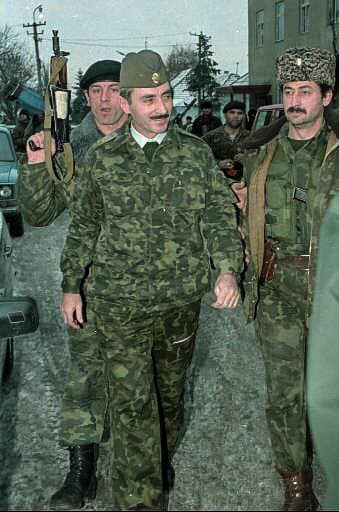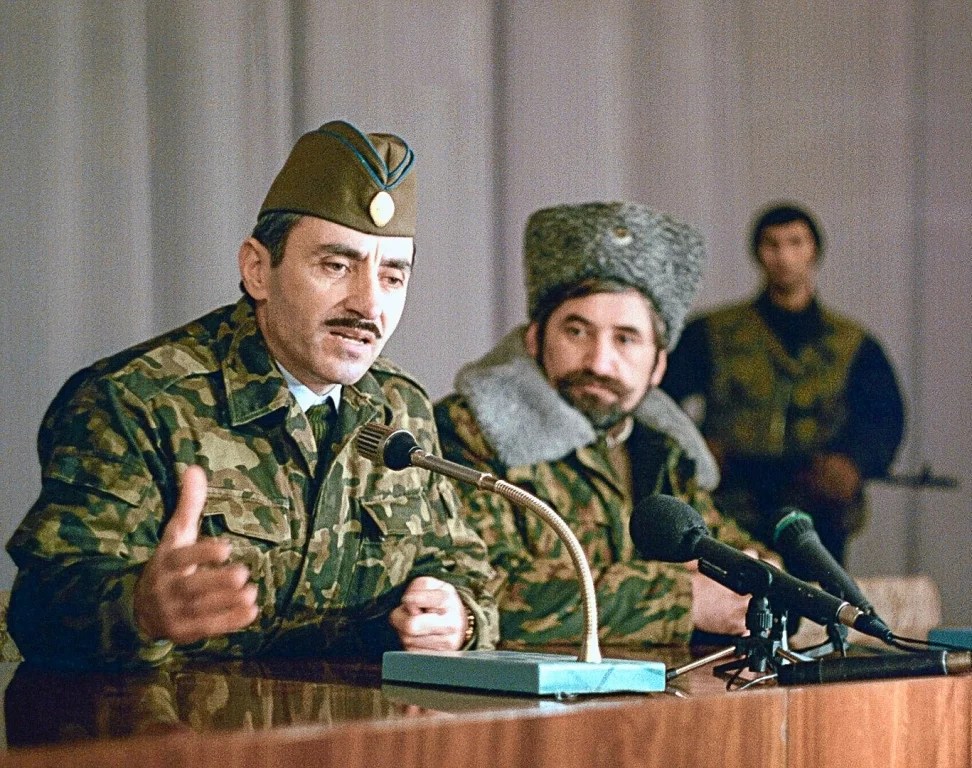
Fighting for a new “August 6”: Francesco Benedetti interviews Aset Sabdulaeva (Part II of “Ichkeria Generation”)

You told me that you moved to Canada in 2004. Where did you go to live?  Has the Canadian government helped you find accommodation and a form of livelihood?

Given the fact that our files were accepted by Canadian immigration authorities, we received the permanent residence cards right away when we landed in the Canadian airport. We landed in Halifax. Two weeks later upon our arrival, we moved to Québec because my mother knew Canadian filmmaker Helen Doyle. Helen was working on a documentary movie about my mother that was released in 2008. The name of the documentary is Birlyant, a chechen story.

When we arrived in Canada, the government gave us 4 000 cad$. But we had to pay back to the government the amount for plane tickets. We rented an apartment, and I was enrolled into a special language class, classe d’accueil.

The first time, I must admit, was very difficult. We had to start everything from zero. I didn’t have friends at school, I didn’t speak French at all. The first week of school, I had a conflict with one Russian guy, Maxim, who used to call me a “terrorist” every time he passed in the corridor during break-time. I went to complain to the director of the school. Later, my sister and my mother came – he stopped his verbal harassment. Even now, when I think about this guy, I feel awkward.

I spent 2 years in classe d’accueil, then I was transferred into regular class. It was very hard to study the French language. When I finally graduated from school and then from Cegep (French collage), I started to appreciate my years in university. I met wonderful people and wonderful professors.

Was Canadian society aware of what was happening in Chechnya? How did people you know react to your situation? Have you found people’s willingness to support you in your integration journey?

Canadian society was aware of what was happening in Chechnya. For example, in daily free journals “Metro” that were distributed every morning in the subway and in public buses to people, I often read short articles about Chechnya. However, I didn’t see any concrete steps made by Canadian society or the Canadian government to help Chechnya. Canadian society had a distant look on everything. Even now, Canadians think that their “far away” geography will protect them from any threat. They seem to lack understanding in geopolitics.

Canada has a history of immigration. It has organizations that deal with immigrants. There are government programs that grant social housing and social aid. People are generally open to immigrants, and they react to immigration as a normal process. The filmmaker, Helen, who knew my mom helped us. She and her husband helped me to get enrolled into a very good high school. I’m grateful to them. Apart from them, no one. My family dealt with everything on its own.

When did you start to feel the need to engage in politics, serving the cause of Chechen independence?

I was always on the side of Ichkeria. However, I started to actively take part in politicssince 2022, the year when Russia illegally invaded Ukraine.

The result of the war in Ukraine will change the balance of power in Eastern Europe. When Russia loses this war, it will be the end of the Russian Empire and the beginning of decolonization of captive nations. Without concrete changes in the center of the Empire, the Chechen Republic won’t be able to reestablish its democratic state because our people don’t have enough resources and capabilities for that. But our government can support Ukraine and is supporting Ukraine in all possible terms and that will help the process of disintegration of the Russian Empire. I want to contribute to the process of de-occupation of my motherland and disintegration of the Russian Empire and that is why I’m motivated to work for the government of Ichkeria.

Also, I know that the truth is on our side. The Chechen government of Ichkeria in exile is defending the legitimate right to self-determination of our people. The Chechen people already made a choice to build a sovereign country, and this choice was democratically articulated in the referendum in 1990. When the USSR made legislative reforms recognizing the right to self-determination of peoples, the Supreme Soviet of Checheno-Ingush republic adopted the Declaration of State Sovereignty on 27 November 1990. Our sovereignty was proclaimed in full accordance with USSR laws and with norms and principles of international law.  The statehood of the Chechen Republic of Ichkeria is crystally clear and undoubtedly legitimate. The legitimacy of our state was further reinforced, when the Russian Federation and Chechen Republic of Ichkeria concluded the Peace Treaty in 1997 where both parties were designated as subjects of international law. The Peace Treaty is published on the official website of the United Nations (UN).

If I had any doubt about the legitimate struggle of our people, I would step down right away. Our land is occupied, our people are being held hostage by the Russian Empire that until today keeps over 100 000 Russian soldiers on chechen soil. The way Chechen people are treated is completely unjust and unacceptable and that is why I find it  is important to defend our country, people and freedom.

What benefits do you think the deployment of ChRI armed forces alongside Ukrainian fighters can bring to the cause of independent Chechnya? And how can the Chechen diaspora in the West support their action?

The Armed Forces of Chechen Republic of Ichkeria play a key role in our resistance and they are fighting not only for Ukrainian victory and for the legitimate right to self-determination of Chechen people, but they are also fighting for the peace and security in Eastern Europe.

Russia threatens international security and is trying to destroy a sovereign Ukrainian state, Ukrainian identity, language and culture. If Russia is not stopped in Ukraine, it will expand its boundaries to other European countries. If Hitler was not stopped in 1945, the world would be dominated by fascism. If Putin is not stopped in Ukraine, Russian chauvinism, that Djokhar Dudaev called russism, will reach other European countries. Lenin wanted to build a Soviet Empire where communism was the absolute ideal and where all captive nations were insignificant subjects all fused into a one big Russian nation. Putin wants to keep this Empire but replace communism with russism and exploit captive nations and their territories the same way as Soviets did.

The fact that Chechen armed forces are fighting alongside Ukrainian fighters sends a powerful message to the world: the Chechen resistance is still alive and Chechens defend Ukraine to help Ukrainian people to defeat the Russian Empire that is threatening international security. The Ukrainian Army is training our troops with high military technology. Ukraine is helping our army to update war skills, use advanced military technology and increase expertise. The Chechen Army is becoming more efficient. Our Army is paving the way for the de-occupation of Ichkeria.

The Armed Forces of Chechen Republic of Ichkeria consist of very brave men that love freedom. Most of the soldiers in our Armed Forces belong to my generation (born in 1990 +). They are doing the best they can to liberate our motherland, to stop the Russian Empire, to help Ukraine and establish peace and security in Eastern Europe. I truly admire them the same way I admire those who defended and liberated Grozny on 6 august 1996.

The chechen diaspora can do a lot of things to help our army. The first and very important thing is to raise awareness about our troops because most people in the West know about Kadyrovtsy, russian puppets fighting within Russian Army against Ukraine, but do not know much about the Armed Forces of the Chechen Republic of Ichkeria. The diaspora should be more open to speak about our army, about our state, about our national tragedy. Also, I find that it is important to give moral support to our troops that are sacrificing their lives for the better future of our nation. Lastly, financial aid is crucial because military and transportation equipment costs money and this equipment is necessary for efficient warfare.

What activities do you mainly do in Canada, in support of Chechen independence? And what are the main problems of the Chechen diaspora in the West?

My role as a Vice Minister of Foreign Affairs is to connect with different people and politicians, seek their support and talk to them about Chechnya. We need diplomatic support from Western countries. On 18 October 2022, Verkhovna Rada of Ukraine recognized that Chechen Republic of Ichkeria is a territory temporarily occupied by Russia. The main goal of our foreign policy is to find support from Western Countries and invite them to follow the example of Ukraine and recognize the occupation of the Chechen State.

The major problem of our diaspora is the lack of expression of political will. The fear of denouncing injustice, oppression and Russian occupation is  justifiable. We all have relatives in Chechnya. When Chechens express political opinions and speak against the Russian regime, the puppets of the Russian administration, kadyrovtsy, kidnap or kill relatives. Fear I think is the biggest problem. Yet, the truth is that if we want to change the status- quo of our occupied State, we must rise here, in the West.

What activities can the Chechen diaspora in the West do to influence Western society and governments, in your opinion?

The best thing that the diaspora can do is support its local Chechen leaders that are trying to get into local governments. The involvement of our local leaders into governments will help us to make hear our voices within western political establishments. For instance, soon there will be elections in Austria. We have a Chechen candidate running for a deputy office. His name is Laziz Vagaev. I’ve listened to his videos. He is highly educated person.  It is an excellent opportunity for Chechens to elect a local leader that will represent them and be capable of making hear our voice in Austrian parlement.

Last year, Chechen diaspora in Belgium had a chance to vote for a Chechen candidate. Unfortunately, our diaspora didn’t participate much in elections. Our people should support local Chechen candidates and vote for them.

Some Chechens say that one of the main risks for Chechens living abroad is Islamic radicalism, and that the government is not doing enough to distance itself from this phenomenon. Do you agree that Chechens in Europe and America are at risk of radicalization? And what is your position as a member of the government on this issue?

I disagree with this statement. Our government  is a democratic government and the rule of law is a core principle of our state.

The Russian intelligence agency (FSB) tries to drag some Chechens into radicalism, but our government is working on this problem, together with European governmental institutions. Chechens have a lot of educated and talented young people who live, work and study in Western schools, universities and companies. So I do not think that radicalization is a major problem.

It is true that we do not share the aggressive secularism of some Chechen social activists, but it does not mean that we support radicalism. Democracy gives a person the opportunity to live according to laws adopted by the majority of society. Democracy is not new to Chechen culture; it is part of our culture, and we inherited it since the 16th and 17th centuries. Chechen people lived in democracy, and we didn’t have any monarchs or social classes.  While other European nations were subjects of monarchs that had absolute power over them, Chechens lived in mountains on equal terms, with equal rights and elected the executive Council of Elders. French writer Ernest Chantre writes about this in his book “Recherches Antropologiques: Le Caucase ” (1886).

Therefore, democratic principles exist in the Chechen cultural code. But some pseudo-democrats who live today in European countries are trying to replace democracy with liberalism. Democracy is a form of government that is the basis of Chechen statehood. These individuals do not make any distinction between liberal ideology and democracy. As you know, in Europe there are a lot of political parties that build their programs/manifesto on  Christian values and ethics.

The Christian Democratic parties exist throughout the world. These parties successfully operate in Belgium, Germany, Great Britain, Italy, etc. The European People’s Party (Christian Democrats) won the elections to the European Parliament. This is normal in democracy. There is an insignificant minority of Chechen society that has not yet really understood democratic principles and is trying to impose strict secularism on the state and people. Their opinion is marginal not only for the Chechen people, but also for most European democratic countries.

How does the government act to keep the attention of the Chechen diaspora around the world on its activities?

Our government is transparent. We inform our diaspora about all the work we do through media resources such as Ichkeria News YouTube channel and the official government’s website www.thechechenpress.com. Also, we have the Council of Elders in Europe and official representation offices that keep close ties with local communities in different countries. 

And it is true that we do not force anything on anyone because we believe that to serve our state is a matter of honor, dignity and free choice.

Speech by the Chairman of the Cabinet of Ministers of the Chechen Republic of Ichkeria at the United Nations meeting

Geneva, 8 July 2024

Dear ladies and gentlemen!

As Prime Minister of the Government and Chairman of the State Committee for the De-Occupation of the Chechen Republic of Ichkeria, I would like to express my sincere gratitude for the invitation and the opportunity to participate in this conference. Your work in organizing this important event deserves the highest praise. Your efforts contribute to the strengthening of international cooperation and exchange of experience, which is especially important in our times. I am confident that the results of our joint work will contribute to further progress and strengthening of international relations.

Today I want to begin my speech not with the history of the centuries-long struggle of the Chechen people for independence, but with the war in Ukraine, from which I came to this conference yesterday.

This crisis is not a local problem. It affects the entire international community because it threatens the foundations of a world order based on respect for sovereignty, territorial integrity and human rights. Russia, using military force, has invaded a sovereign State, violating principles that we all have an obligation to defend.

Russia’s military action in Ukraine has resulted in countless human suffering. Thousands of civilians have been killed, millions have been forced to flee their homes, towns and villages have been destroyed. This is a humanitarian catastrophe that requires an immediate and decisive response from the international community.

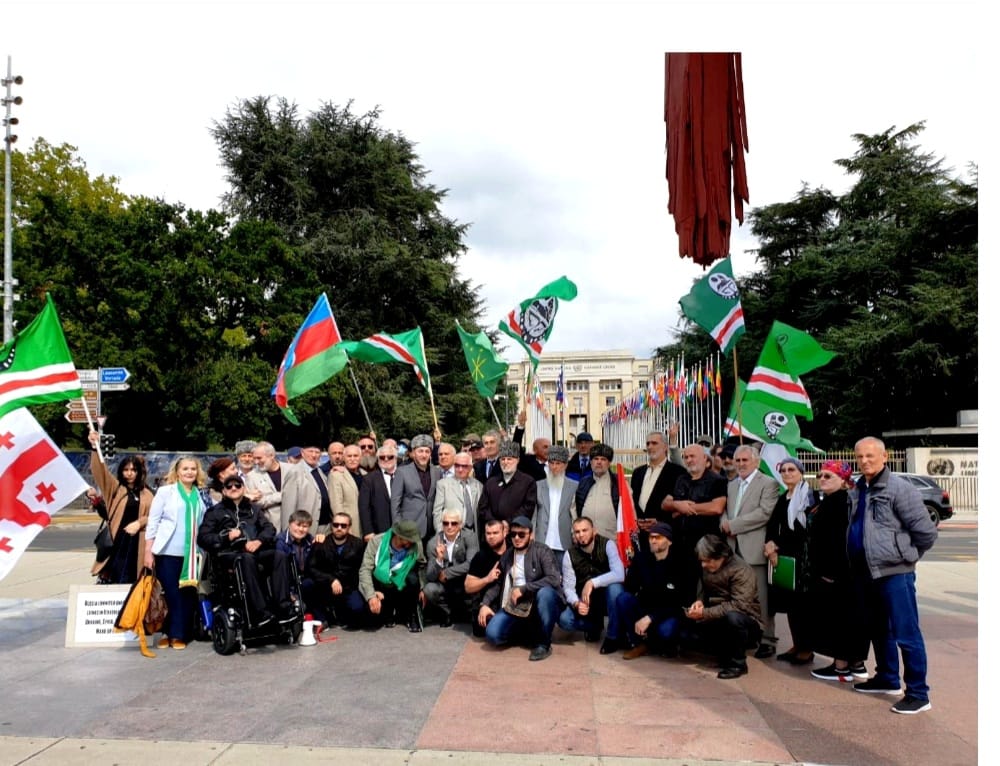
The Chechen delegation at United Nations in Geneva

For us Chechens, this situation is particularly painful. We know what it means to suffer aggression, violence and occupation. We know the price of freedom and independence, and we cannot stand aside when another people is experiencing similar tragedies. Our hearts and thoughts are with the people of Ukraine, who are showing incredible courage and resilience in this struggle.

Units of the Chechen Republic of Ichkeria are today fighting as part of the international legion of the Armed Forces of Ukraine. Although our homeland is under temporary occupation, we are fighting in Ukraine because it is there that the fate of all humanity is being decided. We realize that today’s world is divided, just as it was during the Second World War. The world after this war will no longer be the same as it was after the Second World War. We are on the threshold of great changes, and we must be ready for them.

Democratic reforms in Russia went downhill not yesterday and not today. We all witnessed how Russia began its departure from democratic reforms after it attacked the Chechen Republic of Ichkeria. Some 300,000 people died in that brutal war, 42,000 of whom were children. The Western world, following its morality and logic, believed that this was a forced measure in the process of developing democracy in Russia. However, this was a delusion. The world did not realize that this was the essence of the Russian empire, which was alien to democratic reforms. It only needed time and Western resources for rebirth and revenge.

Today we can say that there is, in fact, a third world war going on. This conflict affects not only Ukraine and Russia, but the whole world. In many countries there is an economic recession, instability is growing, social and political tensions are increasing. The conflict is expanding and taking on increasingly global proportions.

The world, and the United Nations in particular, must think today about the future of humankind. We need to rethink and strengthen international institutions so that they can effectively prevent such conflicts in the future. We need to create conditions in which aggression and violence will not be possible.

Our struggle, the struggle of the Chechen people, is reminiscent of the Resistance movement led by Charles de Gaulle in France during the Second World War. Back then, the true voice of France was heard through de Gaulle, who was accepted into the anti-Hitler coalition despite his lack of control over the territory. The collaborationist Vichy government collaborated with Hitler, but the true voice of France was de Gaulle’s.

Today, we, Chechens under occupation but fighting in the anti-Putin coalition, are also the true voice of the Chechen people. We hope that here, in the UN building, this voice will sound special and will be heard by all members of the United Nations.

After Russia failed to execute a blitzkrieg and take Kiev in three days, the war dragged on for two and a half years with no clear victories for Russia. As the military campaign continued, Russia faced increased Western coalition support for Ukraine. Under these circumstances, Russia has an interest in destabilizing the world to divert international attention from supporting the Ukrainian people.

One of the clearest examples of such destabilization was the recent conflict in the Middle East. It is quite obvious that the beneficiary of this destabilization is Vladimir Putin. The situation in the Middle East has contributed to the redistribution of resources and attention of the world community, which ultimately weakened the focus on the events in Ukraine.

Using and supporting extremist groups fits into the Kremlin’s long-term strategy of creating chaos and disunity on a global scale. This not only distracts the international community from the war in Ukraine, but also weakens the West by forcing it to allocate forces and resources to several conflicts simultaneously.

In pursuit of global destabilization, Russia is counting on decreased support for Ukraine and the possibility of improving its position in this protracted conflict. However, such actions lead to an even greater escalation of tensions in the world, jeopardizing the security and stability of multiple regions.

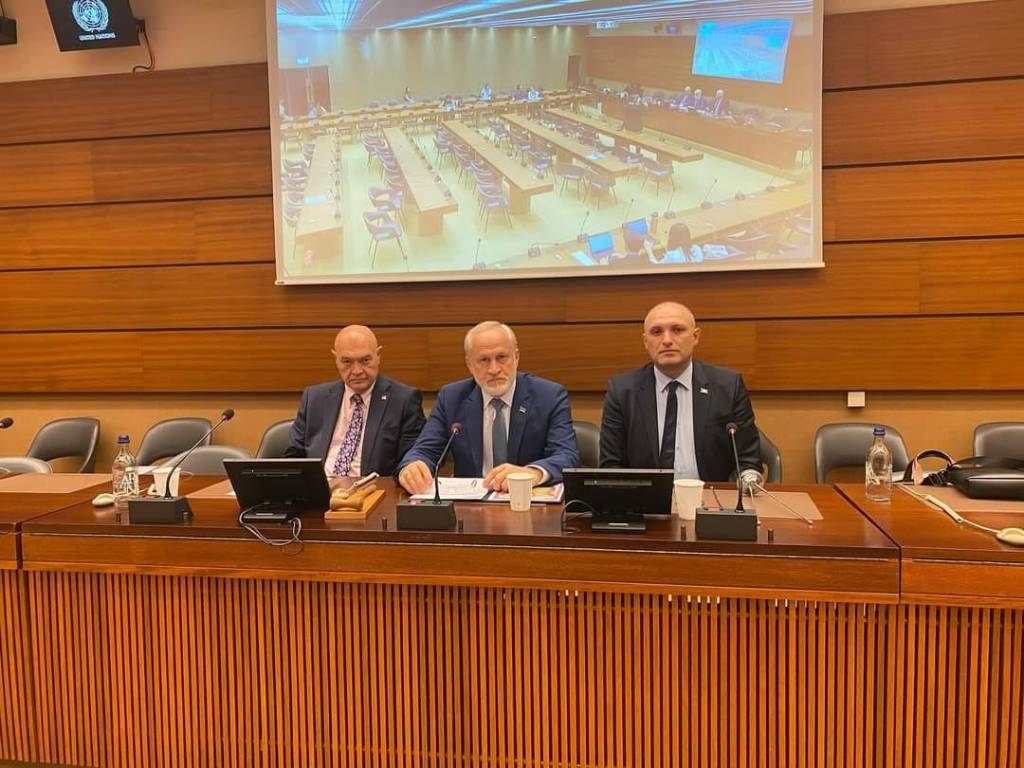
From left to right: Iyad Youghar, Akhmed Zakayev, Burak Otzas

We are following with deep concern the unfolding humanitarian catastrophe in Gaza. The violence and suffering endured by civilians require an immediate and decisive response. We are opposed to any form of violence and terror, regardless of the slogans or justifications behind it. Its victims are civilians, including the elderly, women and children. Such actions not only fail to resolve the conflict, but also cause irreparable damage to human life and dignity. We call on all parties to respect international humanitarian law and to cease hostilities immediately.

The way out of this long-standing conflict in the Middle East may be the implementation of the UN resolution on the establishment of a Palestinian state. This solution will not only resolve the long-standing Israeli-Palestinian conflict, but also reduce the level of tension in the region, which in turn will reduce the opportunities for external players to use the situation to their advantage. The establishment of a Palestinian State will be an important step towards peace and stability in the Middle East.

The government of the Chechen Republic of Ichkeria has reasonable suspicions that Vladimir Putin used Ramzan Kadyrov to finance terrorist organizations. These suspicions are supported by the fact that Kadyrov has concentrated significant financial resources in the Middle East, including billions of dollars that could be used to support extremist groups.

Ramzan Kadyrov and his religious extremist sect Akhmat are accused of committing crimes against humanity in the Chechen Republic of Ichkeria and in Ukraine. Their actions include gross human rights violations, murder and torture of civilians, and financing of terrorist groups.

We welcome the International Criminal Court’s (ICC) announcement of the international wanted list for high-ranking Russian figures such as Vladimir Putin, Sergei Shoigu, and Valery Gerasimov. The decision reflects the serious allegations made against these individuals in the context of international crimes. Such a decision inevitably provokes strong political reactions both in Russia and in the international arena, emphasizing the importance of international justice and the principle that even high-ranking leaders are not immune from prosecution for serious crimes. It should be remembered that a wanted notice is the initial stage of the judicial process. In any case, this event emphasizes the importance of the rule of law in the international arena and the desire of the world community for accountability for serious crimes.

In this regard, we hope that the political leadership of Ukraine will soon decide to establish an international tribunal against Ramzan Kadyrov and his terrorist religious sect Akhmat. We call for the appointment of a special representative with whom we will work to coordinate efforts to bring these criminals to justice. The establishment of an international tribunal is an important step towards restoring justice and ensuring peace and security in the region. We stand ready to provide all necessary information and to cooperate with international organizations to achieve that goal.

The international community must unite and take decisive action to stop this aggression. We must strengthen sanctions, provide the necessary support to Ukraine and send a clear message: aggression will never go unanswered. We must do everything possible to restore peace and justice.

History teaches us that evil triumphs when good people fail to act. We cannot afford the luxury of inaction. We must act now to protect our common home, planet Earth, from the destructive forces of aggression and violence.

As I stand here in the United Nations building, I feel a deep sense of gratitude to the Verkhovna Rada of Ukraine. This respected institution has taken a historic step that will go down in the history of the Chechen people by recognizing the territory of the Chechen Republic of Ichkeria as temporarily occupied by Russia.

This act of recognition is an important and courageous step towards justice and freedom for the Chechen people. It symbolizes international solidarity and support in the struggle for human rights and self-determination.

I urge all UN members to support this initiative of the Verkhovna Rada of Ukraine and also recognize the occupation of the Chechen Republic of Ichkeria. Your recognition and support will send an important signal of the international community’s unwavering commitment to the principles of justice, freedom and respect for the sovereignty of peoples.

Recognition of the temporary occupation of the Chechen Republic of Ichkeria would not only underline the importance of international law, but would also be an act of solidarity with the Chechen people, who have been fighting for their freedom and independence for many years.

In conclusion, I would like to express my deep gratitude to all those countries and peoples who support Ukraine in these difficult times. Your solidarity and support is a source of hope and strength for all of us. Let us work together to create a better future where peace, justice and respect for every human being prevail.

Thank you for your attention.

Akhmed Zakayev, Chairman of the Government of the Chechen Republic of Ichkeria

The Ingush perspective: Francesco Benedetti interviews Mustafa Bekov (Part I)

Mustafa Bekov (artistic name: Mac Bekov) is an Ingush theater and film director, founder of the National Theatre of Ingushetia, Caucasian politician at the end of the 20th century, plenipotentiary representative of Ingushetia in the UNPO (unrepresetitive nationals and people organization) in The Hague from 1993.

As the son of parents who were deported to Kazakhstan in 1944, he was born in exile and had to live with the awareness of being considered an enemy since childhood. “Even before I could read and write, I was aware of the conflict surrounding my identity. Without really knowing why, I was clearly told that I was considered a criminal”. At the age of eleven, Mac received his first lessons in theater and life from the famous director Arsenij Ridal, initially a student and later assistant of Max Reinhard. Ridal introduced him to the methods of Stanislavski, Meyerhold, Vakhtangov and Michael Chekhov and helped him to develop a passion for art. Mac lived for several years in what was then Leningrad, “where Pushkin lived and Dostoyevsky swam”, and studied acting and directing at the Academy for Film, Theater and Music, as well as theater studies, psychology, philosophy and theater business. His professors were Irina Meyerhold (daughter of the famous W. Meyerhold) and Mar Vladimirovich Sulimov.

After many successful years as an in-house director, senior director and artistic director of theaters throughout the former Soviet Union, the National Theater in Grozny offered him the opportunity to bring his ideas to the stage. In this way, he brought his observations on human existence and political realities to a wide audience in artistic form. When the USSR collapsed in 1991, his artistic work was marginalized and Mac moved to Germany. In more than 40 years as a director and lecturer, he has created more than 50 plays and trained numerous actors and directors. His repertoire includes Shakespeare and Chekhov, Schiller and Gorky, Brecht and Lorca, Tennesse Williams and Mrozek, as well as many
other authors. Mac has directed plays, tragedies, comedies, musicals and rock operas in many major theaters.

Ingush and Chechens lived together for a long time, they were deported together and consider themselves “brother peoples”. Why do you think they decided to separate in 1991? Do you think it was the right decision more than 30 years later?


This is not entirely true. Chechens and Ingush have always lived side by side, not together. In 1934, the regions of Chechnya and Ingushetia were united, and in 1936 the Soviet Socialist Republic was given the name “Chechen-Ingush Autonomy”. Prior to this, in 1928, the city of Vladikavkaz and later the areas adjacent to the city, the cradle of the Ingush people, were taken away from the Ingush. Previously Vladikavkaz was a fortress on Ingush soil during the Russo-Caucasian War. On November 1, 1991, President Dzhokhar Dudayev issued his first decree, the Decree on the Statehood of the Chechen Republic. On September 4, 1991, at a session of the Chechen parliament chaired and attended by President Dzhokhar Dudayev, elected at the Chechen People’s Congress, and party leader Selimkhan Yandarbiyev, I asked the Chechens not to declare their independence. I warned that the Russian political elite was not ready to give freedom to the colonized peoples and that this would already cause a great tragedy. I also said that the Russians consider us to be one people, although we are two fraternal peoples. The Chechens’ declaration of sovereignty would not help Ingush to restore statehood and achieve the return of the land by parliamentary means. The euphoria of the seemingly tangible long-awaited freedom drowned out my words. Then the decision was
made.

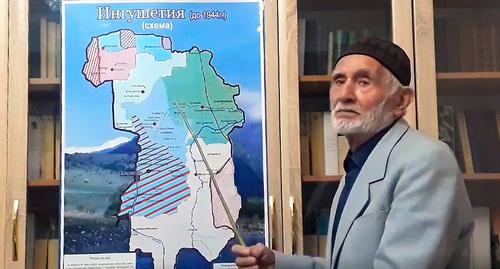
Map showing territories claimed by the Ingush in 1992


After 33 years, I still believe that the Chechens’ decision was wrong. I still think it was right that the Ingush did not go the way of the Chechens.
The Chechens declared their independence 33 years ago. This hasty and ill-considered decision cost them dearly. Did they achieve independence? No. Instead of independence, there were destroyed cities, three hundred thousand dead, forty-two thousand of them children. Destroyed farms and factories, a large number of refugees. Chechen refugees scattered all over the world. Those who stayed ended up under the oppression of Putin’s servant Kadyrov. But that’s not all: new generations have grown up, plagued by Putin’s ideology. Dudaev said that 70% would die, but 30% would be free. Where is the freedom? Thirtythree years have passed and the goal has become even more distant. The Ingush have regained their statehood, albeit only a pseudo-statehood. On June 4, 1992, the Republic of Ingushetia was founded as part of the Russian Federation. If the Ingush had joined the Chechens in 1991, they would no longer exist today. At that time, the population was less than 200,000 people.


In his own words, Dudayev was a bad general and a bad politician: “A good general does not go into a battle that he knows he will lose, and the Soviet general Dudayev knew exactly what the military capabilities of the Russians were. A good politician protects his people from rash decisions. All colonized peoples of the Caucasus should embark on the path of decolonization together. Going it alone is doomed to failure.

In your opinion, the independence of the peoples of the Caucasus from Russia can only be achieved if they all rise up at the same time. Don’t you think this possibility is utopian and don’t you believe that the Russian government is setting the people against each other to prevent this?


Each empire pursues the same policy with the peoples of the territories and resources it has conquered. It assimilates the peoples and plays them off against each other. This is confirmed by the famous saying “Devide er impera”. The Russian empire is no exception. But unlike other empires, the Russians claim that they did not come to conquer, but to
liberate. And they suggest to the peoples that they have joined Russia voluntarily. Following the collapse of the Russian Empire after the February and October Revolutions, a mountain republic was founded in the North Caucasus from 1917 onwards, which existed until 1918/19. It had already taken place, so it was not a utopian idea. With the war against Ukraine, the Russian Empire is well on the way to dissolving itself. It is important that the Caucasian peoples overcome the obstacles created by the empire and reach an agreement.

In my opinion, even the Prime Minister of the Chechen government-in-exile, Zakaev, has understood this and is now talking about the confederation of the Caucasian peoples. With Gamsakhurdia, we issued the motto “The Caucasus is our common home” back in 1986. The path to the liberation of the Caucasus could therefore be that of a general uprising under one banner.

Akhmed Zakayev, Prime Minister of the Chechen Republic of Ichkeria, promoter of the project for the reconstitution of the Republic of the North Caucasus.

The restoration of a single republic in the North Caucasus was already theorized in the early 1990s. Dudayev himself was working on the establishment of a “Caucasian house”, if my sources are correct. Why do you think this project was not realized?


As I have already mentioned, the slogan “Caucasus – our common home” entered the political lexicon even before Dudayev, in 1986. The initiator was the dissident Gamsakhurdia. But the idea and the feeling for the need for unity among the colonized peoples of the Caucasus came from Visangirei Dzhabagiev. Deputy of the Tsarist State Duma, politician of the early 20th century. Considering the fact that the Caucasus was home to various peoples with common but also differentiated characteristics, Dzhabagiev recognized the need for a community and therefore emphasized: “Caucasianism is our nationality”.


Why did it not come about? The mass consciousness of the peoples of the Caucasus, clouded by communist ideology, was not yet ready for unity. In addition, Chechen politicians loudly emphasized the leading role of the Chechen people. This had a negative effect on the other peoples. Nobody wanted another Chechen “big brother” in place of the Russian one have a “big brother”. The empire also actively resisted this idea. And then came the war.

Recently, Akhmed Zakayev, together with other representatives of Caucasian communities, launched the project to establish a republic in the North Caucasus. What do you think of this project?


In principle, I support the initiative to create a pan-Caucasian state. As I said before, this is the only way to get rid of the Russian Empire and at the same time ensure that our peoples preserve their identity. I know Ahmed personally from my time in the theater. Ahmed was a gifted actor. He went through a difficult school of losses and, in my opinion, became a serious politician. The fact that he sent his son to defend Ukraine instills great respect and shows the seriousness of his convictions.
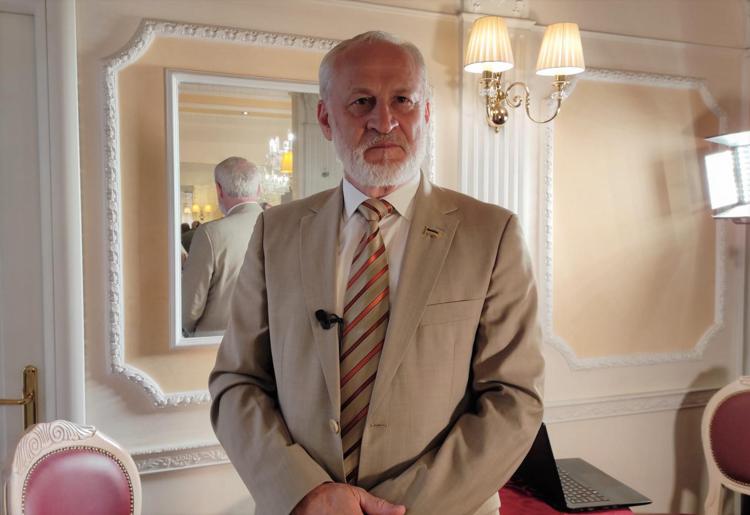

I believe that this project deserves support and has a future. I don’t know the details of the project, but I think Ahmed knows that the free peoples of the Caucasus do not tolerate inequality. Therefore, it is important what form of statehood is envisaged in this project. Whether a nation is large or small, everyone should feel free and have equal rights. The peoples of the Caucasus will not accept the establishment of a caliphate, an imamate and other forms of despotism.

At the end of the 1980s, the idea of founding a Chechen-Ingush federation was born in the intellectual part of Grozny’s population. Unfortunately, it was quickly buried again. As already mentioned, the idea of integrating the Ingush ethnic group into the Chechen ethnic group gained the upper hand, and so Zelimkhan Yanderbiev, a passionate Ingushophobe, became chairman of the VDR (Vainakh Democratic Party) and headed for independence. The Ingush realized that this was a deadly path for the Ingush (in those years there were no more than 200,000 Ingush), and I think that the Ingush did not agree to a war with the Russian Empire out of a self-preservation instinct. Time has shown that the Ingush acted wisely.

Isa Kodzoev


One of the most interesting personalities on the Ingush side is Isa Kodzoev. He was a dissident of Soviet power before the collapse of the USSR. The population was initially very positive towards him, but then favored a “moderate” current, which then negotiated the establishment of a federal republic with Moscow. Do you remember Kodzoev? Are there any other personalities (apart from Aushev, who we will talk about later) who you think deserve attention?


Of course I remember Isa Kodzoev and I knew him very, very well. He was not a “dissident” in the classical sense of the word. He was sentenced to four years in prison for his text “Diary of Kazakhstan”, in which he revealed the truth about the lives of the deported people. He returned from exile and settled in the village of Kantyshevo under KGB surveillance, where he taught in a local school. He was the chairman of the organization we had founded in 1986/87, the socio-political movement “Niisho”. I was one of its founders. Its aim was to restore Ingush statehood, to return the Ingush ancestral lands, to create conditions for the development of the national language, culture and art.

What did you think of the Ossetians? Did you regard them as members of the Caucasian community or as foreign bodies?


Before the 1917 revolution, relations between Ossetians and Ingush were not exactly fraternal, but they were not openly hostile either. There were many inter-ethnic marriages. And entire clans with mixed surnames were formed. After the revolution, relations became hostile. No Caucasian people considers the Ossetians to be members of the Caucasian community; the Ossetian elites themselves have tried to do so. The Ossetians are not natives of the Caucasus, but foreign tribes of modern Iran.

Muslim Ingush civilians stand among the wreckage of their destroyed home in predominantly Christian North Ossetia during the East Prigorodny Conflict, 1992. (Photo by Robert Nickelsberg/Getty Images)

But don’t you think that the Ossetians should somehow be included in the hypothesis of a general uprising in the Caucasus? Or are they not included in the “Caucasian House” project?


If we rely on historical experience, there is little hope that the Ossetians will join the other Caucasian peoples. Rather, they will side with whoever has a stronger position. They helped the 9th and 11th Bolshevik armies to bloodily drown Georgia, which declared its independence, in 1921. I don’t think we can rely on the Ossetians. Most likely, the Ossetians will wait and see and then join the victors. In 1921 and 2008 in Georgia and in 1992 in Ingushetia, they made a very negative impression. The wounds that the Ossetians inflicted on the Georgians and Ingush in those years have not yet healed. That is a problem. But I think it can be solved.

We come to the war between Ossetians and Ingush. The reason for this war, if I have understood correctly, was the Prigorodny district. But what led to the outbreak of tensions between the two peoples? Who fanned the flames of war and why?

The USSR, heir to the Russian Empire, made sure that the peoples of the occupied territories were included in the conflicts. In our case, it expelled the Ingush from and ceded the land to the Ossetians, along with the city that was the capital of both autonomies. Under the conditions of land scarcity, this was reason enough for hostilities between Ossetians and Ingush. After the deportation of the Ingush, the remaining territories were ceded to the Ossetians, part of the mountainous regions to the Georgians and part to the Dagestani. After the repatriation, both the Dagestani and the Georgians voluntarily returned their lands to the Ingush, along with their houses and even equipment; the Georgians also left some of their pets behind. The Ossetians, on the other hand, prevented the Ingush from returning to their former homes. Even when the owner of the house returned and wanted to buy his own house, he was forbidden to do so by the leadership of the republic.

For many years, the Ingush returned to their homeland by hook or by crook. At the beginning of the 1990s, 70,000 Ingush lived in these areas. The Ossetian authorities organized various provocations and suppressed the Ingush at all possible levels. They were accused of all sins. They contributed in every possible way to increasing hatred and intolerance between the peoples. The Ingush living in the city of Vladikavkaz and the Prigorodny district were discriminated against by the Ossetian authorities in all areas of life. This escalation of hatred between Ossetians and Ingush was systematic and was carried out by the leadership of North Ossetia with the approval of Moscow. All appeals to the Kremlin remained unanswered or were not in the interests of the Ingush people. In January 1973, a peaceful demonstration of thousands of Ingush took place in Grozny. The Ingush expressed their distrust of the local authorities and demanded to be heard by Moscow. I was a young man of 21 at the time, took part in this demonstration and witnessed how and what happened there. I mention this because the participants in the demonstration were later persecuted for alleged anti-Soviet activities. The Chechen residents of Grozny supported the demonstrating Ingush en masse. The doors of Chechen apartments and houses were open for the demonstrators to warm up, for prayers and there was hot food for everyone. Temperatures in January are above -25 °C.


I personally experienced the intolerance and prejudice of the Ossetian authorities towards the Ingush people. In 1980, after I had received my diploma, I was sent to the Russian State Theater in Vladikavkaz. I was not allowed to direct a single play. The North Ossetian party headquarters obstructed me and forced me to leave Vladikavkaz. They couldn’t allow
an Ingush to work as a director in the theater. From their point of view, the Ingush were an inferior race.

As is known, the Ingush people achieved the restoration of their statehood through parliamentary work, and on June 4, 1992, the Republic of Ingushetia was established as part of the Russian Federation. As a result of the parliamentary work of our deputies, with the support of the population The Law of the Russian Federation “On the Rehabilitation of Victims of Political Repressions” of October 18, 1991 N 1761-1 was also adopted. The Ossetian authorities were aware that the path to territorial rehabilitation was not far off. Moreover, Article 11 of
the Constitution of the Republic of Ingushetia (The return of territories illegally expropriated from Ingushetia by political means and the preservation of the territorial integrity of the Republic of Ingushetia is the most important task of the state) left no doubt that the Ingushetian people would fight for the return of the annexed territories.

Ichkeria Generation – Francesco Benedetti interviews Surho Sugaipov

Surho Sugaipov was born and raised in Grozny. At the age of fifteen, Surho arrived in Germany after his family had to flee from Grozny during the Second Chechen War. After graduating from high school in the city of Würselen, NRW, he worked in the family business until he enrolled in university. As a student of the Faculty of Economics at the University of Cologne, he simultaneously dedicated himself to his great passion – acting. His first major role was as one of the main characters in the French film “Le grand homme” (2014) directed by Sarah Leonor.

You can learn more about his creative work in cinema in Germany and France on his Wikipedia page:

https://de.m.wikipedia.org/wiki/Surho_Sugaipov).

A member of the Chechen Democratic Party, one of its co-founders and spokespersons, Surho lives with his wife and three children in Cologne.

We can say that you belong to a generation that we could define as the “Ichkeria Generation”, that is, those kids who were born close to independence, and who became adults during the period of independent Chechnya. What memories do you have about the first Russian invasion of Chechnya?

I was 9 years old, and of course, I remember how my life suddenly transformed from a childhood playground into a serious, loss-filled adult life, where the main goal became to survive in the conditions of a full-scale war.

Children play in the streets of Grozny destroyed by bombing

How did you perceive your “being Chechen”?   Speaking with many older witnesses, they told me how they had to deal with a certain “induced” sense of guilt following the deportation and the legend of the “betrayal”.  You were born in a different context: did you also experience this sense of humiliation?

It started when we moved to a neighboring republic where we were registered as refugees. We, the children from the Chechen Republic, were assigned to one school. Our mother tried several times to enroll my sister and me in the city lyceum, but each time, after another inspection, we were expelled based on our nationality—I remember these moments well. By the time of the open invasion of the territory of the Chechen Republic, which had legally declared its independence based on international law, a powerful propaganda campaign had been launched throughout the Russian Federation, portraying Chechens as bandits, terrorists, and a threat to the civilized world. Chechens were blamed for all the negative consequences of the collapse of the Soviet Union as an empire. Brazen false propaganda was carried out continuously 24/7.

Organized, armed groups were sent to the republic to discredit the entire population and portray us in an extremely negative light to the world. Talking to older people who became victims of the genocide of Chechens during the deportation of Chechens to Kazakhstan in 1944, under the false accusation of betrayal and collaboration of the entire population with enemy forces, the situation was similar—people were accused of collaborating with the enemy army before a single Wehrmacht soldier had set foot on the territory of the republic. The elders spoke of how they had to fight against the imposed sense of guilt for the “betrayal” of the people.

The Russians have always used the story of betrayal. They said, “The Chechens have always betrayed us.” What nonsense – an empire that is surprised why its victims do not surrender and remain beaten, but dare to resist

How did you experience the period of the first war? How did your family deal with the situation?

I mainly remember the first war through the emotions of a child, who, holding his mother’s hand, was fleeing from the war. After the first war ended, we returned to Grozny and rebuilt our house, at least to a livable condition, and started anew, from scratch, among mountains of ruins and destruction. But two years later, the second war began. Many in Chechnya understood that the war was not over even before the start of the second one, as military groups operated on the principle of “the worse, the better,” preparing the ground for the return of Russian troops by turning public opinion against Maskhadov’s government, carrying out public corporal punishments, and even executions, which worked against independence. The FSB’s plan to destabilize the situation in the republic worked precisely, giving the Russian army time to escalate its forces anew. As expected, Russia attacked with a much stronger army, seeking revenge for the humiliation they experienced from their defeat in the first war. People in the republic understood that while we were trying to heal our wounds and rebuild the destroyed infrastructure, Russia was quickly assembling a new army and preparing for a new attack.

Chechens, left to their fate, fragmented by internal conflicts artificially created by Russian special services, could not keep up with such a huge empire, with its ability to play political games, its capability to escalate the military race, and adequately prepare for the inevitable war, which was obvious to many at that time. While Russia received billions in its treasury from the sale of oil and gas to the West, Chechnya was in a state of absolute economic collapse, unable to get back on its feet without external assistance, which never came. The reasons for sacrificing us, leaving us to a senseless and brutal fate at the hands of the aggressor, in the form of the Russian Federation, will likely become the subject of many historical studies. Declaring the destruction of an ethnic group as an internal matter of Russia, the international community fed a monster that had already gone wild, threatening everyone with nuclear retribution if they interfered with its new plans. As a result, we had an absolutely impoverished, fragmented, weakened region subjected to religious pressure after the first war, left to be devoured by the predator.

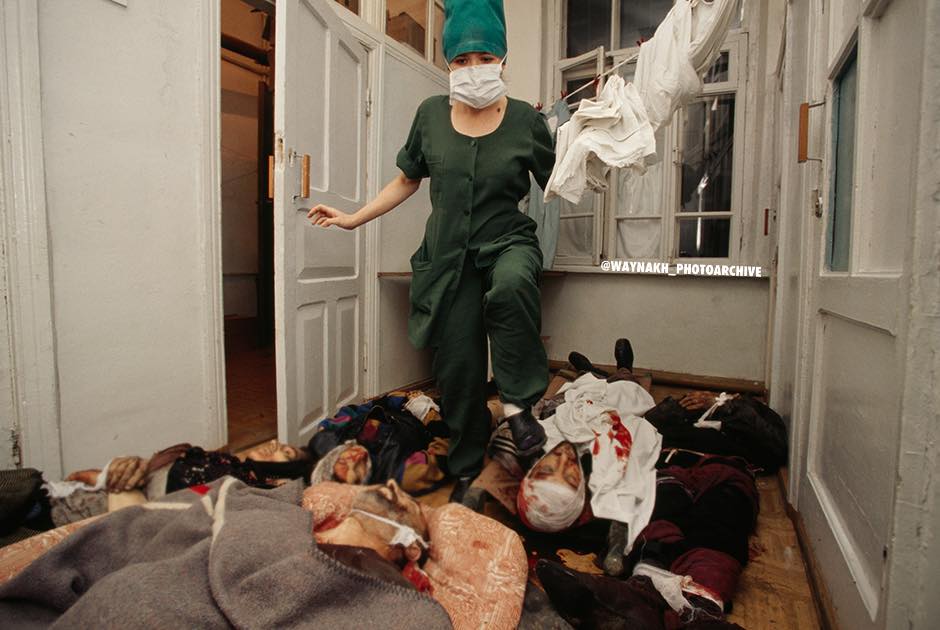
Grozny Hospital, 1999

When the war ended and the Russians retreated, how did you feel? Who was your heroes?

First of all, Dzhokhar Dudayev and all the resistance fighters were our heroes.

In your head as a young Chechen, how did you visualize Aslan Maskhadov?   Was there any leader you didn’t like?

Maskhadov was also a hero. But his politics had many weak points that people did not like. Mainly, it concerned his friendliness towards the Russians. He perceived this war as a misunderstanding that arose under certain circumstances. Being an officer of the Soviet army, he did not fully realize that the imperial policy of Russia had not changed since the Caucasian War. Russia was using us at that moment; first, as a sacrificial victim to scare the international community with its military power. Second, to distract the population inside the country from the total plundering of the USSR’s wealth, seized during the collapse of the Union. Russia unilaterally separated itself from all the union republics to avoid sharing common property with them and, declaring itself the sole successor of the Union’s legacy, appropriated the common wealth. Aslan Maskhadov, instead of reaching out to the international level, establishing relations with the West and America, and securing their support, believed Russia’s promises that the war was over, that reparations would be paid, and that good neighborly relations would be established between two free states.

Another fatal mistake he made was his inability to resist radicalism, artificially introduced into the republic from the East, controlled by the Kremlin, and imposed on the Chechens through the activities of intelligence agents already operating widely in the Chechen Republic at that time.

Aslan Maskhadov

What happened after the second Russian invasion? How did you decide to reach Germany?

My father worked in the Ministry of Justice of the Chechen Republic of Ichkeria. After the start of the Second Chechen War, he brought us back to Nalchik, where we lived during the first war. A year later, he came for us and said that this war was more brutal, and after it, everyone who worked for their republic would be sent through filtration camps, and those who were shot immediately would be the lucky ones, envied by those who would be tortured to death in the camps. The survivors would be imprisoned, and only a few crippled people would return, while the majority would never come back. Just as he said, it happened. The situation was worse than ever. Therefore, we decided to move to Europe.

How did you personally experience arriving in Germany? Was it difficult for you to integrate with the Germans? Were there other Chechen families who helped you?

To imagine what we felt when we were settled in the dormitory, you need to at least partially understand all the persecutions we went through, the fears we experienced, and the expectations of worse scenarios that had accompanied us for years. We didn’t speak German, we couldn’t work yet, but the children were immediately sent to school. Of course, we ended up in Hauptschule at first. After a couple of years, my school teacher Fred Tribbels wrote a letter to the NRW district with a request to transfer me to HHG (Gymnasium). And that’s not all, he realized that I was struggling with physics, so he arranged for the physics teacher to tutor me additionally in this subject. We were among the first Chechens to move to Europe; there were few Chechens living in Germany, and no one who could quickly explain to us how to integrate. In any case, it wasn’t that difficult, because for any question that arose, we could contact certain institutions and always received the help and support we needed. We felt protected, it was a lifesaving support for us. Adapting to the local mentality was not difficult, it coincided with ours. The hardest part was before our arrival in Germany.

Surho Sugaipov

After you reached Germany, how were you integrated into the social system?  Were the Germans kind to you?  Were you able to attend school?

We have received a lot of support and understanding. Being a young boy, a teenager I obviously maintained good and less good relationships with my peers, but German society showed itself to be open, tolerant, available to help us. I can only say good things about how I was accepted. I just had the normal problems as a teenager, like everyone else at this age.

When did you decide to start doing political activity?  And what kind of political vision have you developed regarding Chechnya?

I think I was never apolitical because of my early acquaintance with war and the occupation of my land. In the war in Ukraine, I saw a historic moment to resume the discussion of the situation in the Chechen Republic of Ichkeria, to raise the topic of independence, which is once again banned from discussion in Russia.

Impunity and the killing of one-third of the republic’s population allowed the leadership of the Russian Federation to continue its imperialist expansionist policy by attacking a sovereign state recognized by the entire world – Ukraine. The international community must go back 30 years to 1994 and hold the Russian Federation criminally responsible for the genocide of the Chechen people and for all the crimes committed by Russia on the territory of the Chechen Republic to destroy the Chechen ethnicity. It must help the Chechen people de-occupy their homeland and restore statehood based on the principles of democracy and secularism, where religion should be separated from the state, where any citizen has the right to practice any religion or not practice any at all, where citizens’ rights are protected by the state, and where the people are the rightful owners of their ancestral territory.

We must return to the democratic secular state that the Chechens proclaimed to the whole world, taking advantage of the moment when the Supreme Soviet of the USSR issued Law No. 1409-I of April 3, 1990, “On the Procedure for Resolving Issues Related to the Withdrawal of a Union Republic from the USSR.” In Article 3, it is stated that autonomous republics within a union republic have the right to independently decide whether to remain in the USSR or stay with the seceding union republic. The Chechen Republic, by referendum, remained in the USSR and thus became another union republic within the USSR. Consequently, when the Russian Federation declared its withdrawal from the USSR, the Chechen Republic remained within the USSR and automatically gained independence following the dissolution of the USSR on December 26, 1991.

The Chechen Republic declared its independence in July 1991, and on November 1, 1991, Dzhokhar Dudayev signed his first decree on the state sovereignty of the independent democratic state. Thus, taking advantage of the political moment during the dissolution of the Soviet Union and based on international law, the Chechen Republic seceded from the Russian Federation, declaring its independence. The Russian Federation declared its independence from the union treaty significantly later than us. The Constitution of the Chechen Republic of Ichkeria was adopted one year earlier than the Constitution of the Russian Federation. This means that the Russian Federation attacked an independent state whose people declared their independence to the whole world, exercising their right to self-determination. None of the democratic states dared to recognize our independence, fearing the wrath of the Russian Federation. For this reason, I have become more active in recent years, but I have never been silent.

My political vision is clear. There can be nothing but a democratic, secular state, as recorded in our 1992 Constitution. This state must be de-occupied with the help of the international community.

Banner of the Chechen Democratic Party

You have found a political point of reference in the Chechen Democratic Party.  The first question regarding this: is there a line of political continuity between the Chechen Democratic Party and the Vaynakh Democratic Party, founded by Yandarbiev and the main proponent of Chechen independence in 1991?

We have nothing in common with the Vainakh Democratic Party, which has deviated towards radical ideologies, either by conviction or out of convenience, probably to seize power in Chechnya. Yandarbiyev changed his position to a radical idea; I don’t know if he really believed in it, but he completely transformed from a democrat to a radical. We do not agree with his point of view and have nothing in common with his party.

So, the Chechen Democratic Party supports an independent, democratic, secularized Chechnya, founded on the rule of law.  What political program does the party intend to follow to achieve this objective? Starting from the current situation, what steps do you think the Party should take?

We want to de-occupy our territory, demand full restitution for the moral and material damage inflicted on our people, the extradition of all war criminals and their prosecution in an international court. We also demand the removal of all radon nuclear waste sites established by the Russian Federation on the territory of our republic and the restoration of the ecological damage caused to the republic.

Our goal is also to strengthen democratic institutions in our society, primarily the protection of the rights and freedoms of the republic’s citizens, the separation of religion from the state, and the establishment of healthy international relations, both political and economic, and trade relations. We aim to join the EU as full members. Our goal also includes reconciling and uniting all segments of our fragmented society based on the Declaration of Freedom and Independence of the Chechen Republic and the Constitution of the Chechen Republic of 1992.

I am one of those Westerners who strongly supports the independence of Chechnya): why, in your opinion, should the so-called “West” be interested in supporting the independence of Chechnya? What benefit would get from this situation?

The civilized world, logically, should be interested in the multiplication and prosperity of as many democratic states as possible on the planet. We believe that Russia will soon cease to exist in its current form because it does not fit into the civilized international community of states. Wars, attacks on neighboring countries, and the seizure of foreign territories as a healthy coexistence of state entities have completely exhausted themselves. Humanity created nuclear weapons to become a deterrent from wars that take millions of human lives. The civilized world must be able to manage the world to prevent its collapse. Russia uses enslaved peoples as cannon fodder or radical terrorist organizations and groups that pose a danger to peaceful coexistence. Therefore, it is unacceptable to allow a platform or a training ground to be created on the territory of the Chechen Republic where people capable of harming peaceful creation will be trained. Our time is a time of international trade, global international environmental protection programs, and the peaceful coexistence of people as a single whole. It is time to engage in the rapprochement of religious confessions instead of inciting national or religious enmity. Our program is aimed at progress, and we, who have never known slavery or social inequality, raised on the ideals of freedom and nobility, are created precisely for peaceful purposes. This is our natural state, and we want to return to our normal human essence. We are essentially creators, farmers who accept peaceful labor as the most noble behavior of a person.

An image of barbarians, mentally deficient warriors, and desperate villains has been created of us. We will have to prove for a long time that this was never the case and cannot continue to be. If the West helps the Chechens build their own democratic, reliable state and acts as its guarantor, it will gain a reliable, experienced military and economic partner in the Caucasus, at the crossroads of Europe and Asia.

If this does not happen and the West allows the situation to unfold without intervention, there is a risk that radical elements within our population, financed by the Kremlin, will seize power. These elements can inevitably create something similar to ISIS 2.0 or a scenario reminiscent of modern Afghanistan. All this, of course, will play into the hands of the Kremlin, which has been promoting the narrative of wild, radical Chechens for decades, thereby constantly getting a green light for aggression from the West.

The most tragic thing is that we will disappear from the face of the earth as an ethnic group. For 30 years, the Russian Federation has been conducting the primitivization of our people through the occupation authorities on the territory of the republic, and this is yielding its sad fruits. According to statistics (from open sources), there are 500 schools and 1,500 mosques operating in the republic.

Symbol of the Chechen Democratic Party

Do you believe that in this sense, the activity of the Chechen battalions fighting on the front line in Ukraine, in support of the Kiev army, could be useful in convincing Europe to support the independence of Chechnya?

No, I don’t think so. I respect these people’s decision and understand their desire to fight for Ukraine and its freedom. They follow the call of vengeance that they have carried within themselves for decades. I understand their desire to take revenge for the hell that the Russians created on our land. Nevertheless, I don’t see a great future in this approach. The predominance of radical rhetoric in their behavior gives their struggle more of a “sacred” religious significance. We never fought for religion; we fought for our land and freedom. Every time the Chechens raised their banner for freedom, volunteers from the East appeared, bringing their flags and coloring our struggle for freedom with their own colors, subordinating our interests to their own. This has happened every single time. We kept making the same mistake over and over.

I don’t think civilized society needs small, fragmented Chechen battalions. Ukraine already has its own professional army. Chechen volunteers need to join the regular Ukrainian army. A state that creates private military companies (PMCs) on its territory is doomed because the privilege of legal violence belongs to the state. The West needs reasonable, reliable, and educated people with whom they can engage in dialogue and make agreements based on international law.

So, what do you think Chechens living in Europe can do to support the cause of creating an independent Chechen state? And how can they reach the Chechens in their homeland?

Engage with European governments, political and public organizations, form alliances with other diasporas, communities, and international organizations that support self-determination and human rights. We must create our own political and non-profit public associations. Chechens living in Europe should also raise their awareness about our political situation and share it from all public platforms, helping more and more compatriots become politically educated. Organize and participate in conferences, seminars, and public demonstrations to provide more information about the situation in Chechen society.

Hold cultural events, exhibitions, and festivals to preserve and promote Chechen culture and identity in the diaspora. People in Chechnya are currently hostages; they cannot do anything. They live in constant fear under state terror. People outside Chechnya must do something to help them. We must revive our society, politicize it once again, and show the path we need to take to achieve our goals. First of all, we must revive our spirituality; it has always been of great importance to us. Chechens have traditionally avoided marrying not only within close family circles but even distant ones, observing the norms prohibiting marriage between relatives up to the seventh generation, meaning that if the seventh grandfather is common, it was not possible. In Chechen society, children were considered children until the age of 15. At 15, boys were allowed to wear a belt, signifying the right to carry a weapon, and girls could emphasize their waist. A man would not enter a house if the master of the house was not at home. Ensuring the safety of a woman and accompanying her to her destination was the duty of any man. These things are important and respected to this day.

What are the main problems you are facing in the political education of Chechen society? And what have been the main successes you have achieved to date?

Our main problem is the low level of education and the high level of radicalization among a significant part of our population. There are many reasons for this, including the deliberate actions of the Kremlin, which has repeatedly used this tool, as well as the numerous severe traumas that people have experienced, often leading them to turn to religion.

I consider our great success to be the removal of the taboo on discussing political Islam. Now society is free to discuss and share opinions on topics that just a few years ago seemed almost closed and forbidden. Overall, we have made significant progress in combating political illiteracy in a short period of time. Many people support us and our views, and this number is growing every day. Many remain silent and quietly listen because they fear for themselves and their relatives. However, we receive a lot of feedback in support, which clearly indicates that people are listening and supporting us.

Surho Sugaipov

In your opinion, is the phenomenon of radicalization also involving Chechens living in the European diaspora?  Or is it a phenomenon that occurs only in Chechnya?  And what role does Kadyrov have in promoting this radical culture?

As I mentioned earlier, I believe there are two reasons for the radicalization of some Chechens. More precisely, the main reason is the Kremlin and its deliberate efforts to radicalize the youth for subsequent control and use for its purposes. The fact that they have been “successful” is a consequence of the trauma of two brutal wars, the post-war policy of severe terror, humiliation, and open attacks on honor and public humiliation, combined with the inherent naivety and trustfulness of the Chechens.

Kadyrov, in turn, started by fighting against radicals and explained his switch to the Russian side precisely for this reason. Today, Kadyrov himself has become a force that is radicalizing our society by leaps and bounds. I don’t know if this radicalization is ideological or a direct order from the Kremlin. However, I would rather assume the latter.

Just think about it: in such a small Chechen Republic, 1,400 mosques have been built. They are not building schools, kindergartens, hospitals, factories, or plants where people could work and earn a living, developing the economy. Sermons are held every day, and people are indoctrinated with the idea that they should be obedient, accept their fate, and strive for paradise, forgetting about their earthly life. This is the same old trick that has been used for thousands of years, and people still fall for it. All these newly built mosques are transmitters of propaganda. If it weren’t beneficial to them, the Kremlin wouldn’t allow a single mosque to be built.

what would you say to the European public to encourage their support for the independence of Chechnya?

If we understand that there are only two camps of countries in the world—democratic countries based on citizens’ rights to freedom and self-determination on one side, and tyrannies that usurp power and maintain it through force, violence, and total id

eological brainwashing of their population on the other side—then it will not be difficult for us to understand why it is absolutely logical for the West to help the democratic forces of Chechnya build a state that will become a reliable, strong, and dedicated ally to the entire civilized world, rather than allowing the opposite to happen. Furthermore, passively allowing the extermination and erasure of a civilized, advanced, and spiritually rich people from the face of the earth is, at the very least, inhumane. We live in a world where even cruel treatment of animals is unacceptable.

BIOGRAPHIES – Umalt Yakhubovich Dashaev  

The work on this biography is carried out in collaboration with the Instagram page “Qoman Sij”, based on information received from the former deputy of the Minister of Foreign Affairs of the Chechen Republic of Ichkeria, Ilyas Musaev, verified with the sources at our disposal.

Born in Prigorodnoye (?/?/1956)

Died in Khankala (12/28/1994)

Native of the Varanda teip, he participated in the actions of the International Brigades during the Georgian – Abkhaz war, distinguishing himself for valor on numerous occasions, in particular during the Battle of Gagra (September 1992) and Sukhumi (September 1993). Wounded several times, after the war he returned to Chechnya, where he placed himself at the disposal of the nascent National Guard, operating in the Separate Battalion for Special Purposes “Borz”.

In November 1994 he participated in the operations to defend Grozny from the attack launched by Bislan Gantemirov’s forces. At the outbreak of the First Chechen War he mobilized his unit to defend Grozny, being wounded several times, until he lost an eye.

Umalt Dashaev with Khamzat Khankarov in Abkhazia

At the end of December 1994 he was sent by the Chief of Staff, Maskhadov, to defend the Khanakala airport from the federal troops who were about to occupy it. He led the Chechen contingent in the Battle of Khankala, during which, after being wounded several times, he died. According to the chronicles, he fought to his last breath against the attacking forces, earning the state award of Qoman Turpal (“Warrior of the Nation”).Riguardo la sua morte:

Eyewitnesses say that the seriously wounded Umalt Dashaev continued to lead his soldiers, urging them to conduct grenade launcher fire at Russian tanks. Umalt Dashaev was a born warrior, who did not know what fear is and was selflessly devoted to the ideas of freedom and independence of the Chechen people. From the first days of the beginning of the national liberation movement of the Chechen people, he took part in the hottest spots of the confrontation between Chechen soldiers and Russian mercenaries, destroying the enemies of the Chechen state. (Qoman Sij)

Umalt Dashaev with Shamil Basayev in Abkhazia, 1992

BIOGRAPHIES –Abdulkhadzhiev, Aslanbek

The work on this biography is carried out in collaboration with the Instagram page “Qoman Sij”, based on information received from the former deputy of the Minister of Foreign Affairs of the Chechen Republic of Ichkeria, Ilyas Musaev, verified with the sources at our disposal.

Born in Germenchuk in 04/12/1962, Aslanbek Abdulkhadzhiev joined the National Guard in 1991, during the Chechen Revolution. Volunteer in Abhazhia between 1992 and 1993, he served in the International Brigades of the Confederation of Peoples of the Caucasus, becoming Shamil Basayev’s trusted man. Appointed by the President Dudayev as Military Commander of the Shali District at the outbreak of the First Russian – Chechen war, he commanded a large detachment.

Aslanbek Abdulkhadzhiev, nicknamed “Big Aslanbek”

Nicknamed “Big Aslanbek” (in recognition of his comrade in arms Islanbek Ismailov, nicknamed “Little Aslanbek”) Abdulkhadzhiev was one of the main organizers of the historic raid by Chechen fighters on the Russian city of Budennovsk in June 1995, which forced the Russian authorities to agree to a temporary cessation of the war and the beginning of peace negotiations. For this military operation, among the first, he was awarded the highest state order of the CHRI Qoman Sij (Honor of the Nation), by the first President of the Chechen Republic of Ichkeria, Dzhokhar Dudayev.

One of the main commanders in the Battle of Pervomaiskoye (January 1996) in the Operation Retribution (March 1996) and in the Operation Jihad (August 1996), after the reconquest of Grozny he was appointed military commander of he Capital as Military Commissioner. For his war merits he was appointed Brigader General and decorated with the Honor of the Nation.

Elected Deputy in the parliamentary elections of January 1997, he attempted to gain the presidency of the assembly, but was overtaken by the pro-government candidate Ruslan Alikhadzhiev. Supporter of the nazional – radical party, he promoted the “Law of lustration” with which it was intended to remove from public officies all those who had collaborated with the pro – Russian government during the war. The delays in the approval of this law were the cause of his resignation in 1998.

Preident of the state company Chechenkontrakt since June 1997, at the outbreak of the Second Russian – Chechen War he formed an unit of around 80 men, with whom he fought in the Siege of Dzhokhar (1999 – 2000). After the fall of the city in Russian’s hands, he retreated in the Argun Gorge, leading the partisan fight.

On August 26, 2002, following a denunciation by a Russian informer, the house in the city of Shali, where Aslanbek Abdulkhadzhiev was hiding, was surrounded by Russian occupiers and local collaborators.

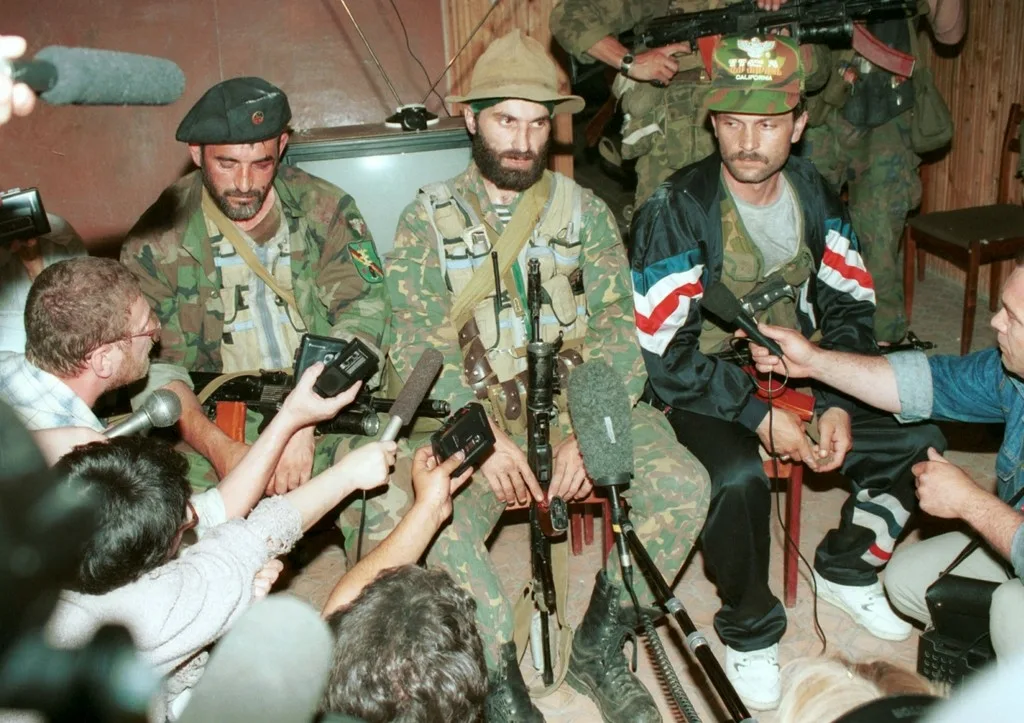
Aslanbek Abdulkhadzhiev attends a press conference together with Shamil Basayev (center) and Aslanbek Ismailov (“Little Aslanbek”, right). June 1995

According to the reports of his death:

The senior FSB officer leading the Russian occupiers through a loudspeaker told the Chechen commander to surrender, to which there was an immediate response from a Stechkin submachine gun. In response, Russian punitive forces began firing grenade launchers and machine guns. Having used up all his ammunition, the Chechen commander began throwing grenades and lemons at the invaders. In turn, the aggressors opened fire from heavy machine guns located on armored personnel carriers. This actually predetermined the outcome of the unequal battle. Aslanbek was seriously wounded. The enemies, having learned about this, tried to take him alive.

However, the Russian punitive forces were not destined to mock the wounded Chechen commander. Aslanbek, who was losing consciousness, at the last moment managed to pull out the pin of the grenade, which exploded in his hands. The blast wave generated by the grenade explosion carried away several occupiers who were close to the Chechen commander. According to Shali residents, at least four occupiers were killed and seven wounded during the night battle in the city of Shali. This is how the life of 41-year-old Chechen general Aslanbek Abdulkhadzhiev heroically ended.


21/04/1996, La Morte di Dudaev – Estratto da “Libertà o Morte! Storia della Repubblica Cecena di Ichkeria”

il 21 Aprile 1996 Dhokhar Dudaev, primo Presidente della Repubblica Cecena di Ichkeria, fu assassinato dall’FSB. Nell’anniversario nel ventottesimo anniversario della sua morte, pubblichiamo un brano tratto dal secondo volume di “Libertà o Morte! Storia della Repubblica Cecena di Ichkeria” (Link)

Nell’aprile del 1996 i ceceni potevano dirsi vicini a raggiungere la vittoria: l’esercito federale era in piena crisi, ed Eltsin aveva un disperato bisogno di pace per vincere le elezioni presidenziali[1]. Le cancellerie europee, rimaste sul chi va là di fronte al “Piano di pace” presentato dal presidente russo, dopo aver inutilmente atteso l’avvio di negoziati tra le parti, erano tornate a tormentarlo con richieste pressanti di interrompere le azioni militari, lamentando la violazione della Convenzione di Ginevra e minacciando un ulteriore slittamento dell’accordo di partenariato tra Mosca e Bruxelles, che ormai languiva dalla primavera del 1994. La Commissione politica dell’Assemblea Parlamentare del Consiglio d’Europa aveva approvato un documento nel quale si diffidava la Russia a procedere alla immediata attuazione del piano di pace, o di qualsiasi altro piano specificando che qualsiasi soluzione negoziale avrebbe potuto avere successo soltanto se tutte le parti in conflitto, compreso Dudaev, vi partecipano. Il documento conteneva una condanna senza riserve delle violazioni dei diritti umani in Cecenia, commessi sia dalle truppe federali che dai combattenti ceceni. Riguardo al comportamento dei primi, la risoluzione riteneva inadeguato ed ingiustificato il massiccio ricorso alla forza da parte delle truppe di Mosca, e riconosceva che tali mezzi erano la prova tangibile del mancato rispetto da parte della Federazione Russa degli obblighi assunti col Consiglio d’Europa. Infine, proponeva la mediazione dell’OSCE in un negoziato che portasse alla ricomposizione del conflitto.  Il tempo giocava a favore di Dudaev, e presto o tardi i russi avrebbero dovuto scendere a patti con lui. Sempre che, ovviamente, non riuscissero ad ucciderlo prima.

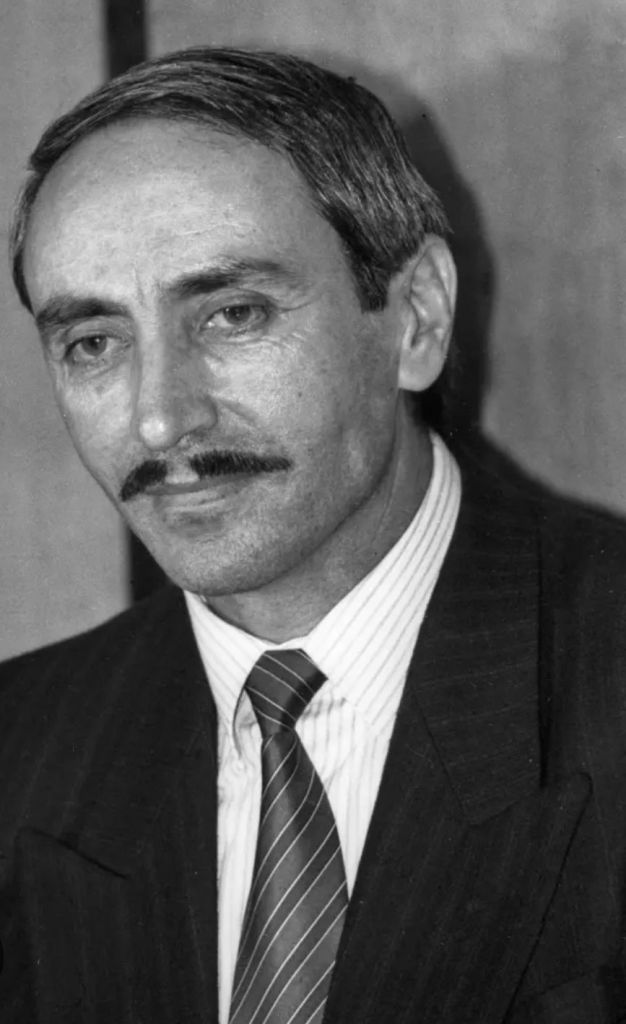
Dzhokhar Dudaev

Fin dall’inizio delle ostilità l’FSK aveva investito ingenti risorse nel rintracciare il presidente ceceno. La prima azione per trovare ed arrestare Dudaev era stata messa in atto dal Procuratore Generale russo il 1° febbraio 1995 quando, all’indomani del fallito assalto a Grozny, la magistratura di Mosca aveva emesso un mandato d’arresto  a suo carico. Il suo caso includeva quattro capi d’accusa: tentativo di usurpare intenzionalmente il potere, sabotaggio delle attività del governo costituzionalmente eletto, incitamento pubblico ad azioni terroristiche e istigazione all’antagonismo nazionale sociale e religioso. L’FSK aveva promesso di prendere Dudaev nel giro di qualche giorno, ma non era riuscito neanche a capire dove potesse nascondersi. Alla fine di aprile era stata costituita una task force che individuasse Dudaev e lo prendesse, vivo o morto. Nel corso del 1995 i russi avevano tentato di eliminarlo quattro volte, ma il Generale non era mai caduto in trappola. L’aeronautica russa bombardava sistematicamente tutti i villaggi dove girava voce che si trovasse, senza mai riuscire a colpirlo. Il 21 aprile 1996, tuttavia, Dudaev commise un errore fatale. Il suo convoglio si trovava nei pressi del villaggio di Gekhi – Chu, diretto ad una vicina collina ben coperta dai boschi dove il Generale avrebbe dovuto intrattenere conversazioni telefoniche via satellite. Insieme a lui viaggiavano il suo assistente, Vakha Ibragimov, il Procuratore Militare Magomed Zhaniev ed il Rappresentante di Dudaev a Mosca, Chamid Kurbanov. Nel convoglio erano presenti anche sua moglie, Alla, ed un nutrito seguito di guardie. Mentre Dudaev stava parlando al telefono un aereo militare apparve dal cielo e lanciò un missile aria-terra che colpì con grande precisione l’auto sulla quale viaggiava. Da tre mesi i servizi segreti russi tentavano di triangolare la sua linea telefonica, utilizzando come riferimento un telefono dello stesso tipo che Salman Raduev aveva abbandonato a Pervomaiskoje. In altre quattro occasioni erano quasi riusciti ad individuare Dudaev, ma la repentina chiusura delle comunicazioni aveva impedito ai missili di intercettare in tempo il segnale, mancando il bersaglio. Il missile che fece centro quel fatidico 21 aprile era progettato per dirigersi verso una fonte radio, e non appena ne fu rilevata una (in quegli anni non erano molti i telefoni dotati di una simile tecnologia in Cecenia) puntò la sorgente. Per evitare questo genere di rischi Dudaev aveva stabilito che il suo assistente avrebbe dovuto cronometrare le conversazioni e, qualora queste superassero una certa durata avrebbe dovuto immediatamente chiuderle, anche contro il suo volere. Anche in questa occasione pare che Ibragimov avesse fatto scrupolosamente il suo dovere, interrompendo la conversazione dopo pochi minuti. Ma quel giorno erano previste due telefonate a distanza ravvicinata, il che permise ai servizi russi di non perdere il segnale. Inoltre il cavo dell’antenna si era rotto, costringendo Ibragimov a sistemarla direttamente sul tettino dell’auto. Per favorire l’individuazione del segnale, nelle settimane precedenti, le autorità federali avevano causato volontariamente una serie di blackout nella rete elettrica locale, spegnendo tutte le sorgenti radio e tracciando così la posizione del telefono. Il primo ad usare l’apparecchio fu Kurbanov, per leggere un comunicato. Subito dopo fu il turno di Dudaev, per una conversazione con il deputato russo Kostantin Borovoj. I due parlarono per tre o quattro minuti, poi la conversazione fu bruscamente interrotta dall’impatto del missile.

Commemorazione della morte di Dudaev sul luogo del suo omicidio, 1997

Dopo l’esplosione Alla Dudaeva, sbalzata in avanti dallo spostamento d’aria, corse al relitto fumante dell’auto, coperto di terra. Kurbanov e Zhaniev erano rimasti uccisi sul colpo mentre Ibragimov, che al momento dell’esplosione era in ginocchio davanti all’automobile, era stato sbalzato dall’esplosione ed era gravemente ferito. Dudaev giaceva poco lontano dalla macchina, coperto di terra e ferito superficialmente dalle schegge. Quando Alla prese la sua testa tra le mani, scoprì che dietro la nuca aveva una profonda ferita, che lo aveva ucciso sul colpo. Trasportato nel vicino villaggio, il suo corpo venne lavato e vestito di bianco. Alla avrebbe voluto seppellirlo in un cimitero, ma il mattino seguente l’aviazione federale bombardò tutti i cimiteri nei pressi del luogo dell’attacco, devastandoli. Così, per mantenere l’integrità del suo corpo, venne deciso di seppellirlo in un luogo nascosto, dove nessuno potesse trovarlo[2].  Una cerimonia pubblica fu comunque tenuta nel villaggio di Salazhi, alla presenza della maggior parte dei capi militari dell’esercito. Le esequie politiche del presidente furono tenute da Yandarbiev, il quale assunse ad interim i poteri di capo dello stato in qualità di Vicepresidente[3]. Parlando ai giornalisti, il braccio destro di Dudaev dichiarò: La morte del primo presidente ceceno non ha piegato il popolo, che è pronto a proseguire la sua battaglia per la libertà[4].

Morendo, Dzhokhar Dudaev lasciava un’eredità politica controversa. I suoi nemici lo avevano descritto come un dittatore attaccato al potere e responsabile delle peggiori atrocità. Dudaev fu più volte accusato di contrabbandare armi e petrolio, di alimentare attività finanziarie illegali. In molti paesi dell’Europa Orientale, come l’Estonia, fu invece considerato un eroe, al punto che gli furono dedicate strade, piazze e targhe. Nei paesi che avevano fatto parte dell’Unione Sovietica, e che avevano subito particolarmente la pervasiva presenza russa, il suo sacrificio fu pianto da molti: soprattutto in Ucraina, la notizia della sua morte fu accompagnata da manifestazioni di lutto pubblico. Perfino in Russia ci fu chi lo pianse: il 24 Aprile, tre giorni dopo la sua morte, fu fatto circolare un necrologio firmato dal Consiglio di Coordinamento del partito dell’Unione Democratica, nel quale si leggeva: Esprimiamo le nostre più sentite condoglianze al governo della Repubblica cecena di Ichkeria e al popolo ceceno in occasione della tragica morte del presidente di Ichkeria, Dzhokhar Musaevich Dudayev. Il suo nome rimarrà per sempre nella storia tra i nomi dei grandi combattenti per la liberazione nazionale dei popoli. Ricordiamo il suo dignitoso rifiuto di prendere parte alle repressioni contro il popolo estone nel 1991. Non abbiamo dubbi che la giusta lotta di liberazione nazionale del popolo ceceno non si estinguerà finché almeno un invasore calpesterà la terra di Ichkeria. Gloria all’eroe della resistenza cecena!

Per parte sua, Eltsin, che in quei giorni si trovava a Khabarovsk ed era in partenza per una visita a Pechino, commentò: Con o senza Dudaev, faremo comunque finire tutto in Cecenia con la Pace. Gli abbiamo proposto più volte di metterci al tavolo negoziale, ma lui ha voluto la guerra. Ebbene, la guerra non ci sarà più. Se l’uomo è morto, pazienza. […][5].

 Chi fu, dunque, l’uomo che tenne in pugno il destino del popolo ceceno, che lo guidò all’indipendenza e poi lo trascinò nella catastrofe? Valery Tyshkov nel suo “Chechnya: Life in a War – Torn society” scrive: “Per comprendere l’emergere dei leader nel periodo post – sovietico è necessario affrontare le seguenti domande: come è nata una nuova generazione di “leader nazionali” dalla liberalizzazione? In che modo la popolazione post – sovietica li percepiva, e perché le masse seguivano tali leader? Su questa domanda ci concentreremo più da vicino, poiché l’impatto del ruolo di leader di Dudaev nel determinare gli eventi in Cecenia non può essere sopravvalutato. Un’idea comunemente sentita nel discorso accademico e pubblico della Russia è che quando le civiltà sono in conflitto, nel corso naturale delle cose, i gruppi etnici o i popoli, di cui sono composte, assumono leader che esprimono la loro volontà collettiva di realizzare un obiettivo storicamente predestinato. In altre parole, se Dudaev non fosse salito al potere, lo avrebbe fatto qualcun altro e tutto sarebbe andato in modo simile. Come ha osservato l’ex compagno di servizio di Dudaev, A.N. Osipenko, “Non fu lui a scegliere l’idea nazionale, fu quell’idea a scegliere lui”. […] Raramente è ammesso che un leader crei, o almeno influenzi in modo significativo il cosiddetto “movimento rivoluzionario” da solo. In realtà, il quadro è molto più complicato.” Dudaev si contese la leadership della Cecenia con personaggi che per molti versi erano più avvezzi di lui alla lotta per il potere. Politici come Zavgaev e Khasbulatov, personaggi pubblici come Hadjiev, sapevano come gestire il consenso, come divincolarsi tra le pieghe della volubile opinione pubblica, possedevano ottimi agganci ed avevano accesso a grandi capitali. Eppure fu lui, e non gli altri, a dirigere il gioco fin dalla sua discesa nell’arena. Se non avesse accettato l’invito a prendere le redini del fronte nazionalista, quest’ultimo non sarebbe stato in grado di percorrere lo stesso sentiero, e probabilmente la Repubblica Cecena di Ichkeria non sarebbe mai esistita. Dudaev seppe fare politica e seppe costruire un solido consenso intorno alla sua figura, seppe polarizzare le passioni di un popolo in cerca di riscatto e libertà sovrapponendo a queste due parole il suo volto[6]. A differenza di tutti gli altri, Dudaev seppe far sognare le masse. Se Zavgaev cercò di comprarsele col clientelismo, e Khasbulatov cercò di conquistarle con l’assennatezza dei suoi discorsi, Dudaev seppe far loro immaginare un futuro. E poco importa se nel pratico si dimostrasse una persona poco adatta all’amministrazione dello stato: era un leader visionario che proiettava tutto intorno a sé un’aura di eroismo, una padronanza di sé, la consapevolezza di essere il condottiero del suo popolo[7]. E questo, alla fine, era quello che la maggior parte dei ceceni si aspettava da lui. Alla sua morte egli fu oggetto di una vera e propria venerazione collettiva, e la notizia della sua dipartita fu presa da molti come falsa, tanto che il plenipotenziario di negoziati del governo, Yarikhanov, dovette fare una dichiarazione pubblica per confermarne il decesso[8], e lo stesso dovettero fare Maskhadov e Basayev, apparendo pubblicamente sul “canale presidenziale”[9]. Ciononostante molti ceceni continuarono a rifiutarsi di credere che Dudaev fosse davvero morto, incoraggiati dalle parole del genero Salman Raduev (il quale giurò sul Corano che fosse ancora vivo) nonché di altri personaggi che facevano parte della sua cerchia ristretta[10], ma anche dallo stesso scetticismo di alcuni alti ufficiali russi[11]. Inizialmente, infatti, le autorità militari russe in Cecenia negarono di aver portato a termine un’azione volta ad uccidere il presidente ceceno, anche se i giornali riportarono svariate “fughe di notizie” dal quartier generale, secondo le quali l’eliminazione di Dudaev fosse uno degli obiettivi primari dell’intelligence del Cremlino[12].

Dare un giudizio di merito su Dzhokhar Dudaev non è facile, e forse non è neanche così utile. Chi lo vide come un capo fu ispirato dalla sua figura, e nel suo nome combatté e morì. Chi lo vide come un tiranno fece di tutto per abbatterlo. Sicuramente fu un leader capace di mobilitare il popolo ceceno come nessun altro aveva mai fatto dai tempi dell’Imam Shamil. Fu un uomo coraggioso, che abbandonò la prospettiva di una lunga e rispettata vecchiaia da illustre graduato dell’esercito per combattere la sua battaglia ideale. Fu anche un abile stratega sul campo di battaglia: sfidò la Russia con un esercito di volontari e riuscì ad umiliare il prestigio di uno degli eserciti più potenti del pianeta. Per contro fu un pessimo amministratore, ed un miope negoziatore politico. La sua riluttanza a scendere a qualsiasi compromesso, se pure rese la sua figura affascinante e romantica, condusse il paese alla distruzione. La sua scelta di gettare la sua patria nel carnaio della guerra totale provocò al suo popolo immani lutti e sofferenze, il suo supporto indiretto alle azioni terroristiche lo portò a sdoganare una tattica militare odiosa, che alienò ai ceceni la simpatia del mondo occidentale.

La morte di Dudaev lasciò un vuoto incolmabile. Per quanto questi avesse da tempo organizzato la successione del potere in caso di sua dipartita, non c’era nessuno in grado di ereditare il peso politico della sua persona. Soltanto grazie a lui le numerose e composite anime dell’indipendentismo ceceno erano rimaste unite sotto la bandiera della ChRI evitando, per il momento, l’esplodere di una guerra tra bande. Il numero 2 del regime, Zelimkhan Yandarbiev, era pronto a farsi carico delle sue responsabilità, ma il suo compito non era facile. L’indipendentismo aveva sempre avuto un solo eroe, e adesso questo eroe era morto. La Repubblica Cecena di Ichkeria non aveva più il suo punto di riferimento e rischiava di spaccarsi in una galassia di piccoli potentati in guerra per la successione al potere. A complicare le cose giunse l’annuncio, falso, da parte del governo Zavgaev che lo stesso Yandarbiev era stato ucciso. Ci vollero alcuni giorni prima che fosse chiaro che a cadere non era stato il Vice – Presidente, ma un suo nipote, e nel frattempo i media specularono su chi avrebbe dovuto raccogliere il suo testimone, ipotizzando addirittura una guerra civile tra le forze indipendentiste[13]. Quando l’equivoco fu ufficialmente chiarito, Yandarbiev si mise all’opera, prima di tutto per ottenere la lealtà dei principali comandanti sul campo. Maskhadov, Basayev, Gelayev, Alikhadziev, Atgeriev, tutti i principali leader della resistenza riconobbero il suo primato politico, in attesa che la fine della guerra portasse ad una ridefinizione dei rapporti di potere[14]. D’altra parte la nomina di un capo era fondamentale: la morte di Dudaev, per quanto tragica, rimuoveva il principale ostacolo all’apertura di un canale diplomatico con le autorità russe. Non che fossero in molti a credere ad una soluzione negoziale della guerra: i militari russi temevano che un’altra tregua avrebbe nuovamente avvantaggiato i ceceni, permettendo loro di ricompattarsi e di lanciare una nuova ondata di attacchi. I comandanti sul campo ceceni, dal canto loro, non si aspettavano niente, considerato com’era andata fino ad allora. Il capo del governo filorusso, Zavgaev, non aveva alcuna intenzione di parteciparvi, essendo intenzionato a capitalizzare il massimo risultato politico derivante dalla morte del suo avversario. In concomitanza con la morte del generale rispolverò addirittura il Congresso del Popolo Ceceno, indicendone un’assemblea straordinaria. L’evento vide la partecipazione di 400 delegati, reclutati tra i rappresentanti delle comunità favorevoli ad un accordo con la Russia. Davanti a loro, Zavgaev chiese ed ottenne il mandato per l’organizzazione di nuove elezioni parlamentari, tramite le quali consolidare la propria posizione e disfarsi, almeno in parte, dell’ingombrante supporto derivante dalla nomina d’imperio ottenuta da Mosca nell’autunno dell’anno precedente. In quell’occasione, una voce si levò contro il “Capo della Repubblica”: quella dell’ex sindaco di Grozny (ora Vice Primo Ministro) Bislan Gantamirov. Intervenuto all’assemblea, si dichiarò insoddisfatto del lavoro di Zavgaev, sostenne che la sua figura non avrebbe facilitato il processo di pace e si dissociò dalla sua politica collaborazionista. Come vedremo, questa posizione gli sarebbe costata cara.


[1] A metà Aprile il governo russo sembrava intenzionato a riprendere i colloqui con Dudaev. Secondo quanto riferito da Kommersant il 18 Aprile 1996, Eltsin aveva dato mandato al Ministro per le Nazionalità, Mikhailov ed al Consigliere Presidenziale Emil Pain di riattivare i contatti, negoziando il ritiro delle forze federali e la normalizzazione della Cecenia. All’iniziativa, ancora informale, aveva fatto eco la dichiarazione pubblica del Ministro della Giustizia russo, Valentin Kovaljov, il quale aveva ventilato il ritiro delle accuse formali a Dudaev a seconda dell’esito dei colloqui, segno evidente che la leadership del Cremlino era disponibile ad accomodarsi pur di presentare all’opinione pubblica un piano di pace credibile. Per parte sua Dudaev aveva chiesto l’intervento quali mediatori del Presidente della Turchia, o del Re di Giordania, dando a intendere di essere disposto a raggiungere un accordo di massima con Mosca.

[2] Pochissimi sanno ancora oggi dove si trovi la sua tomba. Certamente ne fu a conoscenza il Vicepresidente, Zelimkhan Yandarbiev, che dopo la sua morte assunse la carica di Presidente ad interim. In un’intervista rilasciata a Peter Grokhmalski nel Luglio del 1996 disse: Il mondo intero vede il comportamento degli aggressori russi. Niente è sacro per loro. Non vogliamo che profanino i resti di Dudaev. Un ceceno che si fa beffe del corpo del suo nemico, che tortura un prigioniero, cade in disgrazia. Per i russi, questo è motivo di orgoglio. Pertanto, oltre a me, solo poche persone conoscono il luogo di sepoltura di Dudaev.

[3] In realtà, secondo quanto riporta Ilyas Akhmadov in The Chechen Struggle, al momento della morte di Dudaev non esisteva, o non era più reperibile, un decreto legittimo che attestasse la nomina di Yandarbiev alla carica di Vicepresidente. Secondo quanto raccontato dall’autore, quindi, venne redatto un provvedimento predatato per  legittimare il passaggio dei poteri.

[4] La Repubblica, edizione del 25/04/1996.

[5] La Repubblica, edizione del 25/04/1996.

[6] Un contadino di Vedeno di 18 anni, intervistato sul suo rapporto con la figura di Dudaev, raccontò: “Quando Dudaev salì al potere ero studente di una scuola islamica. Il nostro insegnante ci disse che Dudaev era stato mandato dal cielo, che il suo vero nome era Dzhovkhar (“Perle” in ceceno) e che il suo avvento era stato predetto dall’antica tradizione. In quel momento si svolgevano molti raduni e tutti urlavano “Allah Akhbar”. Poi abbiamo iniziato a scandire “Dzhovkhar! Dzhovkhar!”. Anche il nostro insegnante, che era il Mullah della nostra scuola, venne alle manifestazioni. Quando gli ho chiesto chi fossero i nostri nemici, ha risposto “gli infedeli”. Ha anche detto che in un sogno aveva visto Dudaev scendere dal cielo su delle ali. Disse: “Con un leader del genere siamo invincibili!”. Tutto ciò di cui la gente parlava sempre più spesso era la guerra. E anch’io volevo andare in guerra.” Una ragazza cecena, ricordando il giorno della sua nomina a Presidente, riferì: WRicordo il giorno dell’investitura di Dudaev. […] Ha prestato giuramento al teatro e poi è andato al palazzo del governo in mezzo alla gente, una folla enorme. E’ stato straordinario, ho sentito che stava succedendo qualcosa di importante. Non posso dire di essermi votata a Dudaev proprio in quel momento, ma da allora qualcosa è cambiato in me. Era così bello nella sua splendida divisa da generale! Ho detto agli amici: “Andiamo a vederlo, non ci perdoneremo mai di non averlo fatto se ce lo perdiamo!”

[7] Sempre citando Tyshkov: Dudaev era il tipico carismatico “non sistemico” il cui potere risiedeva nella concezione di progetti irrealizzabili […] nell’ignorare soluzioni ai problemi pratici. Come scrive M.A. Sivertsev “Il leader carismatico che cerca una risposta alle sfide di un tempo di transizione e instabile deve affrontarlo in un orizzonte visionario: deve ripristinare i legami di lunga durata con le basi idealizzate della vita. Questa capacità (il suo carisma) di ripristinare l’esperienza sacrale conferisce al leader la legittimazione delle sue azioni. Il suo malfunzionamento e le sue insignificanti carenze nella sfera formalizzata – razionale sono perdonati e persino considerati come un’ulteriore prova di forza carismatica […].” Rivolgendosi ai miti della lotta e della vittoria, all’animosità e alla vendetta, il leader carismatico modella le percezioni dei suoi seguaci e da quel successo la sua immagine eroica personale acquisisce la necessaria stabilità. Quindi, costruisce una sottocultura chiusa che sviluppa la propria lingua, il proprio codice e le proprie pratiche, con connessioni minime verso il mondo esterno.

[8] Secondo quanto riferito da Kommersant, il 23 Aprile Yarikhanov dichiarò alla ITAR – TASS: Dudaev è stato ucciso, non c’è dubbio. Insieme a Dudaev, sono state uccise diverse persone della sua cerchia ristretta, incluso il suo assistente Vakha Ibragimov, così come il Procuratore Militare Magomed Zhaniev. In realtà Ibragimov non era morto, ma giaceva in condizioni critiche in un letto d’ospedale. Si sarebbe ripreso nel giro di qualche mese, tornando a partecipare alla vita politica della Repubblica una volta finita la guerra, tra le file dei nazionalisti radicali.

[9] Il canale televisivo presidenziale era una trasmissione prodotta da una rete di emittenti artigianali gestite dai sostenitori dell’indipendenza. Trasmetteva principalmente dai centri a Sud di Grozny, ed era in grado di rendersi visibile nella capitale ed in buona parte del Sud del paese.

[10] Interrogato sull’argomento, il segretario personale di Dudaev, Sapuddin Khasanov, dichiarò che Dudaev stava lavorando normalmente e che le voci sul suo assassinio erano totalmente infondate.

[11] Secondo quanto riporta Kommersant del 25/04/1996 il Presidente del Comitato per la Sicurezza della Duma, Viktor Iluychin, affermò di essere disposto a credere alla morte di Dudaev soltanto dopo che il suo presunto cadavere fosse stato riesumato, mentre lo stesso comandante in capo delle forze federali in Cecenia, Tikhomirov, dichiarò che le truppe di Mosca non avevano assolutamente niente a che fare con la morte di Dudaev, contraddicendo la versione ufficiale, secondo la quale il presidente ceceno sarebbe caduto vittima di un attacco missilistico. D’altra parte altri alti ufficiali dell’esercito confermavano la presenza di cacciabombardieri a Sud di Urus – Martan, intenti ad attaccare bersagli in ricerca libera come rappresaglia per i recenti attacchi ceceni alle colonne russe.

[12] Secondo quanto riportato da La Repubblica del 25/04/1996: «l’azione punitiva» è stata finalmente rivendicata da un rappresentante altolocato del ministero dell’Interno.Ci siamo vendicati per l’agguato ad una colonna di automezzi russi che ha provocato la morte di decine di soldati e ufficiali” ha detto, e “abbiamo distrutto a colpi dì missili sette sedi segrete di Dudaev di cui sapevamo l’ubicazione”. Una di quelle sedi si trovava a Ghekhi-Chu dove è stato centrato il bersaglio principale. Fonti dei servizi segreti a Groznij sono state ancora più esplicite: “Si è trattato di un quinto tentativo, stavolta riuscito, nei giro degli ultimi 2-3 mesi”.

[13] Sul Kommersant del 30/04/1996 appare un lungo articolo che specula sull’ipotesi di uno “scisma” tra Maskhadov e Basayev. In quel frangente la versione del quotidiano russo fu prontamente smentita dai protagonisti, ma il confronto tra i due si sarebbe consumato davvero, pochi anni più tardi, portando la Repubblica ad un passo dall’autodistruzione. Molto probabilmente in quel momento, nel pieno del conflitto, più che di “scisma” si poteva parlare di “concorrenza”. Riportando le parole usate da Ilyas Akhmadov in una delle nostre conversazioni: Sfiducia” è una parola troppo forte per descrivere la loro relazione in quel momento. C’era sicuramente una certa concorrenza tra loro però. Non era pubblicamente riconosciuto, solo coloro che erano nei circoli privati di Basayev e Maskhadov erano a conoscenza. Alla fine, i due hanno lavorato insieme meravigliosamente. Ci sono stati anche alcuni disaccordi sugli incaricati di Maskhadov . Maskhadov è venuto nella regione natale di Shamil e stava nominando delle persone. Ma durante la guerra c’era una legge non scritta secondo cui un comandante, quando si trovava nella sua regione d’origine, era il principale responsabile. […].Ma come ho detto, a parte poche persone, la competizione tra Shamil e Maskhadov era quasi invisibile agli occhi del pubblico. […] A quel tempo, la tensione tra Shamil e Maskhadov non era grande. Era divertente, a volte quando Shamil voleva dire qualcosa a Maskhadov me lo diceva e viceversa. […] È possibile che nel tempo la competizione abbia portato a disaccordi molto più pubblici durante le elezioni. Ma durante la guerra, sebbene avessero alcuni disaccordi, erano più personali e non divennero un problema pubblico.

[14] Tale decisione fu assunta dal consesso dei comandanti militari in una riunione straordinaria del Comitato per la Difesa dello Stato (GKO) tenutasi a Roshni – Chu subito dopo la morte del presidente ceceno, durante la quale venne avanzata anche l’ipotesi di nominare Maskhadov al posto di Yandarbiev, considerato il contesto bellico nel quale la successione avrebbe dovuto svolgersi. Maskhadov tuttavia rifiutò, invitando i convenuti a rispettare quanto previsto dalla Costituzione.

Biographies –  Aidmar Timurovich Abalaev

The work on this biography is carried out in collaboration with the Instagram page “Qoman Sij”, based on information received from the former deputy of the Minister of Foreign Affairs of the Chechen Republic of Ichkeria, Ilyas Musaev, verified with the sources at our disposal

Aidmar Timurovich Abalaev, a Chechen statesman and military leader, served as the Minister of Internal Affairs and the Sharia Security Council of the Chechen Republic of Ichkeria. Born in Nozhai Yurt in 1964, he belonged to the Chechen teip (Clan) Saysano. A descendant of Alibek-Khadzhi Aldamov, the imam of the North Caucasus and the initiator of the 1877 uprising in Chechnya and Dagestan. During the First Chechen War, he fought in his native village Nozhai-Yurt region, commanding the Mountain Rifle Unit of the Reconnaissance and Sabotage Battalion, and also participated in the defense of Grozny.

On January 9, 1996, on the personal instructions of Dzhokhar Dudayev, units under the command of Salman Raduev, along with other well-known Commanders: Khunkar Israpilov, Turpal-Ali Atgeriyev, he took an active part in the raid in the city of Kizlyar. In 1996, he also participated in the successful military Counter-Attack operation to recapture Grozny from the Russian Terrorists. After the battle, Abalaev was awarded the highest Order of the CHRI “Qoman Sij” (Honor of the Nation) and received the rank of Brigadier General. He was a presidential candidate in the 1997 elections in the CRI and received slightly less than 1% of the votes.

At the end of 1998, he was appointed Minister of Internal Affairs and Minister of the Sharia Security of the ChRI in the government of Aslan Maskhadov. After a meeting of the Military Council of the Armed Forces of the ChRI, held on April 30, 2002, under the leadership of the President of the ChRI, Aslan Maskhadov, Aidamir Abalaev, along with other Chechen commanders, was sent to one of his military bases.

On May 1, 2002, Abalaev’s unit was ambushed by fighters from Yamadayev’s terror gang for special operations together with the Russian unit of the FSB Directorate. Aidamir Abalaev, field commanders Colonel Vashev and Major Uvaisaev offered the Russian intelligence officers to surrender without a fight. The Chechen commanders responded with fire from machine guns and grenade launchers. The battle occurred near the village of Sayasan, Nozhai-Yurtovsky district (his native village). According to FSB Colonel Shubalkin, Abalaev’s corpse was identified by his relatives. He died from a bullet wound received in the left side of the chest. Military doctors tried to help him, but Abalaev, without regaining consciousness, died half an hour after being wounded on May 1, 2002.

WHERE IS CHECHNYA GOING? POLITICAL REFLECTIONS BY DZHOKHAR DUDAYEV (PART 3)

Do you know what basic conditions were constantly and ambiguously put forward by the West in almost all negotiations with state leaders of the USSR in 1989 – 1991, when it came to providing credit and charitable assistance, and this was not publicized in the Union press? Yes, the creation of that very financial oligarchy (5-10% of the population), capable of controlling up to 60% of the country’s total potential, with the guaranteed establishment of the institution of private property and protection of large-scale foreign investments and foreign property!

Then, strangely enough, the first to realize it and tried to take it into account, albeit limitedly. N.Nazarbayev, but M.Gorbachev for a long time was floundering and hesitated, grasping for various alternatives that were saving in his opinion, but miraculous, as it turned out later, until the whole feud with GKChP broke out, mainly because of irreconcilable differences of opinion among his entourage….

As long as the society reforming towards collegial privatcapitalism does not decisively overcome the transition stage of non-authoritarian state capitalism, which is dangerous because of its instability and centrifugal forces, chaos, crime, economic collapse and general ungovernability in public spheres may reach its peak, followed by monstrous armed conflicts and historically irreversible processes. The example of the collapse of the USSR, the “critical boiling points” in Russia and the CIS countries, and, thank God, only sensitive echoes in the Chechen Republic serve as impressive proof of this.

Dzhokhar Dudaev

Back then, in 1984, nothing seemed to foreshadow that such a powerful empire could collapse in such a short period of time by historical standards. And only the highest echelons of power were aware of the fact that the cumbersome and non-adaptive to the ever-increasing demands of the country’s economy management system was failing more and more catastrophically every year, its “slippages” were throwing the USSR further and further away from the advanced countries of the capitalist world in terms of economic development. The “cosmetic repairs” of the state apparatus did not save it, nor did the desperate reshuffling of personnel in it produce any results. That is why, finally, M. Gorbachev, relying on the brave and radical wing of his entourage, decided to reform the state structure. The general public is well aware of the deplorable results of the experiment for the President of the USSR. But what was M. Gorbachev’s mistake, why did he fail to skip the dangerous stage of non-authoritarian state capitalism, even introducing elements of private property and legalizing entrepreneurial activity? Were the centrifugal forces so strong, and the aspirants to the future “financial aces” were still just playing “nursery cooperatives”? Yes, probably. But this was not the only factor.

If one imagines authoritarian state capitalism in the form of the famous Ostankino TV tower, the stability of which is created by the extremely tight steel rope running through it, then the “cable of political stability” of the former USSR consisted of many strands of “unfreedoms” that created the necessary strength. In his attempt to throw the rope bridge from the “top of the Soviet system” to the “Western model”, M. Gorbachev weakened to a greater or lesser extent many of the steel strings, such as freedom of speech, press, information, expression of will, national self-expression…. and even entrepreneurial activity, while leaving the “inviolable” but coveted private property 100% tightened. And while the West was feverishly winding some ropes on its “bay of democracy”, the construction of the Soviet tower staggered and collapsed. The ropes that had already been thrown over did not help; they sagged and plunged us all into the swamp of collegial state capitalism.

The main and also fatal mistake of M. Gorbachev (if only this ERROR!?), was in the FOLLOWING loosening of the strings stretched on the “soviet fingerboard”. The example of “communist China” is clear evidence of this. They do the opposite there and apparently play the “guitar of economic reforms” quite well.

WHAT is the fate of the Russian Federation now? Will “Yeltsin’s sappers” be able to overcome the unfortunate”minefield”for the Union, or is the explosion imminent? Or maybe “Khasbulatov’s” frightened parliament will be able to pull everything back to more familiar circles? What if it all comes back to bite us in Chechnya? Nowadays, few people probably remember the December 1991 speech of Boris Yeltsin. His program speech, made on the 28th after the famous Belovezhskoe deed, although it was verified in parliamentary language and slightly diplomatically veiled for potential Russian tycoons, shone a long-awaited green light as a signal for the most active actions, as an indulgence for the ideals of private property. Behind it stood the little-known fact that the current processes in the Russian Empire (USSR, CIS and the Russian Federation proper) were financed. And it was done by target purpose “under Yeltsin”, who unlike M. Gorbachev, who was bluffing. He gave his consent to the West for the birth of the Russian Financial Oligarchy! International capital already then paid for the first stage, when a person who cannot swim is thrown into the water, seducing him with the pleasure of market relations, which can be obtained on an equal footing with others who have previously mastered swimming in the sea of capital. If he doesn’t drown at once and continues to swim, we will help him a little more, but if he goes to the bottom, we will always find another candidate. It makes no difference who will continue the line of M.Gorbachev and B.G.Yeltsin, be it L.Rutskoy or R.Khasbulatov, but they will not give up what they have, c’est la vie, but that is the logic of the powerful.


 Another, and by no means unimportant factor is the fact that Russia has significant healthy forces, high intellectual potential, desire and means to complete the radical reforms that have been initiated. That is, a complete set – Stimulus, Motive, Means and Power.

That is why, summarizing, we can say with great confidence that the young Moscow guild of capitalists, which is emerging and growing stronger day by day, coupled with a foreign armada of “associates”, together with Boris Yeltsin’s team, although rather shabby in battles, but resilient, will bring the matter to its logical conclusion.  What is in store for us? Will the mutant virus of the management tools of authoritarian state capitalism (last time in our country it had a variation under the name of “Soviet partam pa ratnoy”), which is stubbornly fighting for living space in the Parliament of the Chechen Republic, as well as in the Supreme Soviet of the Russian Federation, still give rise to incurable metastasis. After all, such a cancerous contagion inevitably dooms the representative bodies of the authorities to become a kind of “reanimated Chechen regional party committee”, taking over from its deceased predecessor the rudimentary functions of control, management and distribution in the sphere of production and consumption, and usurping the right of “the only connoisseur of the interests and problems of the people”.

MIkhail Gorbachev

So what should be our priorities? How, what forces and means should we use in the first place? These are not easy questions, but there are visible answers to them.

Let us first of all realize once and for all one simple axiom. Not a single Parliament of the world and not a single President, sitting in their palaces or residences and issuing only laws and decrees, have not fed a single nation or created commodity abundance for anyone in the history of the world. The welfare of their people is brought, usually by special initiative people (large organizers and entrepreneurs, businessmen and business scientists) who, thanks to their efforts, abilities and talent, often at their own expense and at their own risk and risk, create in society special mechanisms of social and state development, known to them alone and, at first, only understood by them, using as a creative driving force the factor of satisfying the interests of the largest and most productive part of the population. Exactly they, using the personal factor of Means, through the Motive of the attracted specialists, maximally include the factor of Interest of the Producer People, strengthening the factor of Power of the State, which in turn contributes to the next similar cycle, but already at a higher level. As a result, new jobs and guaranteed wages appear in the country, the share of “buy-and-sell” business begins to give way to creative and service business, etc. In short, it is what is called “economic recovery”, the main thing is to legally allow them to do it! And if we can’t do anything to help, it is important not to hinder it, shielding this saving layer of society from aggressive attacks of the “socialist virus” of equality without the rich and hatred of “bloodsuckers”.

That is why there is no more important task for us today than to create the most possible conditions for the intensive development of the business class, from which domestic Vainakh tycoons of financial and industrial capital will inevitably emerge, the future flagships of the Chechen ship, the guarantors of stability and prosperity of society. It is all the more urgent because, unfortunately, unlike Russia, no one will finance us. Believe me, to the great joy of the Metropolis and not without its handiwork, there are no countries in the world that at this stage would fill the empty niche of the Chechen financial oligarchy as an external friend. The vectors of geostrategic interests of Russia and those states that could actually do it are very different in their directions. The dominant Russian factor of Power and its known unpredictability leaves no one in doubt here. There is no alternative “adrenaline” for us today, and unfortunately there is no minimum necessary start-up capital. At one time we missed a very important moment when COUNCH could have made timid steps and prerequisites for the creation of oligarchic structures, but in the Parliament of the Chechen Republic we defeated the syndrome of the mental deficit acquired from the Bolsheviks. There were other missed opportunities. However, there is a deep conviction, based again on the laws and examples of social development, that the Vainakh people, having unlimited potential reserves, will be able to dispose of them rationally, that a part of the excessive willpower of the present Chechen population will necessarily transform into the missing factors and compensate for any emerging inhibitory moments on its way. And there is no other Alternative to this!

Finally, the last hot topic of discussion of the day is the legitimacy of the current form and content of the state structure of the Chechen Republic. This is a kind of self-branded tablecloth for our political cooks who are losers. Grief-experts of both the domestic and Moscow variety go to what extremes and grave extremes, looking for a speck in someone else’s eye. In order to prevent the “worm of doubt” about the legality of Chechnya from tormenting some people and to finally knock the labeled “trump card” out of the hands of others, the following clarifications are required. If we take a dialectical approach, then legal professionals know that a reference to any law of any country can always be challenged, whether on historical, legal, moral and ethical, or other aspects, due to the fact that jurisprudence is essentially eclectic, i.e. “no wisdom is simple enough”, since one can always find a counterargument to any argument if desired.

It is impossible to create any small-minded code of laws without explicit or implicit contradictions. Humanity has not yet developed a universally-identified, logically adequate and legally sterile language, like computer linguistics, free from such shortcomings. And then on the scales of the disputing parties, in principle, there will always be strong enough competent justifications in their favor, but the adoption of judicial, arbitration, socio-political or any other “legal” decision depends predominantly on the balance of forces and opinions in society, on the power and force positions of the disputing and verdict parties, finally, on the prevailing realities. This has always been the case everywhere, at any level, from the “village council” to the UN General Assembly,

Boris Eltsin

There is no doubt that Russia has not been able to “crush” us after the 1991 secession, but it is also indisputable that Chechnya has not yet won back its position in this dispute. Today we are like two tired wrestlers on the mat who, having entered the clinch, have taken a wait-and-see stance for the final victory throw. A difficult precarious balance for the country. But, remember that Unrecognized Permanent Reality tends to be legitimized sooner or later. It is only a question of time and stamina, and the effort to make it happen. Apparently, just as scientists pharmacists take a long time to reach the required prescription for a new and unexpected disease, our way of choosing the establishment and implementation of rationally effective public administration is also long. It is just that a sick person always wants to get well as soon as possible.


 Personally, I see us in collegial privatcapitalism, which, of course, has nationally distinctive features, and I am convinced that the Chechen state has not only a history, but also a real, “not banana” big future, all we need to do is to set the “good Gene Capital” free. If we don’t do it, others will do it.

In closing, I would like to remind you of one thing. Do not forget. The TRUTH is like an infinite mosaic panel consisting of innumerable pieces of “truths”. Truth is one, cognizance of all the immense depth of which, apparently, is not given to a mere mortal, to know it in its entirety is destined only to the Almighty Himself. We are destined to perceive only its separate fragments. Each individual has his own set of “truths”, from which he can make his own part of the canvas of truth. How much of it will he really display, of what components is it composed of, and what should they be? These and other similar questions, have not yet been identified in our society.But I believe in the collective Vainakh capabilities, in the Chechen Stimulus and Motive, capable of painting the necessary picture of the Truth, however small in size and large in number its components may be, because behind each of them stands our
Man with his priceless destiny

PEACE, TRANQUILITY AND PROSPERITY TO YOU ALL.

Where is Chechnya going? Political reflections by Dzhokhar Dudayev (part 2)

That is why the archaic for modern foreign political science linguistics terminology “good, honest, decent, fair”, etc. as applied to our new power structures does not have even approximately unambiguously identified semantic content, because a million people will give exactly a million different interpretations to it. For some reason, for example, when speaking about the performing skills of a musician, we use quite natural and characteristic definitions such as “talented” or “skillful”, but not at all “virtuous” or “crystal honest”. This, as they say, is from a different opera.

Why is it that in politics everything is put upside down and professionalism is advanced to the “good guy”? Any specialist is very jealous of dilettantish talks about the subtleties of his profession. In politics, strangely enough, everything is allowed.

If we give in to the verbal exercises and tempting enticements of the rather proliferated “elementary educated” and use as state-building material such abstracted criteria thrown by Satan himself, we will probably not build anything good…ANY community of people at all times is differentiated, and the real basis of its division is the multiplicity of human aspirations, principles of behavior, potentialities and influential moments. Integrating by one or another criteria into groups and categories, they constitute those real natural forces and movements in society. In this connection, it is probably worth recalling that the formation and development of the state, which is also true for any individual, is based on these four characteristic driving factors, conventionally named: STIMULUS, MOTIVE, POWER AND FACILITIES.

STIMULUS is usually understood as a value reflecting the vector sum of its components, such as all kinds of Interests, Desires, Feelings, etc. MOTIVE is a potential value integrating Intellect, Knowledge, Experience, Know-How, etc. Another vector value is POWER, which integrates Power and Strength. And finally, FACILITIES is another potential value, the components of which are Money, Resources, Funds, etc. Predominantly operating with such concepts, which are “political bricks, mortar, armature and concrete”, and not with dilettantish abstract ones – “honesty, decency” or even “competence”, will always help any statesman and not only him to get a sufficiently objective dialectically verified analytical picture of any socio-political processes, to have the basis that does not allow making inexcusable and irreparable mistakes of political nature. The tools used for dismantling and destruction, as a rule, are unsuitable for construction and creation. That is why all appeals to “reason, brotherhood, understanding, unity, consensus…” etc. are useless. Only those who will be able to satisfy the Stimulus of the people, using the Means through the Motive of specialists, will be able to increase the Power of the state.
 Further. Many people thought, and are still strongly convinced of it, that it is worth to adopt the external attributes of the so-called civilized democracies, i.e. to elect a Parliament, a President and a Constitutional Court, delegating there the “best” representatives of the people, and all problems are solved. This is a monstrous misconception, and in conditions of collegial state capitalism, which today is certainly not only the Chechen Republic, but also Russia, these institutions turn out to be nothing more than the well-known “Hottabych’s telephone!” Absolutely identical to the prototype in all externally visible parameters and banally completely empty inside, without the electronic and mechanical stuffing that makes the apparatus work. We think, i.e. “call”, that we govern, while the people live under the influence of their objective social laws of evolutionary development.
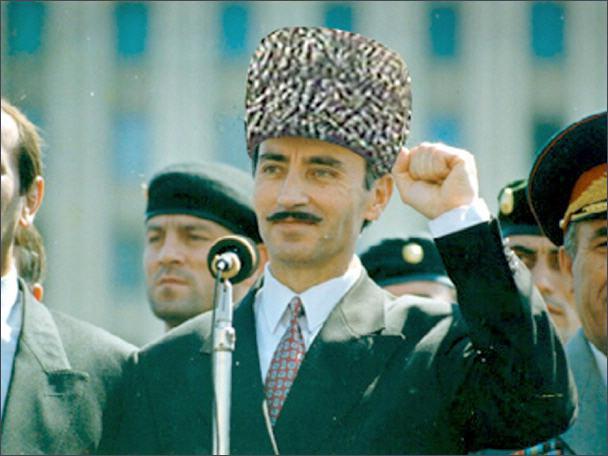
Photo of a voucher (privatization check, 1992) with an indication of the place where the monogram of the artist Igor Krylkov is located on the banknote (letters I and K in an oval).

Parliaments, Senates, Congresses, as a rule, are only a symbol of POWER in the hands of the explicit (authoritarianism) or implicit (non-authoritarianism) MASTER and, at best, serve as a laboratory practice for practicing the legislature set by the Master or giving legitimate form to his wishes.

As for the Presidential Structures, Cabinets or Councils of Ministers, other possible state bodies of executive power, they, as a rule, fulfill the function of these Wishes. Naturally, any form of state governance is characterized by a greater or lesser divergence in the directions of vectors of interests of the Master and the People. Except that in authoritarian state capitalism the change of the direction of the latter in its direction is performed by the Master mainly at the expense of the Power component of the Power factor, and in collegial private capitalism through the predominant use of the components of the Means factor. Unfortunately, and this is probably characteristic of most citizens of the former USSR, we are still in the deep captivity of nostalgic illusions about that executive power, which was exercised thanks to years of clearly defined totalitarian system, which had a wide range of appropriate tools: from fiscal bodies for suppression of dissent to institutions for “ideological straightening of brains”, from the stick to the carrot. Even the most ardent Western “anti-Sovietists” recognized at the time that totalitarianism ensured greater efficiency, discipline, and order. This is achieved, of course, at the expense of such characteristically dominant in authoritarian state capitalism worst components of the Stimulus, such as fear, fear, a sense of hopelessness, powerlessness, etc. Another question, of course, is what we have come to as a result of all this….

Let’s imagine hypothetically that the notorious Power overnight completely and completely passes into one hands: either the President, or the Parliament, or someone else. And let us be ruled by the ideal in each case, either presidential X. or the many-faced parliamentary Y, or nameless Z. What does this mean in practice? And that in this case all the national wealth, all the country’s resources and all its economic potential “falls under the monopoly of X. Y-a, or Z. That is, they will manage and distribute what they personally do not really own, but the owner – the people have very ephemeral economic rights! Together with the entire ministerial team, the governing echelon of the government can hardly constitute even one tenth of a percent of the population. But the psychology of behavior and programmed attitude of any manager – non-private co-owner, especially in the conditions of decline in economic production and deterioration of living standards of the poor part of the population, consists in instinctive efforts to keep the place under the sun by justifying the motives of their activities, referring to the difficulties of objective and subjective plan, as well as criticism of various formal and informal objects that create allegedly insurmountable problems. Remember N. Ryzhkov, V. Pavlov or T. Gaidar. V.Chernomyrdin is bound to follow this path.

Boris Eltsin

Naturally, and it is inherent in human nature, that the dissatisfied and offended, “who know better how the country should be run and what the people need”, necessarily starting with derogatory criticism, can move on to much more serious and active actions to “restore justice”. What is the response for the ruling elite? To tighten the screws? But this is a return to totalitarianism, from which they fled and have not yet had time to catch their breath. Make personnel reshuffles? Nothing will change significantly. Then the System itself must be replaced! But, as it seems, we changed it by dismantling the “unified party-parameter room” and creating a modernized one with “separate warheads”. This is where another stumbling block turned out to be. Having flown out at first in one “anti-imperial missile”, we ended up like those “swan, crayfish and pike”, with our spatially differently oriented vectors of Stimulus and Power, different baggage of Motive and Means.

Yes, sometimes power is divisible. And its rank gradation is possible both vertically and horizontally. But on a national scale, it always has pyramidal differentiation, strengthening from the base to the top. And two or even three pyramids in a country is a competition of authoritarian authorities. Reasonable peace or peaceful compromise in such unnatural conditions is nonsense. Artificial attempts of horizontal separation of powers, i.e. to make several Masters at the same time, is an objective doom for “family-economic” strife, which will continue until the unstable balance will not take its more natural stable state, peculiar only under one definite Master, until the divided pyramids will finally merge into one. Many people mistakenly see the antagonism of “divided powers” as a personal factor. Then imagine, for example, that we swapped places with the Chairman of the Parliament of the Chechen Republic. In half a year, if not sooner, having mastered and gotten up to speed, having been in a “different skin”, each of us will defend new positions, noticing a grain of sand in someone else’s eye and not seeing a log in our own. And there is nothing surprising or tragic in this, it is simply the natural nature of a person to defend the interests of a certain (“his”) group and category of people or, if you like, a part of society. I am sure that the same metamorphosis would have happened if B. Yeltsin and R. Khasbulatov had been swapped.

Former Soviet Parliament Chairman Ruslan Khasbulatov, seen here second-left in 1993

What then is the reason for stability in the collegial private capitalist camp? Is their “collective economy” quiet and smooth and God’s grace? Not at all. And here interests and motives may differ greatly, and various storms and tsunamis may occur. But in the world, where “the dominance of private property” rules, the communicative language of business invariably develops a mutually acceptable solution, which, having passed through “their” structures of power, is always implemented, as it is refined by the filter of economic expediency and the state Guarantor of Private capital. The only way of civilized solution to any conflict, which has been worked out for centuries, is to make it more profitable for the disputing parties to stop the conflict than to continue it. We have yet to master such methods.

Thus, implying a change of the System, in fact we have changed only its external Form, its Attributes. The System itself remained inviolable – state-capitalist! To finally dispel the last illusions about its viability, let us consider the question: “Will such a competitive government be able to effectively realize its management mission in the period of transition to market relations, so that the sheep would be safe and the wolves would be fed? What, in general, is its potential future, if neither M. Gorbachev and the Union Parliament, nor B. Yeltsin and the Supreme Soviet of the Russian Federation, nor other CIS republics have been able to do so so far – one does not need to go far for examples….