

The following is the transcript of the first part of the interview between Francesco Benedetti and Akhmed Zakayev conducted by Inna Kurochkina for INEWS (we attach the link to the original video, which will soon be accompanied by English and Italian subtitles)
1. On December 6, 1994, a few days before the federal army invaded Chechnya, a delegation appointed by Dudayev went to Vladikavkaz to confer with the Russian Minister for Nationalities, Mikhailov. In your memoirs you say that a certain number of oil entrepreneurs joined the delegation led by the Minister of Economy Abubakarov. What do you think was the purpose of their presence? Is it possible that among the proposals that the delegation should have presented was an agreement on the exploitation of Chechen oil, or on the exploitation of Chechen refineries?
At that moment and during that period, the presence in this delegation of the Minister of Economy and Finance Abubakarov, Deputy Prime Minister Amaliyev, was not associated with any possible agreements on the operation of oil refineries. They were then our representatives and proxies of Dzhokhar Dudayev. Not only did they “join”, they were included in this delegation. And from there they went from Kizlyar to Moscow, to further study the issue of preventing military aggression from Russia, to prevent a war. Dzhokhar did everything possible to prevent the outbreak of hostilities in Chechnya. And practically our delegation was in Moscow, headed by Tyushi Amaliyev, with Abubakarov, the Minister of Finance and Economy, and when Russia began to bomb Grozny. On December 11, despite everything, Yeltsin signed a decree on the introduction of troops and the start of a military campaign. Therefore, at that moment and in that period, it was not about the operation of oil wells, or rather, the use of oil refineries, or the Chechen oil that was produced at that time.
2. At the outbreak of war you placed yourself in the service of President Dudayev, and within a few months you were given the task of setting up an autonomous front. At the time you were the Minister of Culture, certainly no one expected you to take up arms and fight a war. Why did you decide to enlist?
(laughs)
The fact is that I did not go to the service of Dudayev. I was appointed Minister of Culture of the Chechen Republic of Ichkeria by Dudayev’s decree. No one served anyone or anyone. We worked for our state, and Dzhokhar Dudayev, as president, had the authority to appoint and dismiss. My appointment was in October, when Dzhokhar Dudayev offered me to work in his team. I accepted it despite everything that happened. I just say in my book that for me there was no difference, it was absolutely obvious that there would be a war. And I told to Dzhokhar: “Dzhokhar, it makes no difference to me in whose capacity I will defend our fatherland, my place is here, with my people. Whether a janitor, whether a minister .. ” And Dzhokhar then said, I remember his words, I just wrote about it. He said: “No, there will be no war. The world will not allow this. I won’t allow it. There will be no war, we need to do creative work. And your place is exactly in this direction. And so you must accept my offer.” I accepted this offer. I returned to the republic, and already on the first day, November 18, I officially went to work, and on November 26 the war began. In principle, this is the first invasion of Russian troops under the pretext of the “Chechen opposition” into the city of Grozny, where they were defeated.
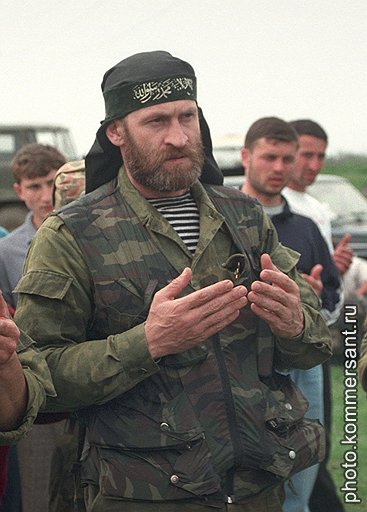
And now for the second part of the question. The fact is that according to our legislation, I think that it is the same in Italy, the same laws, members of the Government, if a war starts, they become liable for military service, regardless of their positions. Culture, or art, it doesn’t matter, everyone becomes liable for military service. I, in principle, before I was appointed commander of the seventh front, I joined the people’s militia. I remember that day, December 28, when my office of the Ministry of Culture, in the Mayor’s Office building, was bombed, and on the same day I… There were people on the square who signed up as volunteers for the people’s militia. I signed up for this people’s militia, and only on January 11, Dzhokhar recalled me from my position as Minister of Culture, because a meeting of the Government was scheduled. And I returned from my positions to the Government meeting on January 11. And on this day Dzhokhar entrusted me with another task, I also wrote about this in my memoirs, and later, already in March, when the city was abandoned and we retreated to the foothills, at that time Dzhokhar signed the Decree on the creation of the Seventh Front and appointed me Commander. That is, we began to form this front, in general, from scratch.
3. After the fall of Grozny in Russian hands, and the withdrawal of the Chechen forces on the mountain defense line, the government was reorganized in order to make up for the defections of some senior officials, but also to function more streamlined in a context of total war. This “war government” continued to function throughout the duration of the conflict, and overcame the death of Dudayev, placing itself at the disposal of the Interim President, Yandarbiev. How did this government operate, and how did it manage to meet, to keep in touch with the President?
The Military Government, what you call the Military Government, was the State Defense Committee, which was formed by Presidential Decree when the military aggression began. And this body was the Supreme State Organ. Parliament stopped its legislative activity. The government had already been transferred to a military footing, and the State Defense Committee was formed as the Supreme Body of State Power. It included members of the Government, members of Parliament, the Leading Military Command represented by the General Staff, and Commanders of Fronts and Directions. And this Government functioned all this period. How were the meetings? Naturally, we all knew where the Supreme Commander-in-Chief was located, in which part of the republic. And periodically he convened a meeting of the State Defense Committee, and we discussed issues related to the continuation of resistance, with defense. Questions of a military nature were discussed in connection with the preparation of military operations or attacks on enemy territory.
All these points were discussed at the meeting of the State Defense Committee, and it functioned very effectively. It was a small number of people, but they were people who were directly involved in all processes – political, military, economic issues. These questions were also not the last ones, because providing the units with the necessary provisions, this was also within the competence, the questions of the State Defense Committee. And all these issues were discussed and functioned very effectively due precisely to the fact that Dzhokhar Dudayev did not go into deep underground, into forests, into the mountains, where it would be impossible to get him, he held personal meetings with all units, not only with the State Defense Committee but also with military units. He went to the front line, to the front line, met with ordinary soldiers. And now all our defense and all our resistance fighters, they all took a very responsible attitude to which side Dzhokhar Dudayev was on. I mean, along the front line, where active hostilities are taking place, the soldiers knew that behind them, behind their shoulders, there was already the Headquarters of the Supreme Commander. Or they disputed, along the Argun River, when he crossed over to the other side, those parts of the resistance, the Armed Forces took it for pride, proudly announced that the Supreme Commander was now on our side of the front. There was a very friendly atmosphere. When I remember these times, this period, despite all the difficulties that we then experienced, there was a war, but the people were different. We were different. The Chechens were completely different. They were different from today’s Chechens, who live in the territory and who are outside. And all this was connected, I think, with the fact that we were under Soviet occupation for seventy years, and for the first time we had a chance to build our own state. Independent state. And now the leader of this movement and the state, and later the leader of the Defense and the leader of the national liberation movement, he inspired in many ways and not only the fighters, but the entire Chechen people to resist and repel aggression. These were simply amazing times in the history of the Chechen people, when the whole people actually accomplished a feat. It was thanks to the feat of the Chechen people that we managed then to preserve both the power structures and what we were doing. And basically win.

4. Between March and May 1995, according to what you refer in your memoirs, you were in charge of setting up, in record time and with almost non-existent resources, the so-called “Seventh Front” south of Urus – Martan, which would serve as a point of contact between the stronghold of Bamut and the rest of the Chechen deployment. In your book you tell how the Seventh Front was born. Could you explain how it developed, which units made it up, and which operations it carried out until June 1995?
This happened in March, Dzhokhar Dudayev signed a decree. By this time, all our units had moved to the foothills, when the flat part was already mainly under the control of the Russian aggressors, and the foothills remained, starting from Bamut and to Alkhazurov, in this direction, and there further up, to the Grozny region, Chishki, Dacha Borzoi. This side was not yet occupied by the Russians, and it was necessary to create a unified defense in this direction, from Bamut to Alkhazurov. And the consciousness of the Seventh Front, and the task of the Seventh Front, was precisely this. And it practically turned out basically, this is the so-called Urus – Martanovsky district, it was believed that this area was loyal to Russia, the Russian aggressors, because the occupation regime functioned there, the occupation power structures, headed by Yusup Elmurzaev, the then prefect, who was appointed occupation mode. The creation of this front and the main task was the creation of military bases in the three gorges. These are Martan Chu, Tangi Chu, Roshni Chu. It was in these three gorges that we formed three military bases in just a few months. Although at the time when the decree was signed, there were practically no military units there. There were only militias, people who were part of the people’s militia, but there was no centralized command, and we in a short time, from those units, from those people’s militias that were then in this region, we created this Seventh Front, and a centralized military unit, under the centralized command of the Supreme Commander-in-Chief Dzhokhar Dudayev. Subsequently, this Seventh Front was already transformed into Sectors – the South-Western Front and Three Sectors – the First, Second, Third Sector. These sectors were under my responsibility.
Later I was in charge of the Third Sector of the Southwestern Front. Speaking by surname, these are, in principle, our young middle-level commanders, Dokka Makhaev, Dokka Umarov, Khamzat Labazanov, Isa Munaev, all these guys … Akhyad (I will not name him by his last name, because he is alive and is on the territory), Khusein Isabaev, these guys, then the middle link of commanders who headed these Sectors, and this Direction. Although it was already such a single military unit, which was part of the Armed Forces and had already been structured into the General Staff of the Armed Forces of the CRI.

5. In the spring of 1995 you could consider yourself one of the main army officers of the ChRI, therefore you were definitely monitored by the FSB, and by the intelligence of the Russian army. How did federal forces try to stop you and other senior officers from participating in the resistance? And how did you manage to evade Russian attempts to track you down?
First of all, God protected us. And, secondly, it is the Chechens and the Chechen people. We were at home. We were in our native villages, in our native settlements. And of course, the Chechen people, in fact, were the main protection of those who were then in the Armed Forces. And President Dzhokhar Dudayev, you know, the republic is small, all this time he was among the Chechens, he was in different settlements, and every village where the fighters stopped, although there were also opposition-minded and cowardly people, but in general, our supporters, supporters and independence, and those who supported our national liberation movement, they were much stronger and were much more numerous. They managed to prevent both assassination attempts and those ambushes that set not only me, but also those who were then involved and were listed in the ranks, as you said, in the highest composition of the Command, and all of them were protected by the Chechen people. And, of course, not everything was under the control of either the FSB or the Russians. Life and death are in the hands of God. And those reasons, those actions that were taken by us in order to survive, and what the Chechens did with us, the Chechen people, protecting their commanders, people who defended their homeland, their fatherland and themselves.
 Ichkeria Digital Archive