Archivi tag: United Nations

Speech by the Chairman of the Cabinet of Ministers of the Chechen Republic of Ichkeria at the United Nations meeting

Geneva, 8 July 2024

Dear ladies and gentlemen!

As Prime Minister of the Government and Chairman of the State Committee for the De-Occupation of the Chechen Republic of Ichkeria, I would like to express my sincere gratitude for the invitation and the opportunity to participate in this conference. Your work in organizing this important event deserves the highest praise. Your efforts contribute to the strengthening of international cooperation and exchange of experience, which is especially important in our times. I am confident that the results of our joint work will contribute to further progress and strengthening of international relations.

Today I want to begin my speech not with the history of the centuries-long struggle of the Chechen people for independence, but with the war in Ukraine, from which I came to this conference yesterday.

This crisis is not a local problem. It affects the entire international community because it threatens the foundations of a world order based on respect for sovereignty, territorial integrity and human rights. Russia, using military force, has invaded a sovereign State, violating principles that we all have an obligation to defend.

Russia’s military action in Ukraine has resulted in countless human suffering. Thousands of civilians have been killed, millions have been forced to flee their homes, towns and villages have been destroyed. This is a humanitarian catastrophe that requires an immediate and decisive response from the international community.
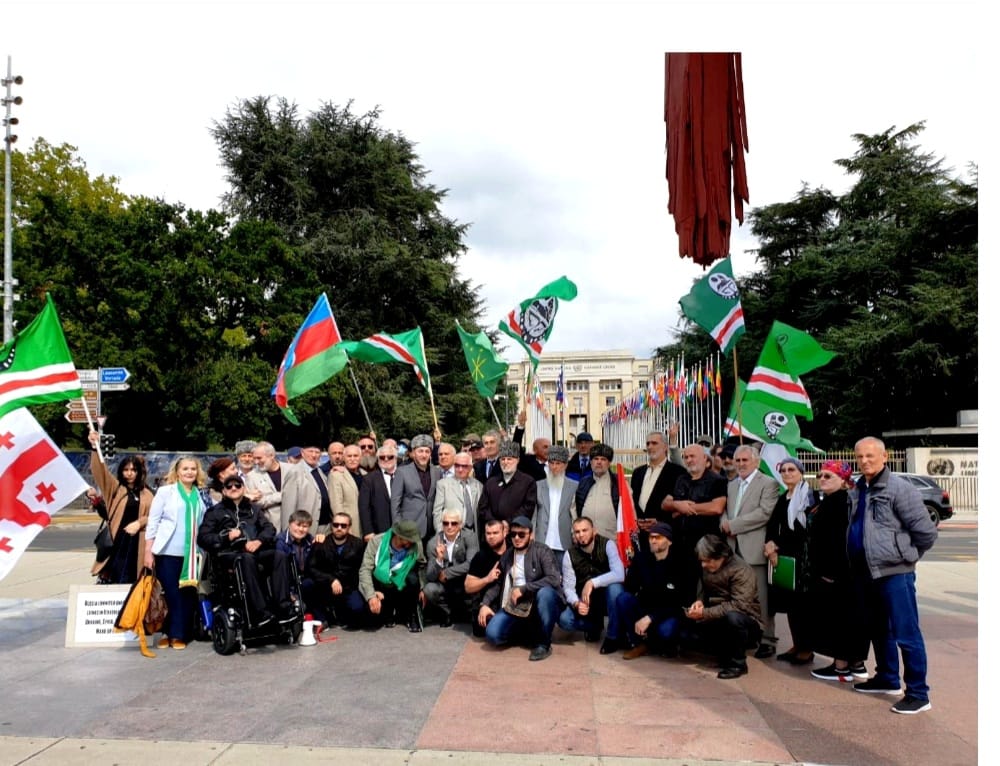
The Chechen delegation at United Nations in Geneva

For us Chechens, this situation is particularly painful. We know what it means to suffer aggression, violence and occupation. We know the price of freedom and independence, and we cannot stand aside when another people is experiencing similar tragedies. Our hearts and thoughts are with the people of Ukraine, who are showing incredible courage and resilience in this struggle.

Units of the Chechen Republic of Ichkeria are today fighting as part of the international legion of the Armed Forces of Ukraine. Although our homeland is under temporary occupation, we are fighting in Ukraine because it is there that the fate of all humanity is being decided. We realize that today’s world is divided, just as it was during the Second World War. The world after this war will no longer be the same as it was after the Second World War. We are on the threshold of great changes, and we must be ready for them.

Democratic reforms in Russia went downhill not yesterday and not today. We all witnessed how Russia began its departure from democratic reforms after it attacked the Chechen Republic of Ichkeria. Some 300,000 people died in that brutal war, 42,000 of whom were children. The Western world, following its morality and logic, believed that this was a forced measure in the process of developing democracy in Russia. However, this was a delusion. The world did not realize that this was the essence of the Russian empire, which was alien to democratic reforms. It only needed time and Western resources for rebirth and revenge.

Today we can say that there is, in fact, a third world war going on. This conflict affects not only Ukraine and Russia, but the whole world. In many countries there is an economic recession, instability is growing, social and political tensions are increasing. The conflict is expanding and taking on increasingly global proportions.

The world, and the United Nations in particular, must think today about the future of humankind. We need to rethink and strengthen international institutions so that they can effectively prevent such conflicts in the future. We need to create conditions in which aggression and violence will not be possible.

Our struggle, the struggle of the Chechen people, is reminiscent of the Resistance movement led by Charles de Gaulle in France during the Second World War. Back then, the true voice of France was heard through de Gaulle, who was accepted into the anti-Hitler coalition despite his lack of control over the territory. The collaborationist Vichy government collaborated with Hitler, but the true voice of France was de Gaulle’s.

Today, we, Chechens under occupation but fighting in the anti-Putin coalition, are also the true voice of the Chechen people. We hope that here, in the UN building, this voice will sound special and will be heard by all members of the United Nations.

After Russia failed to execute a blitzkrieg and take Kiev in three days, the war dragged on for two and a half years with no clear victories for Russia. As the military campaign continued, Russia faced increased Western coalition support for Ukraine. Under these circumstances, Russia has an interest in destabilizing the world to divert international attention from supporting the Ukrainian people.

One of the clearest examples of such destabilization was the recent conflict in the Middle East. It is quite obvious that the beneficiary of this destabilization is Vladimir Putin. The situation in the Middle East has contributed to the redistribution of resources and attention of the world community, which ultimately weakened the focus on the events in Ukraine.

Using and supporting extremist groups fits into the Kremlin’s long-term strategy of creating chaos and disunity on a global scale. This not only distracts the international community from the war in Ukraine, but also weakens the West by forcing it to allocate forces and resources to several conflicts simultaneously.

In pursuit of global destabilization, Russia is counting on decreased support for Ukraine and the possibility of improving its position in this protracted conflict. However, such actions lead to an even greater escalation of tensions in the world, jeopardizing the security and stability of multiple regions.
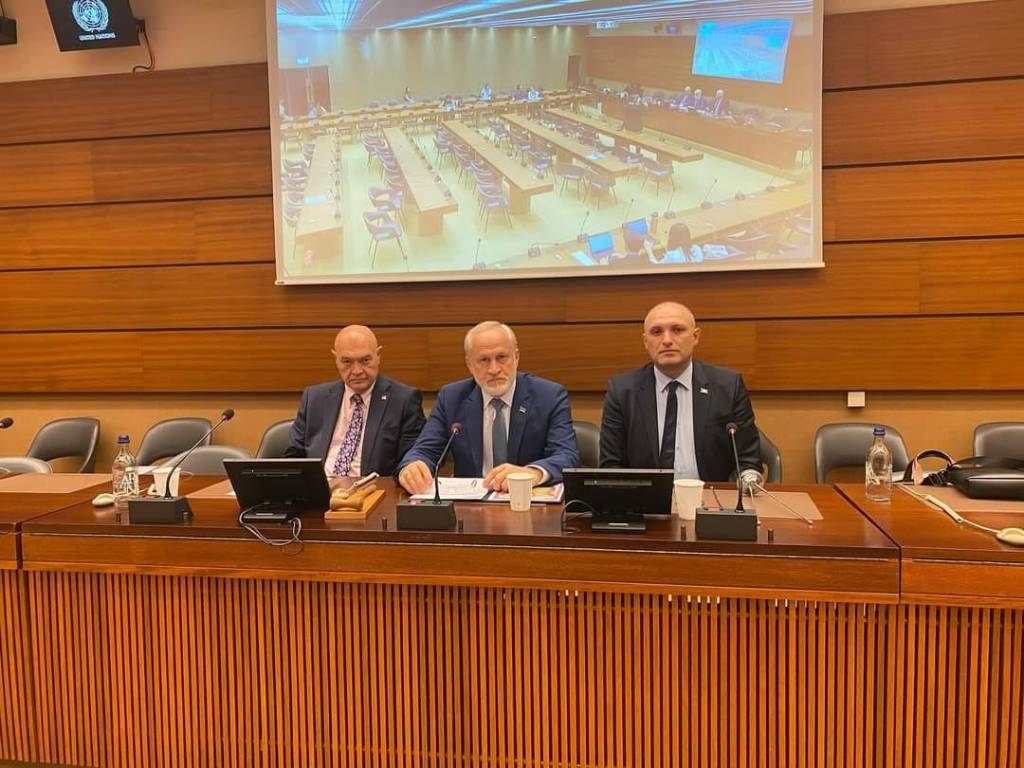
From left to right: Iyad Youghar, Akhmed Zakayev, Burak Otzas

We are following with deep concern the unfolding humanitarian catastrophe in Gaza. The violence and suffering endured by civilians require an immediate and decisive response. We are opposed to any form of violence and terror, regardless of the slogans or justifications behind it. Its victims are civilians, including the elderly, women and children. Such actions not only fail to resolve the conflict, but also cause irreparable damage to human life and dignity. We call on all parties to respect international humanitarian law and to cease hostilities immediately.

The way out of this long-standing conflict in the Middle East may be the implementation of the UN resolution on the establishment of a Palestinian state. This solution will not only resolve the long-standing Israeli-Palestinian conflict, but also reduce the level of tension in the region, which in turn will reduce the opportunities for external players to use the situation to their advantage. The establishment of a Palestinian State will be an important step towards peace and stability in the Middle East.

The government of the Chechen Republic of Ichkeria has reasonable suspicions that Vladimir Putin used Ramzan Kadyrov to finance terrorist organizations. These suspicions are supported by the fact that Kadyrov has concentrated significant financial resources in the Middle East, including billions of dollars that could be used to support extremist groups.

Ramzan Kadyrov and his religious extremist sect Akhmat are accused of committing crimes against humanity in the Chechen Republic of Ichkeria and in Ukraine. Their actions include gross human rights violations, murder and torture of civilians, and financing of terrorist groups.

We welcome the International Criminal Court’s (ICC) announcement of the international wanted list for high-ranking Russian figures such as Vladimir Putin, Sergei Shoigu, and Valery Gerasimov. The decision reflects the serious allegations made against these individuals in the context of international crimes. Such a decision inevitably provokes strong political reactions both in Russia and in the international arena, emphasizing the importance of international justice and the principle that even high-ranking leaders are not immune from prosecution for serious crimes. It should be remembered that a wanted notice is the initial stage of the judicial process. In any case, this event emphasizes the importance of the rule of law in the international arena and the desire of the world community for accountability for serious crimes.

In this regard, we hope that the political leadership of Ukraine will soon decide to establish an international tribunal against Ramzan Kadyrov and his terrorist religious sect Akhmat. We call for the appointment of a special representative with whom we will work to coordinate efforts to bring these criminals to justice. The establishment of an international tribunal is an important step towards restoring justice and ensuring peace and security in the region. We stand ready to provide all necessary information and to cooperate with international organizations to achieve that goal.

The international community must unite and take decisive action to stop this aggression. We must strengthen sanctions, provide the necessary support to Ukraine and send a clear message: aggression will never go unanswered. We must do everything possible to restore peace and justice.

History teaches us that evil triumphs when good people fail to act. We cannot afford the luxury of inaction. We must act now to protect our common home, planet Earth, from the destructive forces of aggression and violence.

As I stand here in the United Nations building, I feel a deep sense of gratitude to the Verkhovna Rada of Ukraine. This respected institution has taken a historic step that will go down in the history of the Chechen people by recognizing the territory of the Chechen Republic of Ichkeria as temporarily occupied by Russia.

This act of recognition is an important and courageous step towards justice and freedom for the Chechen people. It symbolizes international solidarity and support in the struggle for human rights and self-determination.

I urge all UN members to support this initiative of the Verkhovna Rada of Ukraine and also recognize the occupation of the Chechen Republic of Ichkeria. Your recognition and support will send an important signal of the international community’s unwavering commitment to the principles of justice, freedom and respect for the sovereignty of peoples.

Recognition of the temporary occupation of the Chechen Republic of Ichkeria would not only underline the importance of international law, but would also be an act of solidarity with the Chechen people, who have been fighting for their freedom and independence for many years.

In conclusion, I would like to express my deep gratitude to all those countries and peoples who support Ukraine in these difficult times. Your solidarity and support is a source of hope and strength for all of us. Let us work together to create a better future where peace, justice and respect for every human being prevail.

Thank you for your attention.

Akhmed Zakayev, Chairman of the Government of the Chechen Republic of Ichkeria
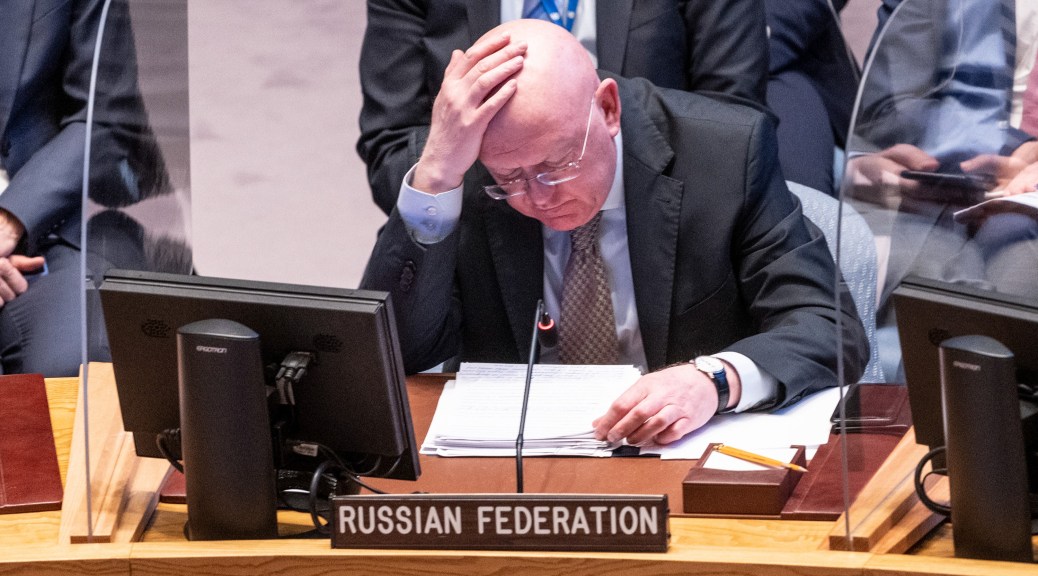
“Russia has never been a member of the UN” – Dr. Ikhvan Gerikhanov on Russia’s legitimacy in the Security Council

On Saturday 1 April, Russia assumed the presidency of the United Nations Security Council. As an aggressor country in the war in Ukraine, there are many questions about the role that Russia can have in supervising a body created to maintain international peace and security.

Francesco Benedetti interviewed the former President of the Constitutional Court of the Chechen Republic of Ichkeria, Ikhvan Gerikhanov, doctor of law and specialist in international law.

This interview begins many years before the invasion of Ukraine. And precisely in 1945, when the Charter of the United Nations was officially adopted…

We begin with a preamble, that is, with the history of the birth of this organization, designated as the United Nations Organization. Firstly, the UN was established after the end of the Second World War, to replace the League of Nations, and with the same aim of preventing future conflicts. In this sense, the UN is practically its legal successor. It is interesting to note that the initiative came mainly from the representatives of the military coalition which had fought against fascism. In the euphoria of victory, its organization was not discussed by anyone, since the primacy in the victorious war belonged to the USSR, the USA, Great Britain and France. The statute of the organization was drawn up between April and October 1944, before the capitulation of the fascist regime, and only China, the Soviet Union and the United States participated. I believe that the dictation of conditions was mainly elaborated by these last two states. From this point of view, it is easy to recognize impositions such as the right of veto, applicable by the so-called “permanent members of the Security Council”. In this very important body, the three signatories of the statute were determined as permanent members together with Great Britain and France. Finally, the Charter of the United Nations was proposed to another fifty states, who signed it on June 26 of the same year.

The system was very similar to the one with which the League of Nations had been established. In 1919, immediately after the end of the First World War, it was established to prevent new local and global conflicts. The initiators of this organization were the winners of that war. The UN, like the League of Nations before it, was formed to safeguard world peace.

The League of Nations

Article 23, Chapter V of the United Nations Charter reads: The Security Council should be composed of fifteen members of the United Nations. The Republic of China , the French Republic , the Union of Soviet Socialist Republics , the United Kingdom of Great Britain and Northern Ireland and the United States of America will be permanent members of the Security Council”. Where is the Russian Federation in this document?

The Charter of the United Nations, as I indicated above, was created and adopted in 1944, the USSR existed then, and it was the superpower that defeated fascism. Under Article 4 of the UN Charter there is a procedure for accepting new members. No one has ever changed it, or deleted it. According to this procedure, the admission of new members “is carried out by the General Assembly on the recommendation of the Security Council”. This procedure has been followed to date for 192 states, but not for the Russian Federation, as a subject of international law.

Therefore, proceeding from the UN Charter procedure, the Russian Federation cannot be a member of the United Nations, much less the Security Council as a permanent member. There is only one answer to your question : the Russian Federation is not included in the Charter of the United Nations, because its admission to the UN has not been discussed as required by the Charter, and its admission has never been accepted.

The day before the resignation of President MS Gorbachev, the USSR Ambassador Yu Vorontsov sent a letter to the UN Secretary General Javier Perez de Cuellar from the President of the RSFSR BN Yeltsin, which states: on joining the Union Soviet Socialist republics in the UN, including the Security Council and all other bodies and organizations of the UN system, continue from the Russian Federation (RSFSR) with the support of the countries of the Commonwealth of Independent States. In this regard, I ask you to use the name “Russian Federation” in the United Nations instead of the name “Union of Soviet Socialist Republics”. The Russian Federation bears full responsibility for all rights and obligations of the USSR under the Charter of the United Nations, including financial obligations. Do you think this is “legal succession”?

I have already referred to the requirement of art. 4 of the UN Charter, adopted with the participation of the USSR, and this legal provision is no exception to any of the world powers. Succession is the transfer of rights and duties from the predecessor to the successor in an identical manner, with only the change of name. In our case, the “succession” arose through a violent change of state power and its membership was not discussed, as required by the UN Charter itself when accepting a new member into its composition. Russia is not the USSR, neither in status, nor in territory, nor in the content of its Constitution. And if we add to this the fact that the Russian Federation arose through the violent overthrow of the legitimate power of the USSR, it would be wrong to say that it is a subject of international law.

The letter you indicated, in accordance with the requirements of the UN Charter, should have been examined by the UN General Assembly and, based on the results of the vote, possibly accepted. Which was not done. Which means that the Russian Federation was an illegitimate member of the United Nations, if the rules of the organization are followed to the letter and in spirit.

Also the letter you mention was sent by a person. Even if this person was the President of the Federation, his intervention could not have resolved the matter by itself, without going through the relevant procedure. Going further, the letter refers to the RSFSR (Russian Soviet Federative Socialist Republic) and not to the Russian Federation.

Churchill, Roosevelt and Stalin in Yalta (1945)

However, Yeltsin’s letter, sent by the then UN Secretary to the tables of the other members of the Security Council, was tacitly approved by all. Why, in your opinion?

I don’t know the real reason, but in my opinion everyone was satisfied with the collapse of a world power like the USSR and were glad that the main and most influential rival in world politics no longer exists on the world map. The UN members themselves should have put the matter to the UN General Assembly, especially to the members of the Security Council, noting that a new state had arisen and that the procedure for admitting a new member had to be followed at the UN. Not only was this issue not raised, but on the contrary, they granted the right to participate in UN meetings to a person not designated in their Charter, and even accepted from him the right of veto on questions of peace and war!

Moreover, against the background of the war in Ukraine which has lasted for more than a year, not a single state has deigned to raise the question of the legality of the stay of the Russian Federation in the UN and its permanent membership in the Security Council ! And this is based on the requirements of Article 2, Clause 4 of the Charter of the United Nations, where it is firmly stated that “all members of the United Nations shall refrain in their international relations from the threat or use of force against the territorial integrity or the political independence of any state, or any or in any other way inconsistent with the purposes of the United Nations”.

As an academic lawyer and specialist in international law, I do not understand the position of 192 states of the world regarding the fact that a separate state can participate in the establishment of world order by unleashing wars and exclusively in its own interests. Here reside other interests: political, economic and territorial, which go against the fundamental principles and norms of international law. The UN has fulfilled its task and it is necessary to move to a new world order and with the creation of a different international structure, as was done with the transition from the League of Nations, which lasted 26 years, to the creation of the UN, which has been pursuing the fulfillment of its tasks for more than 78 years.

IV If the Russian Federation had been born “by exclusion”, ie as a consequence of the abandonment of the USSR by all the states that made it up except the RSFSR, would the succession of Russia to the Security Council have been legitimate?

Above, I partially mentioned the lack of legal basis for a succession of Russia! the USSR could not authorize Russia to succeed even from the League of Nations to the newly created UN structure, as the USSR was not a member of the League of Nations when the UN Charter was approved. Similarly, the forced seizure of power does not give rise to succession, rather it excludes this right on the basis of the modalities and means of this transfer of rights and obligations from the entitled party to the successor. On this occasion, many Russian diplomats and jurists deliberately keep silent about the fact that the USSR was expelled from the League of Nations on December 14, 1939 at the 20th session of the Assembly of the League of Nations in Geneva, due to the invasion of the sovereign state of Finland . By the way, even then the USSR was a permanent member of the Council of the League of Nations.

And now the answer to the question:

First, illegally considering itself the legal successor of the League of Nations, the USSR, as the winner of fascism, dictated the conditions for the creation of the UN Charter and practically imposed itself and the members of the anti-fascist coalition as permanent members of the Security Council. It is like in legal practice, when a legal structure is created, there must be a constituent assembly, whose organizers remain on a permanent basis. But this does not mean that by moving to a new legal structure such as the (UN) Association, they can violate the adopted Charter with impunity and sanctions cannot be applied to them. Secondly, we must not forget that the Russian Federation arose on the world map from the violent overthrow of state power of the USSR and has long violated the international obligations of the USSR and defiantly ignores the requirements of the UN Charter and the international obligations assumed by its predecessor, the USSR.

Logo of the Security Council of the UN

Professor Rein Mullerson , Professor and Chair of International Law at King’s College London, stated that the succession was legitimate, identifying three reasons : “Firstly, after the dissolution, Russia is [ sic ] still remains one of the most largest in the world geographically and demographically.Secondly, Soviet Russia after 1917 and especially the Soviet Union after 1922 was treated as a continuation of the same state that existed under the Russian Empire.These are objective factors to show that Russia is the continuation of the Soviet Union.The third reason that constitutes the subjective factor is the behavior of the state and the recognition of continuity by third states.” What do you think of this statement?

It is difficult for me to evaluate such a statement, although I am a professor . He confuses practice and opportunity with legal provisions, without which no legal structure, regardless of its status, can exist. No one disputes that Russia is a huge country and has incalculable wealth in its assets and human resources reach more than 150 million. However , from a legal point of view, the USSR cannot be considered a continuation of the Russian empire, as the tsarist autocracy was swept away by those who built the “new world” and destroyed the empire to its foundations. Thirdly, I do not see confirmation of the professor’s words that third states recognized the succession of Russia from the Soviet Union. If there is a claim , then there must be legal documents or justification for that claim. Any statement, if it is not empty talk, must be based on facts and documents relating to that succession. In addition to objective and subjective factors, there must be specific actions that comply with the legal provisions of the subject itself!

Journalist Mohamed Sid-Ahmed, on the other hand, noted that “one of the five powers enjoying veto prerogatives in the Security Council underwent a fundamental identity change. When the Soviet Union became Russia, its status changed from that of a superpower at the head of the communist camp to that of a society which aspires to join the capitalist world. Russia’s permanent membership of the Security Council is no longer taken for granted. The global ideological struggle that has dominated the international scene for so long is no more and the new realities need to be translated into a different set of global institutions.” What do you think of his words?

I agree with the journalist’s opinion that the organization itself, like the UN, should go out of business, as it does not monitor many violations of the Charter and world order. To be objective, the reaction to the outbreak of war in Afghanistan, Iraq, Syria and other states should have been the condemnation and exclusion of the United States from the UN as a guilty party. Thus, impunity gives rise to new conflicts, and the fundamental principle of the existence of world order is ignored as a solution of controversial issues exclusively by peaceful means. The UN silently observed the actions of the aggressor during the two Russian-Chechen wars and did not even condemn the military and financial assistance of the United States and other states for the total destruction of the Chechen people on the basis of nationality and ‘ethnicity. And today the UN cannot influence the continuation of Russia’s imperial policy and the violation of the territorial integrity of Ukraine. On the contrary, the UN gives the right to an officially recognized sponsor of terrorism to chair the Security Council! The UN must be reorganized and, taking into account the reality, transferred to a more serious and influential institution, which leverages the behavior of its members.

In the light of all this, does the existence of the veto right in the UN Security Council always make sense to you? Russia , for example, says a veto is necessary for “balanced and sustainable decisions”. However, Russia has used its veto on issues relating to conflicts in which it is directly involved, as have other permanent members. This directly violates Articles 27 and 52 of the United Nations Charter and paralyzes the United Nations system as a whole by undermining its purpose as set out in Article 1, and equally the purpose of the Security Council as set out in Articles 24 and 25. For example, at the outset of the 2022 Russian invasion of Ukraine draft resolution S/2022/155 condemning the invasion and rearticulating Ukrainian sovereignty was vetoed by the Russian Federation on 25 February 2022, while Russia was none other than the chairman of the Security Council, undermining the council’s capabilities regarding the situation.

The right of veto arose in ancient Rome, in the field of the legislative process, when the tribunes of the people could overrule the decision of the Senate. There is another procedure for imposing a veto – this is the refusal of the monarch or the president to sign a law adopted by the legislator. The procedure for vetoing decisions taken by the UN, in my opinion, is meaningless and should not be included in the system of legal methods and procedures of this collective organization. The UN as an international organization was created to establish world order and exclude any conflicts, both regional and international. According to the art. 2 of the Charter of the United Nations, the organization is founded “on the principle of the sovereign equality of all its members”. So what kind of equality can we talk about when only one country can impose a veto at its discretion, without disputes and discussions with other members of the organization. Where is the sovereign equality, when five members of the UN Security Council exist on a permanent basis, that is, they are not replaceable, and the other ten are temporary! Many articles of the UN Charter clearly contradict each other and sometimes are mutually exclusive. Therefore, it has long been necessary to replace this establishment with another international institution!

Logo of the League of Nations

After the 2022 Russian invasion of Ukraine , Ukrainian Ambassador to the UN Sergiy Kyslytsya and some members of the US Congress have called for the suspension or expulsion of Russia from the United Nations and its organs and the removal of its veto power, which violated Article 6 of the Charter. In your opinion, Russia should be expelled from the UN?

Russia is not legally a member of the United Nations, but actually participates in its work. Therefore, in practice, Russia should have pointed to the door from the United Nations building even during the first Russo-Chechen War, when my people’s right to self-determination was ignored, making use of the weapons of destruction of mass prohibited by international law. It had to be expelled due to the creation of filter camps on the territory of a sovereign republic, in which torture and humiliation of human dignity were carried out, when destruction of the environment and social sphere of Chechnya , monuments history and culture of his people. How it is that the founders of the UN Charter, represented by the USSR and the USA, did not provide for liability for violation of the Charter and the obligations undertaken, one can only guess – they were the first to begin to ignore and violate statutory obligations and law international!

In the Charter of the League of Nations, in article 16, it is provided that “if a member of the League resorts to war, contrary to the obligations …”, he is considered to have committed an act of war against all members of the League of Nations . I do not understand, as a lawyer, and as a person who has lived a long life, who is still preventing the adoption of a resolution on Russia’s actions against Ukraine today, why such an issue was not put to the vote before the General Assembly of United Nations, even under the current expulsion procedure from the UN and all its structures!

Therefore, I repeat once again that the UN as a structure designed to restore world order has exhausted itself and it is necessary to create a new structure with real levers of influence on the negative behavior of its members.