
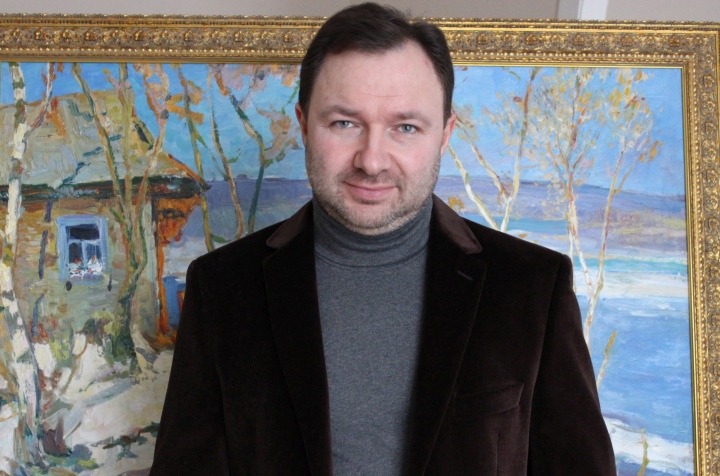
Inal Sharip is the Minister of Foreign Affairs of Ichkeria. Born in 1971, he is a chess champion, a film director and producer, and between the first and second Chechen wars he was Deputy Minister of Culture and head of the Film Department.
Being born in 1971, You had the opportunity to observe the evolution of the situation in Chechnya from the independence until the outbreak of the war in 1994. What was the climate in the country in those years? And what impression did you have of Dudaev’s government?
I lived in Grozny until I graduated from university in 1993. Then I went to Moscow to take my first steps in the cinema. I remember Grozny as an ordinary post-Soviet city no different from other cities in the former USSR or Eastern Europe. As in other cities of the post-Soviet space there was an economic difficult situation. But Dzhokhar Dudayev began to stimulate medium and small businesses and abolished taxes and duties on imported goods. Direct flights were also established from Grozny to cities in the United Arab Emirates and other cities in eastern countries from where the goods were transported. Thanks to this Grozny became in a short time the trade center of the North Caucasus.
When the war started, I was in Moscow, taking my first steps in documentary filmmaking. Many things fade from memory, but what I remember well is the anxiety of realizing that terrible events were coming. Many of my feelings were portrayed in one of my first movies, “My Grozny City”. The piercing pain of what was done to my hometown, which remained only in my memory.

How did you spend the two years of war? And what did you do after?
At the first opportunity I came to Grozny. I established a secret connection with Akhmed Zakayev. (I met Akhmed Zakayev when I was writing music for the theater, in 1992. We were introduced by our mutual friend, Hussein Guzuev, a theater director. Before the war, Dzhokhar Dudayev appointed him director of television and he was one of the first to be killed at the beginning of the First Chechen War. Akhmed was then a theater artist and became at first chairman of the Chechen Union of Theater Workers. A few months before the war started, Dzhokhar Dudayev appointed Zakayev Minister of Culture. When the war started, Akhmed led the people’s militia.) And he coordinated his activities while in Moscow and Grozny. After the first war, Akhmed returned to work as Minister of Culture and invited me to be Deputy Minister.
Akhmed appointed me head of the Department of Cinematography of the Chechen Republic with the rank of Deputy Minister of Culture. I worked there for about a year. Maskhadov then created a commission on education, science and culture (a prototype of the UNESCO commission) to work on accession and cooperation with UNESCO, and to search for and return cultural property from museums that the Russians had illegally exported to Russia in violation of all international conventions. I was appointed head of this commission. Before leaving Chechnya, I was in charge of this commission.
I was the only member of the commission. It was I who initiated the creation of this commission, because we had to enter international organizations, and UNESCO was an organization we could enter, although without the right to vote in this organization at the first stage. In addition, the Russians have taken many museum exhibits out of Chechnya. Including paintings, a collection of 17th-18th century edged weapons, etc. It was necessary to track them down and return them. The international UNESCO conventions that regulate this kind of situation were an ideal tool, given that Russia had ratified all UNESCO conventions. Maskhadov wrote a decree creating this commission and appointing me to head it. Other than that, I received nothing, no funding, no office, nothing. Few among the military at that time understood the significance of this organization. At that time, everything was focused on the military aspect. That’s why I couldn’t hire people. I could work without a salary, other people could not.
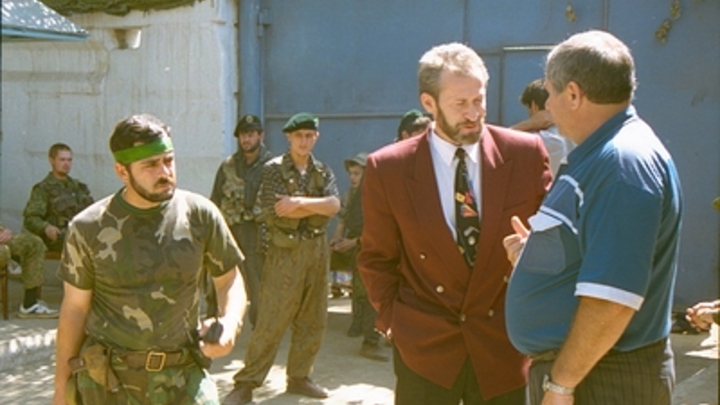
Speaking of the period between 1996 and 1999, what was your impression of the situation? In your opinion, was the Maskhadov government doing a good job? What was the general opinion of the people, in your opinion?
This is one of the most difficult periods in the history of modern Chechnya. Of course, Maskhadov’s government was not ideal, but we must understand the situation it found itself in. Russia was secretly preparing for a second war. It was actively recruiting agents from among the supporters of independence. It was deliberately corrupting Chechen officials. Russian special services were in direct contact with independent commanders of military units, persuading them to commit criminal acts. Russian agents in the Middle East, who specialize in working in the Islamic world, were redirected to Chechnya to split Chechen society along religious lines. In the conditions of post-war devastation and economic crisis, Russia managed to split Chechen society. Of course, at that time few people understood what was really happening. I also did not understand and did not like many things, so in 1998 I left Chechnya and returned to film production.
Now that we have collected information, we see how many FSB agents have infiltrated Chechen society, and we can draw conclusions. Suffice it to say that the Chief Mufti of Chechnya Kadyrov was an FSB agent, but no one talked about it at the time, and the leaders of Chechnya trusted him. In addition, it should be noted that few in Maskhadov’s government understood how world politics actually worked, both in the West and in the East, since there was no international experience. There was no information, no Internet. There was great trust in the Muslim world, based on the myth of the Muslim Brotherhood, but there was no understanding that the governments and intelligence services of most Muslim countries were using religion for their own political and geopolitical interests. Perhaps historians will analyze this period of Chechen history more deeply in the future, but today we can say for sure that Maskhadov was under great pressure from all sides, primarily with the goal of splitting Chechen society.

In 1999, Russia invaded Chechnya for the second time. Shortly before, Vladimir Putin had appeared on the political scene. Do you remember how public opinion experienced his rise to power?
At that time, Russians were tired of crime, corruption and disorder. It seems that discrimination against democracy was deliberate and directed by someone. Of course, what happened in Russia in the nineties has nothing to do with democracy, but it was presented to the people as democratic processes. That is why the people began to miss a strong authoritarian leader, like Stalin, Andropov and others who were leaders of the USSR. A situation was created when the people wanted to get their master back, who would determine their fate for them. In exchange, the new master had to restore order and feed the people. That is why the explosions of apartment buildings, Putin’s harsh rhetoric, all this is part of the scenario of creating a new authoritarian leader of Russia. It should be noted, I say this as a director, that Putin was not the best candidate for this role. He does not have natural charisma. But the circumstances developed in such a way that he was chosen as a collective decision of several influential groups in the Kremlin.
Putin, at the beginning of his career, was a compromise figure for different Kremlin clans. Every Russian billionaire or oligarch has a KGB-FSB general as his head of security. The KGB-FSB nominated three presidential candidates: Primakov, Stepashin, Putin. All of them were from the KGB and all of them were presidential candidates. The least known person, who did not have his own team and was considered harmless for different clans, was Putin, and he was elected. In 25 years, he created his clan, dealt with other clans and now he is the undisputed master in the Kremlin. The problem is that over these 25 years, Russian propaganda has been cultivating Great Russian chauvinism in the people. Chauvinism is constantly present in the Russian people, so cultivating Great Russian chauvinism in the people was not difficult. Putin has created for himself a Putin electorate, which was created for the greatness of Russia, the successor of the tsarist empire, the Soviet empire. Therefore, having removed one tsar, the people will in any case want another tsar and demand revenge for the defeat in Ukraine. Quite recently, Putin said in an interview that the collapse of the USSR is a great geopolitical tragedy. He said this because this is the mood of the people and he expressed the opinion of the Russian people. Therefore, the matter is much more complicated than in one person.
Yes, for a period of time for several years the war may stop, but then preparations for a military revenge in Ukraine will begin. Russians will never forgive the defeat in Ukraine. Just as they could not forgive the defeat from Chechnya in 1996. When they signed a peace treaty with Chechnya, at the same moment they began to prepare for the Second Chechen War. The same will happen in Ukraine. Russia must lose and transform into another democratic state. For example, the leader of the Russian opposition Navalny, who was killed in prison, did not recognize Crimea as Ukrainian. Because in the future he planned to participate in the presidential election campaign, and he must be guided by the opinion of the people. And 90 percent of the population of Russia considers Crimea to be Russia.
So, if I understand correctly, power in Russia is organized as an alliance of clans, and the President is the one who “moderates” the relations between clans. And in this system the FSB is a “clanized” apparatus or is it in competition with these clans?
This was the case before the war in Ukraine. Each major clan had its own people in the FSB leadership. But there was also an FSB clan that included both former and current FSB officers. All this was done with Putin’s approval. Putin was interested in creating a situation where different clans opposed him, and he was at the center of this structure and was an arbiter. In this way, he ensures his own security, and the clans were interested in Putin. But the war in Ukraine changed the balance of power in Russia. Prigozhin’s march on Moscow had a particular impact on these changes. Today, the FSB controls almost everything in Russia. With Shoigu’s departure from the Ministry of Defense, the FSB began a purge of generals and thus the FSB took control of the army. The only person the FSB cannot defeat yet is Kadyrov. Putin supports Kadyrov so that at least someone inside Russia would oppose the FSB. But I assume that the FSB will achieve its goal, and sooner or later the FSB will defeat Kadyrov.

Why, in your opinion, does it (the FSB) not control Kadyrov?
Because Putin is interested in this. Putin knows what the KGB and the FSB are, and he knows that they can play their game at any moment. Putin and his clan have stolen hundreds of billions of dollars. Some “patriotic” generals may not like this, and they may try to stage a coup. Therefore, he is trying to minimize the risks. To do this, he must separate the different clans and do everything so that they do not unite. There are Chechen generals in the FSB who have always served Russia and whom the FSB would like to put in charge of Chechnya. But the FSB is not succeeding, because Putin has placed his bet on Kadyrov, whom he allows to commit any crimes, which helps strengthen him. The FSB was counting on the fact that Ramzan Kadyrov and his father are temporary workers, whom they are temporarily using to transfer the Chechen people’s struggle for independence from Russia into a civil war between Chechens. Kadyrov is not a career FSB employee, he is pursuing his own independent policy in the republic, which the FSB does not like.
In this regard, clashes between the FSB and Kadyrov’s men are constantly taking place in Russia, in which Putin has to act as an arbitrator. But so far there has not been a single situation where Putin has infringed on Kadyrov’s interests. The FSB expects that Putin will have to hand over Kadyrov sooner or later. But there is no doubt that Putin will have to choose between the FSB and Kadyrov. The FSB is getting stronger because of the war in Ukraine and is a state-forming institution, so I have no doubt that they will defeat Kadyrov in the future.
 Ichkeria Digital Archive