

Taymaz Taysumovich Abubakarov was born on April 16, 1948 in Kazakhstan, where his family had been deported alongside the entire Chechen nation under Stalin’s 1944 mass deportations. After the rehabilitation of the Chechen people, his family returned to Chechnya, where he grew up in Grozny.
He initially worked as a mechanic at Grozny’s TETs-2 thermal power plant before pursuing higher education in economics at Moscow State University (MGU). He completed his studies with distinction and later earned the academic degree of Candidate of Economic Sciences. Upon returning to Grozny, Abubakarov embarked on an academic career at the Chechen-Ingush State University, rising to the post of First Vice-Rector. His research specialized in the economic and demographic dynamics of the North Caucasus, earning him respect as a regional development expert.
Entry into Politics and Early Career
During the period of perestroika, Abubakarov became involved in the Chechen national movement. As early as 1985, he was an active member of the organizations “Dosh” and “Nokhchicho”, which advocated Chechen sovereignty. He briefly served in the economic administration under Doku Zavgaev during the final phase of the Soviet administration in the Chechen-Ingush Autonomous Republic.
After General Dzhokhar Dudaev led the Chechen Republic to declare independence in 1991, Abubakarov was appointed Minister of Economy and Finance on October 27, 1991. His appointment was part of Dudaev’s strategy to balance revolutionary legitimacy with the need for capable technocratic leadership.
Economic Policies and Challenges
As minister, Abubakarov faced the enormous challenge of establishing an independent economic system in a collapsing post-Soviet environment. He proposed a mixed economy model: allowing private ownership while maintaining state control over key strategic sectors. This approach aimed to stabilize Ichkeria’s fragile economy and shield it from Russia’s impending blockade.
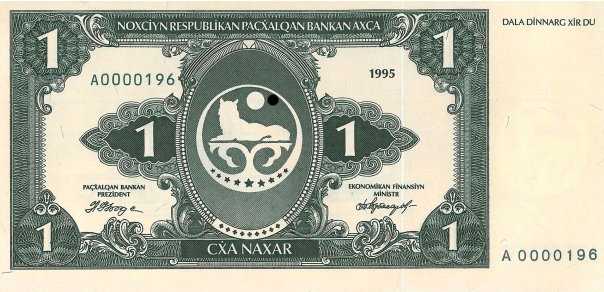
However, tensions soon emerged between Abubakarov and Dudaev, particularly over economic control. Dudaev maintained tight personal oversight over sectors such as oil exports. Abubakarov also opposed Dudaev’s attempts to launch a national currency (The “Nahar”), which were instead handled by Central Bank Governor Usman Imaev. In his memoirs (The Dudaev Regime: Truth and Lies, available HERE), Abubakarov describes the severe economic crisis gripping the republic in 1992-1993, including hyperinflation, speculative black-market pricing, and the collapse of state revenues. Attempts by Dudaev to subsidize basic food items proved unsustainable, aggravating the fiscal strain.
Involvement in Pre-War Diplomacy (1994)
In December 1994, with tensions escalating towards open war, Dudaev appointed Abubakarov to lead Ichkeria’s delegation in negotiations with Russian representatives in Vladikavkaz. Despite his position as Finance Minister rather than Foreign Minister, Abubakarov was chosen based on Dudaev’s personal trust and pragmatism. The Chechen delegation offered major concessions, including dismantling irregular armed formations, provided Russia agreed to withdraw its military forces first. Meanwhile, Moscow supported both negotiations and an escalating military buildup, leading Abubakarov to accuse Russia of duplicity.
The talks were further complicated by the presence of a second, pro-Moscow Chechen delegation representing the so-called “Provisional Council.” Figures like Bektimar Baskhanov and Bislan Gantamirov appeared at the negotiations, highlighting Moscow’s attempt to foster an alternative Chechen leadership.
On December 14, 1994, as head of the Chechen Working Commission, Abubakarov signed an official statement reaffirming Chechnya’s position: disarmament would proceed only after full Russian troop withdrawal. Nevertheless, the negotiations collapsed, and Russia launched its full-scale invasion on December 11, 1994. Shortly thereafter, Abubakarov was replaced in the negotiation team by Prosecutor General Usman Imaev.

(formerly “Sovmin”)
Corruption Allegations and Dismissal
As the war unfolded, accusations of corruption began to surround Abubakarov:
- Prominent Chechen politician Musa Temishev accused him of massive misappropriation of state resources, calling him “one of Ichkeria’s most notorious looters.”
- Russian journalist Yuri Shchekochikhin reported on a 1993 contract in which Abubakarov authorized the purchase of five metric tons of pure gold from Yakutia for 2.78 billion rubles, raising serious suspicions regarding the transaction’s legitimacy.
- Abubakarov increasingly centralized control over export licenses, oil contracts, credit allocation, and financial institutions.
In 1995, President Dudaev dismissed Abubakarov on charges of financial misconduct. Following his removal, Abubakarov relocated to Moscow, where he lived in quiet exile, completely withdrawing from public life.
Memoirs and Historical Testimony
In 1998, Abubakarov published his memoirs, The Dudaev Regime: Truth and Lies, offering valuable firsthand insights into Ichkeria’s early governance, internal conflicts, and economic policies. The book serves both as a crucial historical source and as his personal defense against corruption allegations.
Later Life and Current Status
Following his exile, Abubakarov disappeared from the public scene. According to public real estate records, since 1998 he has owned an apartment in Moscow. As of 2024, no official records of his death exist. He is presumed alive at age 77. He has not participated in political, media, or social activities since the late 1990s.
Extensive searches in Russian archives, media, and historical forums confirm that no verified photographs of Abubakarov are publicly available. His image remains absent from media databases, official archives, and the Ichkeria.net Name Index.
Final Remarks
Taymaz Abubakarov’s personal journey exemplifies the turbulent fate of many Ichkerian leaders. From academia to state-building under extreme conditions, from internal power struggles to exile, his career reflects the complex realities of Ichkeria’s struggle for independence. Decades later, his role remains significant for historians analyzing the republic’s internal political dynamics and its economic challenges in the face of overwhelming adversity.
 Ichkeria Digital Archive