

Mustafa Bekov (artistic name: Mac Bekov) is an Ingush theater and film director, founder of the National Theatre of Ingushetia, Caucasian politician at the end of the 20th century, plenipotentiary representative of Ingushetia in the UNPO (unrepresetitive nationals and people organization) in The Hague from 1993.
As the son of parents who were deported to Kazakhstan in 1944, he was born in exile and had to live with the awareness of being considered an enemy since childhood. “Even before I could read and write, I was aware of the conflict surrounding my identity. Without really knowing why, I was clearly told that I was considered a criminal”. At the age of eleven, Mac received his first lessons in theater and life from the famous director Arsenij Ridal, initially a student and later assistant of Max Reinhard. Ridal introduced him to the methods of Stanislavski, Meyerhold, Vakhtangov and Michael Chekhov and helped him to develop a passion for art. Mac lived for several years in what was then Leningrad, “where Pushkin lived and Dostoyevsky swam”, and studied acting and directing at the Academy for Film, Theater and Music, as well as theater studies, psychology, philosophy and theater business. His professors were Irina Meyerhold (daughter of the famous W. Meyerhold) and Mar Vladimirovich Sulimov.

After many successful years as an in-house director, senior director and artistic director of theaters throughout the former Soviet Union, the National Theater in Grozny offered him the opportunity to bring his ideas to the stage. In this way, he brought his observations on human existence and political realities to a wide audience in artistic form. When the USSR collapsed in 1991, his artistic work was marginalized and Mac moved to Germany. In more than 40 years as a director and lecturer, he has created more than 50 plays and trained numerous actors and directors. His repertoire includes Shakespeare and Chekhov, Schiller and Gorky, Brecht and Lorca, Tennesse Williams and Mrozek, as well as many
other authors. Mac has directed plays, tragedies, comedies, musicals and rock operas in many major theaters.
Ingush and Chechens lived together for a long time, they were deported together and consider themselves “brother peoples”. Why do you think they decided to separate in 1991? Do you think it was the right decision more than 30 years later?
This is not entirely true. Chechens and Ingush have always lived side by side, not together. In 1934, the regions of Chechnya and Ingushetia were united, and in 1936 the Soviet Socialist Republic was given the name “Chechen-Ingush Autonomy”. Prior to this, in 1928, the city of Vladikavkaz and later the areas adjacent to the city, the cradle of the Ingush people, were taken away from the Ingush. Previously Vladikavkaz was a fortress on Ingush soil during the Russo-Caucasian War. On November 1, 1991, President Dzhokhar Dudayev issued his first decree, the Decree on the Statehood of the Chechen Republic. On September 4, 1991, at a session of the Chechen parliament chaired and attended by President Dzhokhar Dudayev, elected at the Chechen People’s Congress, and party leader Selimkhan Yandarbiyev, I asked the Chechens not to declare their independence. I warned that the Russian political elite was not ready to give freedom to the colonized peoples and that this would already cause a great tragedy. I also said that the Russians consider us to be one people, although we are two fraternal peoples. The Chechens’ declaration of sovereignty would not help Ingush to restore statehood and achieve the return of the land by parliamentary means. The euphoria of the seemingly tangible long-awaited freedom drowned out my words. Then the decision was
made.

After 33 years, I still believe that the Chechens’ decision was wrong. I still think it was right that the Ingush did not go the way of the Chechens.
The Chechens declared their independence 33 years ago. This hasty and ill-considered decision cost them dearly. Did they achieve independence? No. Instead of independence, there were destroyed cities, three hundred thousand dead, forty-two thousand of them children. Destroyed farms and factories, a large number of refugees. Chechen refugees scattered all over the world. Those who stayed ended up under the oppression of Putin’s servant Kadyrov. But that’s not all: new generations have grown up, plagued by Putin’s ideology. Dudaev said that 70% would die, but 30% would be free. Where is the freedom? Thirtythree years have passed and the goal has become even more distant. The Ingush have regained their statehood, albeit only a pseudo-statehood. On June 4, 1992, the Republic of Ingushetia was founded as part of the Russian Federation. If the Ingush had joined the Chechens in 1991, they would no longer exist today. At that time, the population was less than 200,000 people.
In his own words, Dudayev was a bad general and a bad politician: “A good general does not go into a battle that he knows he will lose, and the Soviet general Dudayev knew exactly what the military capabilities of the Russians were. A good politician protects his people from rash decisions. All colonized peoples of the Caucasus should embark on the path of decolonization together. Going it alone is doomed to failure.
In your opinion, the independence of the peoples of the Caucasus from Russia can only be achieved if they all rise up at the same time. Don’t you think this possibility is utopian and don’t you believe that the Russian government is setting the people against each other to prevent this?
Each empire pursues the same policy with the peoples of the territories and resources it has conquered. It assimilates the peoples and plays them off against each other. This is confirmed by the famous saying “Devide er impera”. The Russian empire is no exception. But unlike other empires, the Russians claim that they did not come to conquer, but to
liberate. And they suggest to the peoples that they have joined Russia voluntarily. Following the collapse of the Russian Empire after the February and October Revolutions, a mountain republic was founded in the North Caucasus from 1917 onwards, which existed until 1918/19. It had already taken place, so it was not a utopian idea. With the war against Ukraine, the Russian Empire is well on the way to dissolving itself. It is important that the Caucasian peoples overcome the obstacles created by the empire and reach an agreement.
In my opinion, even the Prime Minister of the Chechen government-in-exile, Zakaev, has understood this and is now talking about the confederation of the Caucasian peoples. With Gamsakhurdia, we issued the motto “The Caucasus is our common home” back in 1986. The path to the liberation of the Caucasus could therefore be that of a general uprising under one banner.
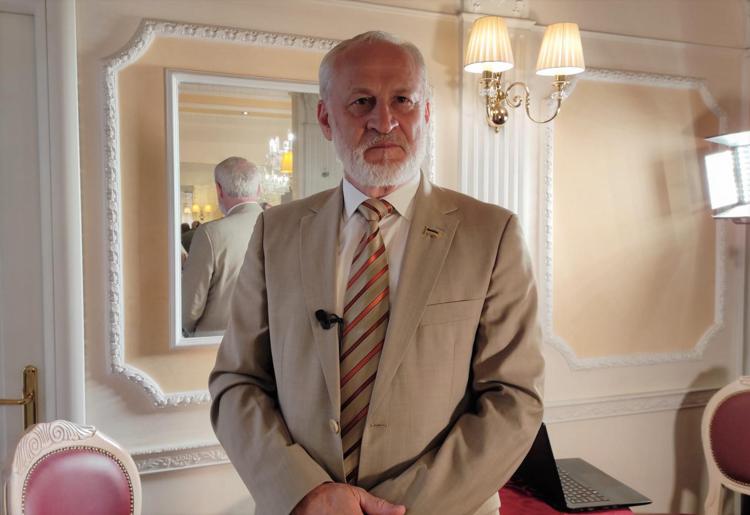
The restoration of a single republic in the North Caucasus was already theorized in the early 1990s. Dudayev himself was working on the establishment of a “Caucasian house”, if my sources are correct. Why do you think this project was not realized?
As I have already mentioned, the slogan “Caucasus – our common home” entered the political lexicon even before Dudayev, in 1986. The initiator was the dissident Gamsakhurdia. But the idea and the feeling for the need for unity among the colonized peoples of the Caucasus came from Visangirei Dzhabagiev. Deputy of the Tsarist State Duma, politician of the early 20th century. Considering the fact that the Caucasus was home to various peoples with common but also differentiated characteristics, Dzhabagiev recognized the need for a community and therefore emphasized: “Caucasianism is our nationality”.
Why did it not come about? The mass consciousness of the peoples of the Caucasus, clouded by communist ideology, was not yet ready for unity. In addition, Chechen politicians loudly emphasized the leading role of the Chechen people. This had a negative effect on the other peoples. Nobody wanted another Chechen “big brother” in place of the Russian one have a “big brother”. The empire also actively resisted this idea. And then came the war.
Recently, Akhmed Zakayev, together with other representatives of Caucasian communities, launched the project to establish a republic in the North Caucasus. What do you think of this project?
In principle, I support the initiative to create a pan-Caucasian state. As I said before, this is the only way to get rid of the Russian Empire and at the same time ensure that our peoples preserve their identity. I know Ahmed personally from my time in the theater. Ahmed was a gifted actor. He went through a difficult school of losses and, in my opinion, became a serious politician. The fact that he sent his son to defend Ukraine instills great respect and shows the seriousness of his convictions.
I believe that this project deserves support and has a future. I don’t know the details of the project, but I think Ahmed knows that the free peoples of the Caucasus do not tolerate inequality. Therefore, it is important what form of statehood is envisaged in this project. Whether a nation is large or small, everyone should feel free and have equal rights. The peoples of the Caucasus will not accept the establishment of a caliphate, an imamate and other forms of despotism.
At the end of the 1980s, the idea of founding a Chechen-Ingush federation was born in the intellectual part of Grozny’s population. Unfortunately, it was quickly buried again. As already mentioned, the idea of integrating the Ingush ethnic group into the Chechen ethnic group gained the upper hand, and so Zelimkhan Yanderbiev, a passionate Ingushophobe, became chairman of the VDR (Vainakh Democratic Party) and headed for independence. The Ingush realized that this was a deadly path for the Ingush (in those years there were no more than 200,000 Ingush), and I think that the Ingush did not agree to a war with the Russian Empire out of a self-preservation instinct. Time has shown that the Ingush acted wisely.
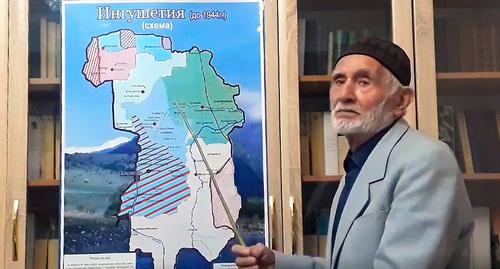
One of the most interesting personalities on the Ingush side is Isa Kodzoev. He was a dissident of Soviet power before the collapse of the USSR. The population was initially very positive towards him, but then favored a “moderate” current, which then negotiated the establishment of a federal republic with Moscow. Do you remember Kodzoev? Are there any other personalities (apart from Aushev, who we will talk about later) who you think deserve attention?
Of course I remember Isa Kodzoev and I knew him very, very well. He was not a “dissident” in the classical sense of the word. He was sentenced to four years in prison for his text “Diary of Kazakhstan”, in which he revealed the truth about the lives of the deported people. He returned from exile and settled in the village of Kantyshevo under KGB surveillance, where he taught in a local school. He was the chairman of the organization we had founded in 1986/87, the socio-political movement “Niisho”. I was one of its founders. Its aim was to restore Ingush statehood, to return the Ingush ancestral lands, to create conditions for the development of the national language, culture and art.
What did you think of the Ossetians? Did you regard them as members of the Caucasian community or as foreign bodies?
Before the 1917 revolution, relations between Ossetians and Ingush were not exactly fraternal, but they were not openly hostile either. There were many inter-ethnic marriages. And entire clans with mixed surnames were formed. After the revolution, relations became hostile. No Caucasian people considers the Ossetians to be members of the Caucasian community; the Ossetian elites themselves have tried to do so. The Ossetians are not natives of the Caucasus, but foreign tribes of modern Iran.

But don’t you think that the Ossetians should somehow be included in the hypothesis of a general uprising in the Caucasus? Or are they not included in the “Caucasian House” project?
If we rely on historical experience, there is little hope that the Ossetians will join the other Caucasian peoples. Rather, they will side with whoever has a stronger position. They helped the 9th and 11th Bolshevik armies to bloodily drown Georgia, which declared its independence, in 1921. I don’t think we can rely on the Ossetians. Most likely, the Ossetians will wait and see and then join the victors. In 1921 and 2008 in Georgia and in 1992 in Ingushetia, they made a very negative impression. The wounds that the Ossetians inflicted on the Georgians and Ingush in those years have not yet healed. That is a problem. But I think it can be solved.
We come to the war between Ossetians and Ingush. The reason for this war, if I have understood correctly, was the Prigorodny district. But what led to the outbreak of tensions between the two peoples? Who fanned the flames of war and why?
The USSR, heir to the Russian Empire, made sure that the peoples of the occupied territories were included in the conflicts. In our case, it expelled the Ingush from and ceded the land to the Ossetians, along with the city that was the capital of both autonomies. Under the conditions of land scarcity, this was reason enough for hostilities between Ossetians and Ingush. After the deportation of the Ingush, the remaining territories were ceded to the Ossetians, part of the mountainous regions to the Georgians and part to the Dagestani. After the repatriation, both the Dagestani and the Georgians voluntarily returned their lands to the Ingush, along with their houses and even equipment; the Georgians also left some of their pets behind. The Ossetians, on the other hand, prevented the Ingush from returning to their former homes. Even when the owner of the house returned and wanted to buy his own house, he was forbidden to do so by the leadership of the republic.
For many years, the Ingush returned to their homeland by hook or by crook. At the beginning of the 1990s, 70,000 Ingush lived in these areas. The Ossetian authorities organized various provocations and suppressed the Ingush at all possible levels. They were accused of all sins. They contributed in every possible way to increasing hatred and intolerance between the peoples. The Ingush living in the city of Vladikavkaz and the Prigorodny district were discriminated against by the Ossetian authorities in all areas of life. This escalation of hatred between Ossetians and Ingush was systematic and was carried out by the leadership of North Ossetia with the approval of Moscow. All appeals to the Kremlin remained unanswered or were not in the interests of the Ingush people. In January 1973, a peaceful demonstration of thousands of Ingush took place in Grozny. The Ingush expressed their distrust of the local authorities and demanded to be heard by Moscow. I was a young man of 21 at the time, took part in this demonstration and witnessed how and what happened there. I mention this because the participants in the demonstration were later persecuted for alleged anti-Soviet activities. The Chechen residents of Grozny supported the demonstrating Ingush en masse. The doors of Chechen apartments and houses were open for the demonstrators to warm up, for prayers and there was hot food for everyone. Temperatures in January are above -25 °C.
I personally experienced the intolerance and prejudice of the Ossetian authorities towards the Ingush people. In 1980, after I had received my diploma, I was sent to the Russian State Theater in Vladikavkaz. I was not allowed to direct a single play. The North Ossetian party headquarters obstructed me and forced me to leave Vladikavkaz. They couldn’t allow
an Ingush to work as a director in the theater. From their point of view, the Ingush were an inferior race.
As is known, the Ingush people achieved the restoration of their statehood through parliamentary work, and on June 4, 1992, the Republic of Ingushetia was established as part of the Russian Federation. As a result of the parliamentary work of our deputies, with the support of the population The Law of the Russian Federation “On the Rehabilitation of Victims of Political Repressions” of October 18, 1991 N 1761-1 was also adopted. The Ossetian authorities were aware that the path to territorial rehabilitation was not far off. Moreover, Article 11 of
the Constitution of the Republic of Ingushetia (The return of territories illegally expropriated from Ingushetia by political means and the preservation of the territorial integrity of the Republic of Ingushetia is the most important task of the state) left no doubt that the Ingushetian people would fight for the return of the annexed territories.
 Ichkeria Digital Archive