
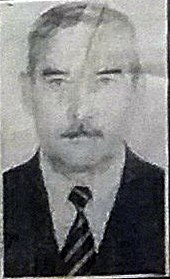
(Golos Chechenskoy Respubliki newspaper, No. 3 (20995), January 24–31, 1997)
Today we present to our readers a conversation with the hero of many articles published in our newspaper in the 1960s and 1970s, civil engineer Magomed Mamatiev, a candidate for deputy to the Parliament of the Chechen Republic in Electoral District No. 3 “Olympic” of the Leninsky District of Grozny.
Correspondent: Magomed, tell us briefly about yourself.
Magomed Mamatiev: I am 55 years old, I come from the village of Valerik, I have a higher education—a degree in construction from the Oil Institute—and I worked my way up from bricklayer to head of the construction department. I am currently vice president of the Federation of Trade Unions of the Chechen Republic. I have been awarded the Order of the Red Banner of Labor and two medals.
Correspondent: You belong to the generation that lived through the tragedy of 1944; did you perhaps think that all our problems were behind us?
Magomed Mamatiev: Our family ended up in the coldest region of Kazakhstan, the Kustanai region. My father was arrested in 1949 along with a learned alim for singing nazmy, and later my mother as well for cutting down three trees when the barn roof collapsed. The five of us children—the oldest was 14 and the youngest a newborn—were left on our own. We were saved from hunger and cold by the kindness of people, both Chechens and Russians.
In September 1959, I enrolled at the Grozny Oil Institute. Studying was easy. For today’s youth, most of whom pretend to study, I want to say that we didn’t know what it meant to pay money for a test or an exam. And we didn’t even have any money. Sometimes we went without food for days. We unloaded carts full of potatoes, onions, and coal at night. We constantly felt the teachers’ distrust of our knowledge. They graded our knowledge one point lower than students of other nationalities. We had to prove our worth through our diligence and hard work.
Like all my peers, my childhood was stolen from me, and we were left with a hungry and difficult youth.
After graduating from high school, I had to spend three months knocking on the doors of construction companies that, according to the ads, were looking for skilled workers. They asked me to fill out application forms and then politely turned me down. After three months, I met the kindest person, my new mentor Baskhanov Umar (Dala gechdoyla tsunna), who
hired me as a foreman and started my new working life.
Correspondent: In almost every country, trade unions are called upon to protect the interests of workers. Naturally, friction arises between them and the authorities on many issues. You and your colleagues led the union leadership in 1992. How did your relations with those in power develop?
Magomed Mamatiev: Numerous measures were adopted and efforts were made to foster cooperation between enterprises and all branches of the Republic’s government. However, none of the issues raised during meetings and by union activists were resolved. Wage arrears increased; pensions, salaries, and other benefits were not paid.
Correspondent: In the spring of 1993, a demonstration organized by the unions began in Grozny. Many are inclined to believe that this demonstration—that is, you and your comrades—is responsible for the subsequent negative events of 1993. What can you say to your opponents?
Magomed Mamatiev: Before the demonstration, the unions called a three-day strike demanding the cancellation of arrears on wages, pensions, and other social benefits, and warned the government that if these issues were not resolved, they would organize a demonstration. No response. We tried to meet with the President, but it didn’t work out. After receiving authorization for the demonstration from the mayor’s office, we organized a one-day protest and concluded the union demonstration at the scheduled time. Subsequently, the demonstration was led by local and municipal officials.
As you say, some politicians blamed union leaders for the subsequent clashes with their former associates. And our president and colleague Ampukaev Ramzan, declared an enemy by these “some,” organized massive rallies and protest marches against the entry of Russian troops into the Polish cities of Warsaw and Krakow.
And no one speaks of the military action in late December 1993, when the Presidential Palace was surrounded by tanks, armored vehicles, and troops.
Correspondent: Who do you believe is responsible for the national tragedies?
Magomed Mamatiev: There are many. Briefly, here are a few. Foremost among those responsible for our tragedy are the gray-bearded “Hajji pilgrims,” whom our President called sailors. These people did everything possible and impossible to divide our society into teips, virds, and nationalities. Having imagined themselves to be leaders of the people, they eventually began to interfere in state affairs. Some of the current candidates for the presidency have supported these pilgrims.
Usman Imaev did everything to exacerbate the confrontation between the President and Parliament; the main fault of this “man” is the complete destruction of the foundations of the Chechen state: its finances. After Russia abolished the 1991–1992 banknotes effective August 25, 1993, Imaev decided to keep this currency in circulation in the Republic until November 1, and for this worthless paper, the sale of everything that had not yet been sold began. This worthless paper was purchased in neighboring regions and republics at 102% of face value and delivered to Imaev’s bank for 30% of the cost. The remaining 70% of the cost was covered by Imaev and others like him.
According to some sources, loans totaling over 800 billion rubles were disbursed in the Republic starting in November 1993. And this is precisely where Imaev’s scheme was developed. Using forged documents from guarantor companies—whose executives received 5–10% of the loan amount—the lender paid Imaev 20% in dollars, and the National Bank transferred the loan amount to one of the commercial banks. These banks, in turn, transferred this sum to any address in the former Soviet Union for 15–20% of the loan amount.
And it is no coincidence that the National Bank and other banks were the first to be destroyed during the war. According to eyewitnesses, all the streets and squares of destroyed Grozny were littered with Imaev’s scrap paper.
In the same camp are Taymaz Abubakarov, Yeraghi Mamodayev with his team, the Albakovs, and, of course, Zavgaev’s team.
Here lies a vast field of activity for the Sharia court.
Correspondent: 16 presidential candidates. Isn’t that too many for our small republic? And in general, who do you prefer? I can’t insist on an answer to the last question…
Magomed Mamatiev: Whether many or not so many. After all, there are only five main contenders. I would vote for any of them if they were the only candidate.
But I see Aslan Maskhadov as the President of the Republic. I don’t know him personally, but I know Vakha Arsanov. Due to my professional responsibilities, I had to attend parliamentary sessions and learn the positions of all the deputies on issues related to building an independent state. I got the impression that Vakha was an honest and decent person who cares deeply about our future.
I am certain that Arsanov would never have agreed to run in the elections alongside Maskhadov if he had doubted his integrity and his intentions to build an independent Chechen state.
Correspondent: What motivated you to run in the parliamentary elections?
Magomed Mamatiev: The only thing that motivated me to run in the parliamentary elections was the hope that we would build a free and socially oriented state.
If I briefly discuss the program and the concrete legislative initiatives I intend to implement in the interest of the workers of the Chechen Republic, then, obviously, they will focus on the implementation of the principles of a social state.
Correspondent: And one last question. What is your vision for state-building and the role of trade unions?
Magomed Mamatiev: I intend to work on these priority issues if the voters of District No. 3 “Olympic” show their trust in me and elect me as their deputy to the Parliament of the Chechen Republic.
I appeal to voters to come out and vote for our future—not for me, but for our President Aslan Maskhadov. Together we will win!
 Ichkeria Digital Archive