
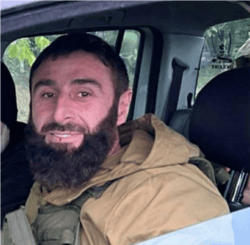
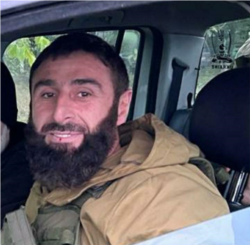
Khavazhi Amaev, known by the nom de guerre Zumso, died in Ukraine in September 2026 at the age of 46. A former commander in the Chechen insurgency, an exile pursued through international police channels, and later deputy commander of the Separate Special Purpose Battalion (OBON), he lived through several distinct chapters of the Chechen armed struggle. His death was confirmed by Akhmed Zakayev, the head of the Chechen Republic of Ichkeria’s government in exile, but the exact circumstances remain unresolved in publicly verifiable reporting.
This retrospective draws on a lengthy interview Amaev gave in October 2022, contemporary reporting from Greece in 2014, official Ichkerian documents and accounts published following his death. It distinguishes his recollections from independently documented events and does not treat allegations or disputed accounts as established facts.
Growing up during the Russo-Chechen wars
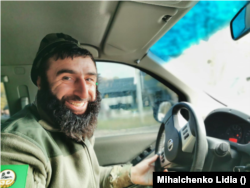
Amaev came from the mountainous Itum-Kali district of Chechnya and was widely described as a native of the village of Zumsoy, the origin of his nom de guerre. Published biographical accounts give his birth year as 1980. When the first Russo-Chechen war began in 1994, he was still a teenager. In an interview with journalist Lidia Mikhalchenko for Kavkaz.Realii in October 2022, he recalled an adolescence disrupted by war and the impossibility of completing his schooling.
In that interview he traced his commitment to Chechen independence to his family. He described years spent moving through the mountains and living in hiding, but specified that he had formally joined Ichkerian forces in 2003. This distinction matters: experiencing the first war as a teenager does not establish that he served as an armed combatant during that conflict.
A commander in the mountain insurgency
Amaev said he had joined forces operating under the command of Dokka Umarov and subsequently rose to command a sector of the guerrilla. He portrayed a campaign in which units that had once assembled dozens of fighters became increasingly fragmented, as Russian military pressure, the loss of personnel and reprisals against suspected civilian supporters made prolonged operations difficult. These are his first-person recollections; independent military records covering his complete service have not been located.
He also described serious persecution of his family, including destruction of family homes, the detention of relatives and abuse attributed to forces loyal to the Russian-backed authorities in Chechnya. Such claims are part of his testimony and deserve to be recorded, while the individual incidents would require additional evidence to be presented as independently established.
The politics of the insurgency changed during those years. Umarov proclaimed the Caucasus Emirate in 2007, an ideological and organizational break from the institutional claim of the Chechen Republic of Ichkeria. Contemporary reports concerning Amaev’s pursuit by Russian authorities also associated him with the network of commander Tarkhan Gaziyev. His precise affiliations across these divisions remain a subject for further documentary research; his later service in an Ichkerian formation should not obscure this earlier complexity.
Syria and the disputed record of his movements
According to Amaev’s own account, he left Chechnya in 2012, passing through Georgia and Turkey before travelling to Syria. He said that he fought alongside rebels opposing the government of Bashar al-Assad, which was supported by Russia. In 2022 he explicitly denied ever having belonged to the Islamic State organization.
There is a significant contradiction in the contemporary record. In an eKathimerini interview published in October 2014, his wife Zarema denied that he had travelled to Syria or Iraq and contested intelligence allegations that connected him to the Islamic State. The Greek newspaper reported that the Greek Public Order Ministry had also rejected claims of such involvement. Amaev’s later admission that he had fought in Syria does not itself validate those separate allegations. Nor does the available evidence establish membership in Islamic State. This discrepancy should remain visible rather than be resolved by conjecture.
Arrest in Greece and the struggle against extradition
Amaev was detained after arriving by boat in Greek waters on 5 September 2014. Reporting by journalist Yiannis Souliotis described his request for asylum under another name, his identification through fingerprints and a Russian request circulated through Interpol. The report quoted both his wife and his Greek lawyer, Yiannis Lavrentiadis, who challenged the adequacy of the documentation supporting the case and opposed his return to Russia.
The case attracted demonstrations by Chechen communities abroad concerned about the risk of ill-treatment if he were extradited. In his 2022 interview, Amaev stated that he had spent about two years in detention in Greece before being transferred to Poland in 2016, where he received refugee protection. He subsequently worked in private security. Kavkaz.Realii reported in September 2022 that lawyers associated with the Chechen human-rights organization Vayfond had secured the removal of his data from an Interpol wanted-person database. A representative of that organization attributed the decision to his protection status in Poland; the underlying decision has not been independently inspected by Ichkeria.net.
Ukraine and the OBON battalion
Amaev said he travelled to Ukraine in March 2022, following Russia’s full-scale invasion. He first joined the Sheikh Mansur Battalion, then moved into the newly created Separate Special Purpose Battalion (OBON), associated with the Ichkerian government in exile. By October 2022, Kavkaz.Realii identified him as OBON’s deputy commander and a lieutenant colonel in the Ichkerian armed forces.
His service connected a generation of veterans of the wars in Chechnya with new volunteers fighting on the Ukrainian side. In his published statements he regarded Ukraine’s resistance and the future of Chechen independence as related causes, while stressing the difficulties of adapting to a different country and battlefield.
On 5 August 2023, the Council of Ministers of the Chechen Republic of Ichkeria in exile awarded Amaev the K’oman Turpal (‘Hero of the Nation’) distinction under Decree No. 38. The decree is a particularly valuable primary document for establishing his recognition by the exiled authorities. A separate decree in the same series, No. 37, honoured Hadji-Murad Zumso, the OBON commander: despite the shared ‘Zumso’ name, these are two different individuals.
Death in September 2026: what is known and what remains disputed
Chechenpress published a commemorative notice on 13 September 2026. On 15 September, Kavkaz.Realii reported that Akhmed Zakayev had confirmed Amaev’s death in Ukraine. Zakayev declined to endorse the competing accounts while investigative work was ongoing. The Sheikh Mansur Battalion also acknowledged the death, and reports referred to funeral arrangements in Kyiv.
The reported circumstances differ substantially. One account, circulated by Russian media, placed the discovery of Amaev’s body in an apartment in Lviv and mentioned stab wounds. Another located the killing in the Zaporizhzhia region and attributed it to a Ukrainian deserter. Russian state-linked reporting additionally raised suggestions concerning a dispute between Ukrainian security agencies. None of these explanations has been established by public investigative evidence available for this article. In an analysis published on 7 October, Kavkaz.Realii continued to describe the circumstances as unclear and cautioned against prematurely attributing the death to Russian intelligence services.
The information available as of 24 October 2026 supports the fact of Amaev’s death, but not a definitive location, perpetrator or motive. For a historical archive, preserving that distinction is essential.
A life across three conflicts
Amaev’s biography is not a simple narrative of uninterrupted organizational allegiance. His experiences belonged to successive and sometimes competing political and military worlds: the post-war Chechen insurgency, armed opposition to Assad in Syria, asylum and legal protection in Europe, and the volunteer formations fighting with Ukraine. His own testimony conveys the continuity he perceived between these experiences; surviving documents also reveal divisions, disputes and unanswered questions.
The significance of his life for the history of Ichkeria lies partly in that complexity. Reconstructing it requires taking seriously both the experiences he described and the contradictions left by the documentary record. The final chapter of his life remains open to clarification by Ukrainian investigative findings.
Sources and documentation
- Kavkaz.Realii / Radio Free Europe–Radio Liberty — 14 October 2022
- eKathimerini / Yiannis Souliotis — 16 October 2014
- Chechenpress — ChRI Council of Ministers Decree No. 38 — 5 August 2023
- Chechenpress — Commemorative announcement — 13 September 2026
- Kavkaz.Realii — Zakayev confirms Amaev’s death — 15 September 2026
- Kavkaz.Realii — Retrospective on disputed circumstances — 7 October 2026

