
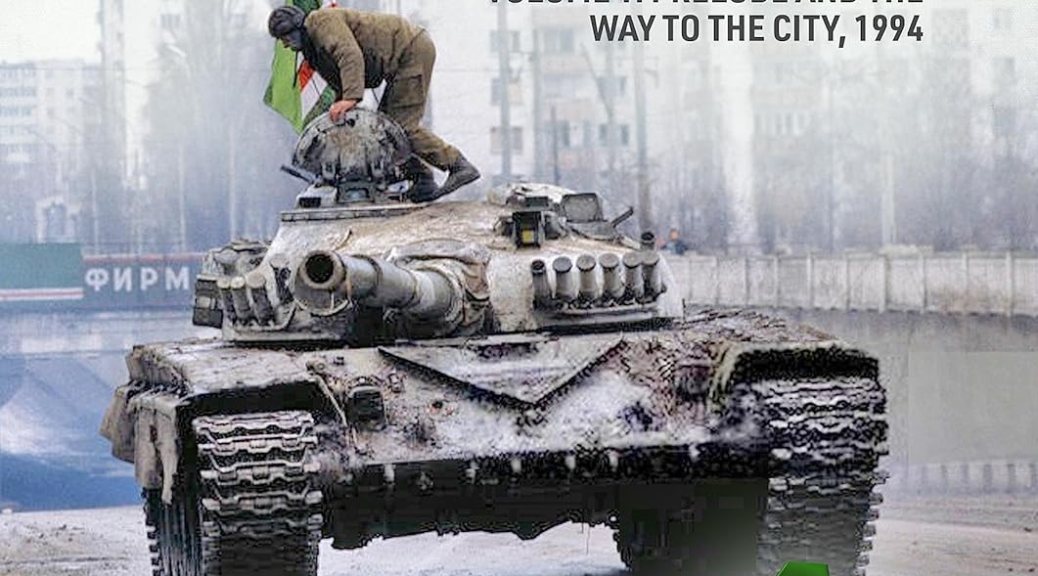
Born in the Union of Soviet Socialist Republics, Efim Sandler is a veteran of the Israeli Defence Force Armoured Corps and is currently living in the USA. An enthusiastic historian since his youth, he developed a deep interest in the armoured warfare of the Arab–Israeli Wars and conflicts in the former USSR, and has been collecting related information for decades. He is the co-author of the Lebanese Civil War series, and after posting several articles about the Chechen Wars he wrote Battle for Grozny: Prelude and the Way to the City, 1994. Next January the second volume of his work, Battle for Grozny: The First Chechen War and the Battle of 31 December 1994-january 1995 will be avaiable.
Your work on the First Russian-Chechen War, released in 2023, is the first in a series of essays whose next volume will be released in January next year
Yes, originally there was a plan for 2-3 volumes but it looks there will be at least 4 or even 5. The publishing house is not able to release the next one till spring 2025. Thus it is not really connected to when my books ready but to the availability of publisher resources.
Why did you decide to take such an in-depth interest in the First Russian – Chechen War?
It is kind of personal. I left Soviet Union in 1989 when I was 15 and by 1994 I was already in IDF. I cannot say we were following the war but the New Year assault on Grozny was pretty much discussed. We were shown the pictures of destroyed Russian tanks and killed Russian soldiers. Of cause there was not much details but the feeling was pretty bad. I felt bad for the whole situation in general, political stupidity and carelessness, poor condition of Russian army and the destruction that was coming upon Chechens. I had absolutely no doubt that Russia would grinder Chechnya despite the losses. At the top nobody ever cared about the losses. I visited Moscow in early 1995 and there were talks about the war was all about money and power. Some people blamed Yeltsin, others blamed Dudaev. There was no real censoring and you could see all the chaos of Grozny on various TV channels. I remember watching the footage of burning Russian armor and was thinking – how lucky I am for not being there! Many years later, when I started to develop my interest in military history one of my major directions were modern wars of USSR/Russia and the two big ones fell right into it: Afghanistan and Chechnya.
Did you find difficulties in the preliminary research work?
Obviously. There were several problems. At first there were not many sources and those available basically were telling the same story. It looked “fishy” as it was basically supporting the formal version that I did not believe. It took me a while to arrange a decent collection of sources including books, periodicals, videos and internet resources. Secondly there was barely any mention of particular units besides the ill-famed 131st and 81st. Majority of the sources gave very high level picture of the events. I had to approach this issue like assembling a puzzle. The phenomena of so-called ‘joint units’ added complexity as, for example, on veteran forums sometimes people were using their original units and not the ones they were assigned to.Chechen side was mostly covered by Russian version that was copied from one source to another. Especially pre-war period. I found a lot of stuff in Chechen History group on FB and later in your book. I also had to go over video footage from western news channels like AP and Reuters.I used veteran memories as well though many of them were kind of misleading. This is pretty obvious as people do not memorize everything in order but fetch some most vivid pieces. Some of the accounts I was able to cross-check, some I treated as ‘probable’. I also used a lot of my personal experience and logic to decide if the account is valid for the research.
What were your main sources?
This is a hard question as I do not have any major source for the whole period. For example to work on the Russian advance from 11 till 31 December I used the blog of Konstantin Yuk (botter) for the general structure then added information from several other sources like the books I am Kaliber 10, Win or Disappear, Life and Death of a General, Moloch of Grozny, Tanks in Grozny, Fangs of the Lone Wolf, First Chechen War, Soldier of Fortune and Bratishka magazines, and others. The videos also did some good job especially the news feeds as I was able to identify military units by the markings on the vehicles.

As a former – soldier and an expert in military history, what aspect, in your opinion, is particularly interesting in this war?
First of all I do not consider myself ‘an expert’ but an enthusiast of military history. I know a thing or two and I’ve developed my own method to make a research and tell the story in a way that is not as boring as pure academic history papers. Besides personal factors that I mentioned above, I think that the Battle for Grozny was the first and only massive urban clash of such a scale since WWII. It was asymmetric engagement where the advantage of firepower was minimized by mobility, experience and training. It is also interesting to see how Russian forces got themselves adapted to the very unfamiliar type of war and managed to take over the city. At last this war is barely explored and this makes it even more interesting – probably this is the major reason for me personally.
What experience, from the military side, do you think the First Russian-Chechen War brought?
Talking about military side we need to accept the fact that not all Russian units were devastated as common narrative tells us. There were many that fought well and got themselves adapted very quickly. I am talking not only about Lev Rokhlin and his troops. The major issue was at the top. As I tried to show it in my first book the whole management of preparations was a failure. This was the reason that I spent so much on describing the issues in details. I called it ‘a show of absurd’. Personally I was so horrified by learning the actual picture that I could not simply pass by. Thus my most important message – each operation should be carefully prepared from the top to the bottom.
Having studied this topic in depth, do you think that the Russian army has effectively learned from that experience, considering the operational fields in which it has competed in the following years, especially in Ukraine?
I don’t really know the operational details of the battles in Ukraine but we can look at the Second Chechen war (1999-2000) for example. I do believe that Russians learned something and tried to apply to certain extent. In general the Russian military remained on the low level of training and equipment while the higher command remained disconnected from the situation on the ground with some exceptions. Speaking about later conflicts like 5-Day (2008) it looked like there was some improvement in level of training but there still were issues with coordination.
One of the certainly most interesting aspects of this war is the fact that its asymmetrical nature has overwhelmingly benefited the militarily less strong faction, going so far as to force the Russian invasion army to retreat, recognizing a factual victory for the armed forces of the Chechen Republic of Ichkeria. How do you, as an expert, interpret this unexpected Chechen victory against the Russians?
Well, I believe there are two answers – simple and not very obvious. As I mentioned above Russians had upper hand in firepower but it was minimized by mobility, experience and training of Chechen units. What is not obvious is the fact that Russians were totally unprepared for fighting while the whole operation was taken as ‘show of force’ by the higher command with the exception of Group North-East commander, Lev Rokhlin. In large Chechens managed to repel Russian assault on the night of 31 Dec – 1 Jan due to neglectance and carelessness of top Russian commanders. There is no sense to compare types of firearms or other equipment. The tank is a tank and it can fire and kill. The problem is when the tank crew is unprepared and unit commander has no idea where he is and who is from the right and who is from the left – this is a problem. Squeezing dozens of armored vehicles into the small railway station area – this is a problem. Having not enough troops to perform proper sweeping and organize defensive perimeter – this is a problem. This will sound strange but I will say like this: Chechens did not win the New Year night, Russians lost it by giving them the lead. I hope I will be able to prove it in my coming book.
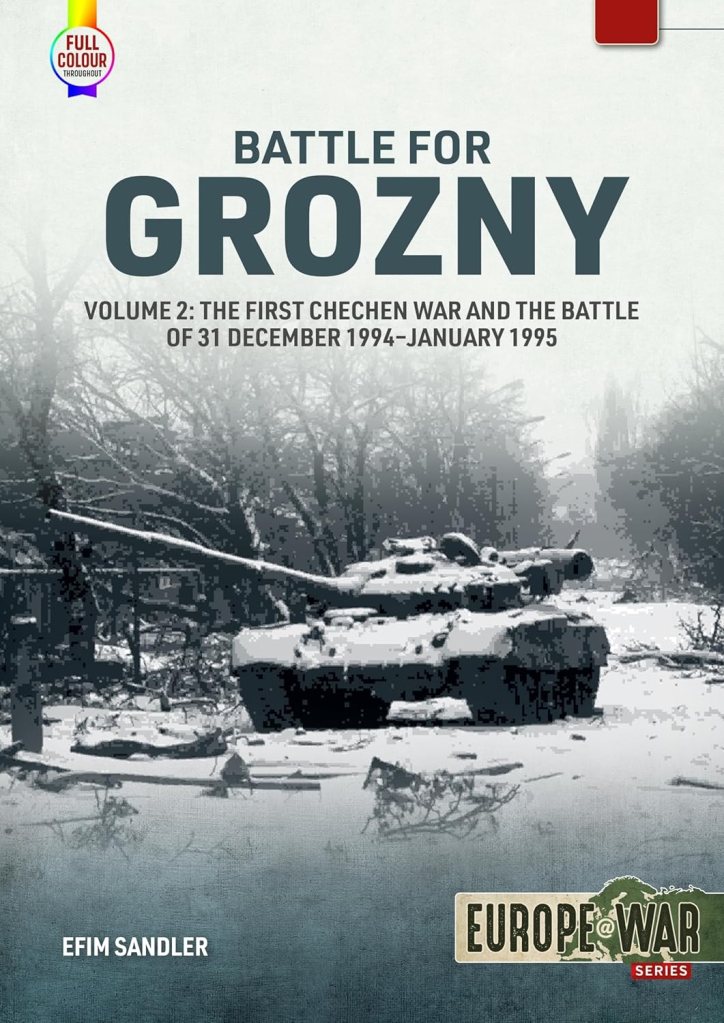
Regarding your next volume, what could you tell us to make the reader curious to read it? What could he find “unpublished”, compared to the superficial narrative that often fills the internet about this topic?
First of all let’s agree that there are only a few comprehensive publications available to western audience. All of them give a relatively decent overview of the events that led to the war (mostly from Chechen side) but poorly describe military activities. Sometimes the authors fill the gap with their own fantasies making the story look spicy. My job is to present the events in a most realistic way. Describing military actions I will go as deep as I can down to single unit level – battalion, company, platoon or even a team. I am combining various types of sources like publications, books, forum discussions, documentaries, personal memories, blogs, raw footage, news channels. Of cause majority of such sources are Russian and less of Chechen. Your books give good insight on the Chechen side.
Did you have the opportunity to interview war veterans, or eyewitnesses of these events? If yes, what impression did you get from their words?
As I mentioned above, I mostly used published accounts. I tried to interview a couple of times but it did not go well. Too many emotions. Can not blame them.
Have you had any difficulties talking to veterans? Do you remember a conversation that particularly impressed you?
Most of the veterans that I tried to contact declined after learning that I am living in USA. Several conversations I had were not very impressive and gave almost no additional details while switching to emotions. After Russia launched its intervention into Ukraine I lost all my contacts in Russia.
Two years later, do you feel that the public still retains a strong interest in this topic?
You means since the release of first book? I think the War in Ukraine invoked additional interest in everything connected to modern Russia. I cannot estimate to what extent though. Just to mention that general interest in Chechen wars was very low and this is the reason there so few serious publications about it. Need to mention that in early mid 1990s there were several major events that completely overshadowed what was going in Chechnya. Gulf War, collapse of Soviet Union, rearrangement of Eastern Europe just to name few. There were also numerous local conflicts like Balkans, Somalia, Lebanon, Tajikistan, Transnistria, Abkhazia, NKAO, etc. Thus for western observer 1st Chechen War was just one of them. Talking about Russians – they are trying to forget it due to their reasons.
Trying to bring the First Russian-Chechen War into the present day: do you think there are any similarities, or points of contact, between the invasion of Chechnya in 1994 and that Of Ukraine in 2022?
To my personal knowledge of the events in Ukraine (and I definitely can’t consider myself an expert there), the situation is pretty much different. Starting from the point that Ukraine is an independent country, and not a part of Russia trying to separate itself. Russians prepared the invasion and it looked they started to work on it well in advance. Russian military at least at first showed pretty much organization, equipment and training. Similar to Chechnya Ukrainian local population showed their dedication to resist invading troops and in my opinion that was the major factor that caused Russian advance to stall. In Chechnya Russians managed to suppress such resistance with numbers and firepower have almost no issues with supplies. In Ukraine this did not work. Western weapons also played some role in Ukraine while Chechens relied mostly on what they inherited from Russian units located in Chechnya prior to 1992. Of cause this is only a couple of examples but I tend not to compare these two wars. On the other hand the conflict in Donbass (2014-15) can be compared to Chechen War.
 Ichkeria Digital Archive