

Surho Sugaipov was born and raised in Grozny. At the age of fifteen, Surho arrived in Germany after his family had to flee from Grozny during the Second Chechen War. After graduating from high school in the city of Würselen, NRW, he worked in the family business until he enrolled in university. As a student of the Faculty of Economics at the University of Cologne, he simultaneously dedicated himself to his great passion – acting. His first major role was as one of the main characters in the French film “Le grand homme” (2014) directed by Sarah Leonor.
You can learn more about his creative work in cinema in Germany and France on his Wikipedia page:
https://de.m.wikipedia.org/wiki/Surho_Sugaipov).
A member of the Chechen Democratic Party, one of its co-founders and spokespersons, Surho lives with his wife and three children in Cologne.
We can say that you belong to a generation that we could define as the “Ichkeria Generation”, that is, those kids who were born close to independence, and who became adults during the period of independent Chechnya. What memories do you have about the first Russian invasion of Chechnya?
I was 9 years old, and of course, I remember how my life suddenly transformed from a childhood playground into a serious, loss-filled adult life, where the main goal became to survive in the conditions of a full-scale war.

How did you perceive your “being Chechen”? Speaking with many older witnesses, they told me how they had to deal with a certain “induced” sense of guilt following the deportation and the legend of the “betrayal”. You were born in a different context: did you also experience this sense of humiliation?
It started when we moved to a neighboring republic where we were registered as refugees. We, the children from the Chechen Republic, were assigned to one school. Our mother tried several times to enroll my sister and me in the city lyceum, but each time, after another inspection, we were expelled based on our nationality—I remember these moments well. By the time of the open invasion of the territory of the Chechen Republic, which had legally declared its independence based on international law, a powerful propaganda campaign had been launched throughout the Russian Federation, portraying Chechens as bandits, terrorists, and a threat to the civilized world. Chechens were blamed for all the negative consequences of the collapse of the Soviet Union as an empire. Brazen false propaganda was carried out continuously 24/7.
Organized, armed groups were sent to the republic to discredit the entire population and portray us in an extremely negative light to the world. Talking to older people who became victims of the genocide of Chechens during the deportation of Chechens to Kazakhstan in 1944, under the false accusation of betrayal and collaboration of the entire population with enemy forces, the situation was similar—people were accused of collaborating with the enemy army before a single Wehrmacht soldier had set foot on the territory of the republic. The elders spoke of how they had to fight against the imposed sense of guilt for the “betrayal” of the people.
The Russians have always used the story of betrayal. They said, “The Chechens have always betrayed us.” What nonsense – an empire that is surprised why its victims do not surrender and remain beaten, but dare to resist
How did you experience the period of the first war? How did your family deal with the situation?
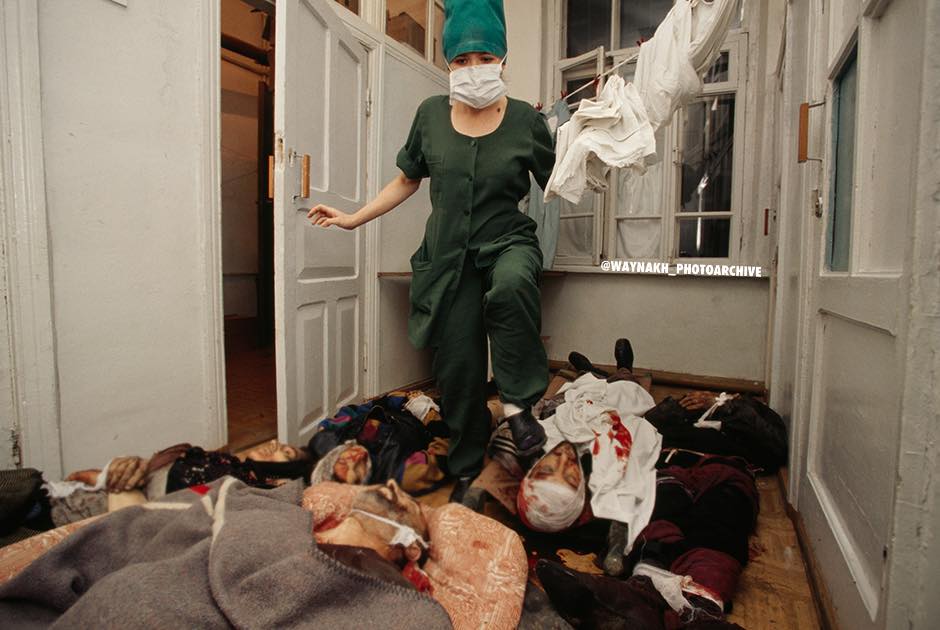
I mainly remember the first war through the emotions of a child, who, holding his mother’s hand, was fleeing from the war. After the first war ended, we returned to Grozny and rebuilt our house, at least to a livable condition, and started anew, from scratch, among mountains of ruins and destruction. But two years later, the second war began. Many in Chechnya understood that the war was not over even before the start of the second one, as military groups operated on the principle of “the worse, the better,” preparing the ground for the return of Russian troops by turning public opinion against Maskhadov’s government, carrying out public corporal punishments, and even executions, which worked against independence. The FSB’s plan to destabilize the situation in the republic worked precisely, giving the Russian army time to escalate its forces anew. As expected, Russia attacked with a much stronger army, seeking revenge for the humiliation they experienced from their defeat in the first war. People in the republic understood that while we were trying to heal our wounds and rebuild the destroyed infrastructure, Russia was quickly assembling a new army and preparing for a new attack.
Chechens, left to their fate, fragmented by internal conflicts artificially created by Russian special services, could not keep up with such a huge empire, with its ability to play political games, its capability to escalate the military race, and adequately prepare for the inevitable war, which was obvious to many at that time. While Russia received billions in its treasury from the sale of oil and gas to the West, Chechnya was in a state of absolute economic collapse, unable to get back on its feet without external assistance, which never came. The reasons for sacrificing us, leaving us to a senseless and brutal fate at the hands of the aggressor, in the form of the Russian Federation, will likely become the subject of many historical studies. Declaring the destruction of an ethnic group as an internal matter of Russia, the international community fed a monster that had already gone wild, threatening everyone with nuclear retribution if they interfered with its new plans. As a result, we had an absolutely impoverished, fragmented, weakened region subjected to religious pressure after the first war, left to be devoured by the predator.
When the war ended and the Russians retreated, how did you feel? Who was your heroes?
First of all, Dzhokhar Dudayev and all the resistance fighters were our heroes.
In your head as a young Chechen, how did you visualize Aslan Maskhadov? Was there any leader you didn’t like?
Maskhadov was also a hero. But his politics had many weak points that people did not like. Mainly, it concerned his friendliness towards the Russians. He perceived this war as a misunderstanding that arose under certain circumstances. Being an officer of the Soviet army, he did not fully realize that the imperial policy of Russia had not changed since the Caucasian War. Russia was using us at that moment; first, as a sacrificial victim to scare the international community with its military power. Second, to distract the population inside the country from the total plundering of the USSR’s wealth, seized during the collapse of the Union. Russia unilaterally separated itself from all the union republics to avoid sharing common property with them and, declaring itself the sole successor of the Union’s legacy, appropriated the common wealth. Aslan Maskhadov, instead of reaching out to the international level, establishing relations with the West and America, and securing their support, believed Russia’s promises that the war was over, that reparations would be paid, and that good neighborly relations would be established between two free states.
Another fatal mistake he made was his inability to resist radicalism, artificially introduced into the republic from the East, controlled by the Kremlin, and imposed on the Chechens through the activities of intelligence agents already operating widely in the Chechen Republic at that time.

What happened after the second Russian invasion? How did you decide to reach Germany?
My father worked in the Ministry of Justice of the Chechen Republic of Ichkeria. After the start of the Second Chechen War, he brought us back to Nalchik, where we lived during the first war. A year later, he came for us and said that this war was more brutal, and after it, everyone who worked for their republic would be sent through filtration camps, and those who were shot immediately would be the lucky ones, envied by those who would be tortured to death in the camps. The survivors would be imprisoned, and only a few crippled people would return, while the majority would never come back. Just as he said, it happened. The situation was worse than ever. Therefore, we decided to move to Europe.
How did you personally experience arriving in Germany? Was it difficult for you to integrate with the Germans? Were there other Chechen families who helped you?
To imagine what we felt when we were settled in the dormitory, you need to at least partially understand all the persecutions we went through, the fears we experienced, and the expectations of worse scenarios that had accompanied us for years. We didn’t speak German, we couldn’t work yet, but the children were immediately sent to school. Of course, we ended up in Hauptschule at first. After a couple of years, my school teacher Fred Tribbels wrote a letter to the NRW district with a request to transfer me to HHG (Gymnasium). And that’s not all, he realized that I was struggling with physics, so he arranged for the physics teacher to tutor me additionally in this subject. We were among the first Chechens to move to Europe; there were few Chechens living in Germany, and no one who could quickly explain to us how to integrate. In any case, it wasn’t that difficult, because for any question that arose, we could contact certain institutions and always received the help and support we needed. We felt protected, it was a lifesaving support for us. Adapting to the local mentality was not difficult, it coincided with ours. The hardest part was before our arrival in Germany.

After you reached Germany, how were you integrated into the social system? Were the Germans kind to you? Were you able to attend school?
We have received a lot of support and understanding. Being a young boy, a teenager I obviously maintained good and less good relationships with my peers, but German society showed itself to be open, tolerant, available to help us. I can only say good things about how I was accepted. I just had the normal problems as a teenager, like everyone else at this age.
When did you decide to start doing political activity? And what kind of political vision have you developed regarding Chechnya?
I think I was never apolitical because of my early acquaintance with war and the occupation of my land. In the war in Ukraine, I saw a historic moment to resume the discussion of the situation in the Chechen Republic of Ichkeria, to raise the topic of independence, which is once again banned from discussion in Russia.
Impunity and the killing of one-third of the republic’s population allowed the leadership of the Russian Federation to continue its imperialist expansionist policy by attacking a sovereign state recognized by the entire world – Ukraine. The international community must go back 30 years to 1994 and hold the Russian Federation criminally responsible for the genocide of the Chechen people and for all the crimes committed by Russia on the territory of the Chechen Republic to destroy the Chechen ethnicity. It must help the Chechen people de-occupy their homeland and restore statehood based on the principles of democracy and secularism, where religion should be separated from the state, where any citizen has the right to practice any religion or not practice any at all, where citizens’ rights are protected by the state, and where the people are the rightful owners of their ancestral territory.
We must return to the democratic secular state that the Chechens proclaimed to the whole world, taking advantage of the moment when the Supreme Soviet of the USSR issued Law No. 1409-I of April 3, 1990, “On the Procedure for Resolving Issues Related to the Withdrawal of a Union Republic from the USSR.” In Article 3, it is stated that autonomous republics within a union republic have the right to independently decide whether to remain in the USSR or stay with the seceding union republic. The Chechen Republic, by referendum, remained in the USSR and thus became another union republic within the USSR. Consequently, when the Russian Federation declared its withdrawal from the USSR, the Chechen Republic remained within the USSR and automatically gained independence following the dissolution of the USSR on December 26, 1991.
The Chechen Republic declared its independence in July 1991, and on November 1, 1991, Dzhokhar Dudayev signed his first decree on the state sovereignty of the independent democratic state. Thus, taking advantage of the political moment during the dissolution of the Soviet Union and based on international law, the Chechen Republic seceded from the Russian Federation, declaring its independence. The Russian Federation declared its independence from the union treaty significantly later than us. The Constitution of the Chechen Republic of Ichkeria was adopted one year earlier than the Constitution of the Russian Federation. This means that the Russian Federation attacked an independent state whose people declared their independence to the whole world, exercising their right to self-determination. None of the democratic states dared to recognize our independence, fearing the wrath of the Russian Federation. For this reason, I have become more active in recent years, but I have never been silent.
My political vision is clear. There can be nothing but a democratic, secular state, as recorded in our 1992 Constitution. This state must be de-occupied with the help of the international community.
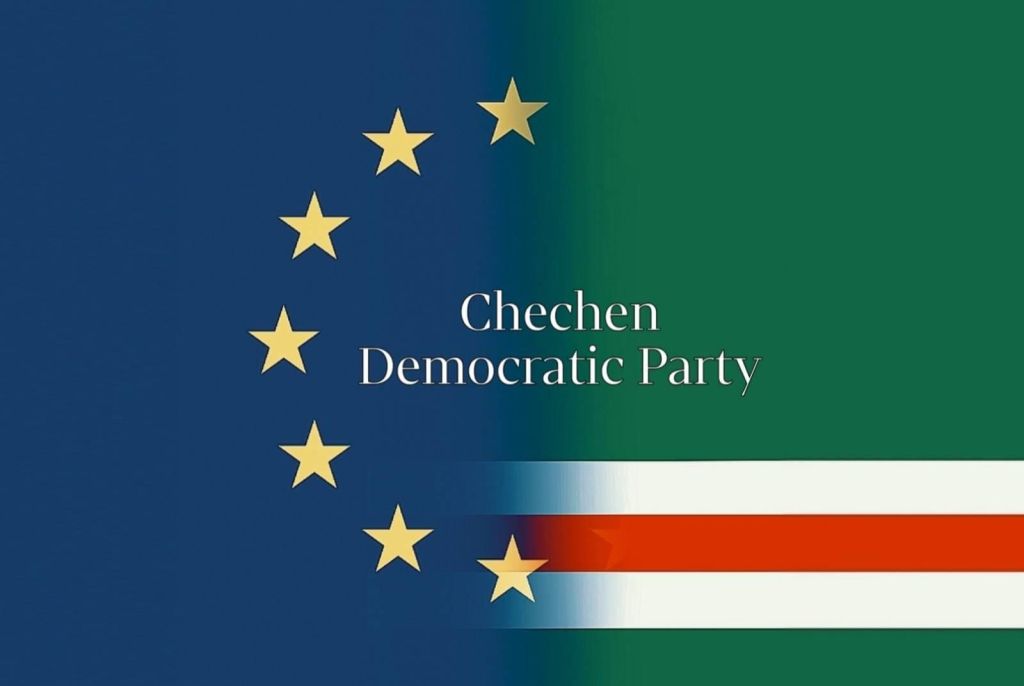
You have found a political point of reference in the Chechen Democratic Party. The first question regarding this: is there a line of political continuity between the Chechen Democratic Party and the Vaynakh Democratic Party, founded by Yandarbiev and the main proponent of Chechen independence in 1991?
We have nothing in common with the Vainakh Democratic Party, which has deviated towards radical ideologies, either by conviction or out of convenience, probably to seize power in Chechnya. Yandarbiyev changed his position to a radical idea; I don’t know if he really believed in it, but he completely transformed from a democrat to a radical. We do not agree with his point of view and have nothing in common with his party.
So, the Chechen Democratic Party supports an independent, democratic, secularized Chechnya, founded on the rule of law. What political program does the party intend to follow to achieve this objective? Starting from the current situation, what steps do you think the Party should take?
We want to de-occupy our territory, demand full restitution for the moral and material damage inflicted on our people, the extradition of all war criminals and their prosecution in an international court. We also demand the removal of all radon nuclear waste sites established by the Russian Federation on the territory of our republic and the restoration of the ecological damage caused to the republic.
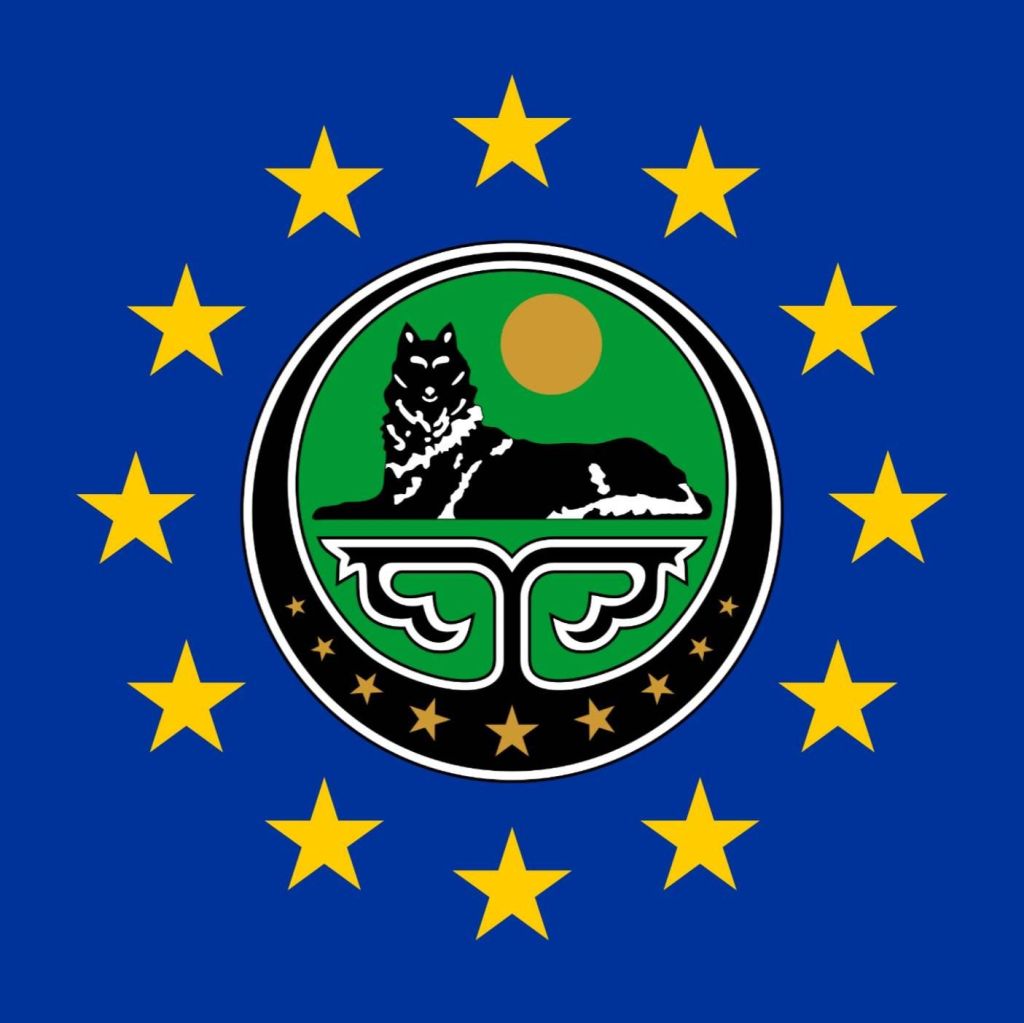
Our goal is also to strengthen democratic institutions in our society, primarily the protection of the rights and freedoms of the republic’s citizens, the separation of religion from the state, and the establishment of healthy international relations, both political and economic, and trade relations. We aim to join the EU as full members. Our goal also includes reconciling and uniting all segments of our fragmented society based on the Declaration of Freedom and Independence of the Chechen Republic and the Constitution of the Chechen Republic of 1992.
I am one of those Westerners who strongly supports the independence of Chechnya): why, in your opinion, should the so-called “West” be interested in supporting the independence of Chechnya? What benefit would get from this situation?
The civilized world, logically, should be interested in the multiplication and prosperity of as many democratic states as possible on the planet. We believe that Russia will soon cease to exist in its current form because it does not fit into the civilized international community of states. Wars, attacks on neighboring countries, and the seizure of foreign territories as a healthy coexistence of state entities have completely exhausted themselves. Humanity created nuclear weapons to become a deterrent from wars that take millions of human lives. The civilized world must be able to manage the world to prevent its collapse. Russia uses enslaved peoples as cannon fodder or radical terrorist organizations and groups that pose a danger to peaceful coexistence. Therefore, it is unacceptable to allow a platform or a training ground to be created on the territory of the Chechen Republic where people capable of harming peaceful creation will be trained. Our time is a time of international trade, global international environmental protection programs, and the peaceful coexistence of people as a single whole. It is time to engage in the rapprochement of religious confessions instead of inciting national or religious enmity. Our program is aimed at progress, and we, who have never known slavery or social inequality, raised on the ideals of freedom and nobility, are created precisely for peaceful purposes. This is our natural state, and we want to return to our normal human essence. We are essentially creators, farmers who accept peaceful labor as the most noble behavior of a person.
An image of barbarians, mentally deficient warriors, and desperate villains has been created of us. We will have to prove for a long time that this was never the case and cannot continue to be. If the West helps the Chechens build their own democratic, reliable state and acts as its guarantor, it will gain a reliable, experienced military and economic partner in the Caucasus, at the crossroads of Europe and Asia.
If this does not happen and the West allows the situation to unfold without intervention, there is a risk that radical elements within our population, financed by the Kremlin, will seize power. These elements can inevitably create something similar to ISIS 2.0 or a scenario reminiscent of modern Afghanistan. All this, of course, will play into the hands of the Kremlin, which has been promoting the narrative of wild, radical Chechens for decades, thereby constantly getting a green light for aggression from the West.
The most tragic thing is that we will disappear from the face of the earth as an ethnic group. For 30 years, the Russian Federation has been conducting the primitivization of our people through the occupation authorities on the territory of the republic, and this is yielding its sad fruits. According to statistics (from open sources), there are 500 schools and 1,500 mosques operating in the republic.
Do you believe that in this sense, the activity of the Chechen battalions fighting on the front line in Ukraine, in support of the Kiev army, could be useful in convincing Europe to support the independence of Chechnya?
No, I don’t think so. I respect these people’s decision and understand their desire to fight for Ukraine and its freedom. They follow the call of vengeance that they have carried within themselves for decades. I understand their desire to take revenge for the hell that the Russians created on our land. Nevertheless, I don’t see a great future in this approach. The predominance of radical rhetoric in their behavior gives their struggle more of a “sacred” religious significance. We never fought for religion; we fought for our land and freedom. Every time the Chechens raised their banner for freedom, volunteers from the East appeared, bringing their flags and coloring our struggle for freedom with their own colors, subordinating our interests to their own. This has happened every single time. We kept making the same mistake over and over.
I don’t think civilized society needs small, fragmented Chechen battalions. Ukraine already has its own professional army. Chechen volunteers need to join the regular Ukrainian army. A state that creates private military companies (PMCs) on its territory is doomed because the privilege of legal violence belongs to the state. The West needs reasonable, reliable, and educated people with whom they can engage in dialogue and make agreements based on international law.
So, what do you think Chechens living in Europe can do to support the cause of creating an independent Chechen state? And how can they reach the Chechens in their homeland?
Engage with European governments, political and public organizations, form alliances with other diasporas, communities, and international organizations that support self-determination and human rights. We must create our own political and non-profit public associations. Chechens living in Europe should also raise their awareness about our political situation and share it from all public platforms, helping more and more compatriots become politically educated. Organize and participate in conferences, seminars, and public demonstrations to provide more information about the situation in Chechen society.
Hold cultural events, exhibitions, and festivals to preserve and promote Chechen culture and identity in the diaspora. People in Chechnya are currently hostages; they cannot do anything. They live in constant fear under state terror. People outside Chechnya must do something to help them. We must revive our society, politicize it once again, and show the path we need to take to achieve our goals. First of all, we must revive our spirituality; it has always been of great importance to us. Chechens have traditionally avoided marrying not only within close family circles but even distant ones, observing the norms prohibiting marriage between relatives up to the seventh generation, meaning that if the seventh grandfather is common, it was not possible. In Chechen society, children were considered children until the age of 15. At 15, boys were allowed to wear a belt, signifying the right to carry a weapon, and girls could emphasize their waist. A man would not enter a house if the master of the house was not at home. Ensuring the safety of a woman and accompanying her to her destination was the duty of any man. These things are important and respected to this day.
What are the main problems you are facing in the political education of Chechen society? And what have been the main successes you have achieved to date?
Our main problem is the low level of education and the high level of radicalization among a significant part of our population. There are many reasons for this, including the deliberate actions of the Kremlin, which has repeatedly used this tool, as well as the numerous severe traumas that people have experienced, often leading them to turn to religion.
I consider our great success to be the removal of the taboo on discussing political Islam. Now society is free to discuss and share opinions on topics that just a few years ago seemed almost closed and forbidden. Overall, we have made significant progress in combating political illiteracy in a short period of time. Many people support us and our views, and this number is growing every day. Many remain silent and quietly listen because they fear for themselves and their relatives. However, we receive a lot of feedback in support, which clearly indicates that people are listening and supporting us.

In your opinion, is the phenomenon of radicalization also involving Chechens living in the European diaspora? Or is it a phenomenon that occurs only in Chechnya? And what role does Kadyrov have in promoting this radical culture?
As I mentioned earlier, I believe there are two reasons for the radicalization of some Chechens. More precisely, the main reason is the Kremlin and its deliberate efforts to radicalize the youth for subsequent control and use for its purposes. The fact that they have been “successful” is a consequence of the trauma of two brutal wars, the post-war policy of severe terror, humiliation, and open attacks on honor and public humiliation, combined with the inherent naivety and trustfulness of the Chechens.
Kadyrov, in turn, started by fighting against radicals and explained his switch to the Russian side precisely for this reason. Today, Kadyrov himself has become a force that is radicalizing our society by leaps and bounds. I don’t know if this radicalization is ideological or a direct order from the Kremlin. However, I would rather assume the latter.
Just think about it: in such a small Chechen Republic, 1,400 mosques have been built. They are not building schools, kindergartens, hospitals, factories, or plants where people could work and earn a living, developing the economy. Sermons are held every day, and people are indoctrinated with the idea that they should be obedient, accept their fate, and strive for paradise, forgetting about their earthly life. This is the same old trick that has been used for thousands of years, and people still fall for it. All these newly built mosques are transmitters of propaganda. If it weren’t beneficial to them, the Kremlin wouldn’t allow a single mosque to be built.
what would you say to the European public to encourage their support for the independence of Chechnya?
If we understand that there are only two camps of countries in the world—democratic countries based on citizens’ rights to freedom and self-determination on one side, and tyrannies that usurp power and maintain it through force, violence, and total id
eological brainwashing of their population on the other side—then it will not be difficult for us to understand why it is absolutely logical for the West to help the democratic forces of Chechnya build a state that will become a reliable, strong, and dedicated ally to the entire civilized world, rather than allowing the opposite to happen. Furthermore, passively allowing the extermination and erasure of a civilized, advanced, and spiritually rich people from the face of the earth is, at the very least, inhumane. We live in a world where even cruel treatment of animals is unacceptable.
 Ichkeria Digital Archive