
Since the beginning of the war in Ukraine, Chechen fighters have played a visible and symbolic role in the defense of Ukrainian sovereignty. Motivated by their own nation’s history of resistance and by a deep hostility to the Kremlin regime, hundreds of volunteers from the Chechen diaspora have joined the Ukrainian Armed Forces or operated in close coordination with them.
Their journey is more than military—it is political, ideological, and tied to a broader struggle: the liberation of Chechnya and the revival of the independent Chechen Republic of Ichkeria.
2014 – The First Volunteers and Birth of the Dudayev Battalion
- After the annexation of Crimea and the outbreak of war in Donbas, the first Chechen volunteers arrive in Ukraine, often from exile in Europe or the Middle East.
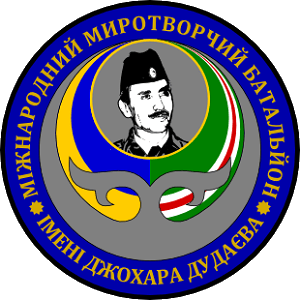
- In the summer of 2014, the Dzhokhar Dudayev Battalion is founded under the command of General Isa Munayev, a veteran of the First and Second Russo-Chechen Wars and former commander of the Ichkerian National Guard.
- Shortly after, the Sheikh Mansur Battalion is formed, composed largely of fighters with Islamic-nationalist leanings, many of whom fought in Syria against Russian-backed forces.
- Both battalions fight alongside Ukrainian forces in key early battles such as Debaltseve and Donetsk Airport.
2015 – The Death of Isa Munayev
- On February 1, 2015, General Isa Munayev is killed during combat near Debaltseve.
- Leadership of the Dudayev Battalion passes to Adam Osmayev, a controversial figure accused by Russian authorities of plotting to assassinate Vladimir Putin.
- Despite the loss of its charismatic founder, the battalion continues its operations in Donbas.
2016–2019 – Quiet Front, Strategic Recruitment
- During the “frozen conflict” years, both Chechen battalions remain in Ukraine, maintaining defensive positions and conducting patrols.
- Networks within the Chechen diaspora are used to recruit fighters, with many arriving from Germany, France, Turkey, and Georgia.
- The Sheikh Mansur Battalion remains formally independent, while the Dudayev Battalion begins working more closely with Ukraine’s International Legion.
2022 – Full-Scale Invasion, Full Mobilization
- Following Russia’s February 24, 2022 full-scale invasion of Ukraine, Chechen volunteers re-mobilize in large numbers.
- Both the Dudayev and Sheikh Mansur battalions are deployed to strategic fronts:
- Kyiv Region (Irpin, Hostomel)
- Mariupol and Bakhmut
- Later, Zaporizhzhia, Kharkiv, and Chasiv Yar
- The Chechen fighters distinguish themselves in both urban combat and reconnaissance missions.
- The Adam Group, an elite subdivision of the Dudayev Battalion, specializes in deep incursions behind Russian lines.
2022–2023 –New Chechen Units
Beyond the two main battalions, new formations begin to emerge:
- OBON (Special Purpose Battalion)
- Khamzat Gelayev Detachment
- 34th Assault Battalion “Mad Pack”
- Muslim Corps “Caucasus” .

October 2022 – Ukraine Recognizes Ichkeria
- On October 18, 2022, the Ukrainian Parliament (Verkhovna Rada) officially recognizes the Chechen Republic of Ichkeria as “temporarily occupied territory.”
- The same resolution declares Russia a “state sponsor of terrorism.”
- This move is seen by Chechen fighters as a historic vindication of their decades-long struggle for independence.
2023–2025 – Strategic Role in the Ongoing War
- As the war drags into its third and fourth year, Chechen battalions maintain a high level of operational activity.
- They conduct joint operations with Ukrainian special forces and are often deployed to hot zones where their battlefield experience is most needed.
- Prominent Chechen commanders, including Adam Osmayev, become spokespeople not only for their units but for the broader cause of Ichkerian independence.
Today – Between Two Flags
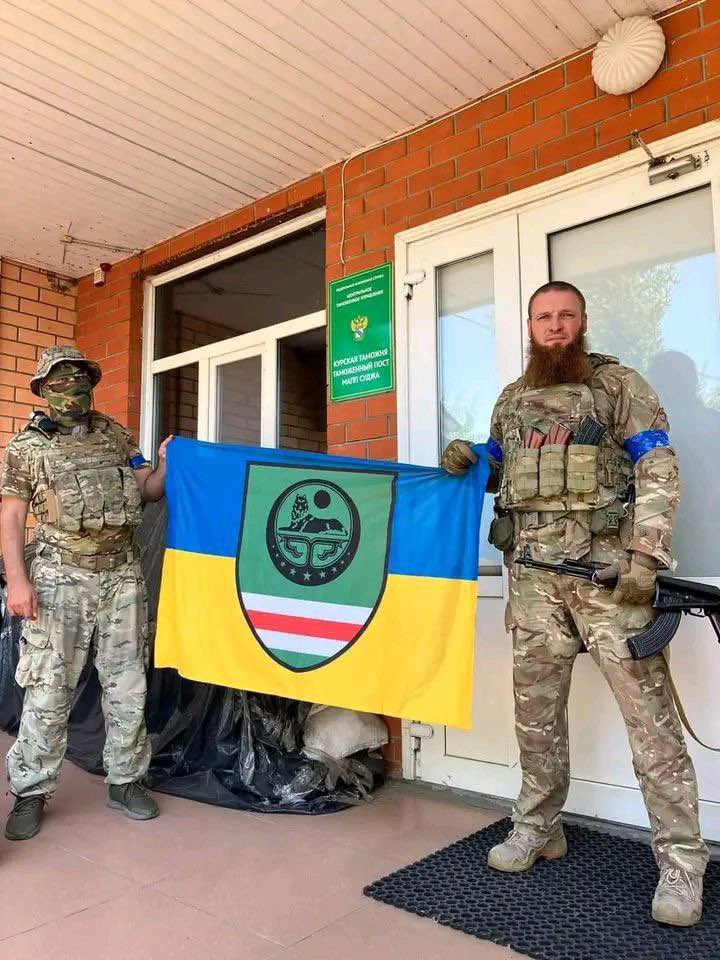
- The Chechen volunteers in Ukraine fight under two banners: the blue-yellow Ukrainian flag, and the green-white-red tricolor of Ichkeria.
- For many, the war in Ukraine is seen as a continuation of their own national liberation struggle—one that began with the collapse of the Soviet Union and the First Chechen War in 1994.
- They believe that Russia’s defeat in Ukraine could open the way for renewed sovereignty in the Caucasus and justice for the crimes committed in Chechnya.
Final Remarks
Estimates suggest that between 800 and 1,200 Chechens are currently active in Ukrainian-controlled battalions. Since 2014, over 2,000 Chechens may have passed through the various units, making the Chechen diaspora one of the most politically and militarily organized among Ukraine’s foreign volunteers.
Their presence is not only a military asset—but a potent symbol of anti-colonial resistance, transnational solidarity, and the long shadow of Russia’s imperial violence.
 Ichkeria Digital Archive