
Take a Stand. Sign the Petition. Become a Supporter.
Join the call for justice, freedom, and international recognition for the Chechen Republic of Ichkeria.
By signing the petition, you raise your voice. By making a voluntary donation, you help us go further — and receive an official Supporter Badge to show your commitment.
👉 Sign the petition now — and stand with Ichkeria.
👉 Make a donation to receive your personal badge and strengthen our cause.

The war in Ukraine did not begin in 2022—it began in Chechnya, in 1994. The West’s refusal to recognize the Chechen Republic of Ichkeria after the fall of the Soviet Union was the first act of appeasement that empowered Russian imperialism. Today, the same regime that crushed Chechnya with bombs and massacres now threatens the whole of Europe.
This petition calls on the European Parliament to recognize the Chechen Republic of Ichkeria as the legitimate representative of the Chechen nation—a democratic state born in 1991, brutally invaded, yet still alive through its institutions and its people in exile. Recognition would correct a historical mistake, support the Chechen people’s right to self-determination, and send a powerful signal to all nations resisting Russian domination.
Ukraine has already taken this step. Europe must follow. Freedom, peace, and justice demand it.
SUPPORTERS




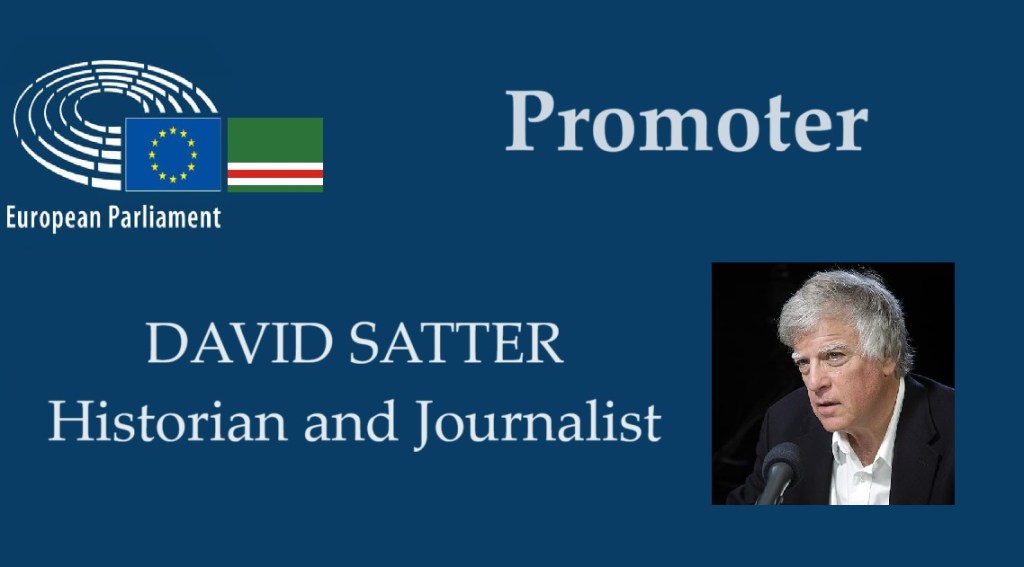
FULL TEXT OF THE PETITION
The failure to recognize an independent Chechnya was the West’s first concession to Russian imperialism.
Today Chechnya is occupied, and the dictator who governs it represents the denial of the values on which the European Union is founded
Correcting this error of perspective means rewinding the tape of history, to restore credibility to the Western world
The war in Ukraine started in Chechnya
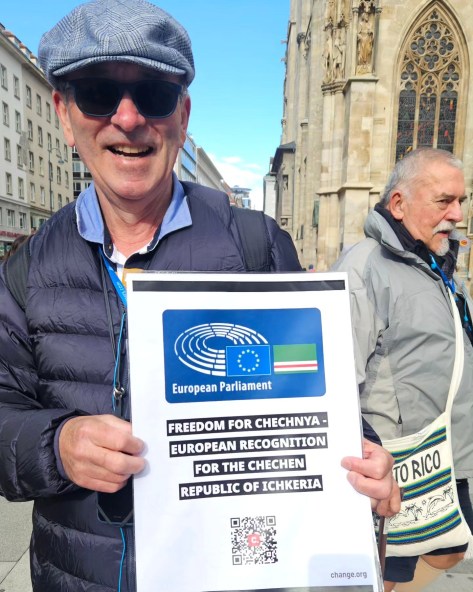

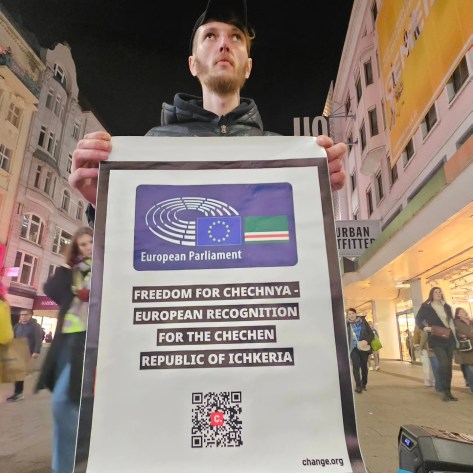

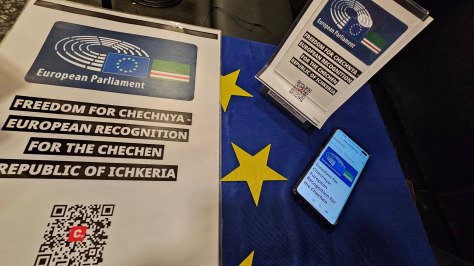

On Feb. 24, 2022, the Russian Federation invaded Ukraine, triggering the bloodiest conflict on European soil since the end of World War II. The specter of war in Europe, thought to have vanished with the end of the Cold War, has returned to loom ominously. Yet the aggression unleashed by Vladimir Putin is merely yet another act in a tragedy that began soon after the end of the Soviet Union. When the Chechen Republic proclaimed its independence in 1990, its president, Dzhokhar Dudaev, appealed to the Western world in 1991. At the time, European countries chose to ignore the Chechens’ demands, fearing that intervention in what was considered an “internal Russian issue” would disrupt the democratization and liberalization process that President Yeltsin had promised them.
A devastating invasion war ensued, and the genocide of the Chechen people. Faced with the tragedy of massacres, bombings, and the displacement of hundreds of thousands of people, Europe gasped, but continued to hope that the Chechen one was a “bump in the road” on the road to modernization of the Russian state. Despite the West’s lack of support for their cause, the Chechens managed to defend their independence, forcing Russia to sign a peace treaty. The new Chechen president, Aslan Maskhadov knocked on all the chancelleries of Europe and North America, demanding formal recognition of Chechen independence. And once again, Western governments continued to regard the issue as an “internal Russian problem”. Shortly thereafter, the Russian Federation again attacked Chechnya. That very second invasion marked the rise of Vladimir Putin, who was rewarded by the government apparatchiks and the ruling oligarchy in Moscow with election as President of the Russian Federation.
The failure of appeasement
Since then, Europe has sought ways to coexist with a Russia increasingly headed toward imperial restoration, tolerating a long series of invasions, intrusions, and political tampering in the hope that Putin’s regime would exhaust its claims. After Chechnya, Russia invaded Georgia, “guilty” of desiring a prospect of existence outside the so-called “Russian space.” Then it organized the annexation of Crimea, literally “wrested” from Ukraine manu militari. In 2020 it was the turn of Belarus, where Putin played a key role in keeping dictator Lukašenka in power. And then direct support for Donbas separatism, with extensive use of armed forces against the Ukrainian national army, on Ukrainian soil, without formal declaration of war. And still then Europe deluded itself that it could negotiate with Putin, just as in 1938 it deluded itself that it could negotiate with Hitler. As then, concessions to the aggressor only matured the aggressor’s belief that he was unstoppable, encouraging him to push further. Which led to the very war that European governments hoped to avoid by their condescending behavior.
At last Europe has become aware of the futility of negotiations, and has supported the Ukrainians’ struggle for freedom from the invader. Ukraine’s battle, however, is also the battle of Chechnya, Georgia, Belarus, and generally all the nations that have gone before it in opposing Putin and his regime. Volunteer units from these nations are fighting alongside the Ukrainian army. Among them are numerous units made up of Chechens, many of them from European countries where they have been welcomed as refugees or political refugees.
Rewind the tape
If, as we have seen, the invasion of Ukraine is only the epilogue of a tragedy now reaching its final act, and if it is true that Europe has understood the existential threat posed by Russian imperialism, the response of European institutions cannot stop with Ukraine. It must start from the origin of the process that brought the war to the borders of the Union: the invasion of the sovereign Chechen state, and the genocide of its people. On October 10, 2022, the Ukrainian Parliament understood this necessity, recognizing the independence of the Chechen Republic of Ichkeria. With this gesture, the Verchovna Rada put Ukraine’s freedom in perspective with that which Chechens have been claiming and defending for more than 30 years.
The Parliament of the European Union today has a historic opportunity to correct that “original sin,” that fundamental error of judgment that represented the green light, for the Russian revanchists, to the imperial restoration that Putin is enacting with cynicism and brutality. Right in Chechnya, right now, in power is a figure who represents the negation of all the values that underlie our civilization, and our institutions. Not recognizing the government of Ramzan Kadyrov, responsible for the worst crimes against the population is the least that a European Union founded on the rule of law, democracy and the defense of the freedom of individuals can do. Furthermore, an act like this would also bring practical and immediate benefits. It is good to remember that Putin’s invasion army is recruited mainly from minorities oppressed by the central power, and from the most marginalized strata of Russian society, and that people like Kadyrov are essential for the regime to supply its armies with “expendable” soldiers.
Recognizing the independence of the Chechen Republic of Ichkeria would make it possible to rewind that ribbon that started in 1994, and is developing into the war of aggression against Ukraine. It would also give a strong signal to all nations oppressed by Russian imperialism, encouraging them to shake off this yoke: first of all, Georgia, already bent in 2008 by a military invasion, these days crossed by a wave of protests that risk being suffocated if a welcoming signal does not come from Europe.
A reason for Europe to exist
In the battle against Russian imperialism lies Europe’s reason for existing: beyond ethnic and political cohesion, economic advantages, and cultural identity, the European Union must earn a historical reason for existing, which cannot be expressed in any other way than in defending the rights of nations and ensuring peace, playing that moderating role so necessary in a context of increasing political polarization. This is not an unrealistic, or a paternalistic position: it is a character trait that the European Union must mature as soon as possible, as a political background, first and foremost in its own interest. In recent years, the whole land border around our continent has sunk into chaos. There is not a single country around Europe that is not at war. This “event horizon” on the borders of the Union is determined first of all by the absence of an actor with the strength and credibility to foster peace, not to be understood as a futile exercise in good intentions, but in the original sense of the term, Pax, which draws its main meaning in the concept of agreement. If the requirement for credibility is the consistency that passes between the values one believes in and the actions one takes, it is essential that the image of the EU be promoted first and foremost among those peoples who have felt betrayed by the inaction of Western nations, first and foremost the Chechens.
The recognition of the Chechen Republic of Ichkeria
From a legal point of view, the Chechen Republic of Ichkeria, proclaimed in 1991, has never ceased to exist. Its institutional bodies survived the war, and its officials operate on European soil under the protection of host governments as political refugees or legal immigrants. The institutions of the Chechen Republic of Ichkeria are operational, possess all the requirements to be recognized as a formal interlocutor, and maintain regular relations with members of national parliaments and the European Parliament itself. Formal recognition of the only Chechen state that arose by popular will in 1991, confirmed by free elections in 1997, and legitimized by the only constitution freely adopted by the Chechen parliament in 1992, would not only be a dutiful gesture of solidarity with the people who first suffered from Russian imperialism, but also a way to enshrine an important caesura with respect to the current pro-Russian government that rules in occupied Chechnya, ignoring the most basic concepts of rule of law, democracy and respect for personal freedoms.
This proposal might raise some doubts, which we intend to dispel. First, one might fear that recognition of the Chechen Republic of Ichkeria would be perceived as a futility, when not outright provocation. Second, one might fear that this could be a precedent harbinger of new claims and violence. With respect to this, it is important to point out that:
This would not be an unprecedented act: as mentioned above, the Ukrainian Parliament adopted a resolution to this effect back in 2022. The European Parliament should simply implement it, granting a representation of the Chechen Republic of Ichkeria the right to open an office in the European External Action Service (EEAS).
This would not be a provocation: leading members of the pro-Russian government currently in power in Chechnya are already subject to political, economic and criminal sanctions on European soil for multiple abominable behaviors, such as the murder of political opponents and the persecution of minorities, whose brutality shocked Western public opinion and led to popular initiatives participated in by hundreds of thousands of people, in which they called for the intervention of institutions to stop the arrest and torture in Chechnya. Recognition of a diverse representation of Chechen interests in Europe would both benefit the public image of the European Union and provide greater protection for the Chechen community in Europe, which numbers hundreds of thousands of people, mostly young people, active in both the world of work and social associations. The presence of a representative in the European institutions would ensure the protection of the interests of these communities, strengthen their connection with the structures of the Union, and improve the consideration of these communities towards their host societies, improving their integration.
Finally, this would not be a purely symbolic gesture: if this gesture had been made in 1994, it would almost certainly have prevented the extermination of a third of the Chechen nation. Had it been done in 1999, it would probably have prevented Vladimir Putin’s rise to power. If this gesture were made today, it would encourage Chechen civil society to distance itself from the dictatorial government in power, and it would give new generations confidence in European institutions, paving the way for the day, hopefully not far off, when the Eastern European nations still under Russian rule can develop as independent and democratic political entities.
 Ichkeria Digital Archive